Paddy Claffey was born in Noggusboy, Ferbane, on April 17th, 1921, three months before the end of Ireland’s War of Independence. His parents were Sarah (Flaherty) of Gallen and Kieran Claffey, Noggus. The youngest of their ten children, Paddy had six sisters – Maryann, Maggie, Kit, Ellen, Jane, and Sarah – and three brothers – Ned, Kieran, who died aged 27, and Johnny, at birth.
The siblings attended Gallen NS, where Paddy’s teacher was Master Goodwin. In Brendan Ryan’s book, On Gallen Green, a 1927 school photograph on page 122 shows P.J. Claffey in the front row.
For his 90th birthday party in the Bridge House Hotel, I had the pleasure of interviewing my granduncle and writing his story. Paddy was a natural storyteller. Recalling his first time away from home for a long spell, he was thirteen and had taken an awful pain. Doctor Maher advised hiring a car to drive him to Tullamore. The hospital was the very same as a big hayshed, Paddy said, with auld lads smoking; they couldn’t see one another with the smoke. His sister, Ellen, cycled in to see him every day, and the woman who owned Lawless’s shop sent her two daughters with books and sweets. He was glad to go home, but couldn’t get used to the small house in Noggus for the longest time.
A few years back I met up with some members of the Offaly diaspora in the Gresham Hotel, Dublin, for coffee, and we had a reflective chat about the Faithful County. My fellow aficionados were Laura Price and the late Dr. Michael J.S. Egan. Dr. Egan, a truly wonderful Offaly man, raised the idea of marking the termans at Clonmacnoise.
While I had grown up in the area I had never heard the expression. He explained it was the point where funeral corteges paused on the way to the cemetery. I was well aware of the practice, for as a child in the area every funeral paused at what was called the `coffin bush`. I have enquired from local folk and found nobody had used the expression in this context.
I have good reasons to write a follow up article to my blog of September 2023 on the above topic, as have Four Courts Press to produce a paperback version of my book Adomnán’s Lex Innocentium and the Laws ofWar (Dublin, Four Courts Press, 2020). This welcome decision was made, not only because the hardback version is now out of print, but because world events since 2020 have given the book an urgent relevance for our modern times.
First a quick recap: In the last blog I told the story of the great assembly in Birr in 697 AD of ninety-one leaders of the Irish world, lay and ecclesiastical, which proclaimed this law for the protection of non-combatants or innocents in time of war. The inspirer and driving-force behind it was Adomnán of Iona, a man with an unique awareness of the suffering of the innocent victims of war, and a leader who had the moral authority to persuade his peers, many of whom strongly resisted, to travel to Birr from all over Ireland and northern Britain to formally accept and guarantee the law. We saw that this law was unique for its time and, indeed, for many centuries thereafter. It was not until the Fourth Geneva Convention of 1949 and additional protocol of 1977 that the nations of the world, having learnt the lessons of two world wars in which millions of innocents were killed, that a comprehensive law for civilian protection was agreed. Down through the centuries innocents have always suffered greatly in war; the sheer scale of their suffering in the first half of the twentieth century impelled nations to take steps to limit it.
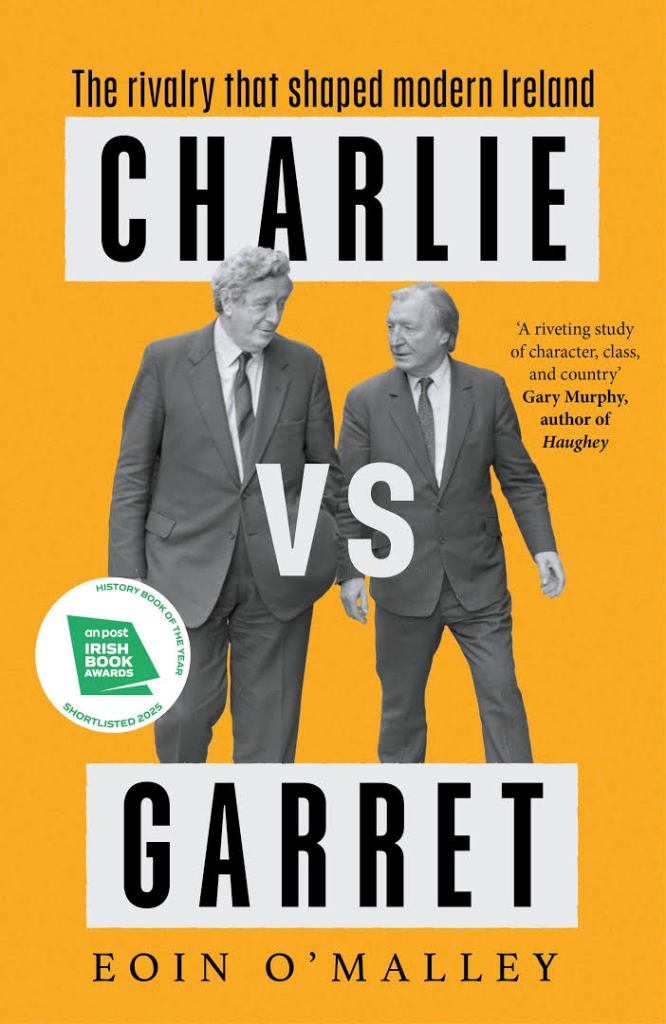
Today we mark the 100th anniversary of the birth of that hugely popular politician Garret FitzGerald. An intellectual in politics he was greatly respected in Ireland, Britain and Europe. Recent estimates such as that of Eoin O’Malley’s Charlie vs Garrett (2025) have not been so flattering to his handling of the economy in the 1980s. And yet his achievements and those of John Bruton have underestimated their roles in bringing peace to Northern Ireland.
FitzGerald, according to the DIB life by Patrick Maume (summarised here) was one of the most influential Irish political figures of the late twentieth century, known for his intellectualism, his commitment to European integration, and his efforts to modernise Irish society. Born in Dublin to the prominent revolutionary and cabinet minister Desmond FitzGerald and his wife Mabel McConnell, Garret grew up in a household steeped in politics, culture, and international connections. His parents’ mixed religious backgrounds—his father Catholic, his mother Protestant—shaped his lifelong interest in reconciling Irish identities and overcoming sectarian divides.
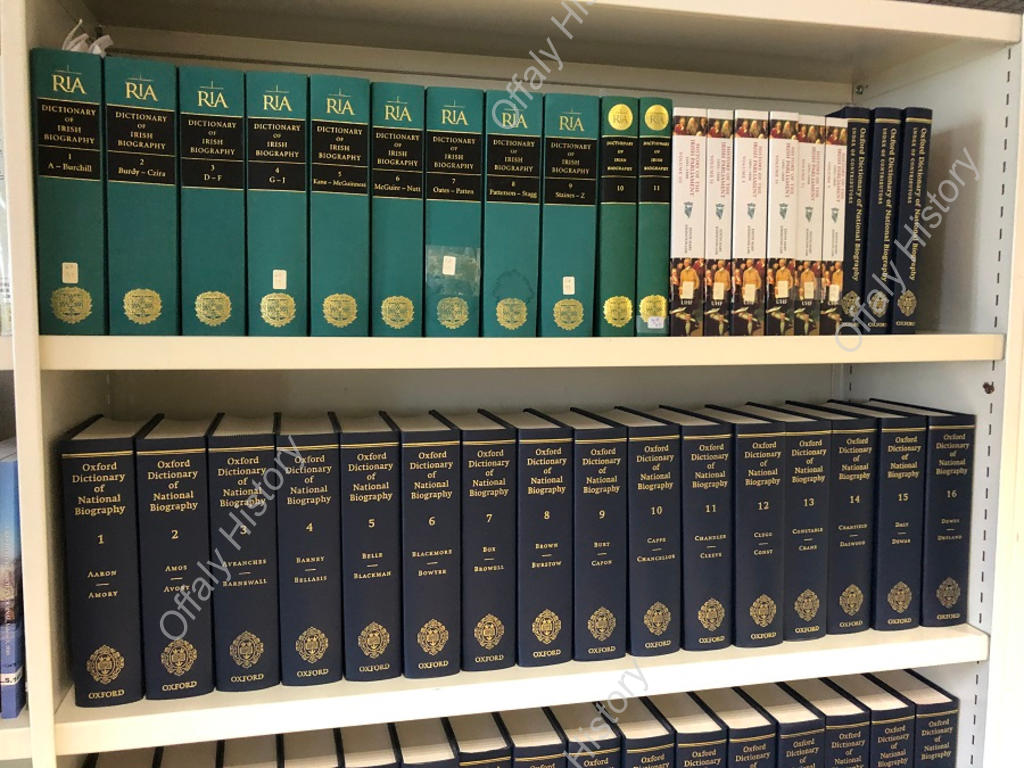
The DIB (above in green binding) runs to eleven printed volumes and is now online and free to use – a wonderful resource.Pic from Offaly History Centre.(more…)
As mentioned earlier there are many histories of hurling in recent times, particularly county and local club histories. A major and broad history of hurling, Scéal na hIomána was produced by Brother Liam Ó Caithnia in Irish and was published in 1980, but was left largely unappreciated for decades. Ó Caithnia’s history was an exhaustive work, the definitive historical account, written initially as an academic thesis, 826 pages long, written in dense Irish with a small print font and included references and appendixes. Over a dozen mentions of Co. Offaly are to be found in the Scéal.
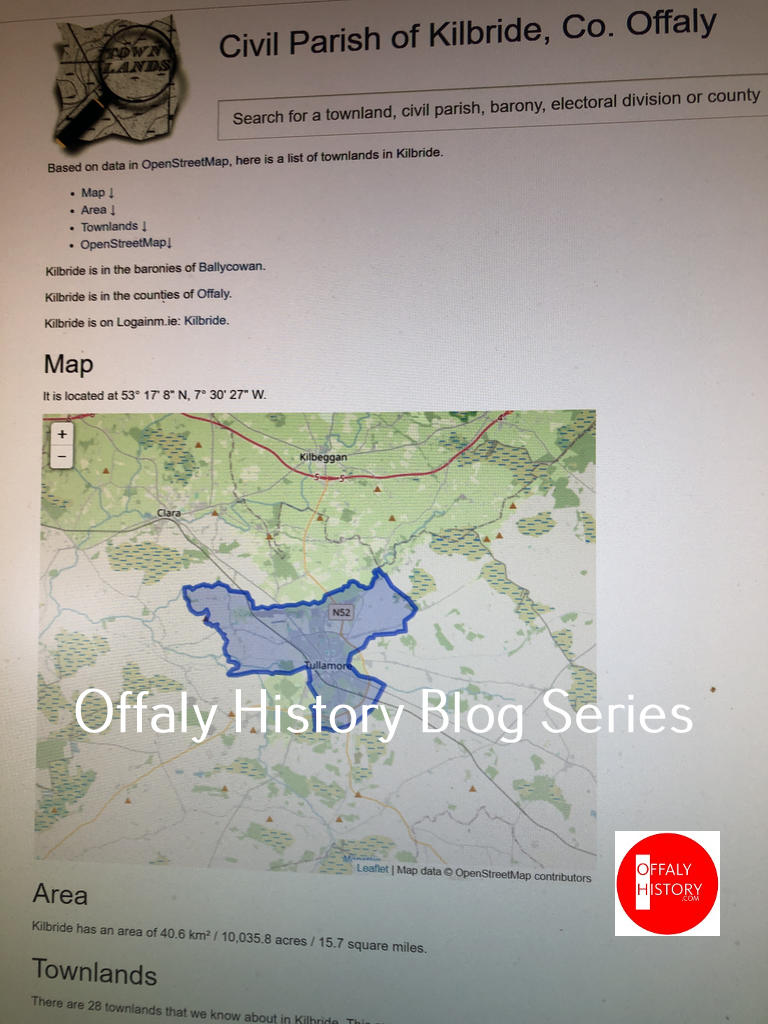
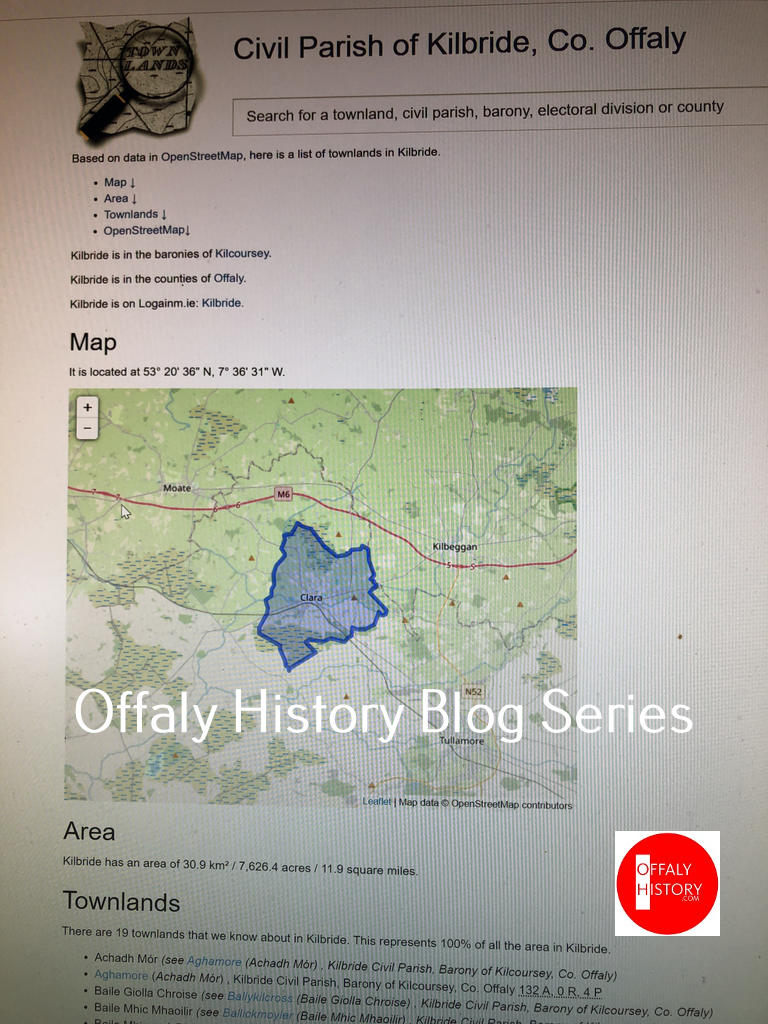
Tullamore is situated in the civil parish of Kildbride with 28 townlands and so too is the town of Clara with 19 townlands. Both parishes have a connection with the churches dedicated to Saint Brigid. Now Ireland mark the saint’s day on 1st of February with a public holiday, the beginning of spring and the celebration of Lá Fhéile Bríde, St Brigid’s Day.
These are the only townlands in Offaly dedicated by name to a church associated with Saint Brigid.
Kilbride (Cill Bhríde) , Kilbride Civil Parish, Barony of Ballycowan, Co. Offaly 193 A, 3 R, 20 P
Kilbride (Cill Bhríde) , Kilbride Civil Parish, Barony of Kilcoursey, Co. Offaly 146 A, 2 R, 30 P
The proximity of the two parishes often leads to confusion especially when tracing soldiers of the First World War who gave their place of birth as the civil parish of Kilbride without distinguishing wherether it was Clara or Tullamore.
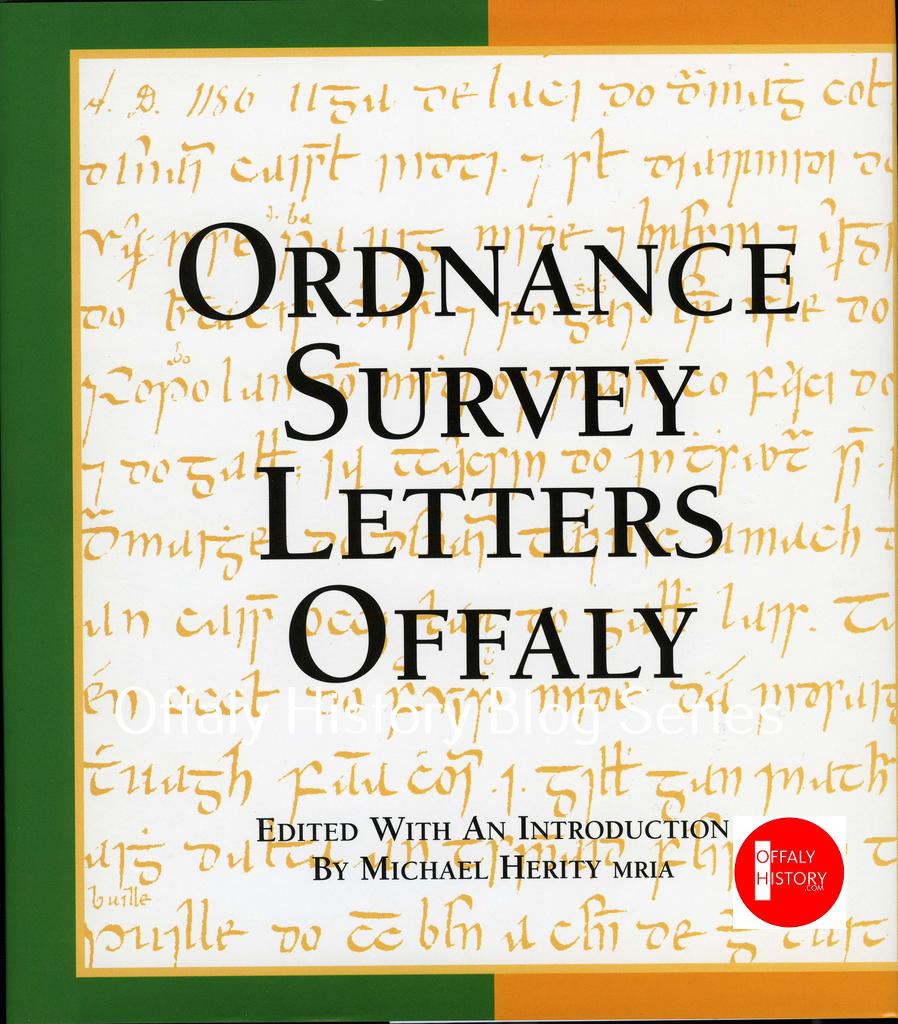
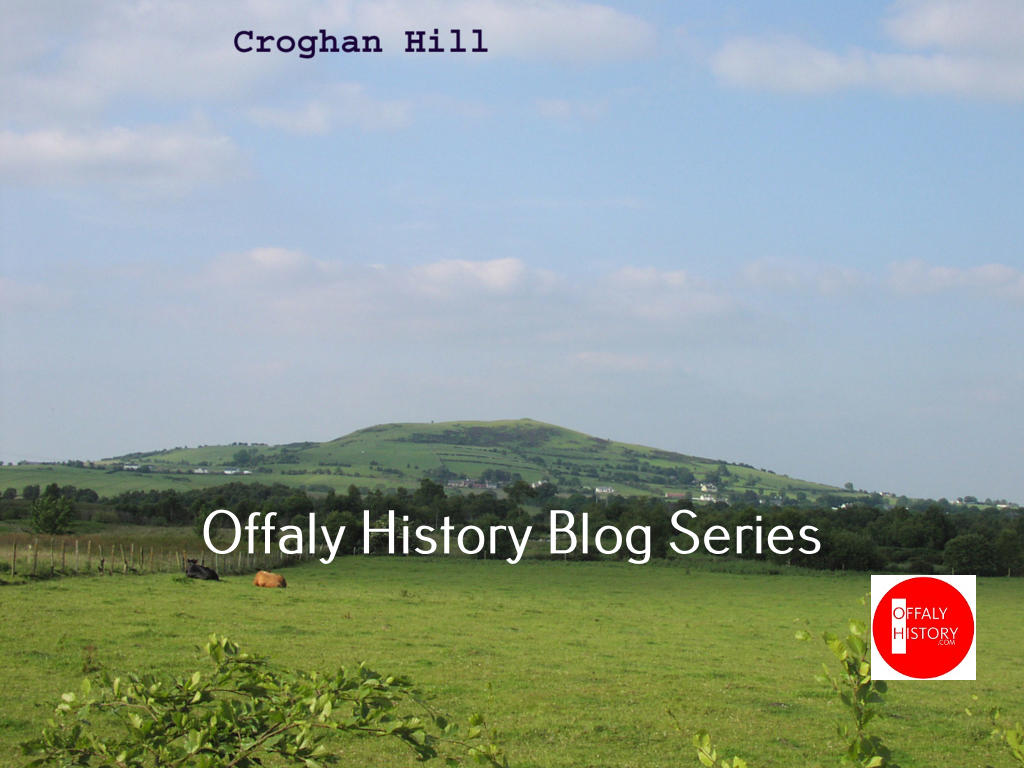
To the east of both towns is Croghan Hill associated by some scholars with the birthplace of St Brigid. John O’Donovan was well aware of the association of the hill with the legend and cult of St Brigid and wrote of it in the Ordnance Survey letters. The Ordnance Survey Letters for County Offaly form part of a countrywide series, are commonly known as O’Donovan’s Ordnance Survey Letters.
The Ordnance Survey Letters for Offaly of 1837-1838 represent the first attempt on a systematic basis to collect material on Offaly’s historical and archaeological remains. The pioneering effort of the Ordnance Survey and of its topographical department, in particular, was not emulated until the publication some 150 years later of the Archaeological Inventory of County Offaly by Caimin O’Brien and P. David Sweetman. O’Donovan’s Ordnance Survey Letters are in manuscript form in the Royal Irish Academy and were published in a typescript by Fr. Michael Flanagan in 1933. The late Professor Michael Herity edited the volume of letters for Offaly and this book is available from the Society and can be ordered online at our shop at www.offalyhistory, or consulted at Offaly History Centre.
Civil parish of Kilbride, Tullamore from Townlands.ieCivil parish of Kilbride, Clara from Townlands.ie
The Offaly material consists of fifty-one letters of John O’Donovan and of Thomas O’Conor. O’Conor, a native of Carrickmacross, was assistant to O’Donovan. Both men had spent September, October and November of 1837 in County Westmeath and in late December of 1837 their attentions turned to Offaly, then and until 1920 called King’s County. The letters concern local antiquities, placenames, early Irish history and the genealogy of the native families
It should be noted that in the Westmeath letters volume are one of John O’Donovan’s from Tullamore and another from Edenderry. That from Tullamore is dated 1st January 1838 and could properly be in the King’s County volume. A list of the fifty-one letters concerning King’s County written over the period from 18 December 1837 to 11 February 1838 with the inclusion of two letters about Durrow, that of October 1837 and the second written on 1 January 1838.
O’Donovan wrote of the legends associated with St Brigid as follows:
St. Briget was consecrated a Bishop.
(Father Bollandus complains of the silliness of the writers of the lives of the Celtic Saints; and the Benedictines complain of the folly even of St. Jerome and Augustin!.)
“Bridget was desirous that a degree of Penance (gradh Aithrighe) should be conferred upon her. Hearing that Bishop Mel was at Bri Éle (Croghan old Church) she repaired thither, accompanied by seven nuns. But on their arrival the Bishop was not there, but had gone into the Country of the Hy Niall “terra nepotum Neill” (Meath). On the morrow she passed in search of him in company with Mac Caille (the Bishop of Brig-Ele) who guided her over the bog of Monaidh Fathing, which she converted into a flowery plain. When they had come close to the Town (baile) where Bishop Mel was, Briget told Mac Caille (Macaleus) to put (place) a veil on her head, that she did not wish to appear unveiled before the clergy. Upon her arrival a pillar (column, a glory?) of fire sprung rose, shot out) from her head, reaching even to the roof of the church. When Bishop Mel had seen this, he asked: “Who are the Nuns”? Mac Caille answered: “This is Briget, the celebrated Nun of Leinster.”
“My affection to her, said Bishop Mel, it was I who predicted her greatness, even while she was in her mother’s womb, and it is I who will confer orders on her.”
“This (gloss) alludes to one occasion that Bishop Mel came to the house of her father, Dubhthach; he saw the wife of Dubhthach grieved and sorrowful, and he asked whence the cause of her sorrow. I have cause of sorrow, said she, for Dubhthach admires (loves) the handmaid who attends. This is just (meet, dethbhir) said Bishop Mel, for thy seed shall serve (obey) the seed of this handmaid, alluding to Bridget.” (Bridget was illegitimate, but not the worse Bishop for that, and —-).
“Then Mac Caille placed a veil (caille, cowl) on the head of Briget. Wherefore, from that day to this, the Coarb (successor) of St. Briget (Abbess of Kildare) is entitled to receive the grade (dignity, orders) of a Bishop.”
“Wherefore have the Nuns come? said Bishop Mel. To have orders of Penance conferred on Bridget, said Mac Caille. Then he conferred orders on Briget, and it was the orders of (gradha eps.) a Bishop, that Bishop Mel conferred upon her!”
(Columbkille intended to get himself made a Bishop, but the Consecrator made him only a Priest by mistake. The authorities of the Irish Bulls Begins with Brian Boru).
“While St. Briget was being ordained, she held the foot of the altar (the altar was like a little table) in her hand; and (since that time) seven churches were burned down, in which this altar was, but it received no injury from the fire: Sed servata est per gratiam (favor) Brigidae. Dicunt alii, that this Church, to which Bishop Mel had gone, is in Feratullach. Ita ut alii putant.” (Fartullagh is near Bri Ele). – Liber Maculatus, Leabhar Breac, Fol. 31.
Colgan was ashamed of this. Cogitosus has not a word about it, or if he has, Colgan has suppressed it. I don’t laugh at these stories, for I think they are very nice if they were well told.[1]
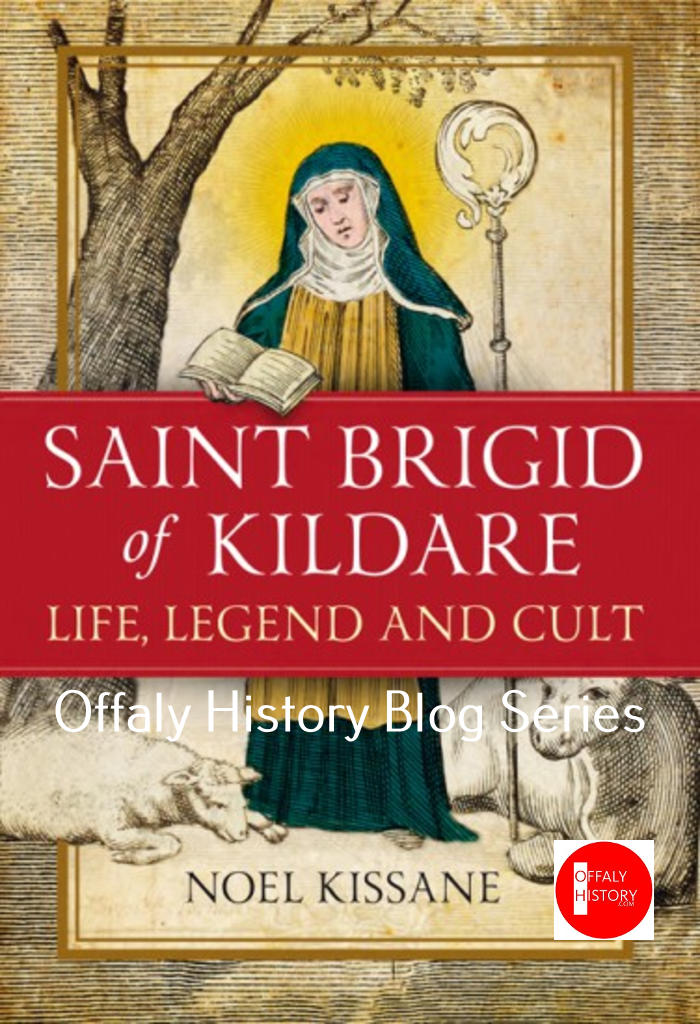
For more on the Saint Brigid story see the Noel Kissane Life in the online Dictionary of Irish Biography. Some extracts below
The Brigit story Brigit was the daughter of Dubthach son of Deimre, a nobleman or military leader. He was of the Uí Bressail (Rawl. B. 502, 126a 28), a sept of the Fothairt, a subject people located in the present Co. Offaly, but with branches elsewhere. Brigit’s mother was named Broicsech; she is presented in alternative accounts as Dubthach’s wife (Cogitosus) or slave. When Broicsech becomes pregnant by Dubthach, in the scenario where she is a slave he sells her to a poet but retains ownership of the unborn child. The poet later sells Broicsech to a druid (magus) in whose house Broicsech gives birth to Brigit, who is born with the status of a slave. The location is not stated; claims for Faughart, Co. Louth are based on late medieval tradition. The druid kindly allows Brigit to live with her father Dubthach whose house was seemingly located in the area east of Cruachan Breg Éile (Croghan Hill, Co. Offaly). She is particularly involved with dairying and looking after the cattle, activities commonly represented in her iconography. She is especially kind to the poor and performs various miracles on their behalf. Her father and brothers want her to marry a suitor, but she refuses as she is committed to a celibate life in the service of God. Her father eventually allows her to take the veil. The ceremony is performed, according to different accounts, by one or other of the bishops Mel (qv) (d. 487) or Mac-Caille (qv) (d. c.489), the location probably being in Mag Tulach (the present barony of Fartullagh, Co. Westmeath).
Croghan Hill, County Offaly, associated with the Life of St Brigid
Brigit is said to have established a convent at Kildare, but the Lives are silent regarding the date and the circumstances. ….
The hagiography of St Brigit is typically Christian and it echoes the Old and New Testaments, the Apocrypha and the early Fathers. It presents her as wise, humane, charitable to a fault, and concerned with the welfare of the common people. She is in constant communion with the Lord and is a prolific worker of miracles, which are almost invariably attributed to divine intervention and often have precedents in the New Testament. Many of the miracles and other aspects of the Lives, however, seem to reflect pagan religion or superstition; for example, the story of Brigit’s origin features a poet and a druid, both from classes with important functions in pre-Christian society; her suitor is the fictional poet Dubthach (qv) of the moccu Lugair, who is represented in seventh-century literature as a pagan who converts to Christianity; the only milk she can tolerate as a child is that of a white red-eared cow; and she resolves an unwanted pregnancy as if by magic. A notable feature of the Lives is a preoccupation with fire and light: a column of light rises from Brigit’s head; she hangs her cloak on a sunbeam to dry; the house in which she is asleep catches fire but remains intact. .
Folklore Echoes of pre-Christian religion and superstition are also intrinsic features of the folklore associated with St Brigit. Her feast-day (Lá Fhéile Bríde) on 1 February coincides with the pagan festival of Imbolc, one of the four quarter days of the pagan year, which marked the beginning of spring, lambing, and lactation in cattle. The feast of a saint was normally celebrated on the anniversary of the death, but there is no evidence that Brigit died on 1 February. Cogitosus states that she did, but the context suggests that his only evidence was her feast-day. In any case, the celebration of St Brigit’s feast-day retained various features of the pagan festival, including probably the straw or rush crosses, believed to bring luck to the home and the byre, and the strips of cloth representing Brat Bhríde (St Brigit’s mantle) which were claimed to protect virginity, cure barrenness, and relieve women in labour. The ceremonial often included visits to Brigit’s wells, some of which were thought to cure sterility. While much of the imagery relating to Imbolc was probably censored or Christianised at an early date, some of the folk customs associated with St Brigit’s Day retained explicit references to sexuality and fertility. Séamas Ó Catháin has identified parallels in the international folklore of northern Europe, especially that of Scandinavia, which suggests that the cult of the goddess was widespread and tenacious.
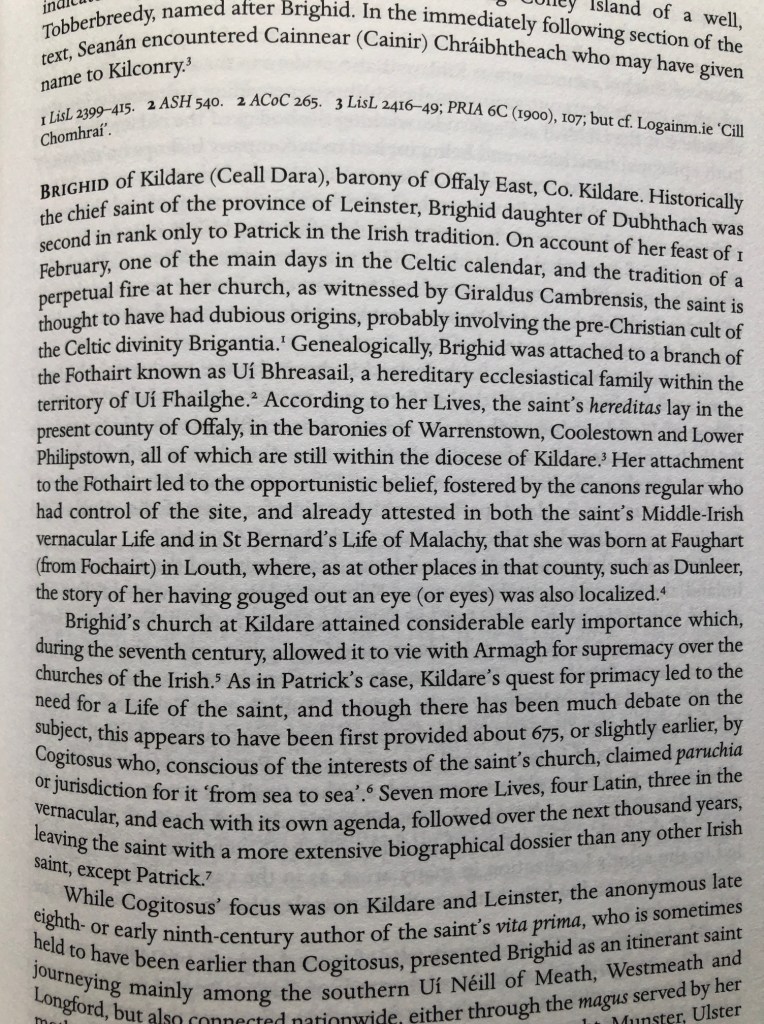
See also the Dictionary of Irish Saints by Pádraig Ó Riain below from the 2011 edition:
This is part two of a three-part blog on the 1835 Poor Law Inquiry into the baronies of Philipstown Upper and Lower. The respondents to the questionnaires for Philipstown were Rev P. Rigney and Roger North. Roger North was a landowner in King’s County. He inherited the Kilduff estate upon the death of his father, Roger North, in 1830. He was involved in estate management, including raising rents, which made him unpopular with local farmers and other landlords.[i] Roger North was shot dead in September 1850.
Offaly History Lecture at Offaly History Centre, Bury Quay, Tullamore, R35 Y5V0 On Monday 26th January 2026 at 7. 30 p.m. following the AGM at 7 p.m. Offaly History presents a lecture about the recently launched “Voices of Offaly” resource available from http://www.offalyistory.com. The collection now comprises over 300 recordings of Offaly People captured over the past 30-40 years. Presented by Aidan Barry and Shaun Wrafter.
The illustrated lecture with voices will include: 1. An overview of the resources available on the new “Voices of Offaly” website. 2. A chance to listen to short audio clips which will give a flavour of the recordings available on the website.
1. Overview of the Website The website is organized into several key sections:
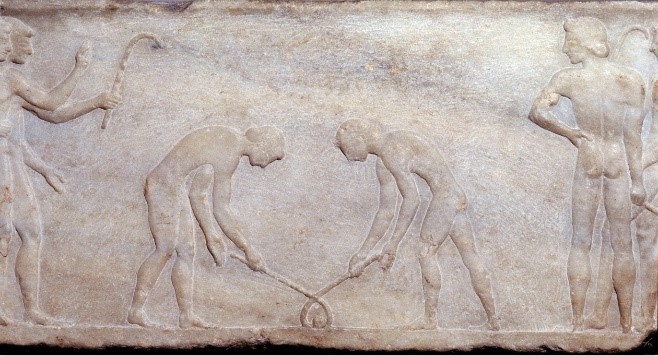
The story of people hitting a ball with a stick is a story which is told everywhere, from Iceland to Ethiopia to the Far East and across to the Aztecs. Look at lacrosse played by the American Indians, the stick and ball games played by the Mongols, the Berber stick and ball game played on the sands of the desert. The Irish game of hurling is a modern variant of a theme which is written through history, across millennia.
Players with two sticks and ball. Greek National Museum, Athens.
There are plenty of books that cover the history of hurling in Ireland. The public library system has most of them. Along with a general history of hurling that are also many histories that are specific to individual counties, particularly parishes and clubs.
Town Commissions in Ireland were possible from 1847 after the introduction of the Towns Improvement (Ireland) Act that would allow the larger towns to introduce a series of measures starting with the appointment of commissioners to carry out works in a town like drainage, paving, and other improvements to the infrastructure. Unfortunately, this legislation was neglected in Ireland during the years of the Great Famine and it was not until the early 1850s when events slowly improved in terms of lesser number of deaths that several towns began to explore embracing this legislation for their districts. Parsonstown (Birr) Town Commissioners held their first meeting on August 4 1852 with Laurence Parsons elected as the first chairman and slowly began to implement the 1847 Act and its subsequent consolidation statute in 1854. Over the next 46 years Parsonstown/Birr Town Commissioners attempted to run the town from the rates received from the ratepayers and loans from the Local Government Board as they engaged in constant disputes with the King’s County Grand Jury and the County Surveyor for decades over which authority was responsible for the scavenging and cleaning of the streets and the expenses incurred.
We are glad to welcome the second of our Young Historians blogs this week and this year. If you have an article or an idea for an article do contact us at info@offalyhistory.com. Offaly History blogs now number 774 and reach 80,000 to 100,000 views each year. So do join the panel of authors of this treasure trove of easily accessed articles since 2016. Doing (or have done) a Leaving Cert History Project on local history -keep Offaly History in mind for your piece of research. We can help with editing and illustrations.

 offalyhistoryblog