
While many are now familiar with the value of the 1901 and 1911 censuses for family history, less use has been made of these documents for social history and population studies. Great excitement was created when the censuses were made available free online through the good offices of the Irish government and the people of Mumbai in India who transcribed them for us at no great expense. Now the department of heritage proposes to make the 1926 census available by again outsourcing the work to a far country. However, we will have to wait until 2026. How much more excitement there is for some places where the 1821 census survives. This is the case with Birr and the entire barony of Ballybritt.
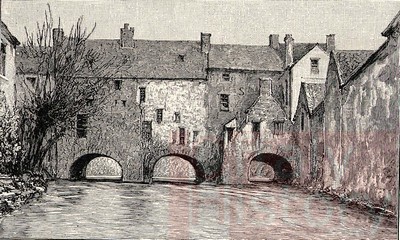
Houses on the old bridge at Birr
Some years ago some 16,500 entries were indexed by Offaly Historical and Archaeological Society and can be consulted for a modest fee on Roots Ireland as part of the promotion of Irish family history and the families of Laois and Offaly. This site caters for the DIY family history enthusiast. In time, the entire Ballybritt census will be published and in doing so it will be utilised for social, economic and population history as was done with the County Cavan material some years ago in a published volume.
So much for being able to trace back one’s family for 100 years, when the opportunity is available as it is for Birr town and district to go back 190 years. Family members of a great age in 1821 bring us back two to three generations further. The oldest person in the town at the time seems to have been Ellen Egan of Graveyard Street. If the census had also survived for Clonlisk barony the Kearneys of Obama connection who left Ireland by 1851 could have been looked at in even closer detail.
Castle Street, for example, was then a crowded place with some 32 occupied houses and over 200 people. Probably the principal business there was the distillery of Arthur Robinson (later the Woods brewery and in the 1980s the Williams Waller business). But in the same street lived a horse breaker, comber, bakers, a chandler, a hatter, jeweller, a copper smith, publicans and labourers. The story of the street can be put together from that time and even back to the leases of the 1740s and beyond.
On the northern side of the town in Cumberland Street (now Emmet Street) lived the soon-to-be local historian then fresh from his controversies over Fr Crotty (who would later have a church in Castle Street), none other than Thomas Lalor Cooke. He published his first history of Birr in 1826. Cooke was then 31 years old and living on 28 May 1821 with his wife Lucinda (26) and sons William (1) and Richard (5). There were several other families in the town of the same surname. Lucinda was connected with the legal family of Antisell and her mother, also Lucinda (48) lived with them – at least on census night. Working in the house were a servant boy, cook, nurse and servant maid.
The streets of the town were densely populated. It was not until the 1900s that one saw the development of new suburban housing for the working classes. Prior to that people were crammed into the lanes and courts behind the bigger houses and paying 6d to 1s per week. In 1821 the details of the housing were provided for each street in a Dublin newspaper along with that of Tullamore.

Castle Street, about 1900 with the former Robinson distillery and behind that Birr Castle
The street names, number of houses in each street and total population for each street will be of interest to those studying urban history. The study of the urban history of Birr is greatly enhanced by the estate records, parish records and from the 1830s the mapping and valuation surveys. The Atlas of Birr published some years ago by John Feehan and Alison, Lady Rosse, must make the study of the town so much more enjoyable.
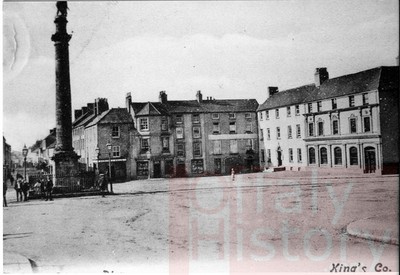
Cumberland/Emmet Square, Birr about 1900
The Census of Ireland
Population of the Town of Birr in 1821 and number of houses in each street
Street Houses Inhabitants
Pound Street 39 197
Charles Street 39 200
Melsop Street 34 137
Love Lane 6 30
Burke’s Hill 50 243
Cumberland Street 35 234
Old Bridge Street 33 182
Davis’s Close 2 12
Moor Park Street 87 488
Old Post Office Lane 23 111
Walcott Place 10 52
Back Lane 47 249
Burke’s Lane 14 81
William Street 5 43
Langton’s Lane 8 33
Duke Square 13 84
Duke Street 13 80
Pig Market 3 17
Main Street 67 439
Graveyard Street 124 639
Mount Silly 4 23
Lower Eden 41 190
Upper Eden 37 189
Turf Market 9 51
Castle Street 32 203
Spinner’s Lane 30 150
Mill Lane 21 62
Church Lane 25 128
Chapel Lane 11 74
Connaught Street 35 109
New Bridge 76 366
The Green 38 203
Oxmantown Place 5 34
The Castle of Birr 0 19
1027 5429
[1016] [5352].
Sq brackets indicate the published figure in the 1821 published census.
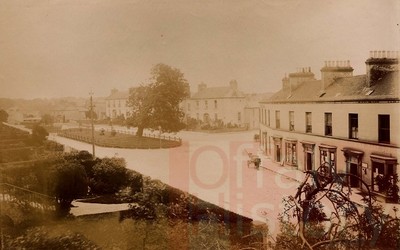
 offalyhistoryblog
Response
[…] Greham, “The Irish Potato Famine,” Your Family Tree, May 2005; Michael Byrne, “The families and streets of Birr in 1821,” offalyhistoryblog, Jun 23, 2017; “Scots-Irish,” accessed May 12, 2018; Noise […]
LikeLike