All over the world, as maritime trade moves downstream and heavy goods are transported by motorway, redundant docks and harbours have become prime targets for urban redevelopment. In my work as a town planning consultant, I visited renewal schemes from Buenos Aires to Barcelona and from Boston to Bilbao. Some have been very successful – others less so. Two common problems with many schemes is that they are either remote from the centre of the city with consequent costs and difficulties in integrating them seamlessly into the urban fabric or else they have to be developed as stand-alone districts; which can tend to have a rather soulless character- particularly if the dominant use is commercial offices.
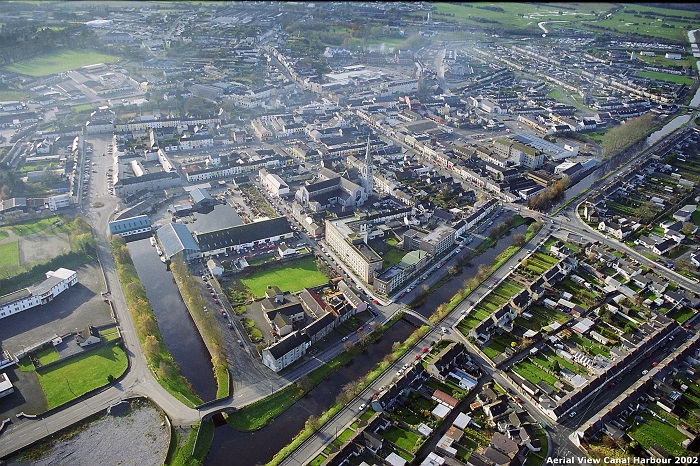
With a few notable exceptions (Liverpool and Galway certainly, but even these are on the edge rather than within the centre of the city) the opportunity to integrate a large waterbody into the very heart of an urban area is rare, if not unique. That is why the now mooted redevelopment of Tullamore’s canal harbour is of such significance and offers such extraordinary opportunities.
The Old Harbour
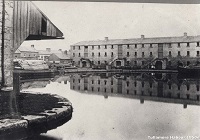
When I was growing up in Tullamore in the 1950s, commercial traffic on the Grand Canal was at its height as barges brought Guinness to Limerick and turf to Dublin. Recreational boating was rare but increasing and the arrival of a visiting cruiser was still an event. Though it was a busy place, my recollection of the harbour is that it was relatively open and accessible and was so public that some of us kids made rafts and sailed or swam around it.
Sometime in the 1960s, the harbour became the central depot for the maintenance and repair of the waterways network in the Midlands. Surrounded on all sides by high walls and rendered virtually invisible, it became an enclosed commercial property and public access or activity was discouraged. Over the years the memory of it as an attractive and vibrant part of the town gradually died.
A New Quarter for the Town
Gladly, change is at last at hand. The redevelopment and reintegration of the harbour into the heart and life of the town has become a priority project for the bodies that matter. Identified by the recently adopted Eastern and Midlands Regional Strategy as a key driver in the renewal of the centre of Tullamore, it will be eligible for renewal funding from the Regeneration and Development Fund. Offaly County Council and the owners of the harbour, Waterways Ireland are combining their skills and powers to deliver the project.
Though it may have to await the next tranche of funding in 2027, it is now possible for the people of Tullamore to begin to imagine the enjoyment of a development of hopefully world class quality. Like any major but worthwhile project, there will inevitably be setbacks and disappointments, but by making it a designated objective in the regional and local plans, the right initial steps have been taken and it is now only a matter of time before things begin to happen. What are the likely next steps?
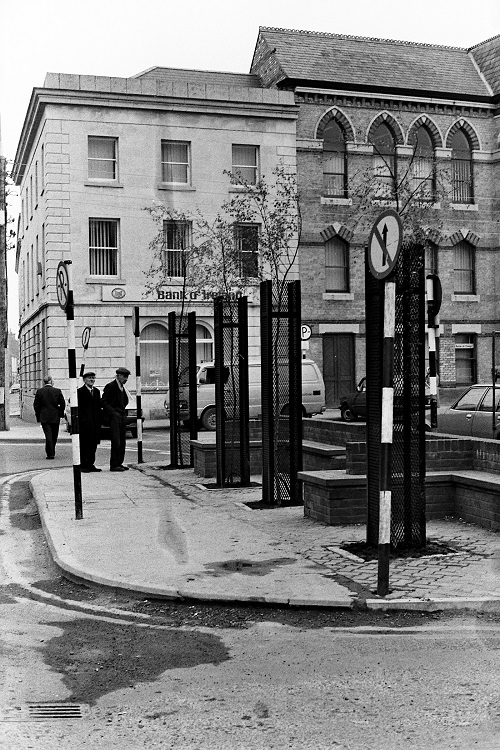
I once again visited my old friends in Tullamore in the last few weeks. I was down from D4 to sort out a charity account with Bank of Ireland in O’Connor Square. I had to make my way through the bollards with the footpath widening. I came on the train of course (thanks Charlie, nice one). I was reminded by a customer that the Bank of Ireland opened in Bridge Street in the summer of 1979. At the time of my visit I was too busy to pay attention because between money laundering forms and this new GDPR stuff I was fit to be tied. And the account is 60 years old. What is all the fuss about small money. Now the new bank of 1979 is so different to the one I remember in High Street where Hoey & Dennings are now.
Fr Willie Cleary died after a short illness at Tullamore hospital on Sunday 19 July 2015 aged 80. He had been parish priest of Tullamore from December 1989 until his retirement from that post in September 2004. He was then transferred to Laytown as a curate and was serving there at the time of his death. His last days in Tullamore hospital were entirely appropriate in that while he loved his work and the people of Laytown it did seem to some that his heart was still in Tullamore and he liked nothing more than to meet friends from the parochial house ‘team’ both current and in the 1990s and call on some of the parishioners of his old parish that he knew well. Fr Willie was appointed parish priest of Tullamore of Tullamore in December 1989 in succession to Fr Pat Fallon who had carried the burden of building the new church following the fire in 1983. Fr Willie was a native of Rathwire/ Killucan and was ordained in Maynooth in 1959. After a short time on loan to Ossory diocese he spent 21 years in Mullingar of which 7 years was as parish administrator in what is the bishop’s parish. His work in Mullingar has been recently recalled in that town.
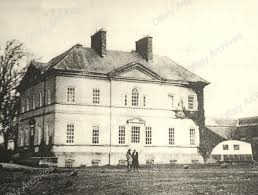
Banagher’s Cuba Court (now demolished) is said to date from the 1730s and may have been constructed by one George Frazer, a former Governor of Cuba and perhaps to a design of Sir Edward Lovett Pearce. The house was unroofed in 1946 because, like so many Irish houses, it was ruined by the policy on rates at the time. If the abolition of rates in 1977 was disastrous for the National Debt and local government at least, it may have contributed to the saving of many Irish houses.
Towards the end of the eighteenth century Cuba was the home of Denis Bowes Daly. Bowes Daly was a prominent member of the local ascendancy. Prior to his death in 1821 he had leased Cuba Court to the Army Medical Board as of 1804 on a 61-year lease. The building was but little used as a hospital and the Medical Board was quite happy to give it up to the Commissioners of Education for the purpose of the Royal School. In 1819 the school had some forty pupils. The then headmaster, Thomas Morris, was succeeded by Revd Alan Bell in 1822. Bell purchased the headmastership from Morris for £1,000.
Alan Bell was at the time master of a classical school in Downpatrick and was the son of a County Antrim farmer. He graduated from T.C.D. in 1814. One of his assistant teachers in the late 1830s was Arthur Nicholls, a nephew and a past pupil of Banagher school. Alan Bell died in 1839 and was succeeded by Revd James Hamilton. After a succession of school masters James Adamson Bell, son of Revd Alan Bell, was appointed in 1848 – at the age of 21. The later agreed, at an inquiry at Tullamore in 1855, that he had not the experience at the time to run the establishment. He graduated from T.C.D. with a B. A. in 1847 and in 1852 became a clergyman. The school improved under his management and had 36 pupils in 1852.
Arthur Bell Nicholls
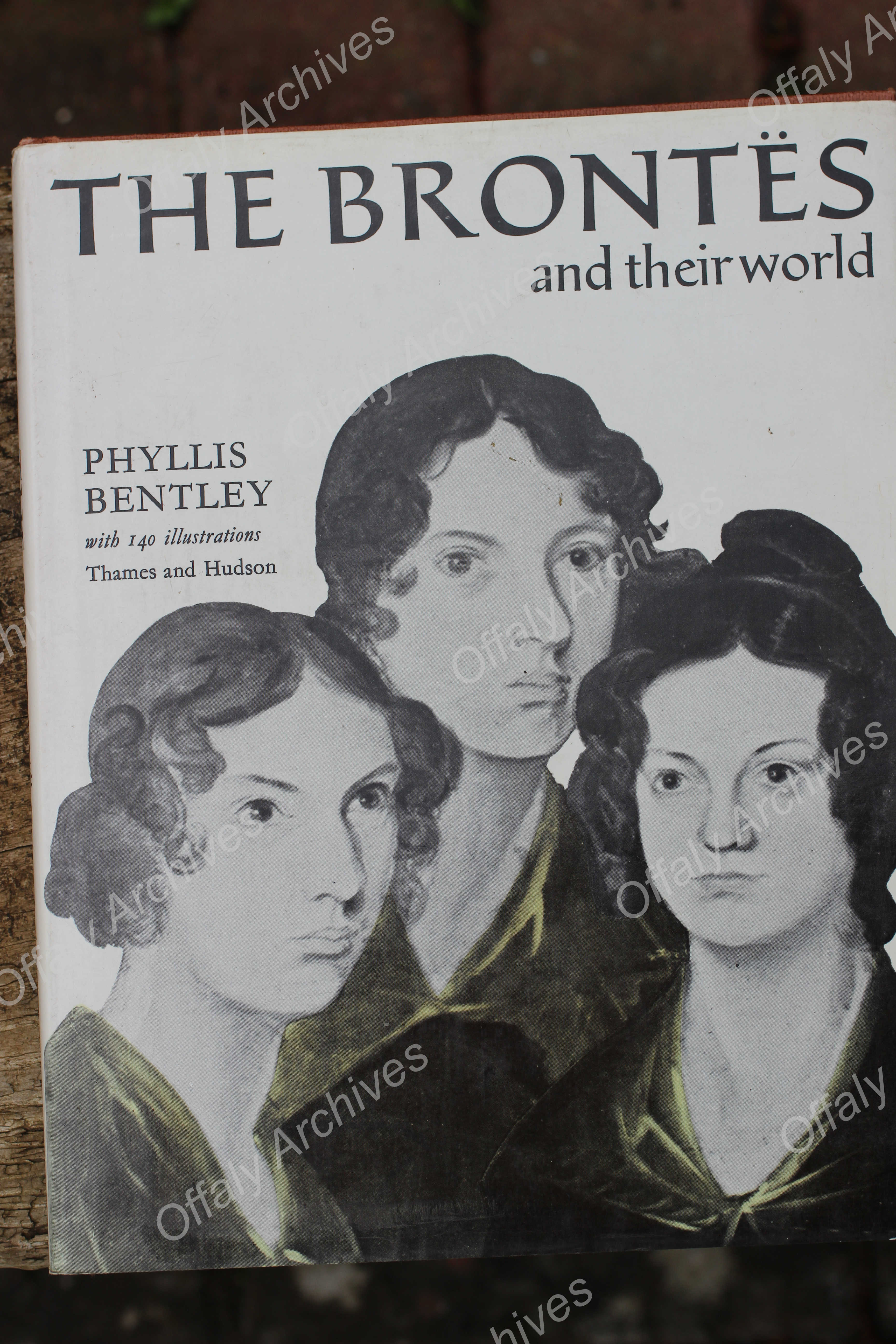
Arthur Bell Nicholls was born of Scottish parents in County Antrim in 1818. He was orphaned early and subsequently brought up by his headmaster uncle in Banagher. He graduated from T.C.D. in 1844 and became curate of Haworth in 1845. It was at Haworth in the West Riding of Yorkshire that he met Charlotte Bronte, daughter of Patrick Bronte, a clergyman at Haworth. Charlotte was born in 1816 and at 31 published an extremely successful novel, Jane Eyre. Her sister, Emily, had earlier published Wuthering Heights. Bell was two years younger than Charlotte and was said to be very serious, almost grave, reserved religious young man of strong convictions – highly conscientious in the performance of his parish duties and narrow in his ideas. Phyllis Bently in her book The Brontes and their World described the marriage proposal and acceptance as follows:
‘For some time Charlotte had been uneasily aware of constraint and awkwardness in Nicholl’s behaviour in her presence, and when one evening in December 1852, just after the disappointing reception of Villette by George Smith, Nicholls on leaving Mr. Bronte’s study tapped on the parlour door, she guessed in a flash what was coming. But she had not realized how strong his feelings for her were. Pale, shaking from head to foot, speaking with difficulty in a low but vehement tone, Nicholls made her understand what this declaration meant to him. She asked if he had spoken to Mr. Bronte; he said, he dared not. She half led, half pushed him from the room, promising him an answer on the morrow, then went immediately to her father with news of the proposal. Mr. Bronte was furious. Charlotte’s own accounts of this courtship and eventual engagement, given in her letters to Ellen Nussey as it went along, could not be bettered in the finest novel in the world. Mr. Bronte’s jealous fury, expressing itself as snobbish resentment – a curate with £100 a year marry his famous daughter! Mr. Nicholl’s stubborn passion, which almost unseated his reason – he would not eat or drink; stayed shut up in his lodgings at the Browns’ (though he still took poor old Flossy out for walks); broke down in the Communion Service, while the village women sobbed around; was rude to a visiting Bishop; resigned his Haworth curacy and agreed to remain till Mr. Bronte found another curate; volunteered as a missionary to Australia but finally took a curacy at Kirk Smeaton, in the West Riding itself. Charlotte, exasperated by Nicholl’s lack of the qualities she desired in a husband, infuriated by her father’s ignoble objections to the match, conscious of the absence of alternatives. The villagers, torn between opposing parties – some say they would like to shoot Mr. Nicholls, but they gave him a gold watch as a parting present. What a tragic drama – or a roaring comedy, depending on its result. Love, coupled with Charlotte’s loneliness and Mr. Bronte’s dissatisfaction with his new curate, Mr. De Renzi, triumphed.
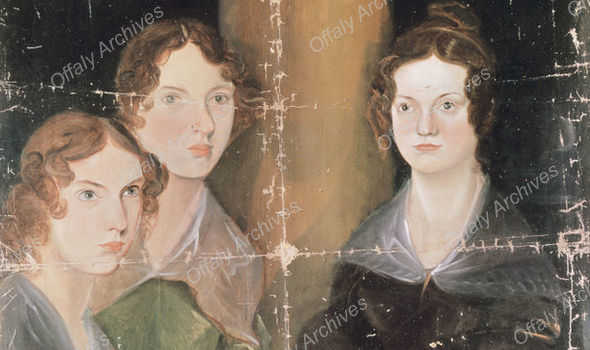
The only-known surviving portrait of Charlotte, Emily and Anne Bronte was painted by their brother Branwell in 1834 and then bought by the National Portrait Gallery in 1914 after it was rediscovered in Banagher. The painting is creased because it was discovered folded up on top of a cupboard in 1914 by the second wife of Charlotte’s husband.
The marriage took place at Haworth on 29 June, 1854, just 165 years ago. The honeymoon was in Ireland and if Bell was a poor unknown curate in England – in Banagher he was a member of a respectable family. In a letter quoted by Mrs. Gaskell in her book The Life of Charlotte Bronte, Charlotte wrote:
“My dear husband, too, appears in a new light in his own country. More than once I have had deep pleasure in hearing his praises on all sides. Some of the old servants and followers of the family tell me I am a most fortunate person; for that I have got one of the best gentlemen in the country . . . . I trust I feel thankful to God for having enabled me to make what seems a right choice; and I pray to be enabled to repay as I ought the affectionate devotion of a truthful, honourable man. “
Cuba Court about 1977
She noted of the school in Cuba House where she stayed while in Banagher: “It is very large and looks externally like a gentleman’s country seat – within most of the rooms are lofty and spacious, and some – the drawing room, dining room &c handsomely and commodiously furnished. The passages look desolate and bare – our bedroom, a great room of the ground floor, would have looked gloomy when we were shown into it but for the turf fire that was burning in the wide old chimney. “Mrs. Bentley felt in her biography that it was difficult to judge whether Charlotte was happy in her marriage. “We’ve been so happy,’ she murmured to her husband, and she spoke warmly of his care and affectionate company when she was ill. But to Ellen she wrote: ‘It is a solemn and strange and perilous thing for a woman to become a wife.’ At least she was no longer lonely, but alway occupied, always needed; she had a parish and two men to care for – ‘my time is not my own now’ – and knew the reality of sex.
In January 1855 Charlotte discovered she was pregnant. It was accompanied by severe illness and she died on 31 March 1855 probably killed by the same illness – consumption – that had killed her two sisters and her brother. The marriage was of short duration – no more than nine months. As to Mr. Nicholls he “remained faithfully with Mr. Bronte in Haworth for the six long years which remained of the old man’s life. He was a somewhat stern guardian of the bedridden invalid that Mr. Bronte rapidly became, and allowed himself a strong dislike to references to his wife’s fame, refusing, for example to baptize infants with the names of any of the Bronte family. Mr. Bronte, learning this, once baptized an infant in his bedroom from a water jug – a sufficient indication of the terms on which the two men stood. When Mr. Bronte died in 1861 Mr. Nicholls returned to Banagher, taking with him his wife’s portrait, her wedding dress (of which a copy has been made), some of Charlotte’s letters and other mementoes, including Mr. Bronte’s dog Plato and Martha Brown. He made a happy second marriage with his cousin, but did not forget Charlotte. Forty years later, when the critic Clement Shorter prepared to write Charlotte Bronte and Her Circle, he found at Banagher among other cherished relics two diary notes of Emily and Anne, in a tin box, and some of the minute childhood writings wrapped in newspaper at the bottom of a drawer.
The following report of the pictures he brought from Haworth appeared in 1914 in a local newspaper:
Banagher and Valuable Pictures
The Trustees of the National Portrait Gallery have purchased and placed in Room XXXVII a group and a single portrait of considerable personal value. The group represents the portraits of Charlotte Bronte and her two sisters Emily and “dear”, gentle Anne”; the single image is believed to be a long lost portrait of Emily, both pictures from the brush of the brother, Branwell, who was born a year later than Charlotte. The importance of the discovery is indicated also by the reference of the London daily papers. The Morning Post, from which the above extract is taken, says further:- “There seems to have been another group of the three sisters by Branwell. Mr. A. B. Nicholls took the picture with him to Ireland, and not caring much for the portraits of his wife, Charlotte, and Ann he cut them out of the canvas and destroyed them. He retained the portrait of Emily, however, and gave it Martha Brown, the Brontes servant, on one of her visits to Ireland. Martha took it back with her to Haworth, and from that date the fragment disappeared until recently rediscovered in the possession of the widow of Mr. Nicholls, and from her acquired for the National Portrait Gallery.
In order to ascertain particulars the editor of the King’s Co. Chronicle communicated with the Revd. J. J. Sherrard, B. D. , Banagher, wrote to the Chronicle on 7th March –
“The Rev. A. B. Nicholls, left an orphan at six, was practically adopted by Rev. A. Bell, Headmaster of Cuba School, which Mr. N. who was a relative, attended as a boy. He returned to Banagher after the death of Rev. P. Bronte, to whom he was curate in Yorkshire, and married Miss Bell, daughter of Rev. A. Bell. The pictures, two in number – one of the three sisters and one of Emily, were found wrapped in brown paper in a wardrobe a few weeks ago in the Hill House, Banagher, by Mrs. Nicholls, who sent them to Mr. Smith, of Smith and Elder, Publishers of Charlotte Bronte’s books, and were sold through him to the National Gallery. The enclosed cutting (from the Morning Post) is wrong in stating the picture given to Martha Brown was among these. It was not and is believed to be lost.
Banagher Church of Ireland where Bell Nicholls was buried
Subsequent to the publication of the above there appeared in the Morning Post a letter from James J. Sherrard of Banagher a letter dated March 8, 1914. ” Sir, I have received a copy of the “Morning Post” containing an article animadverting on some information I had recently forwarded to the King’s County Chronicle with reference to the above. I may state that your account of the discovery, &c. , of the pictures – though not quite correct- was nearer the truth than any of the accounts I read in other newspapers. The facts are as follows: The pictures sent by Mrs. Nicholls to the National Gallery have been at The Hill House, Banagher, ever since they were brought there by the late Rev. A. B. Nicholls. The single one of Emily – cut out of a large portrait containing three sisters – was preserved by Mr. Nicholls. The rest of picture, with the portraits of his wife Charlotte and Anne, was handed to Martha Brown – who lived at The Hill House for upwards of eight years – not for preservation, but to be destroyed, and it is believed it was destroyed by her. I need not go into all the reasons for this action on the part of Mr. Nicholls. You see, therefore, that I was correct in saying that the picture of Emily forwarded to the National Gallery was never in Martha Brown’s possession, though I was mistaken in implying that Mr. Nicholls had ever given any portrait to Martha Brown. I have the above facts on the best living authority. Yours &c. “ James J. Sherrard.
Banagher before the First World War
Charlotte Bronte and the Bell Family
Charlotte died in 1855 and her husband at Banagher in 1906. He had married his cousin and spent the last 45 years of his life there. Their writings place the three Bronte sisters on the highest eminence. Today their novels are read with the same avidity as marked their first publication, and promise to be perpetual. Charlotte’s, Jane Eyre, a romantic love story, met the public eye in 1847, and immediately had an immense circulation, which greatly relieved the straightened circumstances of the family, besides winning lasting fame for its author. Her two other principal works of fiction are known by the names Shirley and Villette, the former a tragedy appearing two years after the first, and at which time her brother and two sisters were dead. In both stories nearly all the people appear as living pictures of relatives and neighbours, and both secured a circulation surpassing expectation. Emily’s undying fame is due to her novel, Wuthering Heights, which saw the light in 1847, but she was not destined to reap the reward of her success as she expired in the course of another brief year, aged 30. The sister Anne’s novel, Agnes Grey, afforded another evidence of the almost evenly divided genius of the three immortal sisters.
Cuba School, Banagher, was one of the Royal educational institutions in Ireland, and ceased as such about 40 years ago, its last master under the endowment having been Mr. Joyce, who afterwards became a medical doctor. The school turned out not a few who rose to distinction in after life, one of these having been the late Sir William, father of Oscar Wilde.
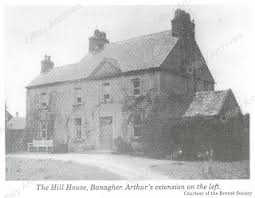
HIll House, Banagher
Hill House, where Nicholls spent so many years, was sold to Major Bell in 1919. He died in 1944 and his wife inherited the property. Florence Bell died in 1959. It is now once again open to visitors who can enjoy its restored appearance and sense the history of a place connected in a curious way with the Bronte family.






 offalyhistoryblog