
A contribution to Tullamore 400 and the Heritage Council’s Historic Towns Initiative.
The Hibernian Bank opened in Tullamore’s Bridge Street in 1864. The footprint of the original site was the Ridley leasehold of 1786. In 1948 the bank was extended by the inclusion of the Berrill shop on Bridge Street. About 1970 the Wakefield shop was added to the property portfolio and soon after the second Ridley leasehold in O’Connor Square being the ‘Brick Building’ erected by T.P. & R. Goodbody in 1871. We had a blog article on 12 O’Connor Square in June 2022 under the title The ‘flamboyant three-storey Ruskinian Gothic warehouse’ in Tullamore. Today we are looking at no. 10, 11, and 12 Bridge Street
.

10, 11 and 12 Bridge Street, Hibernian Bank (part of Bank of Ireland, Tullamore branch, since 1977–9).
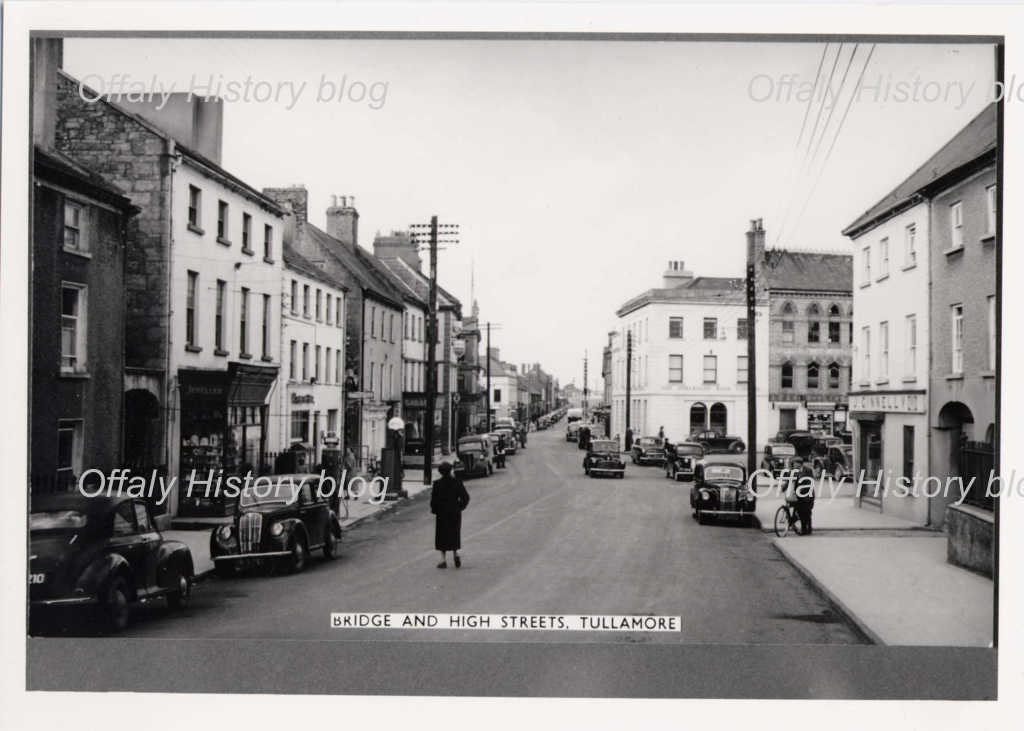
The Bank of Ireland opened a ‘second class branch’ in Tullamore’s High Street in the 1836 and it was after the merger of Bank of Ireland with Hibernian Bank that this building, now GV 12 O’Connor Square and 10, 11 and 12 Bridge Street, came to be used as a Bank of Ireland bank branch. Other banks in Tullamore were Ulster (1892), Munster & Leinster (now part of AIB c. 1924), and local people banks since 1820 and moving on to Tullamore Credit Union in 1963. Tullamore had about ten banks in 2009 and thereafter it all changed course with closures, the most recent being Ulster in 2023. Whereas the Tullamore bank staff might have been 200 in 2000 it would now be perhaps 80 of which half would be with Tullamore Credit Union.
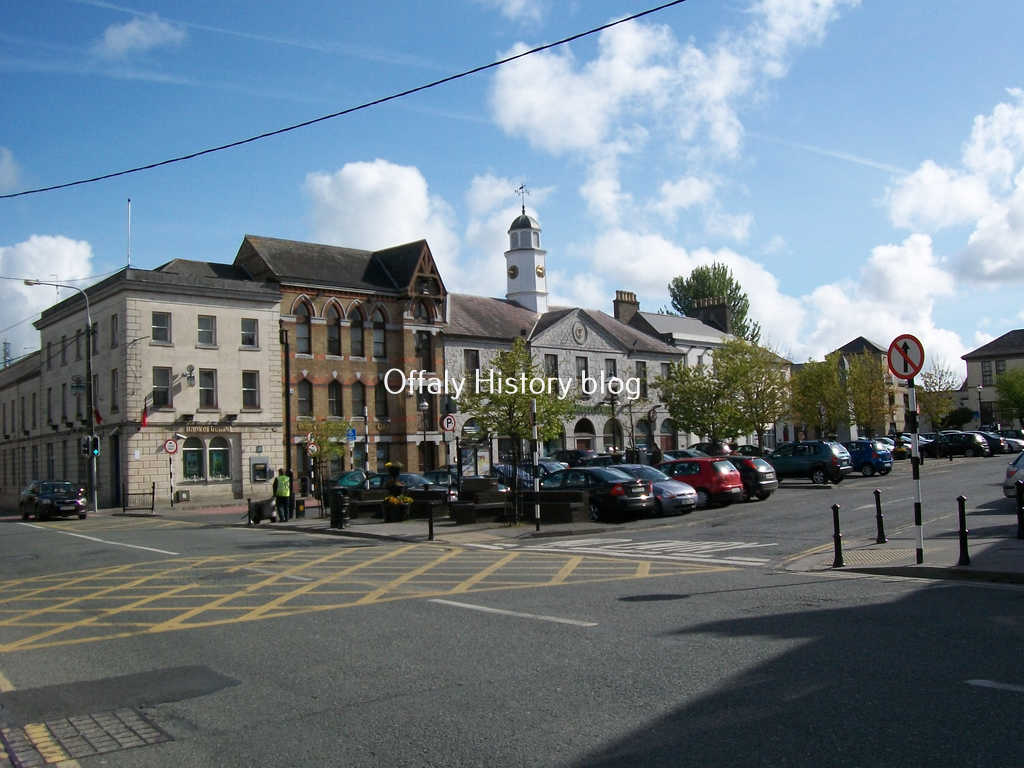
The ‘main part of BOI, O’Connor Square Bridge Street, was described by Garner (1980) as a building having ‘a facade of five bays and three-storeys, plus an extension of four bays and two storeys, on the Bridge Street side. On the O’Connor Square side the facade has three bays with a pair of round-headed windows on the ground floor. It is built of Portland stone, channelled on the ground floor and ashlar above with chamfered raised coigns and a heavy limestone cornice. The bank made considerable improvements to the building in 1866 and by the 1870s the valuation had increased to £32. [1] Further improvements were made for the Bank and designed by W. H. Byrne, architect, in 1908’.[2] The costing for the three-storey part of the Bank on the corner side in 1908 was £776 with Kevin Toole, building contractor of Upper Dorset Street, Dublin. The valuation increased from £32 to £40 by 1911. Further additions of adjoining premises (the four bay two-storey portions in white Portland stone, nos 11 and 12 Bridge Street) were made c. 1951-4 and 1971 (being the addition of the Berrill Woollen Store and Wakefield’s). However, a picture of 1902 shows the original part of the bank building much as it is today save for the extensions on the Bridge Street side.[3] More improvements were made in 1954 and again in 1979.
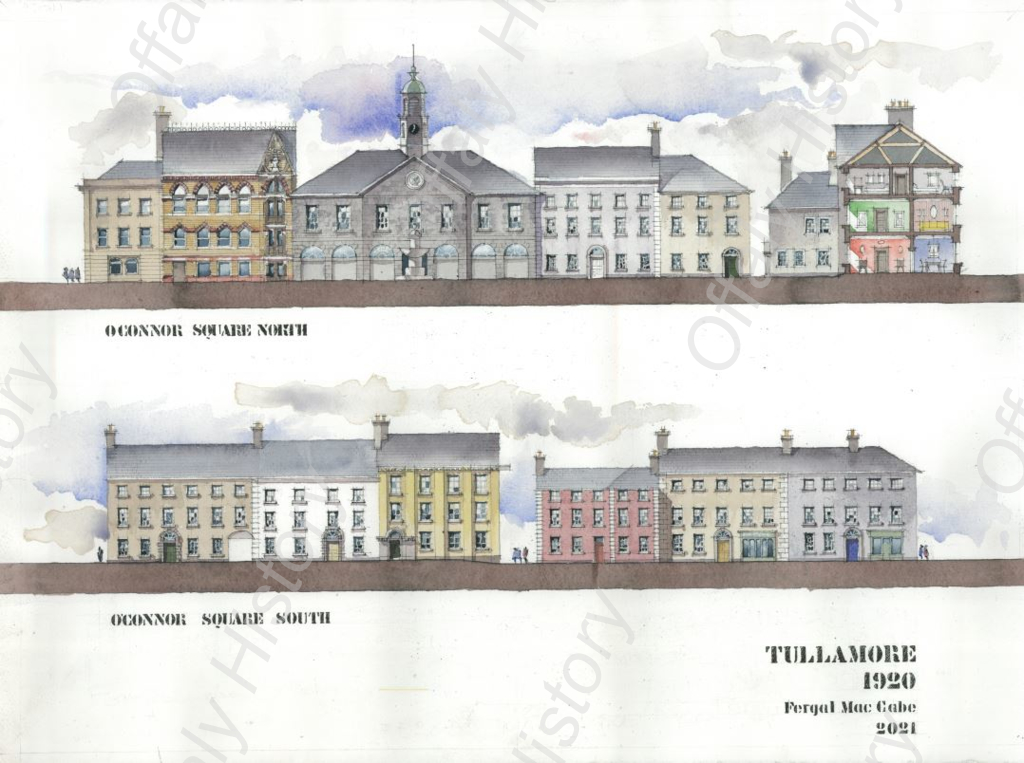
The original title is a lease of March 1786 from Charles William Bury to Francis Ridley of ‘the plot of ground adjoining Margaret Ridley’s house [12 O’Connor Square] to the corner of High Street [Bridge Street] twenty six feet, ten inches and in front to High Street [Bridge Street] forty nine feet, six inches and in the whole three perches’ for three lives with perpetual renewal at a yearly rent of £2 and £1 renewal fine.[4] A house was erected on this site which Francis Ridley sold to James Ryan in 1796.[5] Richard Ryan, grocer and spirit dealer, was in possession in 1843. The surveyor remarked that it was ‘an excellent situation for business’.[6] Mrs. Mary Ryan occupied the building in 1854 and she leased it to the Hibernian Bank in 1864 for sixty years at a yearly rent of £45 and then described as a dwelling house and premises together with a small house adjoining same but now forming one premises.[7] A certain Francis Ridley, shopkeeper of Tullamore, who died in 1862 gave his interest in his O’Connor Square -Bridge Street house to his niece, Mary Ryan, widow of the late Richard Ryan ‘all my interest in the house in which she at present resides’ with the remainder of his property to another niece, Mary Prenter. Mary Ryan, now of Belfast, in her will of 1896 (she died in 1902) left her interest in the bank property at Tullamore to her son James Francis Ryan. The rest she divided equally between her sons James Francis, Richard and her daughter Arabella Charles.
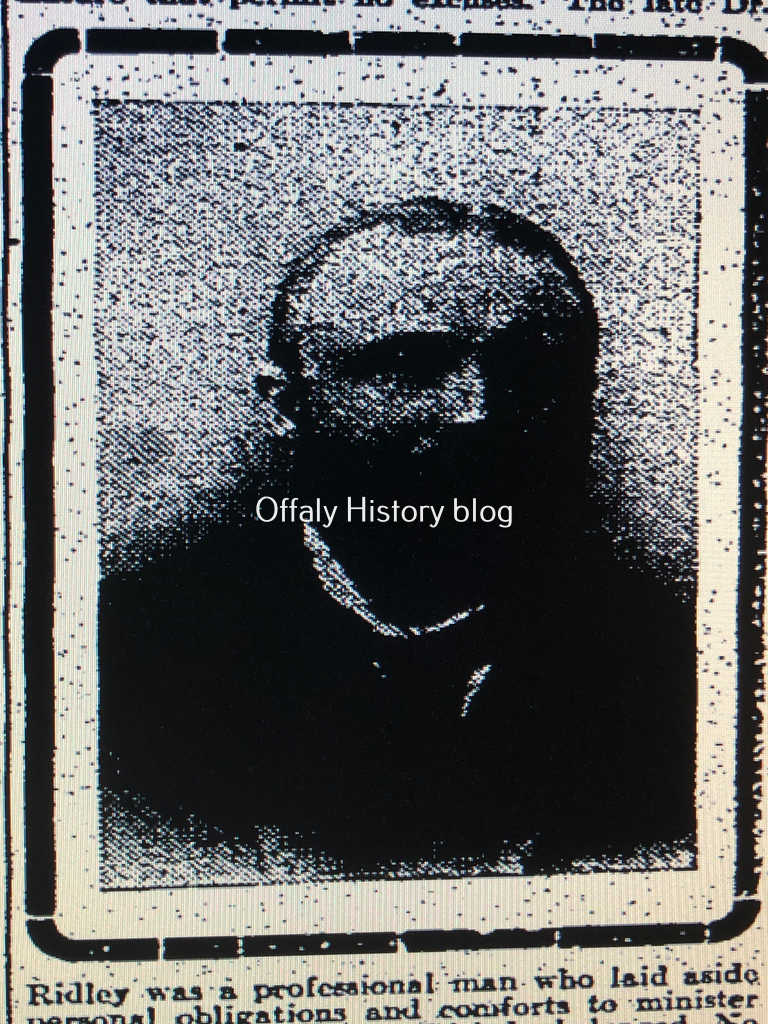
Francis Ridley, the builder of the house at Bridge Street was of an old Tullamore family with extensive property interests in Tullamore at this location and at Patrick Street and Columcille Street. The names of Francis Ridley and Elinor Ridley appear in the prerogative wills for 1782 and 1796 respectively while in the manor court book for Tullamore are the names of Francis (from 1765 to 1816 presumably father and son); John Ridley (1788–1876) and Robert (1776– 1789). The adjoining plot at 12 O’Connor Square was taken by Margaret Ridley. The family survived in Tullamore until the early 1900s and were for a time owners of the Charleville Arms Hotel and doctors at the infirmary and the gaol.
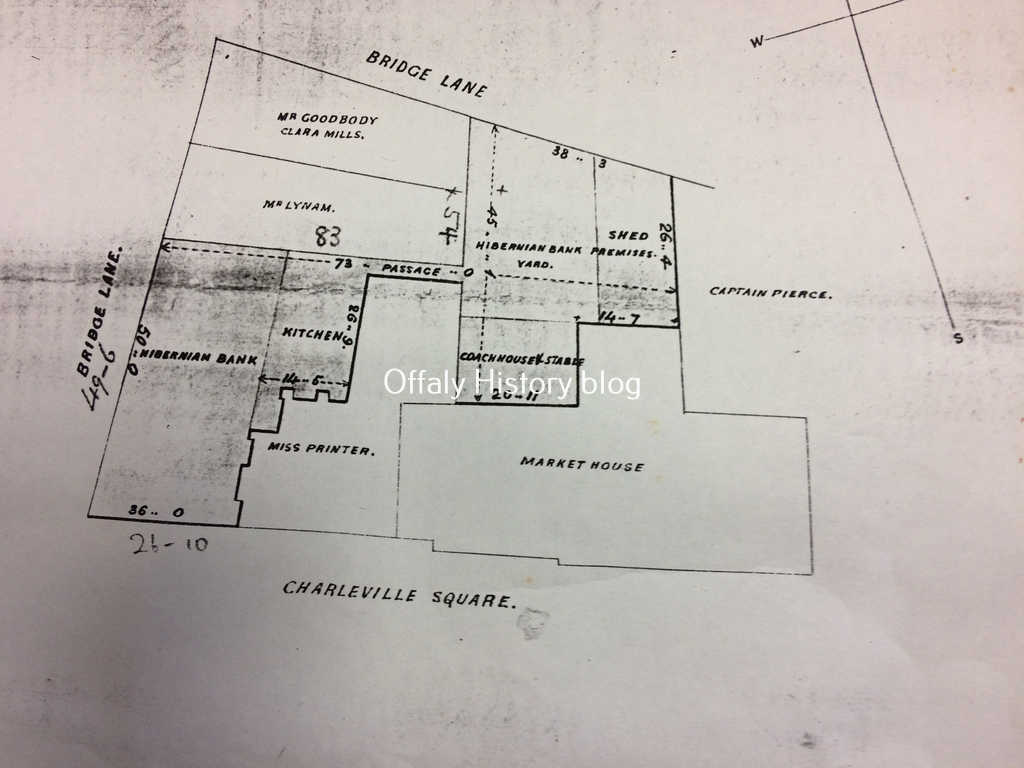
The first agent or manager of the new Hibernian branch was Mr. Richard Butler, and he was succeeded in turn by Mr. Denis P. McCann (1867); Mr. T. A. Segrave (1868); Mr. J. J. Kenny (1879); Mr. P. J. Feeney (1882); Mr. P. M. Stewart (1888); and Mr. W. R. Power (1889). Mr Power’s successor was Mr. James Dunne, and he was manager until 1902, when he was succeeded by late Mr. Thomas D. Costello, who was born at Springpark, Moate. He was a brother of Dr. Hubert Kelly-Costello, M.O.H.., Ferbane, who died in 1899. Mr. Costello held office in Tullamore for the long span of 22 years and when he retired in 1924, he was succeeded by Mr. F. J. Murray, who in his time held the record as regards length of service. When he retired in 1950, he had been 26 years manager. A native of Derry City, before his appointment as manager, he had been, like his successor, Gerry Burke Kennedy for a long time a member of the staff.
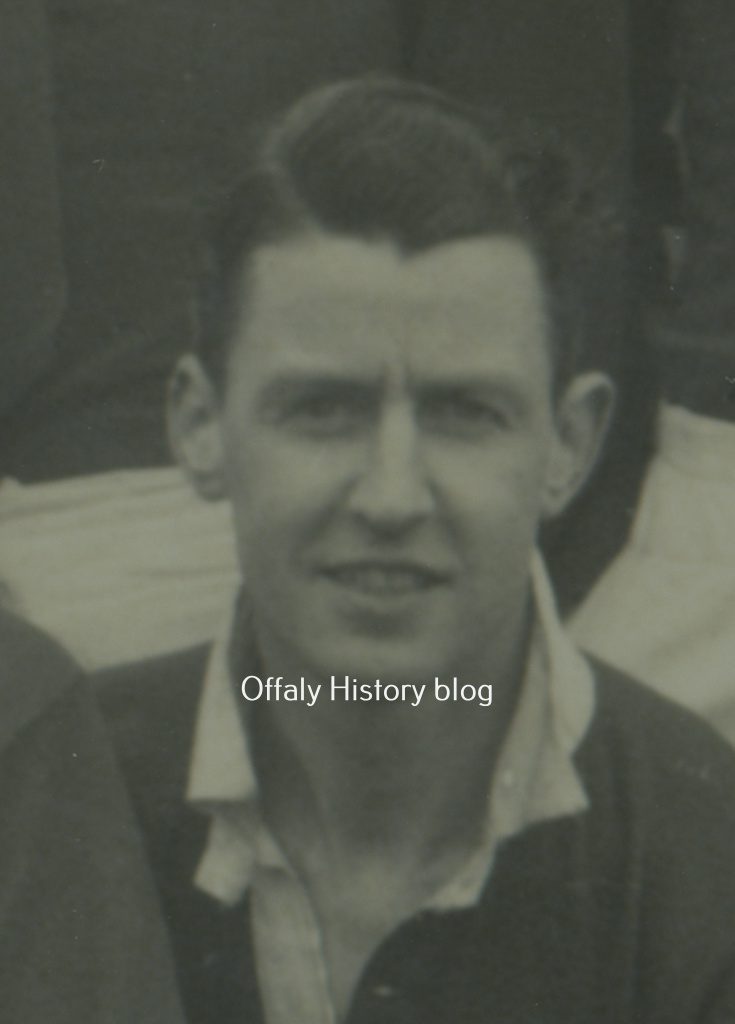
Among more recent managers were the late Gerry Burke-Kennedy and Des Power. Managers of the combined Hibernian and Bank of Ireland branch included Claude Hill, Christy Lennon and George Manzor.
Occupancy in 1901
In 1901 the bank house was occupied by James Dunne and had nine rooms and a family of seven in addition, a stable, a coach house and harness room. The occupiers were as follows:
| Name | Religion | Occupation | Marriage | Where Born |
| James Dunne | R.C. | Bank Official | Married | King’s County |
| Margaret Dunne | R.C. | Married | Co. Meath | |
| Mary Dunne | R.C. | Not married | King’s County | |
| Nathaniel Dunne | R.C. | Not married | King’s County | |
| Stanislaus Dunne | R.C. | Not married | King’s County | |
| Anne Hogan | R.C. | General Servant | Not married | King’s County |
| Margaret T. Tiernan | R.C. | Nurse, Domestic Servant | Not married | Co. Westmeath |
It should be noted that the Hibernian manager in 1901 was a Catholic. The Bank had been founded in 1824 by Roman Catholics, among others, with Quaker assistance. As stated above the first bank branch in Tullamore was that of the Bank of Ireland opened in 1836. Athlone had its first bank branch in 1827, Birr 1833, Banagher 1839, Moate 1836, Longford 1834, Mountmellick 1836. In Tullamore the second bank branch was Hibernian in 1864 and it was 1892-3 before Ulster Bank opened what was the third branch of a national bank. In O’Connor Square a locally managed loan fund bank was opened in 1820-21.
In 1911 the manager was T.D. Costello (58) and living over the bank with his wife, two of his three children and one servant. Beside him at GV 11 in Bridge Street was the staunch nationalist Michael Berrill (aged 53) with five draper’s assistant and one general servant. Costello lost a son during the Somme offensive in July 1916.

The deep cleaning of the exterior of the Goodbody warehouse in 1978–9 was a landmark for Tullamore. It came after demolition jobs at Ulster Bank, Tullamore in the 1973, the canal hotel in t 1974 and of course the Tarleton building (now Tullamore library) back in 1936. The benefits of that work on no. 12 O’Connor Square are now appreciated in the partly pedestrianised district. The warehouse adds vibrancy and colour to the square and is making a contribution that the Goodbody brothers would be proud of. Equally no. 10, 11, and 12 Bridge Street in the magnificent white Portland stone make a singular contribution to the streetscape.
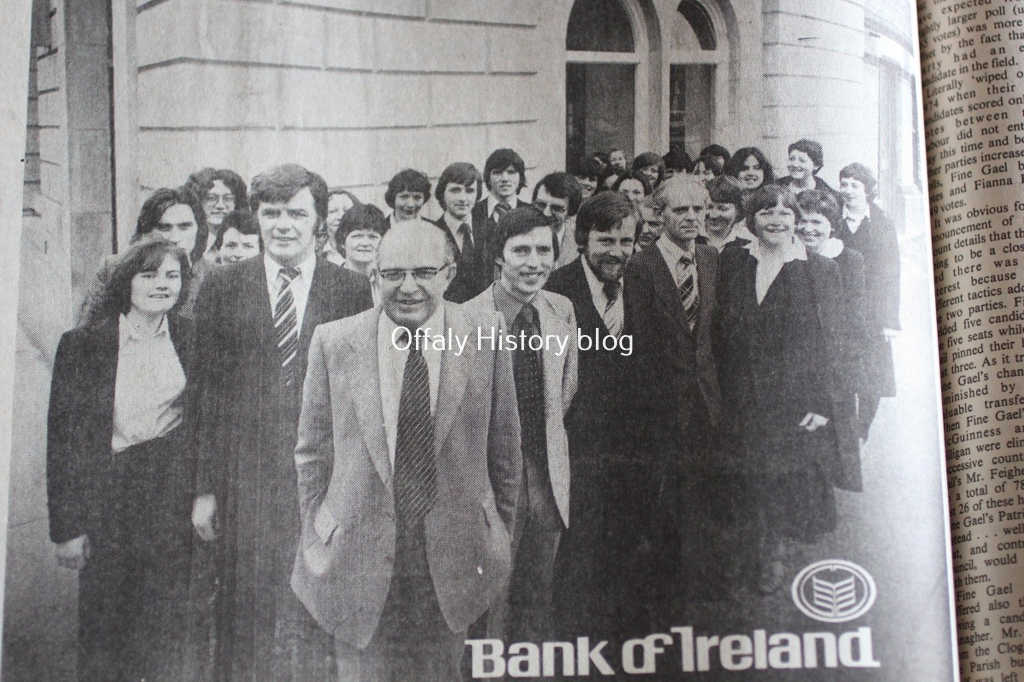
The Bank of Ireland celebrated 150 years in 1986 when it had almost 40 staff locally, now reduced to about 15. It started in 1836 with three people in High Street and moved to what since 1980 is the Hoey & Denning building). In 1977 the Bank of Ireland and Hibernian staffs joined together locally and work commenced on the reconstruction of the Hibernian branch in Bridge Street. This provided for the inclusion of the former Wakefield shop and the brick building in O’Connor Square (erected in 1871 by Goodbodys) and more recently the Sunshine Café (no. 12 O’Connor Square). The bank’s work was a turning point in heritage building restoration in Tullamore and was of a high standard. Granted the interior was wholly modern but at least the façade was in this case handsomely restored. Unfortunately, the handsome interior, much praised as to counter and ceiling, much praised in 1954 was lost in the reconstruction of the late 1970s. The hall of that period has also been lost and replaced by a warren of small offices and self-help technology. The author of the 1954 article commented:
A special feature of the reconstruction is the splendid mahogany counter, which runs the entire length of the office, incorporating the original counter, a model of Irish craftsmanship, designed and made in the spacious days of old. In the same manner the beautiful ceiling has been preserved. The heating and lighting are of the most modern kind. The office is now almost twice its original size, a fact made constructionally possible by the purchase of the adjoining premises, which were known as The Irish Woollen House, and which was long controlled by the late Mr. Mitchell Berrill, U.D.C.[8]
Claude Hill was the manager at this time and he come from the Bank of Ireland and continued to serve as manager until 1982[9] when he was succeeded by Christy Lennon and later George Manzor. The combined Tullamore branches in 1979 was 37 staff members of whom about one-third were male with almost all of the senior managers men. By 2023 this had changed to 10 to 15 staff. From 2008 all the banks began to look at cost-cutting and reduction of staff. The banks became technology driven with even senior customers (who in the 1980s and 1990s were specially welcomed as ‘Golden Years’ clients) now expected to adapt to the new technology in regard to their bank business. For a time, what with the spate of retirements among senior staff in all the banks, it was hard to know who the manager was and less easy to meet him (or sometimes her). Lending dried up after 2008 and the effort was centred on recovery of funds with staff allocated to this function in place of the commission-driven lending of the 1997-2007 period. Now there is more money but rates are rising as are charges and the borrowers are hard-pressed while the savers lose perhaps ten percent per year on the value of their savings. A long way from the steady funds of Jane Austen’s time.
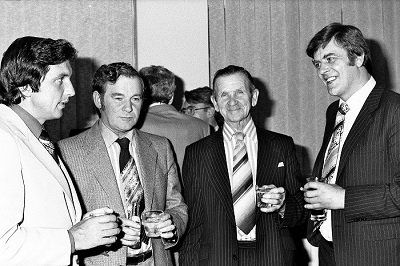
On a lighter note to finish it was said that Gerry Burke Kennedy was fond of hunting with the Westmeath Harriers and on one occasion when an official from head office called to Bridge Street unannounced he was advised that Mr Burke Kennedy was not available to meet him having gone to the funeral of a Mr Fox in Kilbeggan
[1] Ordnance Survey, name books to accompany Ordnance Survey, King’s County, XVII, nos 42-3, 52-3 (Tullamore town, five-foot scale, 8 August 1888), p. 13; Valuation Office, Tullamore town cancelled house book, 1870–74, p. 164.
[2] Bank of Ireland, Tullamore, Toole and Hibernian agreement.
[3] King’s County Chronicle, 13 December 1902.
[4] Registry of Deeds, Bury to Ridley, 24 March 1786, memorial no., 546/478/360890.
[5] Ibid; Registry of Deeds, Ryan and Scully, 19 August 1811, 635/446/438849.
[6] MS valuation, Tullamore, property no. 92.
[7] Bank of Ireland, Tullamore, lease in branch, Ryan to Hibernian Bank.
[8] OI, 2 Oct. 1954.
[9] TT, 5 June 1982.

 offalyhistoryblog