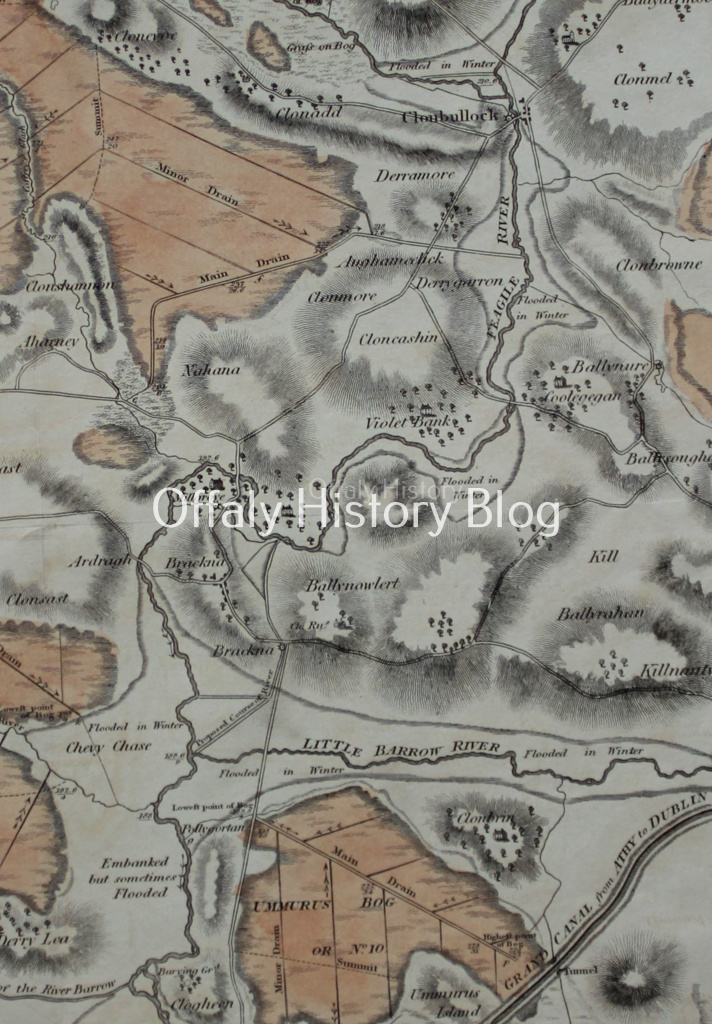
Bracknagh a small village in east corner of Co. Offaly, formerly, in the Barony of Coolestown. While originally part of the parish of Clonsast, today it forms part of the parish of Clonbullogue. It borders Co Kildare to the east, lying approximately six kilometres from Rathangan, and borders Co Laois to the west, situated seven kilometres from Portarlington. Geographically it is located on the Figile River and fringes the Bog of Allen.
While Bracknagh village is the focal point of the settlement, the area of Bracknagh includes the hinterlands of Ardra, Clonsast, Clonshannon, Ballinrahan, Ballinowlart, Ballyshane, Nahana, among others.

The name Bracknagh, sometimes spelled Brackna, is generally taken to be derived from “a speckled place” probably reflecting the dispersed nature of settlement in the eighteenth and nineteenth centuries. However, the name is most likely to have reference to early christian times and has derived from “Farran na Brachan” the territory of St. Broghan, (brachan or bearchán Bearchán is listed in Padraig Ó Riain’s A Dictionary of Irish Saints as Bearchán of Clonsast and is referred to as Fear Dhá Leithe, man of two parts, as he was known to have divided his time between Clonsast and his native Scotland.[1] This saint is said to have come from Scotland and set up a monastery here in the early seventh century and gives his name to the present parish. It is therefore likely that Bracknagh originated as a dispersed settlement in the hinterland of St Broghan’s monastic site. It is claimed that the monastery was substantial and on a par with that of Clonmacnoise or Glendalough. While there is no evidence of a round tower on the site, there are many references to Broghan as a scribe suggesting the presence of a scriptorium. In fact, Bearchán’s church at clonsast is credited with the possession of a book known as Leabhar Bearchán, referenced locally as Leabhar Cluain Sasta. According to Ó Riain this formed part of the Library collection of the Earl of Kildare up to the sixteenth century. Its whereabouts remains unknown. However, a copy of part of this manuscript was copied and can be found in the Leabhar Breac presently in the Royal Irish Academy, Dublin.[2]
Very little remains of the ruins of the monastery today, except for a few sections of the outer walls, however, people continue to visit Saint Broghan’s Well, which is known for its healing powers. The well is situated in an adjoining field to the ruins.

Through the centuries the population of Bracknagh increased and was at its highest in the Mid-Victorian period, before the onslaught of the Great famine. Bracknagh like other places in King’s County and indeed throughout the country witnessed mass clearance and evictions from the 1850s onwards. Dr Ciaran Reilly cites how Charles Trench, agent for the second baron Ashtown, oversaw the clearance of over 700 people from the village of Bracknagh. He refers to Trench’s men as a team of ‘wreckers’ who completely decimated the landscape forever.[3] Most of lands of present day Bracknagh village and Clonsast was owned by Lord Ashtown, In fact, the Ashtown estate comprised of 4.414 acres and extended west to Cushina, and east to Ballinrahan, and Aughamellick.
By the early years of the 20th century the village consisted of only 12 households and a population of between 60-70 people. In both the 1901 and 1911 census the majority of the population are recorded as being farmers or farm laborers supporting the view that agriculture was the dominant economic activity in the area. The lifestyles of the local people were mainly subsistence, growing their own food, if lucky rearing an animal or two and cutting their own turf for fuel, long before the commercialization of the bogs.

There is however, evidence of a few local industries. Millgrove Mills either built by or acquired by, Henry Edward Joly between 1901 and 1911. Joly is listed in the 1911 census as magistrate, landed proprietor and Mill owner.[4] It seems that there was both a corn mill and saw mill located at Millgrove both of which gave much employment in the area. Men worked here grinding corn for local farmers while many others worked are carpenters. Names like Thomas Ryan and Michael Conlon of Millgrove are listed in 1911 census as carpenters, while many other members of their families were apprentice carpenters. [5]Milling continued here until the 1940s. It is believed that the water from the adjacent river was used to power the industry.

It was reported that there was a quarry located in Clonsast, known as Murray’s Quarry which employed over 30 people. Stone from this quarry was used to build the new national school in 1910 [6]. In fact, the current GAA pitch is still locally referred to as “The Quarry”. There was also a lime Kiln located within a few hundred meters from the quarry currently owned by the Bennett Family of Clonsast.
There was also a forge located in the heart of the village of Bracknagh where Murphy’s pub is today. This was owned by Edward and Pat Kavanagh[7] and supplied the locality with metal used for horseshoes, gates and other metal objects and building materials. They also repaired implements for the local farmers.
There was one grocery shop recorded in the 1911 census. This was located in Millgrove and was owned by the Allen family. Namely Larry Allen. It seems the family also ran a boarding house as there is evidence of the local school master called Carvill living in their house in 1911.[8]
There was one pub in the village owned by the Campion family.
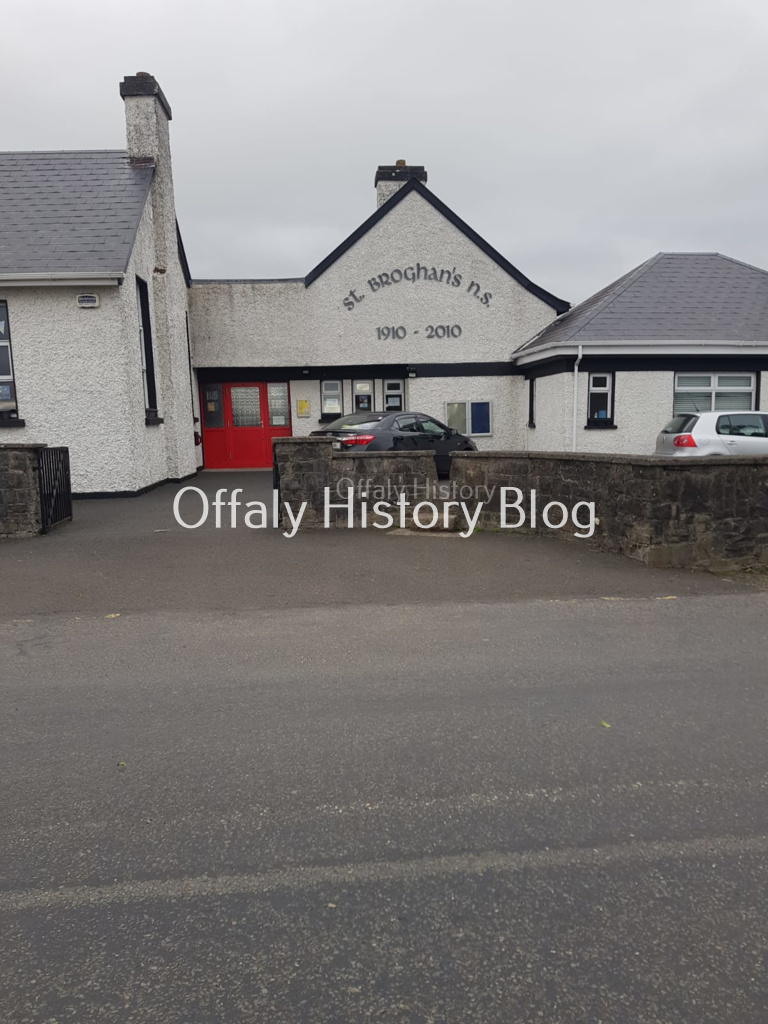
A new school was built in 1910 which saw the improvement of educational services in the village. Gaelic football was first introduced to Bracknagh by a teacher called Edward Carvill who came to teach in this school. Carvill who was a native of county Down, encouraged the students to participate in Gaelic football. In fact, he managed the Bracknagh Junior football team to victory in the Junior County Championship in 1912.[9]
The beginning of the twentieth century in Ireland witnessed a change in landownership and a shift in power from landlord to tenant. This was very much reflected in the community of Bracknagh, when the lands of Lord Ashtown were divided and eventually redistributed by the land commission in the early 1920s.The transition seems to have created tension within the community as was recorded in an article in “ The King’s County Independent”, May 24, 1913[10], where prisoners from the Bracknagh area were returned for trial at Tullamore court, having been involved in a local cattle raid on the lands formerly owned by Lord Ashtown. This came about s a result of a public meeting held on the 24th of February 1913 to discuss the breaking up of the estate and how the land could be returned to the local people.[11] It seems that agents and bailiffs who had worked for Trench decided to graze their animals on the land that had been cleared due to the enforced evictions. A large crowd of over 300 local people gathered on the night of May 15th to drive the cattle from the estate onto the public roads around Ballynowlart. [12]
They were surrounded by police under the command of Constable John Wolfe who advised them to stop. However, the police were outnumbered, and the locals continued. This event known as The Battle of Ballynowlart resulted in the deaths of up to 50 cattle, while many locals and members of the RIC were injured. Several arrests were made. Many prisoners, having spent the night in the RIC barracks, were transferred to Portarlington, by horse and carriage the following morning and from there, they were sent by rail to Tullamore where they were eventually charged and fined.
Names of the prisoners included Coughlan, Cassidy, Blong, Kavanagh, Kearney, Conlon and Mulpeter. [13]

In the early part of the twentieth century a War of Independence raged in Ireland which resulted in the establishment of a Free State in 1921. In the Bracknagh area a Ballynowlart/Bracknagh Co-operative was set up. This co-op was led by the local parish priest Fr M.P Kennedy. It is alleged this cooperative aimed to promote the cutting of turf in the area and the selling of this product both nationally and abroad. The Co-op. commissioned the making of a film in order to raise money. [14]The Pathe Frere Company from Dublin visited the local area in 1921 and filmed the turf cutters in action. (All dressed in their Sunday Best).One must remember that a camera, not alone a film was a great novelty back then. There are stills of bags of turf being transported by horse and carriage from Bracknagh through Rathangan to be taken by barge on the canal to Dublin for export. The sacks of turf contained labels saying “Fód Móna to New York from Brackna Co-Op”[15]. Part of the film was devoted to highlighting the examination of remains exhumed in 1917 from a site at Ballynowlart where a massacre is believed to have occurred there in 1643 during the Confederation Wars.[16]It is reported that a number of people were burnt to death while attending Mass in the Catholic church on little Christmas day. These remains were to be later reinterred in Bracknagh Church yard. Some questions remain unanswered about the purpose of this film.
By 1929 the Irish land Commission divided the Ashtown Estate and other smaller local estates among the people and built new houses for those who acquired land. While this brought stability and security to some the population, the structure and layout of Bracknagh village would not undergo any significant change until the1950s This change was largely due to the impact of the commercial exploitation of Peat. The raised bogs of Ireland began to be exploited commercially from 1946 onwards. This was a result of the setting up of the semi state body Bord na Mona which aimed to introduce technology into Irish bogs especially the Bog of Allen. Bord na Mona was to have a direct impact on the community of Bracknagh from the 1950s onwards. Not only was it to be a major employer in the area but according to its 1948 annual report, “ permission was given for the erection of fifty houses in the village”.[17] These houses were to provide accommodation for workers from the four provinces of Ireland and the estate today, known as St Broughan’s Estate, forms a significant part of the village.
The impact of this new development in the 1950s would have a huge impact on the community of Bracknagh demographically, economically and socially. The increase in population created a demand for improved services and led to the revitalisation of the community. The number of shops increased in the village in the 1950s as a direct result of an increased demand for goods and an increase in the purchasing power of the residents as well as an increased demand for educational services.

The impact of Bord na Móna has not only left a lasting imprint on the physical landscape of the village but has significantly contributed to the social and economic development of both the village and surrounding areas over the last eight decades.
Our thanks to Mary Delaney for this article and wishing the Bracknagh History Group all the best.
[1] Ó Riain Padraig, A Dictionary of Irish Saints, Dublin ,2011.p.97
[2] Ó Riain Padraig, A Dictionary of Irish Saints, Dublin,2011, p.97
[3] Reilly Ciaran, The Levelling of Bracknagh and Famine time eviction in Offaly, Offaly Independent June 22, 2020.
[4] 1911 census Bracknagh, Barony of Coolestown.
[5] 1911 census Bracknagh Ryan and Conlon.
[6] . The Parish History Committee “The life, the Times, the People” Topic Newspapers , Mullingar, (1993)p252
[7] Cunningham, Frances, 6th June, 2023
[8] 1911 census
[9] The Parish History Committee “The life, the Times, the People” Topic Newspapers , Mullingar, (1993)P.254
[10] The King’s County Independent, May 24th (1913) page 6
[11] The Parish History Committee “The life, the Times, the People” Topic Newspapers , Mullingar, (1993) p.235
[12] The Parish History Committee “The life, the Times, the People” Topic Newspapers , Mullingar, (1993),p.235
[13] The Parish History Committee “The life, the Times, the People” Topic Newspapers , Mullingar, (1993) p236
[14] The Parish History Committee “The life, the Times, the People” Topic Newspapers , Mullingar, (1993) p.237
[15] Photo of still of film, courtesy of Larry Fullam, Rathanagan.
[16] Reilly Ciaran, John Plunket Joly and The Great Famine in King’s County. Four Courts Press, 2012, p12
[17] Bord na Mona’s Annual report 1948, page 10
 offalyhistoryblog