
High Street is still the principal street in Tullamore and this has been so for the past two hundred years. It, together with Bridge St., O’Connor Square, O’Moore St., and Cormac St., deserve detailed attention because of the quality of the surviving urban fabric. The same might be said of the terrace in Church St. and Bury Quay/Convent Road Terrace. Patrick St. has a few houses of very high quality. The designation of principal street applies to the quality of the surviving houses and not to extent of business, or the number of those living in the houses as owner occupiers of the original residences. A walking tour of O’Connor Square and High Street, Tullamore organised by Offaly Historical and Archaeological Society on 18 June 2023 has promoted this review of what we have published so far on High Street (see the articles listed in the appendix to part 2 of this article (next week) and all online at http://www.offalyhistory.com). This work is supported by the Heritage Council.
Shopping has been on the decline in High Street since the parking regulations were introduced in the 1960s and this has deteriorated further since the on-going restrictions on street parking, wide footpaths and pay only off street parking . More research needs to be done to confirm this and account taken of the draw of the Mr Price, Midland Books Anthony Kearns and other shops as against the loss of the Book Mark, Horan’s, Lawless’ grocery, Lawless Pharmacy, two betting shops, Bank of Ireland, Daly’s Sweets, McGinn’s, two butcher shops, Kilroy’s hardware and Ulster Bank. High Street is the principal street in the county town and its background is wrapped up in the colonisation of the county in the seventeenth century and the beginning of attractive long leases for house builders after 1740.
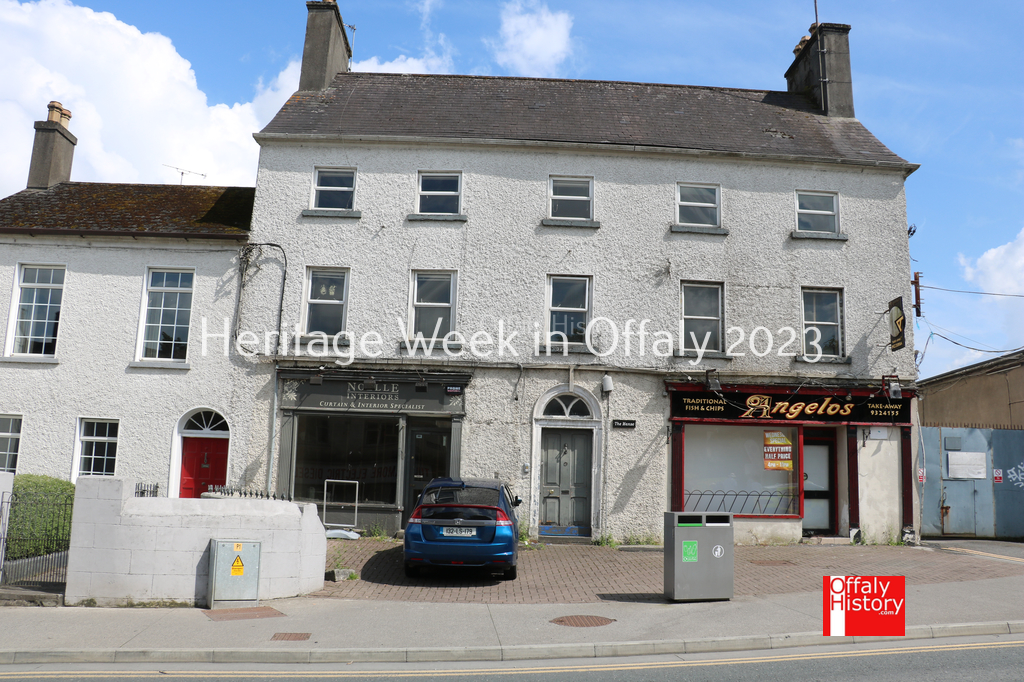
There are more parking spaces (c. €3 per day) and probably more people living in the street now than in 1911. Off the street at Roselawn, Altmore and the apartment blocks beside Bridge Centre there are over 100 residences. Of course the style of living is very different to 1800-1980 with many houses let into apartments and six of the houses now used under the Direct Provision scheme and catering for a large number of households. In 1954 Moorheads gave up no. 33 High Street and it became a hostel for girls only. First, a word about the urban setting.
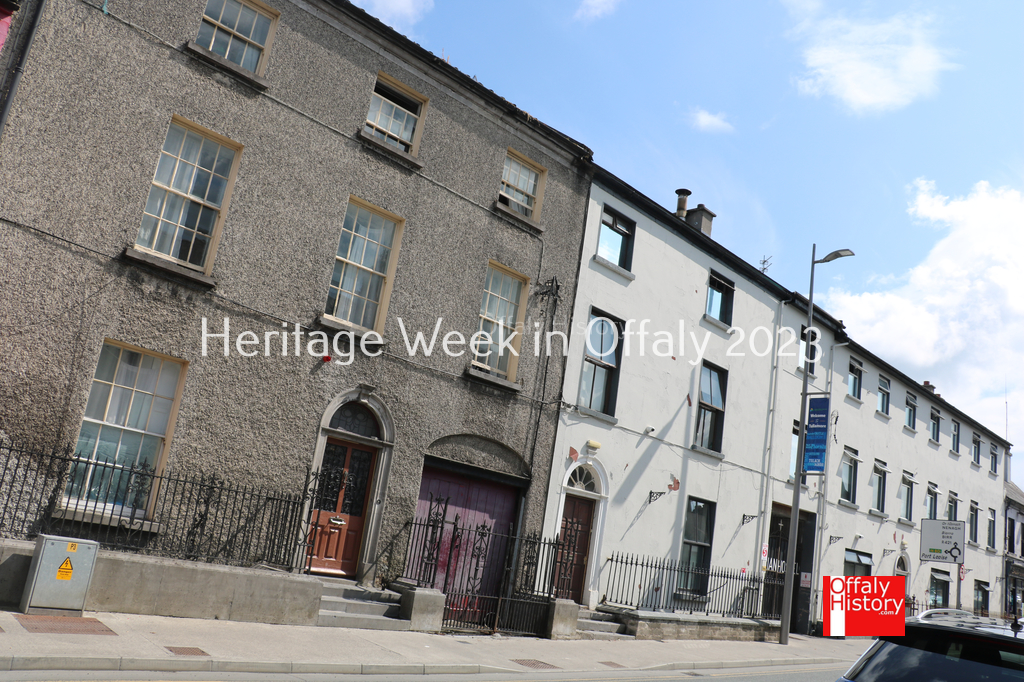
Tullamore is the county town in Offaly with a population in the town and environs of about 16,000 (2022). The town is dated back to the grant of fairs and markets in 1620–22 to its new owners, the English family of Moore, who were soldier-settlers from Kent. The previous owners of the lands of Tullamore and the lands of Ballycowan, Ballyboy and Eglish were the O’Molloy family. Little is known of the town in the seventeenth century, but a large house was built in 1641, at what is now Charleville Demesne, and the Moore family purchased this house in 1740. In the early 1800s it was demolished, and Charleville Castle completed nearby over the years 1800 to 1812. Tullamore town was developed after 1716 with the building of government military barracks where the present-day garda station is located. Patrick Street developed and so too did High Street and O’Connor Square from 1713, but more especially from the 1740s. Charles Moore’s death in 1764 at the age of 52 and without issue was a setback to Tullamore’s progress. Within six months the estate had passed to a grandnephew of no more than six weeks in age. Naturally growth took off when the new owner entered into possession in 1785 after a minority of over twenty years. New leases were granted throughout the town and significant improvements were made to O’Connor Square, High St., Church St and William/Columcille Street. The Grand Canal reached Tullamore in 1798 and that gave a further impetus to the construction of new streets as did the build up of the army during the Napoleonic Wars when rentiers such as Thomas Acres could build the east side of Cormac St. for letting to the officers and men. Development continued up the completion of the workhouse in 1841 and very little was built over the next fifty years save the two railway stations of 1854 and 1865, together with the new Presbyterian church (1865) and the new Methodist church (1889). The economy improved over the period from 1891 to 1914 and so did Tullamore with new shops and housing, both private and public. The council’s role in housing would grow in significance from the late 1920s and 1930s.

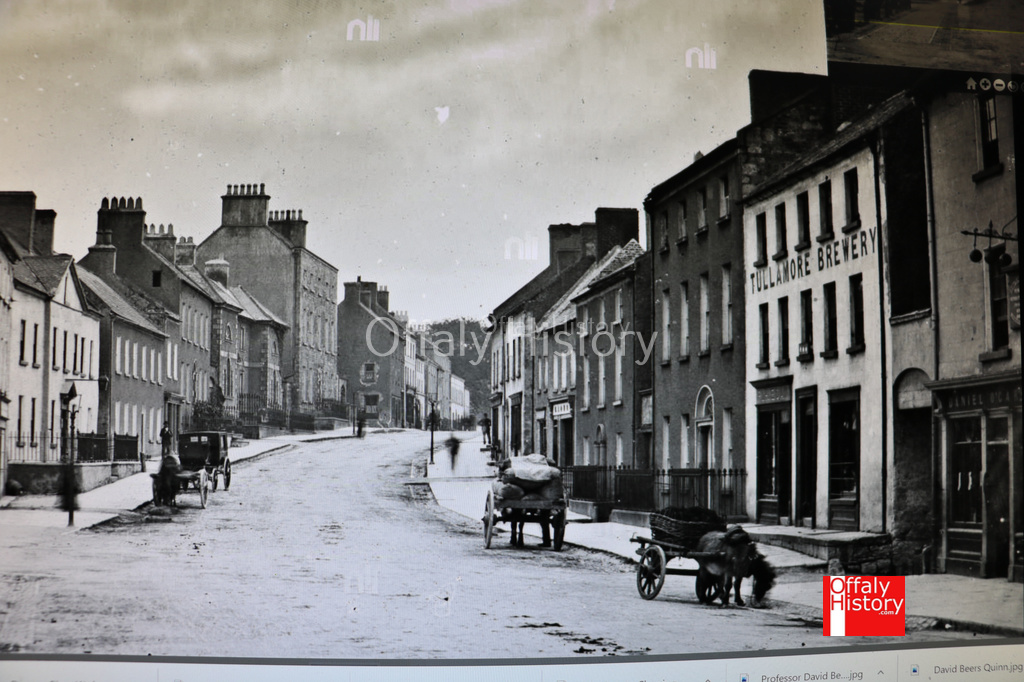
The former Hayes’ Cross where Boots Pharmacy is today was, and is, the centre of the town. Standing at the bridge in Bridge Street and looking south to where the Windmill hill was situated on the hill to the east of Cormac Street is to observe 300 years of development comprised of three and two-storey houses and no single-storey properties or ‘cabins’. The latter were reserved for the lanes, side streets and long gardens to the rear of these large houses. When Arthur Young passed through Tullamore in 1770 he remarked that part of the town was well built. T.W. Freeman, the well-known geographer, noted the firm ground on either side of the inconspicuous bridge and a slight rise northward to the canal, 203ft. above O.D., some ten feet higher than the river, and southwards to the courthouse, at 225ft. O.D. Tullamore (An Tulach Mhor) was anglicised from the dative form of the Irish name. John O’Donovan preferred the translation as signifying ‘a gentle sloping rise of ground’. This fits very well with the rise from the river to Cormac Street.
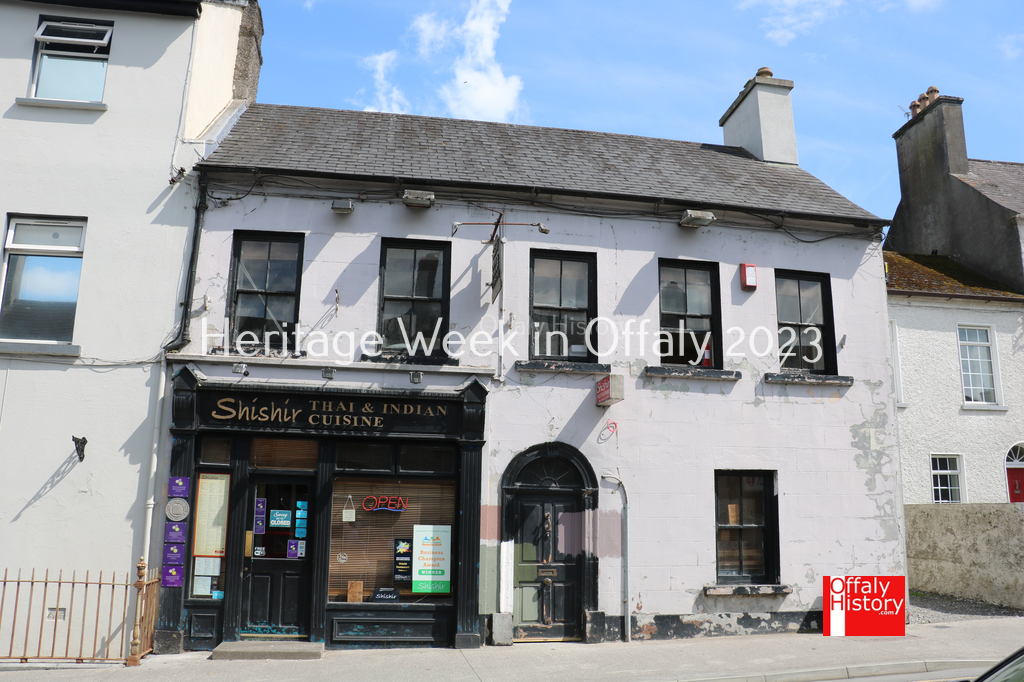
Near to the bridge at Bridge Street on the west side was the town watermill (behind what is now the Omyia pub) drawing on the power from the Tullamore or Maiden River. At the high ground behind O’Moore Street and Cormac Street was a windmill dating from the early 1700s. One hundred years later the building of High Street was almost completed having been a work-in-progress for eighty years.
High Street in the eighteenth century was from the bridge at the Tullamore River in Bridge Street to take in the western side of O’Connor Square and proceed to the large open space at the junction with O’Moore Street and Cormac Street. The way via O’Moore Street led to the windmills, Clonminch and the new cutting of about 1812 that provided a Bachelors Walk and access to the new St Catherine’s Church completed on the Hop Hill in 1815. Many have reasonably assumed that Hop Hill is the hillock the gives the name to Tullamore, but there is another view that the hill is that at the top of High Street and where up to two windmills were located from as early as 1715–20. O’Moore Street leads on to the Killeigh Road while that at Cormac Street leads on to the Birr road and the demesne of Charleville.
High Street in 1821 contained eighty-four houses and 543 inhabitants. As almost all the houses were built before 1821 and there were only forty-two in 1901 this would suggest that this calculation includes the houses in Bridge Street and sub-divided properties.
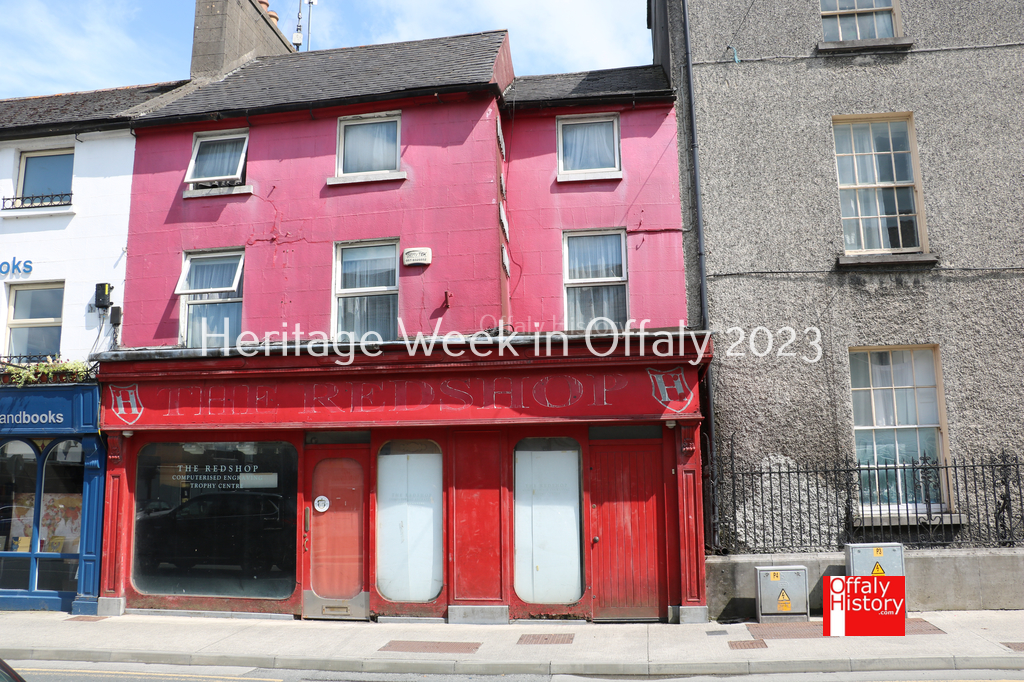
In 1901 High Street with a population of 225 had forty inhabited and two uninhabited houses and forty-one families of whom 158 were Roman Catholic, 50 were C of I, four Presbyterians and thirteen Methodists. The houses were all slated and stone-walled, twenty-six were placed in the first division and fourteen in the second. As to out buildings there were nineteen stables, five coach houses, three harness rooms, two cow houses, one calf house, one piggery and five fowl houses.
According to the census return for 1901 covering the properties only from the Presbyterian Church to Conway & Kearney and from the former Mary Dunne’s (Griffith Valuation – GV 49) to the former Motor Works (GV 29) were 40 occupied dwelling houses with five unoccupied.
Thirty of the properties had servants or assistants living with them, 11 none and five not stated (no. 19 was subdivided). Most of the servants were young girls and all were Roman Catholic with the exception of Curate Craig who had a Church of Ireland servant. There were no male domestic servants but there were male and female assistants in the business and living with the owners. Dr Moorhead in GV 33 (now the main house in the Direct Provision Centre) had a live-in midwife. The wealthy families had live-in nurses for the children. The street had two hotels, with Hogan’s (GV 16, now part of the Town House bar) the smaller, and catering mainly for Catholics, while the larger, Colton’s (GV 48) had mainly Protestant clients.
The returns for the 1911 census equating to GV 5 to GV 49 High Street) had 207 occupants and forty-two buildings of which four were not used as dwellings. Of the occupied houses twenty were in the first class and sixteen were in the second class. There were no single-storey or thatched residential properties or third for fourth class properties. Twenty-one of the houses were private dwellings and the rest mixed use or non-residential. Twenty-two houses had servants or staff living in. This figure was down by eight on that of 1901. The population of the street had fallen by only eighteen since 1901.
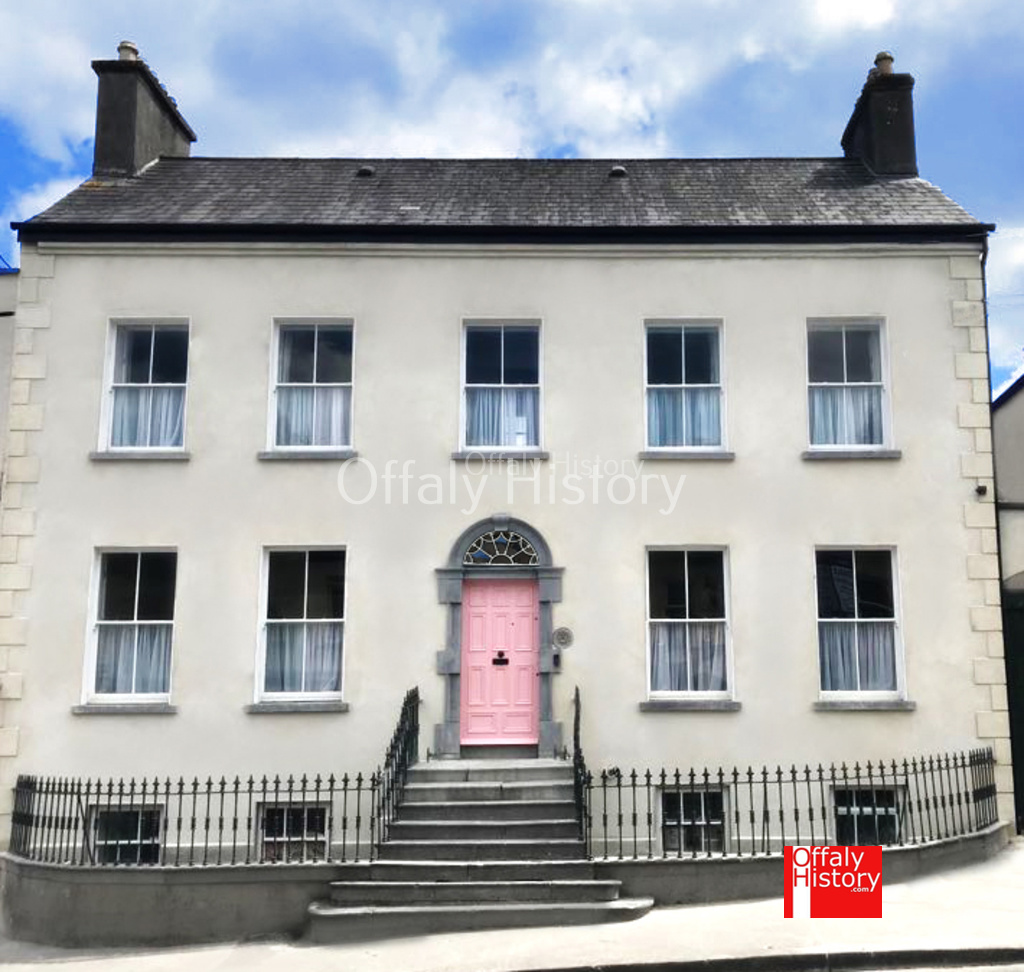
The number of Roman Catholics in 1911 was 146, Church of Ireland 42, Presbyterian 12, Methodist 5, Others 2.
In Summary
Table 1: The number of houses in High Street in 1821, 1901 and 1911 from the census returns
| Year | No of houses inhabited/vacant | No of inhabitants | Class of House in 1901 and 1911. None thatched. First class | Class of House in 1901 and 1911. None thatched. Second Class |
| 1821 | 84* | 543 | ||
| 1901 | 40/2 | 226 | 26 | 14 |
| 1911 | 39/3 | 208 | 20 | 16 |
- Including the later Bridge Street and GV 1–4 High Street. Source: Published abstract of the census for town of Tullamore; the manuscript returns for the 1901 and 1911 censuses. Online from NAI.
More next week on the evidence from leases since the 1720s

 offalyhistoryblog