
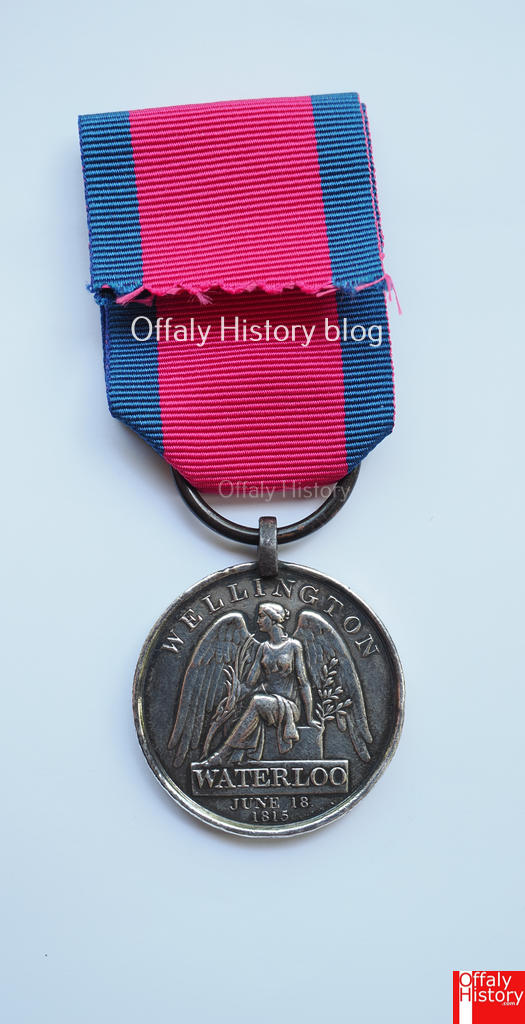
208 years ago, the Battle of Waterloo took place in Belgium. The armies under the command of the Duke of Wellington defeated Napoleon, putting an end to the Napoleonic Wars, which had begun in 1803. To mark the victory and acknowledge the men that fought at the battle, a campaign medal was decided upon by the House of Commons. Rather than given for acts of bravery, it was given to all those involved in the campaign. Similarly, other counties in the coalition issued medals of their own, however the medals issued by the British were named to the recipient, making it possible to trace them. In today’s post, we will look at one of these Waterloo medals, which was awarded to Private John Dargin of the 54th Regiment of Fo
John Dargin was born near the parish of Kilbride or Tullamore. He enlisted in the British Army on 6 May 1812 and was a labourer. Assuming he would have been around 18 years old at the time of his enlistment, this would place his birth around the 1790s.
The 54th Regiment of Foot was formed in 1755, and had seen service during the American Revolution, the French Revolutionary Wars, the campaign in Egypt and Syria and were deployed to South America during the Second Invasion of River Plate.
At the time of John’s joining the regiment, the Napoleonic Wars were in full swing. The regiment was based in Stralsund, which was part of Swedish Pomeraina. They remained here until they moved to Belgium in June 1815. During the Battle of Waterloo on 18 June, the regiment were held in reserve as part of the 4th Division. Later in the month they stormed the French town of Cambrai. The town would act as the headquarters for the Duke of Wellington and the British Army of occupation from 1815 – 1818.

In 1819, the 54th were sent to South Africa, where the participated in the 5th Xhosa War. The Xhosa wars were a series of conflicts in the Cape where European colonists fought against the native Xhosa people. The regiment further went to India in 1822, although at the time India was under the thumb of the British East India Company.
The period between 25 October – 24 November 1823 shows Private Dargin was in the regimental hospital. The entry for the following month shows that he died on 31 December 1823. While no cause of death is listed, it can’t be hard to imagine the climate and or disease had its part to play, and not just with the death of Private Dargin, but the death of many a man on foreign service in places with hot and tropical climates.

The pay roll for the month of John’s death, lists his sister Mary as his next of kin. It is fair to assume that any money he was owed and possessions, including his Waterloo medals went to her. Nearly 200 years after Private John Dargin’s death, it is quite possible that last physical tangible connection to him, is his Waterloo medal.
 offalyhistoryblog