

About Garrycastle Coote wrote in 1801: The few demesnes of the gentry are highly planted and improved, but the remainder of this country is almost in a state of nature . . All the fuel of this district is turf, which is very cheap and plenty: the country is intersected with very extensive bogs . .[1]
[110 This country is thickly inhabited on the eastern side, but towards the Shannon it is wild and barren, and not populous. Very few gentry reside here, and their numbers have been diminished since the rebellion [of 1798]. The Rev. Doctor Mullock has improved a large tract at Bellair, where he resides; he has, literally speaking, planted with his own hands every tree in his demesne, which consists of forest-trees of all kinds. They had long to combat with a very bleak and exposed situation, but they are now naturalized, and in good vigour, lying very high; they give a great appearance of wood to this part of the country.
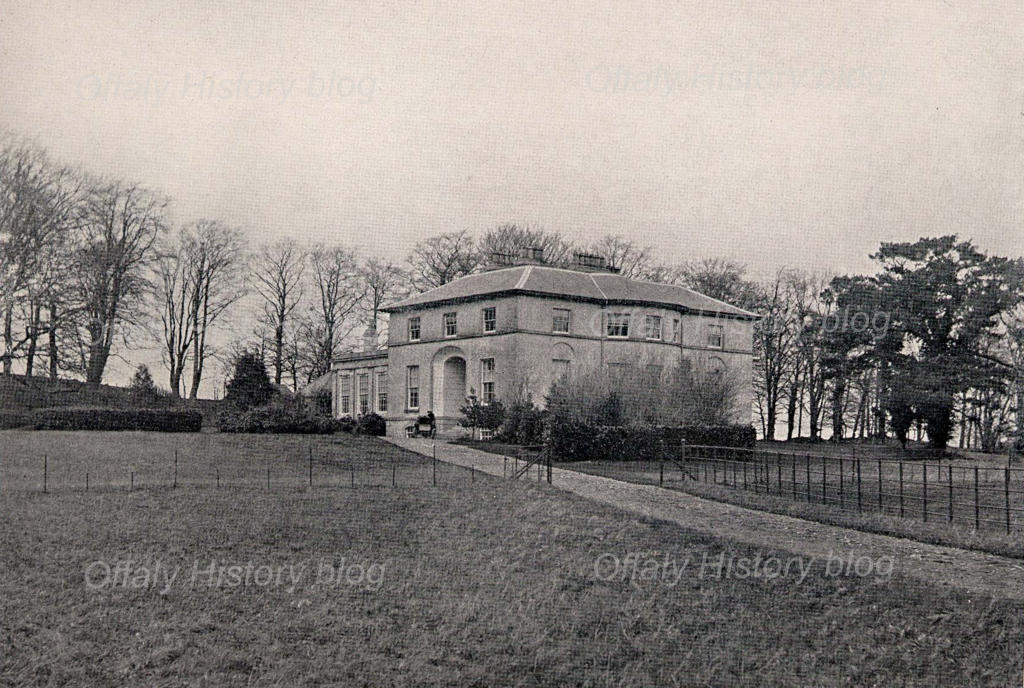
Thomas Mullock, Esq. son to this gentleman, is now building a very neat village adjoining Bellair: this word is only a modern modification of Ballyard, its true name, which signifies the high town; it consists of about fifty houses, built with stone and mortar, and all slated roofs, which will be only inhabited by linen manufacturers, to whom this gentleman gives employment. The plan of this little village is very correct, and, in its intended police, neatness, and cleanliness must be strictly observed. The whole model is not inferior to the small manufacturing English villages. The linen manufacture is rapidly and steadily encreasing, and this village is likely to be of consequence, from the industrious exertions of its proprietor. [111] In this neighbourhood are mill-sites, and every advantage for any branch of manufacture; but that of the linen is most eagerly pursued; the people seem better disposed to engage in this than agriculture, which accounts for the number of small farms, as each family tills little more than supplies their provisions. If the Linen Board should be pleased to furnish wheels to this little colony, ’tis presumed it would have the happiest effect, as the poor would be better employed, and idleness is not their characteristic. Since the discontinuance of wheels, many have wanted employment; and here is a considerable quantity of flax spun, which they rear at home, and manufacture into dowlass and coarse linen.
The few demesnes of the gentry are highly planted and improved, but the remainder of this country is almost in a state of nature. Mr. Holmes has a very extensive bleach-yard, and a large capital in the trade, which was very spiritedly carried on till the late rebellion, but it is intended to be again pursued. Firbane is a town in this barony, situate on the river Brosna, fifty-four miles from Dublin, near to which are the ruins of Kilcolgan and Cool[e] Castles: it has a patent for a weekly market, but no market is held; it is on the estate of John Henry, Esq. The country immediately around it abounds with the richest landscapes and finest prospects, and near to it is the beautiful demesne of Galen [sic], the seat of J. Armstrong, Esq.; the Brosna winds under this demesne, through the most charming and fertile banks, and, with the fine plantations here, presents a scene of picturesque [112] and splendid beauty. The old castle of Garrycastle, from whence the barony is named, has very rich feeding-ground in its neighbourhood, and at Cuba, a seat of Denis Bowes Daly, Esq., the parks are rich and luxuriant. but this engaging scene is soon lost; when you pass Banagher, all is a wild, barren, and uncultivated waste; under this description, Kor Hill is very conspicous.
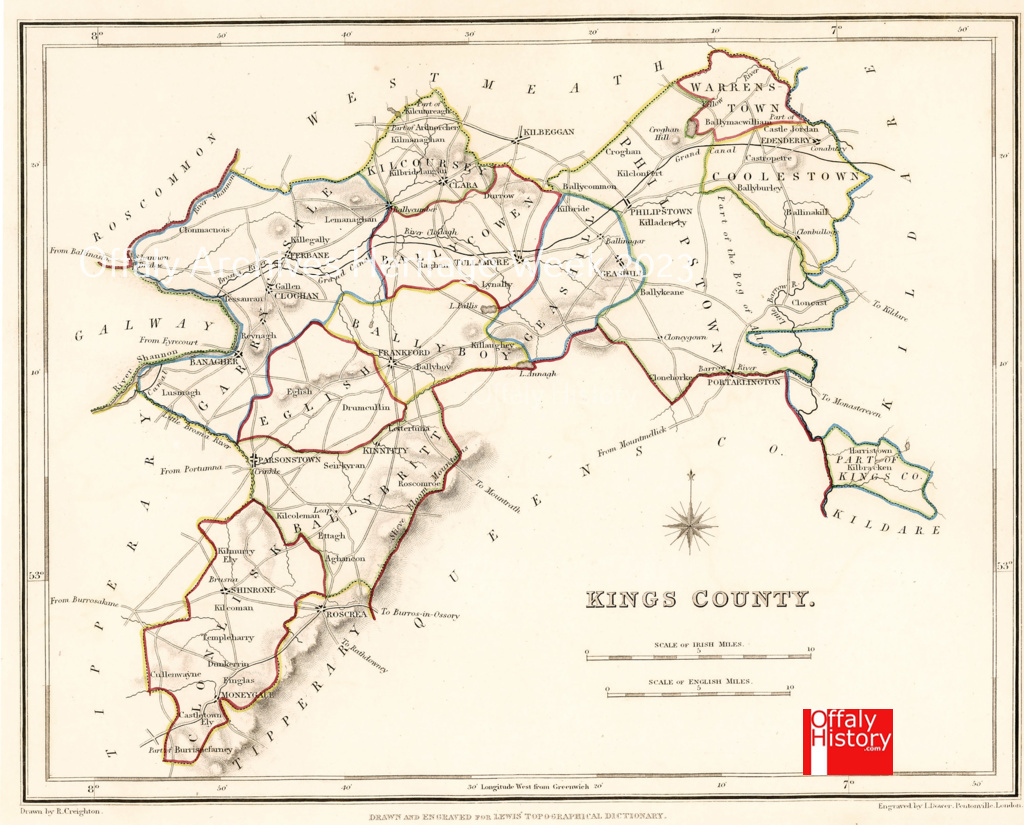
Banagher is a good town, and well inhabited; it is situate on the banks of the Shannon, and is the western extremity of this county, and also of the province of Leinster; as here, beyond the river, is that of Connaught. At this side of the bridge are the barracks for two companies of foot, and, at the other side, is a castle, which commands the town, with the adjacent country towards Connaught, and was well situated to defend this important pass: it is distant sixty-six miles from Dublin, and formerly sent two members to parliament; the Holmes family had a patronage of the borough. The banks of the Shannon, just adjoining, are richly clothed with meadow, but all insulated, and of a wet season, in a very precarious state. In Banagher are a distillery, brewery, malt-house, and tan-yards. The country shops are well supplied, and an inconsiderable branch of the linen manufactory is carried on here. There is also a school, with an excellent endowment; some hundred acres are annexed to it, said to be well worth 200l. annually, and those lands are now become a sinecure set, during the interest of the proprietor; but no school business at all attended to, as I am informed.

[113] Cloghan is a village of midling appearance, four miles to the east of Banagher, and sixty-two from Dublin; it is on the estate of Denis Bowes Daly, Esq. and is remarkable for an excellent inn. At some distance are the ruins of a church, and near Moystown, the seat of Colonel Lestrange, are those of Streamstown Castle. This country abounds with ruins of castles, which were in possession of the O’Coghlan clan, almost all of which have Latin inscriptions over the entrance, which shew they were erected in the reign of Queen Elizabeth.
All the fuel of this district is turf, which is very cheap and plenty: the country is intersected with very extensive bogs. The constant food is potatoes, and oatmeal is used generally in spring. Coarse friezes rate at about 2s.6d. per yard, and stuffs at 8d. Price of wages, from 7d. to 10d. per day through the year. Cottier’s house, garden, and cow’s grass at no regular price, but generally regulated by the benevolence of their employers. Doctor Mullock’s cottiers pay but 20s. for a cow’s grass; the like for house and garden, and have turbary free.
Beer increasing in demand, as spirits are declining, and is had tolerably good zz from Moat, in the county of Westmeath. Roads but in very midling repair. Soil every where light, and of limestone gravel. There have been no mines yet discovered, but they have many chalybeate springs, nor is there any marle found, or clays of calcareous quality.
There are some valuable eel weirs on the river Brosna, and some near Banagher, which are the property of the inhabitants [114] of this side of the river. These weirs are evidently very injurious to the bottom meadows, and throw up a considerable quantity of back water. No other fishery here of individual property, but all kinds of the finest fresh-water fish are in this part of the Shannon, in the greatest abundance. This river is here navigable, and boats of burthern pass from Killaloe to the county of Leitrim, generally laden with slates, from the quarries in that district; and sometimes they are also freighted with corn. Farmers complain of want of encouragement; their leases being generally set but for twenty-one years. All Dublin bankers paper, and little specie, are in circulation. At Ferbane are the bolting-mills of Wm. Hone, Esq.[Horne]; at Lumpcloon, now called Mill-brook, are those of Dennis Cassin, Esq.; and at Moystown are those of Edward Lestrange, Esq.; they are all well supplied with corn, and of considerable powers. No nursery for sale in the barony; trees are had from Galway and the Queen’s County nurseries. No timber of any account for sale; building timber had from Limerick by the Shannon navigation.
The village of Shannon Bridge is small, and noted for having the best stone bridge over the Shannon: it has a patent for four fairs, and a weekly market; it is on the estate of Colonel Lestrange, and here is a very conspicuous pass into Connaught.
On the banks of the river, and on the confines of this county and that of Westmeath, in a very wild country, stand the ruins of the seven churches, called Clonmacnoise, of Cluainmacnois, which signifies, the retreat or resting [115] place of the sons of the chiefs, or the cemetery of the nobles or kings. This place was famous for having entombed the ancient Christian monarchs of this country; …
[117] About six miles from hence, and in this barony, is the small village of Ballicumber; and near a mile beyond which, is the parish church, situate on a hill. This village is fifty-two miles from Dublin.
Raghera is a very inconsiderable village, but remarkable for an excellent bridge over the Shannon. There are several ruins of old churches in this barony, and, indeed, are very numerous through the county, which has occasioned the union of several parishes, as will be shewn in the latter part of this book.

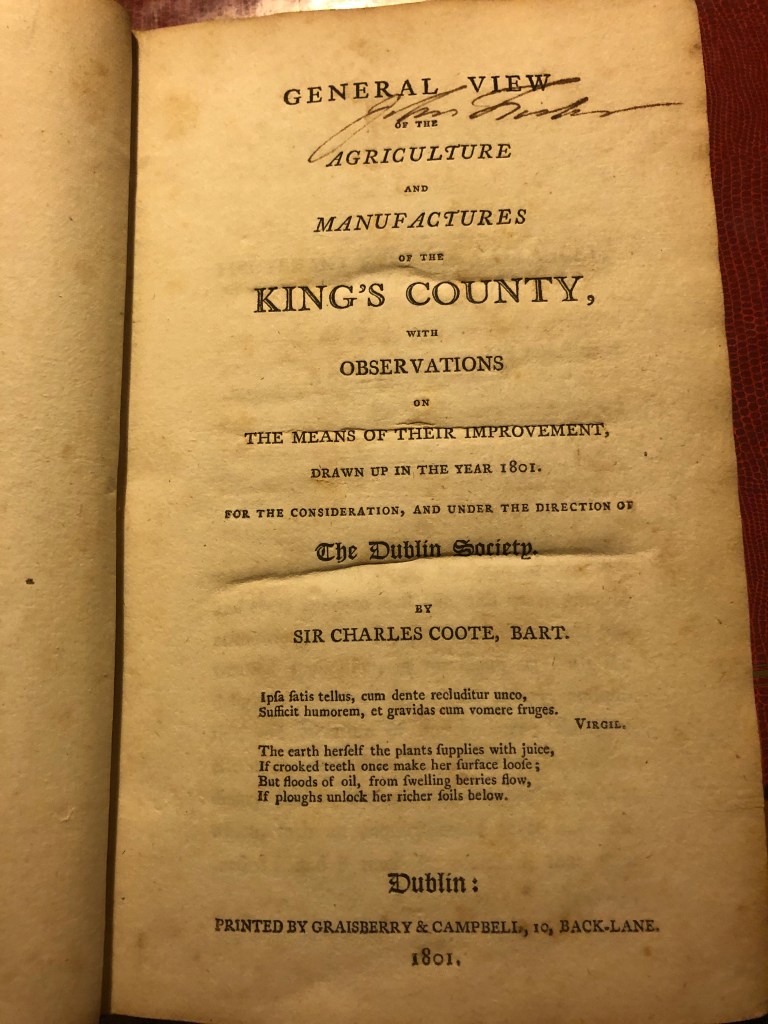
[1] Charles Coote, King’s County Survey (Dublin, 1801), p 111.
 offalyhistoryblog