
Urban Design ‘The design of buildings, groups of buildings, spaces and landscape’
Early Efforts
The purpose of urban design is to create attractive and enticing public environments through the use of harmony, proportion, rhythm, art, unity and vistas. Urban designers treat towns and cities as artefacts whose appearance and civic life can be improved by the application of aesthetic devices .
In the late 18th and early 19th century these principles played an important role in the evolution of Tullamore. The laying out of O’Carroll Street and the fine terraces of Church Street and Bury Quay as well as the alignment of Patrick Street to frame the gate of the Barracks were all considered urban ensembles.
In 1950 the great town planner Frank Gibney used urban design as a key determinant in his suggestions for the evolution of the town centre. A tree lined promenade would focus on the spire of the Church of the Assumption which would itself stand as the centrepiece of a public garden. Harbour Street would be extended westwards into a spacious new public plaza. A busy formal market square would greet visitors arriving at the railway station and bring them via a green park into the heart of the town. The imposing facade of the Courthouse would become the culmination of a grand new avenue.
Gibney might have provided pictorial or three dimensional images of what these dramatic interventions would look like and which might therefore have garnered public support. But he didn’t and his ambitious plans were rejected.The attractive Clontarf Road housing and the prominent line of canalside poplar trees are the sole reminders of what might have been.
Urban design in 20th century Tullamore
Following the introduction of statutory planning in 1963 such deterministic three dimensional urban design visions were rarely pursued and most Irish planning authorities adopted the pragmatic approach of using their development control powers to extract civic improvements from otherwise unwilling applicants.
A good example of this approach is the delivery of New Main Street in Tullamore which was developed in 2001. Though it had long been an objective of the Council to provide a link to the Western Relief Road, no three dimensional plans of how the released lands might be developed had ever been advanced.
In contrast to the American style internal mall model of the adjoining Bridge Centre with its extensive surface car park, the Council urged a more urban approach and persuaded the developers to provide their mixed use and retail proposals in the form of a traditional street with a continuous facade and with car parking hidden behind in a multi-level form. A public square was provided together with a pedestrian bridge across the river, though its linkage to High Street across the private car park of the Bridge Centre later proved problematic.
This model of private bargaining with developers in the absence of a publicly ratified framework plan was less successful in the case of the large vacant Tesco/Texas site behind Colmcille and Patrick Streets. An agreement on a unified urban design approach between its two owners proved unachievable and in the end both pursued their own individualistic visions and a valuable urban design opportunity was lost.
Ad Hocery
Many would argue that this case by case approach has generally worked and that for the past sixty years Tullamore town centre has got on very well without any coherent statutory vision for its central area.
Shopping centres and business parks were built, new apartment blocks arrived and lots and lots of convenient surface parking was provided. The result might have been what some town planners refer to disparagingly as ‘developer led’, but it brought growth and progress. The Town Council consolidated the success by accessing EU and Government funding to deliver the Lloyd Town Park, the part pedestrianisation of O’Connor Square and bridges over the river and canal.
However, all of these projects, both private and public, were essentially stand alone responses to an expectation of profit or to funding streams available under disparate programmes. There wasn’t any apparent relationship between the individual projects and it is fair to say that the Council’s plan was not to have any plan but to exploit individual opportunities as they arose.
But in the years following the property crash of 2008 it began to become clear that this model no longer worked. Large areas of the town were now empty and unused, dereliction and vacancy were spreading while traffic congestion was increasing. Above all, the enormous potential of the Grand Canal Harbour still lay hidden and inaccessible behind its high walls as it had for over two hundred years.
Meanwhile central Government policy was changing rapidly. The commitment to achieving net zero carbon emissions by 2050 would inevitably mean fewer private car journeys, more greenery and the reuse of existing buildings and infrastructure. A new policy of ‘Town Centres First’ had been introduced to curtail the edge sprawl of towns into the countryside while making their centres more attractive and liveable by providing safer cycle and walking routes to schools and shops. More town centre housing and the conservation of existing stock was encouraged.
As the private sector had little incentive to deliver many of these projects, local authorities would have to take the lead within the context of an overall vision whose objective was to reduce emissions.As the country was now rich, finance would flow- but only to well considered and detailed schemes.
So, for the first time in its history, Tullamore had to make coherent and unified plans for its centre.
New Plans
Two separate but interlinked plans have now emerged from a process of survey, analysis and public consultation.
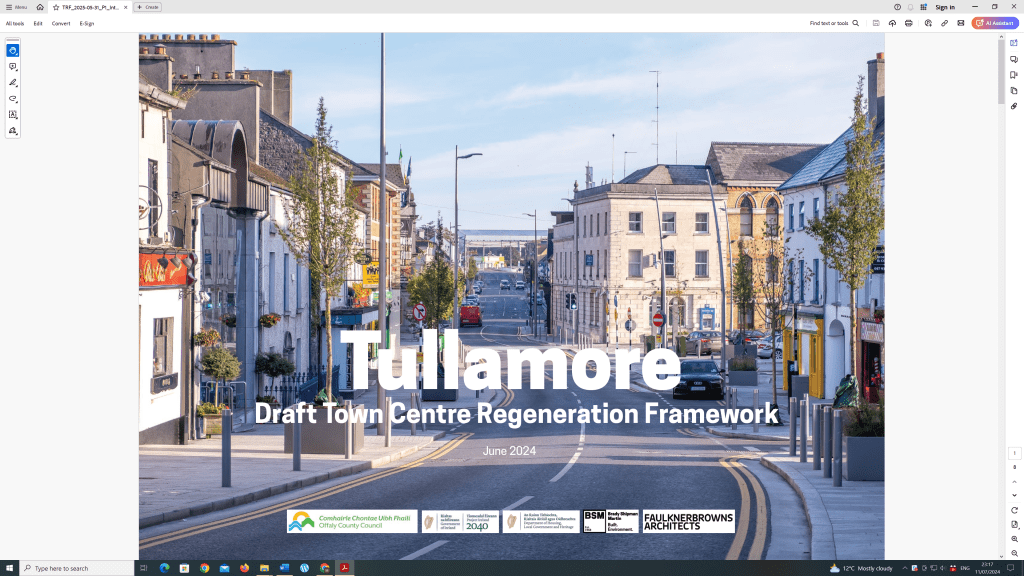
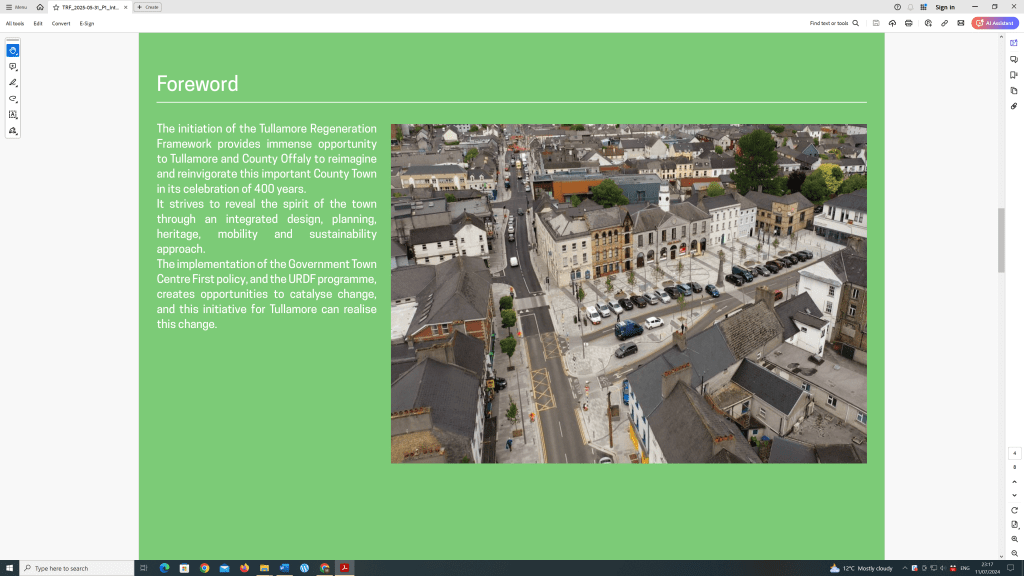
One, described as an Urban Regeneration Framework, makes suggestions for the early stage renewal of key vacant sites around Tullamore town centre and ties them together by pedestrian/ cycle paths. The other provides a Masterplan for the development of the Harbour and sets out possible short term amenity uses and a longer term mixed use scenario.
The common aim of both plans is to create attractive public spaces and to demonstrate through illustrations and models how these will enhance the appearance and vitality of Tullamore.
Urban Regeneration Framework
The team chosen to deliver this project are the Dublin based town planners and landscape architects Brady Shipman Martin who have a long association with Tullamore having delivered the award winning Lloyd Town Park. For this project, BSM has teamed up with the internationally known UK urban designers FaulknersBrown.
The team have identified projects which can respond to government town centre policies and are therefore likely to attract funding. Preliminary layouts and three dimensional studies have been prepared to show their feasibility and qualities. These include:
- Proposals-mostly housing- for the development of the nine vacant ‘Opportunity Sites’ in the town centre
- A continuous and linked safe route for cyclists and pedestrians uniting the schools, town centre and recreation with the outlying suburbs and facilitating visiting cyclists arriving by the Greenway..
- Opening up public walks along the riverside to capitalise on the ‘Living River’ project.
- Identifying, conserving and reusing the towns valuable architectural heritage
- Introducing extensive new planting to enhance the urban setpieces of the town.
Grand Canal Harbour Masterplan
The redevelopment of the Harbour for waterside amenity was proposed in the very first Development Plan for Tullamore fifty seven years ago and has dutifully appeared in every Plan since then without any concerted attempt to achieve it.
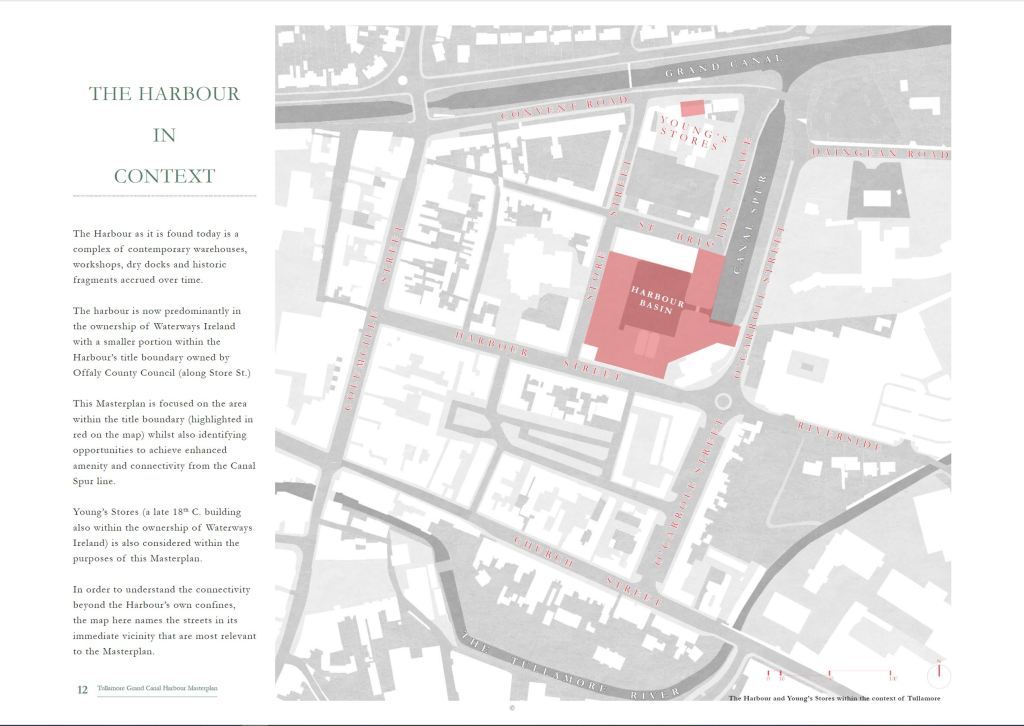
The County Council and Waterways Ireland have now joined together to advance the project and in a moment of inspiration, commissioned Grafton Architects who arrive laden with honours from Lima, Milan, Toulouse, London and Venice to explore it. That one of its principals, Tullamore born Yvonne Farrel, is now tasked with reimagining the Harbour adds piquancy to the appointment.
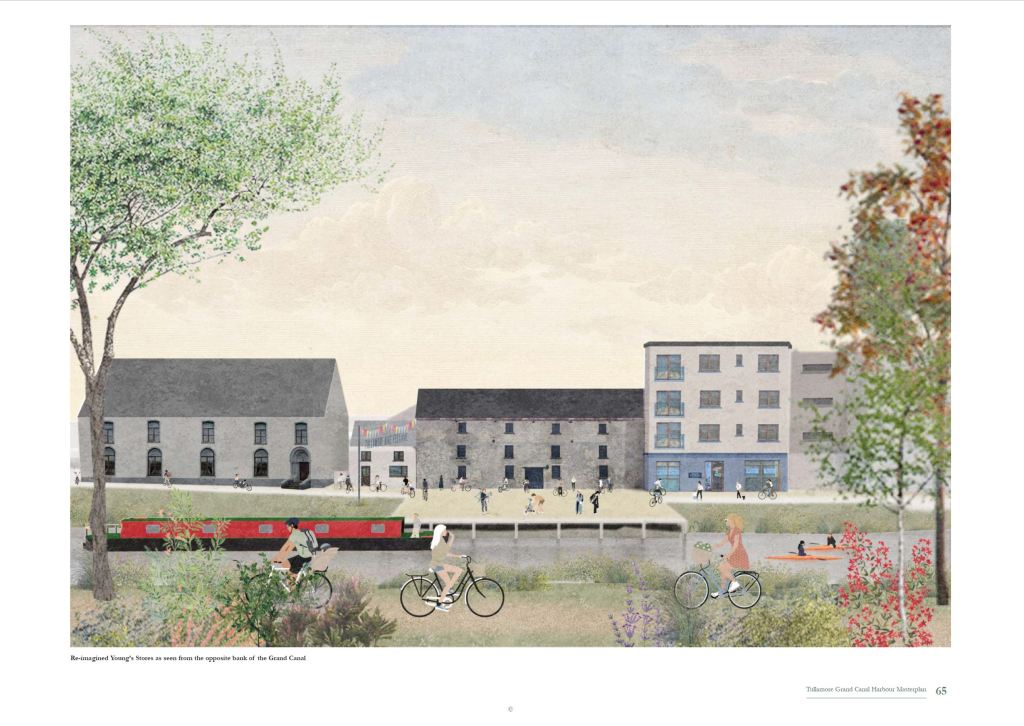
Grafton’s plan will open up the Harbour to the public and provide for extensive water based amenity opportunities in its early stages. The nature and extent of further development will depend on future, and as yet unknown, opportunities. However, it is expected that a building of significant architectural quality will dominate the entrance to the Harbour from the Spur canal line.
In a secondary but related project, the 18th century warehouse known as Young’s Store on Bury Quay will be conserved and reused for tourism uses and allied to a new canalside deck.
The Road Ahead
Both schemes are presently the subject of a public consultation process.The projects outlined in the Urban Framework Plan will probably need to be formally ratified by the local Councillors before they can be progressed further. A new and complex exercise will then begin as the Executive ensures their inclusion in appropriate funding programmes or assists private developers in delivering them.
In the light of the current housing supply crisis, some of these projects may arrive relatively quickly. The overriding purpose of the Harbour Plan on the other hand is to stimulate a public debate around the future of this unique amenity and will take longer to progress.
Even after agreeing basic design principles there will still be a tough road ahead to resolve ownership issues, planning and environmental procedures, site remediation, investment streams and finally initiating and completing an extensive building programme. It is suggested that a ‘Working Group’ be assembled to advance this very ambitious project.
But by engaging top rank professionals who have obviously taken this project of re-imagining our town to their hearts, a very good start has been made. Should their visions be delivered in the spirit and ambition of their stimulating initial proposals, Tullamore may well advance in time to the front of the Irish urban design class.
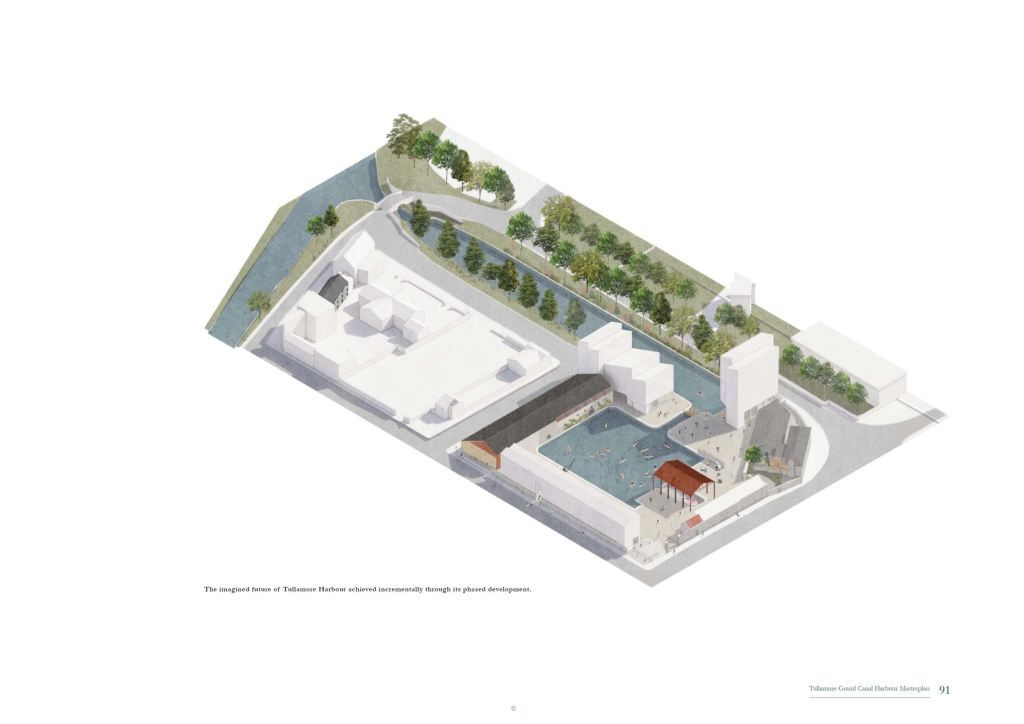
Thanks to the architectural teams involved. Much to be considered. The images above are drawn from these plans with thanks and both reports are available in full online. (editor)
 offalyhistoryblog