
My paternal great-great grandfather was James Corcoran (c. 1801 to c. 1848), a tenant farmer/freeholder who, in the mid-1820s, had dominion over approximately 44 acres (current measurement) in the townland of Crissard in County Laois. At that time Crissard was often referred to as “Cropard,” with numerous variations on the name since. “Crissard” appears to be the official townland name, although local residents today favour “Crossard.”
In 1823 James married Elizabeth Conlon. Elizabeth was almost certainly from either Crissard or perhaps from one of two adjacent townlands; Wolfhill or Kellystown. Below is a cut-and-paste record from the Ballyadams R.C. Parish marriage records identifying their February 5, 1823 marriage. Note “Cropard” as the place name.



James and Elizabeth would go on to have six children between 1824 and 1846; Margaret, Mary, Frances, William, Honora and Patrick. A long gap between the birth of fifth child Honora in 1833 and sixth and final child Patrick in 1846 initially had me wondering if I had the “right” Patrick but all was quickly confirmed upon locating the baptism records for the children, all confirming the parents as James Corcoran and Elizabeth Conlon.
Aside from the Tithe record and baptism records for James and Elizabeth’s first five children, the next credible record(s) that I find of James are at least six newspaper entries in the Leinster Express between 1839 and 1842 where James, along with numerous other County Laois (Queens at that time) residents were seeking the right to vote. I never determined if James secured voting rights.
Following the early 1840s newspaper references, James appears in the record of son Patrick’s March, 1846 baptism. This is the final written reference to James. Then, in 1850, we find Elizabeth Corcoran in the Griffith’s Valuation records living as head-of-household in the townland of Shanbagh (Shanrath today), two miles to the east of Crissard (see below). The 11-shilling valuation of her residence suggests fourth class housing, an indication that she may have been living in mud hut poverty, as were seemingly most of her immediate neighbours.
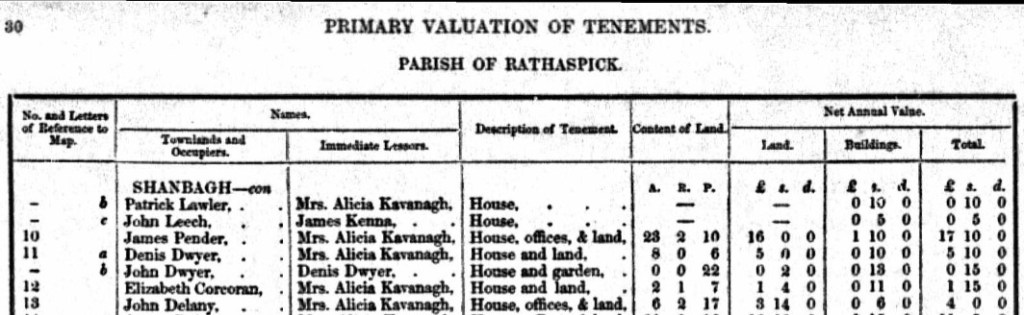
I have little doubt that this is the correct Elizabeth Corcoran, owing in large part to the landowner listed for Elizabeth’s residence; one Alicia Kavanagh, a resident of nearby Wolfhill. The connection between these two women was likely tied to Alicia owning the land in Wolfhill on which the Roman Catholic Chapel of that time was located, which was almost certainly the church where my Corcoran ancestors would have worshipped.
Remains of the original Wolfhill R.C. Chapel, the ruins of which are found in present day St. Mary’s Church Graveyard

James disappearance from the records after 1846 and Elizabeth’s subsequent appearance as a head-of-household in 1850 strongly hints that James died during this four-year period, which not coincidentally was the time of the Famine.
The Famine, and likely the death of James, triggered emigration of three and quite possibly four of the Corcoran children, including my great-grandfather William Corcoran who departed for New York in 1850, one year after his sister Frances Corcoran left for New York in 1849 and one year prior to sister Margaret (Corcoran) Knowles emigrated to New York in 1851; classic Irish “chain immigration” on display! There is strong circumstantial evidence that sister Honora Corcoran followed suit in 1852, although definitive proof is teasingly lacking.
I was able to trace the lives of William, Frances and Margaret until their deaths in New York. Frances, the first to emigrate, arrived in New York City, married another Irish immigrant named Patrick O’Brien, and remained in Manhattan until passing in 1895. More interestingly, William Corcoran and Margaret (Corcoran) Knowles relocated to Clinton County in the northeastern corner of New York State, both eventually landing in the rural Crissard-like town of Beekmantown, on the same road, just two houses/farms apart. Another Knowles, Patrick Knowles, the older brother of Margaret’s husband Dennis Knowles, lived on and farmed the property between William and Margaret’s; a little cluster of Crissard emigrants living in an environment in which they likely would have taken some comfort. Other Irish immigrant families surrounded the Corcoran/Knowles clan; families with surnames such as Conroy, Kearney, Mullen and Golden.
Margaret’s life in New York was sadly marred by two events. The first was the death of her and Dennis’ two young Irish-born children, Mary and Michael Knowles, both of whom died in New York City during the six months that the family lived there before relocating to Beekmantown. The second tragedy was the passing away of Margaret herself in 1861, at age 37. Brother William did not purchase his land in Beekmantown until 1863, so he was never reunited as a neighbor to his sister, although they did live in the same County for 10+ years, which no doubt allowed for close interaction.
William would marry another Knowles, Catherine Knowles, in 1869 (see St. James Church record below – “Knowles” is misspelled as “Noles”). Catherine was the Beekmantown-born daughter of Patrick Knowles and a niece of Dennis Knowles, further tightening the Corcoran/Knowles bond in Beekmantown. But in another grim twist, Catherine would die in 1871, only 10 days after giving birth to her and William’s second child and daughter, Anna Corcoran.

William quickly remarried in 1872 to Julia Kilroy (later “Gilroy”), Clinton County-born daughter of another Irish immigrant couple from County Cavan; Patrick Kilroy and Alice Keenan.
William and Julia would have one child, my grandfather, John Corcoran, in 1877. Upon William’s death at his Beekmantown home/farm in 1904, John inherited the farm where he would follow in William’s footsteps for over two decades, before losing his 300+ acres of land to the economic scourge of the Great Depression.
John Corcoran (c. 1900)

John would marry Margaret Dowd, with the couple going on to have four children of their own; my father Francis Corcoran, Mary Corcoran, Ruth (Corcoran) Martin and Florence (Corcoran) Tusa. The direct line Corcorans, including my brother, sister and I would remain in Beekmantown until 1975, at which point my father was transferred to Albany, New York for work, resulting in my siblings and I all dispersing after marriage, but all still making our homes in upstate New York.
My brother and I each have a son and daughter, with both of our sons living in upstate New York, ensuring at least one more generation of Crissard-origin Corcorans leaving their footprints, however small, in the same geographic area as our Irish immigrant William Corcoran.
 offalyhistoryblog