
Acres Folly
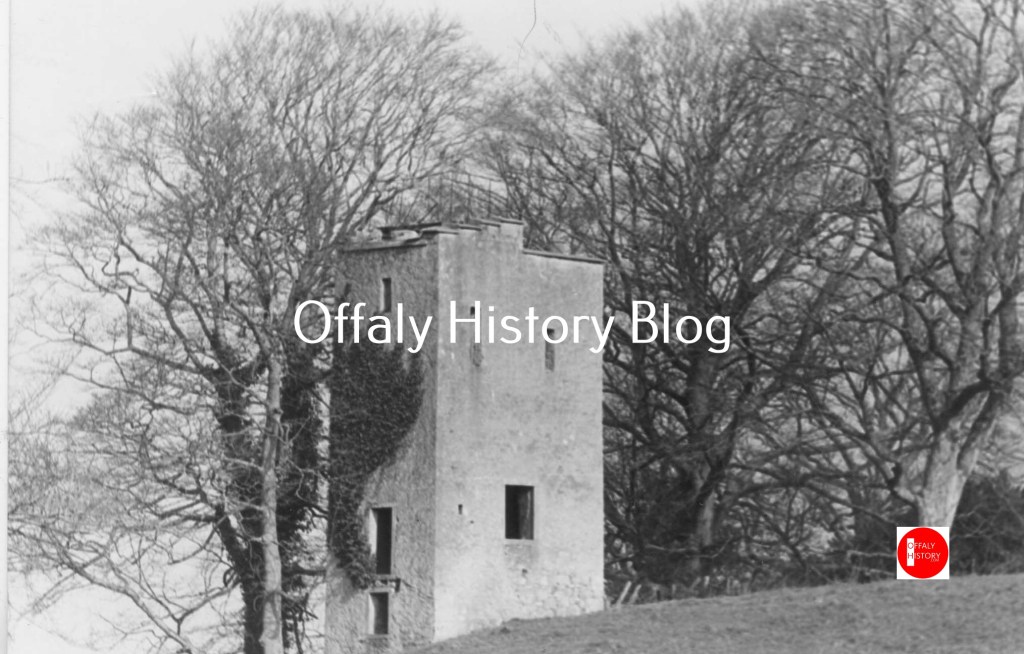
Wellington’s victories in the battles in the Peninsular War were celebrated by Thomas Acres by the erection of the folly or tower in the garden of his private house at Acres Hall. This is now the Tullamore Municipal Council building and the garden is in part used for parking. The entire Acres development in Cormac Street west was based on the 1790 Kilcruttin Hill lease. The folly has been largely restored in 2020-22, but the part of the hill that was removed to facilitate more council parking ought to be replaced. In time perhaps the entire garden and folly could be incorporated into the town park.
The tower/folly is a three-storey building with a vaulted ground floor, rendered walls and the handrail at the third storey. The vaulted ground floor is for the most part intact, but the other floors have been destroyed. Part of the handrail on the third floor still survives. There are two chimney stacks on the north side. The main entrance was at the second floor. A stone (now covered over) has inscribed on it various battles associated with the Peninsular War. Acres had reason to be thankful because a lot of his wealth had come from the military build-up in the midlands and elsewhere to head off a possible French invasion.

The Town Park
What is since 2006 known as Lloyd Town Park (after the Lloyd family of Cormac Street) was also part of the Acres Estate and comprised of some twelve acres and was sold by public auction in September of 1891 to John Lloyd for £145 and held on the long lease from the predecessor of Charleville Estate Company for an annual rent of £30. No doubt for most of the nineteenth century these lands comprised part of the town parks or fields of Acres Hall. This was so by the 1850s when George Pierce had 12.5 acres in Kilcruttin townland held directly from the earl of Charleville. Prior to that the town park lands were held by several occupiers from the earl.
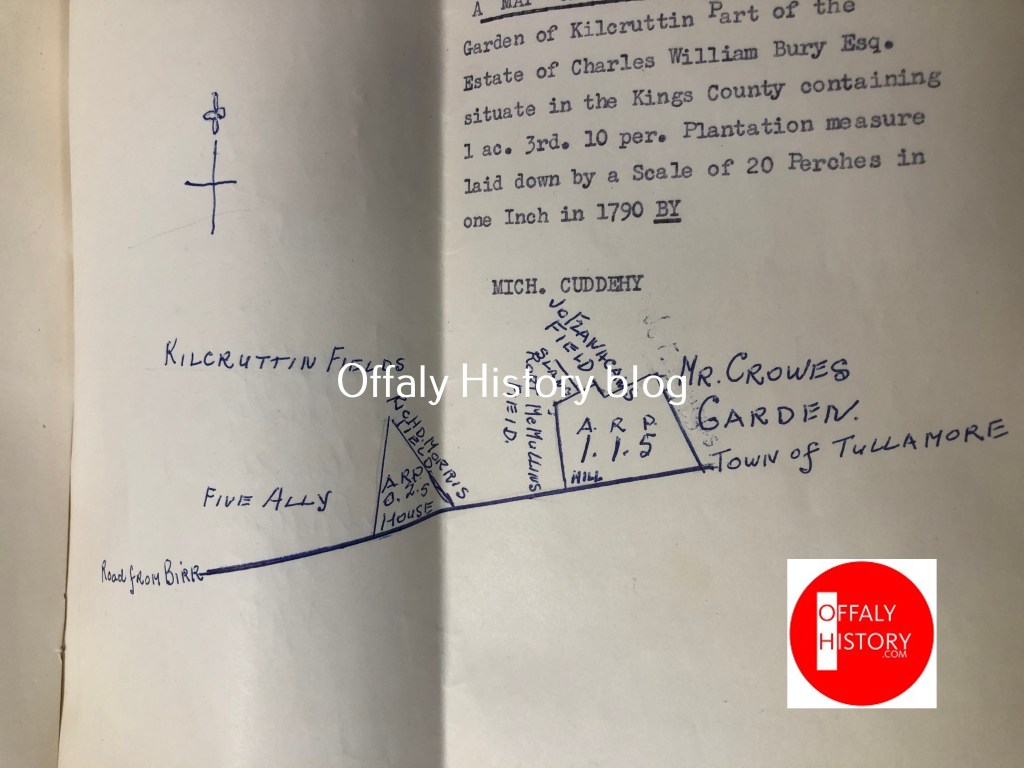
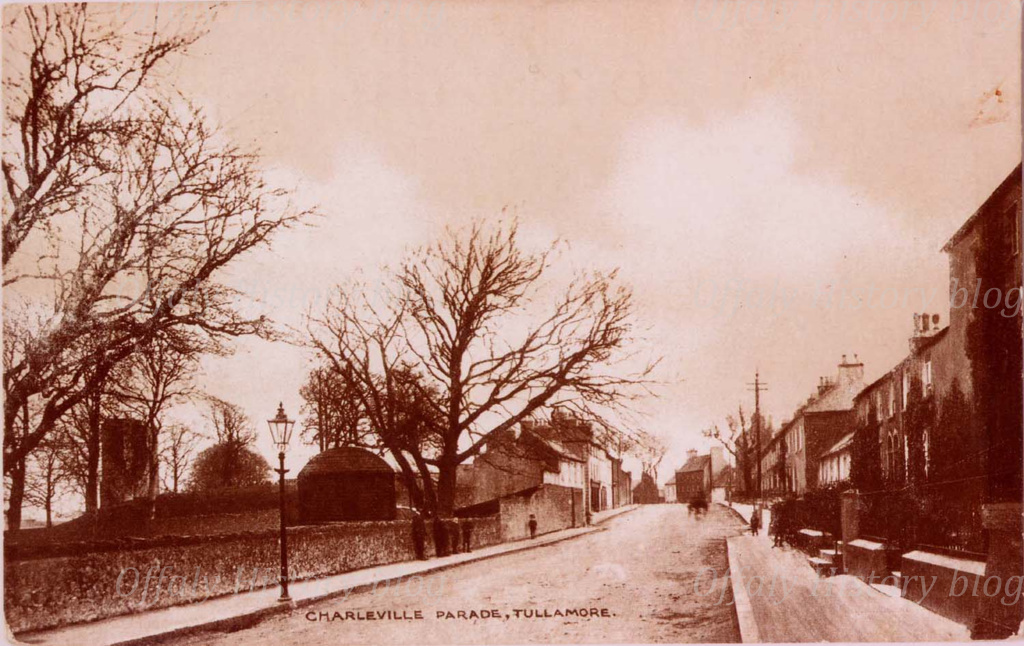
Things might have been different had the lands been better drained because in the 1830s the second countess of Charleville produced a sketch plan for a crescent of fine houses here to be in the view of the new courthouse. Apart from the drainage and the nearby graveyard this was also a time when demand for housing had greatly reduced. Nothing further is heard of this proposal although it should be said that Victoria Terrace proceeded in 1837-8 as did the terrace of houses in O’Carroll Street.
The town park lands were sold in the 1960s by the Lloyd family to Irish Shell and B. P. Limited, who then applied for permission to locate a filling station there. Tullamore U.D.C. decided to revoke this permission and the company appealed this decision to the Minister for Local Government (An Bord Pleanala was not established until 1976). The grounds of the revoking of the permission (which had been obtained over five years earlier and not acted on) was that a filling station would be injurious to the amenities of the area which was instead recommended as a public open space. At the time the field was considered as a possible location for a new indoor heated swimming pool or a site for a home for the aged. Offaly County Council later acquired the property and planned to use it as a site for a new fire brigade headquarters. At the same time, arising from a 1977 needs survey by a local group of enthusiastic young people, Junior Chamber Tullamore, it was suggested as a location for a town park and a submission made to the county council in 1981. Subsequently, the proposal was put to Ruari Quinn, as a minister in the coalition government of the early 1980s and he gave moral support to it. The new park was approved as a special youth employment scheme project in 1982, and consultants Brady, Shipman, Martin appointed in 1983. Many of their recommendations save the ‘adventure area’ and band stand were acted on. The band stand arrived in 2024. By 1987, some £210,000 had been spent in labour, mainly in developing the new park. The park was developed almost entirely under the Y.E.S. /S.E.S. employment schemes. Included in the ‘clean-up/improvements’ was the old Kilcruttin graveyard adjoining the park.[1]
While the story of the town park goes back to the early 1980s it benefited from a totally new design and make-over in 2007-8 which has put it into great shape. The new park was designed by Murray and Associates, landscape architects, who were also responsible for town parks in Carlow and Roscommon. For the first time the park is now widely used by adults and children for leisure activities. The opening to the park from Main Street and Marian Place provided real connectivity and indicates what might have been possible had the park opened to Bridge Street and possibly to Patrick Street. Nonetheless it is a great success and a significant achievement for the Tullamore Town Council. Earlier efforts off Callary Street in the 1930s were halted by the Second World War and the need for more housing. The 1960s effort at Kilbride Street beside the canal was successful as far as the improvements to the old quarry and canal bank were concerned but did not succeed as a children’s playground for very long, largely due to lack of funds to develop it to a high standard, together with the building of more houses despite the advice of Gibney as town planning consultant in the 1940s and 1950s.
Kilcruttin Cemetery
Kilcruttin cemetery is located off Cormac Street and close to the boundaries of what is now Scoil Mhuire. Indeed, the original access lane and entrance to this cemetery is still to be seen and now forms part of the school grounds. It is the oldest cemetery in Tullamore town and dates back to the 1700s. At one time it was on the outskirts of the town and in a soft poor ground close to the Tullamore river. It was not the cemetery of choice for the upper ten in Tullamore, but nonetheless has some very good monuments including that to the Methodist merchant Burgess and the German baron Oldershausen of the King’s German Legion, the heroes of Waterloo. Out of Kilcruttin came no less than three new cemeteries, that for ‘paupers’ on Ardan Road in 1852 and the Sleeping Ground for largely Protestants at Clonminch in the same year. Forty years later the new Catholic cemetery at Clonminch (in Spollanstown townland beside Collier’s Stream) was opened and first in was M.F. Gorry of the well-known news agency.
How old is Kilcruttin?
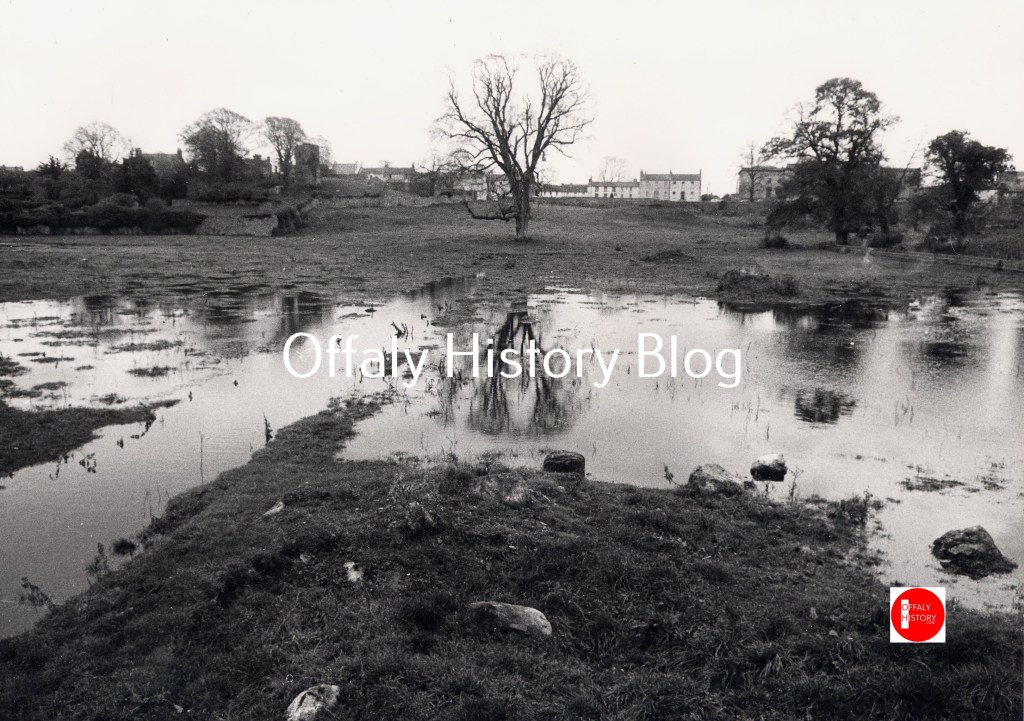
Was there a church at Kilcruttin and is it an early site? There is little or no evidence of any remains there at the time of the first ordnance survey in 1838. Yet curiously Canon O’Hanlon included the place in his Lives of the Saints even providing an illustration. Was it conjectural or actual? It is surprising that it is not mentioned in the ordnance survey letters if any such historical traditions or building remains survived. It is not known when people first began to be buried here but the earliest known gravestone dates from 1770 and the latest was in the 1850s. Most of the people buried here were members of the Church of Ireland or Methodists. Catholics were generally buried at the older Catholic sites at Kilbride, Durrow or Lynally and only in Tullamore when the Clonminch Roman Catholic graveyard was opened in 1893. However, the better off Protestants were also buried at the old graveyards near the town because these graveyards became the property of the Established Church after the Reformation. Families buried at Lynally included the Tabuteaus of 6 O’Connor Square and the Acres family of no 1 Cormac Street. Dr Piece and spouse were buried CofI cemetery at Clonminch. The cemetery at Ardan Road dates to 1852 and was for the use of the workhouse.

Kilcruttin was also used for the burial of the poor of whatever religion and as the burial place of those who died in the public institutions (except by execution) and is particularly associated with the victims of the Famine who were brought from the workhouse through the town for burial at Kilcruttin. As for the Moore family, the owners of Tullamore prior to the Burys and who lived in Tullamore from the 1700s to the 1750s, it may be that their burial place was beside the church erected in Church Street in the 1720s and in use until St Catherine’s was completed in 1815.
1,000 poor people buried there, 1848-52
Kilcruttin cemetery was officially closed in 1892. However, an attempt was made to close the place in the 1850s. In 1852 the then rector of Tullamore, the Rev. E. F. Berry, wrote to the responsible local authority, the board of guardians of the Tullamore union advising of the difficulties with Kilcruttin: and the second letter was written to the Board by Francis Berry, the agent for the earl of Charleville (the local landlord)..
The Rev. E. F. Berry to the Board of Guardians:-
I beg leave to inform you that within the last few days I have been inspecting the graveyard of Kilcruttin where the greater number of persons who die in the Tullamore Poorhouse are buried and I find that it is now so full that no more bodies can be interred without greatly endangering the healthfulness of the neighbourhood. In one corner more than a thousand paupers have been buried within the last four years, and according to Patrick Gorman’s return to me two hundred have been laid there within the past year. Under those circumstances I trust that the Board of Guardians will, as soon as possible, obtain a burial ground for interment of all paupers who die in the Poorhouse, as I trust as I must very soon, close Kilcruttin churchyard and prevent any more interments.” E. F. Berry, Glebe House, Tullamore. 30th January, 1852.
It seems clear from the letter that by this time no well-off Catholics or Protestants were using the cemetery for burial. The new cemetery at Durrow, beside the Catholic church, was opened in 1832 but no exclusively Protestant cemetery was available near the town. The large number of interments from the workhouse during the Famine years had made Kilcruttin unacceptable but there was the additional difficulty that no clear title was available to a new plot of ground until 1851 when the third earl of Charleville succeeded his father, who from the mid-1840s had lived largely in Berlin and had both mental and financial problems. The agent, Francis Berry, sent good news to the board of guardians in 1852. Berry advised the board that:
After one corpse gets Christian burial in this land you would not get a man for the fee simple of the whole townland to till it for agricultural purposes.
Lord Charleville had been informed that the churchyard at Kilcruttin cannot without great danger to the inhabitants of Tullamore, receive any more. Under these circumstances his Lordship has been looking out for proper places where the dead can be buried decently. He has fixed on one for the parish generally about a mile from the town on the Killeigh road and given it to the minister and church wardens at a nominal rent.
But this will not at all answer for the Poorhouse in consequence of its distance, and that the bodies should be brought through the town he thinks objectionable. He understands that the Board of Guardians were in treaty with the tenant in possession of land on the Kilbeggan road and only a short distance from the Poorhouse , for a small plot of land for a burial ground for the exclusive use of the Poorhouse. There is a lease of this land in existence of one old life; with his tenant’s right he cannot interfere but his lordship has directed me to inform the Board of Guardians that after the expiration of the present lease he will give this bit of land (he understands about one acre) to the Board for 6d. a year and make them the longest lease he can of this acre of land. He cannot make a lease longer than three lives but you will, I am sure, be of opinion that this is of no consequence for after one corpse gets Christian burial in this land you would not get a man for the fee simple of the whole townland to till it for agricultural purposes. Francis Berry, agent to the Earl of Charleville, 30th January 1852.”
Land was let by the landlord for three lives and when the three persons named in the lease died the lease had to be renewed and perhaps a higher rent paid by the tenant. The Poorhouse graveyard on Ardan Road is not now in use but the Church of Ireland cemetery at Clonminch is still used for burials. This cemetery was also used for the children born outside marriage to single mothers but no registers survive. This use may have continued until 1949 when an unmarked plot at Clonminch RC was made available for workhouse people who had no home place to be buried in.
Next blogs: the jail, courthouse, Wellington Barracks and east Cormac Street.

 offalyhistoryblog