
Undoubtedly, the history of Tullamore jail would make a book in itself for besides the mundane occurrences there were a few extraordinary events such as the imprisonment of some of those involved in the Plan of Campaign including William O’Brien and John Mandeville in 1887-88, the women’s suffrage prisoners in 1913, the Tullamore Incident prisoners of 1916 and, of course, the executions, the last in Tullamore being in 1903, and of a woman, Mary Daly. She was buried in quicklime in the precincts of the prison as were those before her. Perhaps no more than twenty from the 1830s. In 1936 the remains of these prisoners were reinterred in Clonminch RC cemetery according to a note in the Offaly Independent in 1962.[1] That may not be the whole story as Mary Daly was said to have been buried three times – the prison, Ardan and finally her home place in Laois.
Today we are reminded of the jail every time we stop at the lights at the junction with Kilcruttin and Charleville Road or emerge from the railway station. We can look to the magnificent limestone façade, the memorial tablet, the jail warders’ cottages and the very fine gates with their Roman fasces to remind us of the symbols of authority back to Roman times. The Gothic style was medieval, a great turreted structure from which there was no escape. Lord Tullamoore (1800–1851) would have liked to have the courthouse in the Gothic style also, but his Grand Jury colleagues insisted on the neo-classical. Some will have heard of the underground passage (now mostly closed off) that allowed the prisoners to be brought from the jail into one of the two semi-circular courts in the old pre-1922 courthouse and right up into the dock. None of this happened by chance and the building of the jail from 1826 and the courthouse in 1833–5 was part of the elaborate strategy of Lord Tullamoore to ensure that Tullamore secured its long-sought county town status over the historic mid-sixteenth century conferral of that honour on Philipstown or Daingean.
As mentioned in previous blog articles the houses on all sides of the jail and those on the approach near the courthouse were all part of a plan to ensure that these new public buildings were located in an attractive planned setting.
William Garner, in his survey of the architectural merit of Tullamore buildings, published in 1980, credited the remains of the jail as having regional status. He wrote:
The gaol was laid out on the radiating principle and had a huge castellated central tower. When the gaol was demolished in the 1930 [1937] only the front wall and gate-house were retained. The gate house has two crenellated towers flanking a lower, machicolated centre. Running away on either wide of the gate-house are high walls. Although the architect of the gaol is unknown, it follows the layout of the Limerick Gaol which is by James Pain. On the road is a battered wall topped by heavy railings similar to those in front of the Court House. The entrance gates have cast-iron piers in the form of Roman fasces.
Of the adjoining jail cottages Garner remarked:
To one side of the entrance is a row of two-storey houses built of rough-cut limestone ashlar with brick dressings, enclosed porches, eaves and dormer windows with pierced barge-boards. This attractive row dates from the mid-nineteenth century [in fact 1889]. [2]
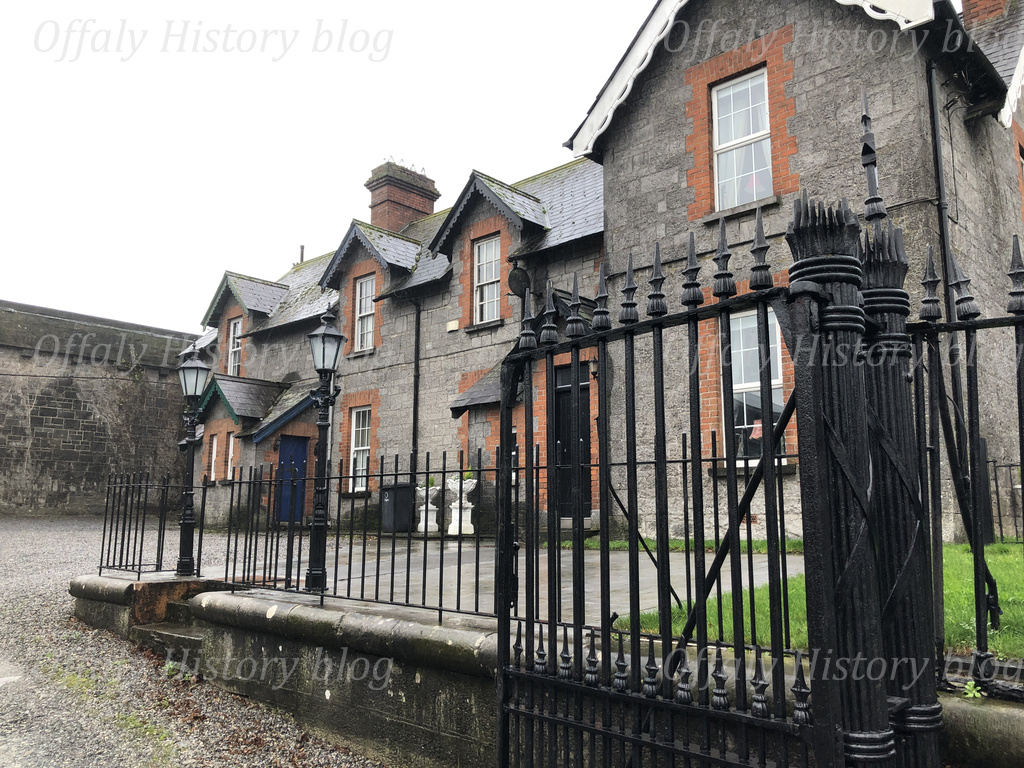
The battered wall and railings were a throwback to the medieval castles and ensured that no mob at election time (before the secret ballot in 1872) or that of a major trial would gain unauthorised access.
The more recent comments of Andrew Tierney in his Central Leinster talk of the fortress-like façade dominated by a formidable gatehouse of snecked limestone, the work after the style of James and George Richard Pain, but attributed on the jail date-stone to John Killay (Killaly).[3] Killaly was the well-known canal engineer who had strong connections with Tullamore since the construction of the canal to the town and his marriage to a miller’s daughter.
Although only the façade of the jail now survives it is one of the most impressive architectural features in Tullamore and makes for a striking and impressive structure as one takes a first view of it coming from the railway station. The façade was saved by the county engineer T.S. Duggan (1928–54) who wanted to ensure that the new Salts Woollen Mills did not detract from the county courthouse. The courthouse was rebuilt in 1927 following on its destruction on the same night in July 1922. There were, of course, no plans to rebuild the county jail as that in Portlaoise had been the subject of substantial investment from the 1900s and earlier, and there was no need for two in close proximity. The Tullamore jail was almost purchased in the mid-1930s by the Offaly Vocational Education Committee on the lookout for a site for a much-needed vocational school. It was the solicitor James Rogers (and the founder member of Offaly History) who advised CEO J.J. Horgan of the availability of the magnificent site at O’Connor Square where the new school (now the county library) was built in 1937. If the prison had not been burned perhaps Salts would not have opened in Tullamore and provided substantial employment for 44 years. Such are the vagaries of history.
The building of the jail is recorded on a memorial tablet over the entrance (see photograph):
‘The first stone of this prison was laid by Charles William Baron Tullamoore on the 13th day of September in the year of our Lord 1826 and in the 7th year of the reign of his Most Gracious Majesty George the Fourth. Commissioners Lord Baron Tullamore M P, Colonel Thomas Bernard M P, William Trench, John Head Drought, Valentine Bennett and Francis Berry Esquires. Engineer John Killay Esq., Contractors Henry, Mullins and MacMahon. John Rafter sculp’.
It was a member of the same R[W]after family who sculpted the War of Independence memorial in front of the courthouse a little over 100 years later. Another curiosity of history.
The Tullamore jail of which nothing survives now but its castellated entrance front took four years to complete. The jail was laid out on the radiating principle and had a castellated central tower where the governor lived (see photographs) and who could view all the corridors of the prison. When the jail was demolished in 1937 only the front wall and gate-house were retained. The gate-house has two crenellated towers flanking a lower, machicolated centre. Running away on either side of the gate-house are high walls. At Cormac Street is a battered wall topped by heavy railings similar to those in front of the courthouse and dating to its completion in 1835. The entrance gates for both buildings and the warders’ cottages (Jail Lawn, 1889) have cast-iron piers in the form of Roman fasces as already noted. While the inspiration may be the work of James Pain on other jails it does seem likely that the local detail was worked out by the noted engineer, John Killaly (not Killay as named on the plaque). Killaly was a well-known canal engineer with business interests in Tullamore where he was resident at least some of the time. He was certainly the overseer for the project and is named as the inspector of the works on a poster notifying the public of the laying of the foundation stone ceremony (see Offaly History blogs on John Killaly and the DIB entry).
The earl of Charleville leased the site at Cormac Street of over two acres for 999 years with a proviso for a lesser term of years if used for any purpose other than as a county jail.[4] Fortunately, the right of reverter was not exercised and Col. Bury conveyed the freehold to Salts Ireland at a later date. The site for both the jail and courthouse were reserved by the earl of Charleville for that purpose and were on the perimeter of the town, surprisingly on the road to the demesne and not on the Ardan Road where the workhouse was erected in 1841. In 1790 a site at William/Columcille Street was set aside for a sessions’ house, but was later used to provide an entrance to the new harbour street of 1799–1800.[5]
It is only from the late 1860s that prison registers survive for Tullamore in a run to its closing in 1921. These are available on Find my Past and in the National Archives.
An extended version of this article will appear in 2025 in Offaly Heritage 13.

[1] Offaly Independent, 21 April 1962.
[2] Garner, William, Tullamore Architectural Heritage (Dublin, 1980).
[3] Andrew Tierney, Central Leinster: the counties of Kildare, Laois, and Offaly (Yale, 2019),
pp 621–2.
[4] Offaly Archives, lease of 23 March 1826, Lord Charleville to Lord Tullamoore and ors [the commissioners for the new gaol].
[5] See the Pentland plan now in Offaly Archives – part of the lease of Pound Street from Bury to Acres in 1790; obituary notice of James Pain in Ir. Builder, 1878, p. 4; Irish architectural drawings: an exhibition to commemorate the 25th anniversary of the Irish Architectural Records Association (London, 1965), p. 15
 offalyhistoryblog