
Robert James Enraght-Moony was a native of Doon, King’s County. His father owned a large estate and was a Justice of the Peace and Deputy Lieutenant for the county. The Moony family has enjoyed a continuous history, stretching back over a thousand years, in Doon.
According to a profile of the artist in The Westmeath Independent in 1909 the family went abroad when Robert was about five years old. They travelled on the Continent, firstly visiting Eisenach, in Thuringia, Germany, where they lived under the shadow of Wartburg Castle, where Martin Luther was imprisoned. They then went to Dresden and stayed for about a year, and from there they went to Lausanne where Robert first began to take an interest in art. His mother, Angelina (nee Maunsell) used to take him with her when she went out sketching, and it was at her side that he received his first art lessons.
As he reminisced he remembered the great enjoyment he derived from his early pictorial scribbles of Lake Geneva and among the Alps. He also remembered the intense pleasure the wild Alpine flowers used to give him, and the wonderful times he and his siblings, spent in clambering about the rocks and woods and bathing in the icy pools of the streams. From his father, who was clever at carpentry, he learned a good deal which was useful to him in later years. From Lausanne, where the family lived for about three years, young Robert went to Algiers and after a period spent there, the family returned to Ireland, and he went as a boarder to Kingsley College, Westward Ho! in north Devon before attending Galway Grammar School.
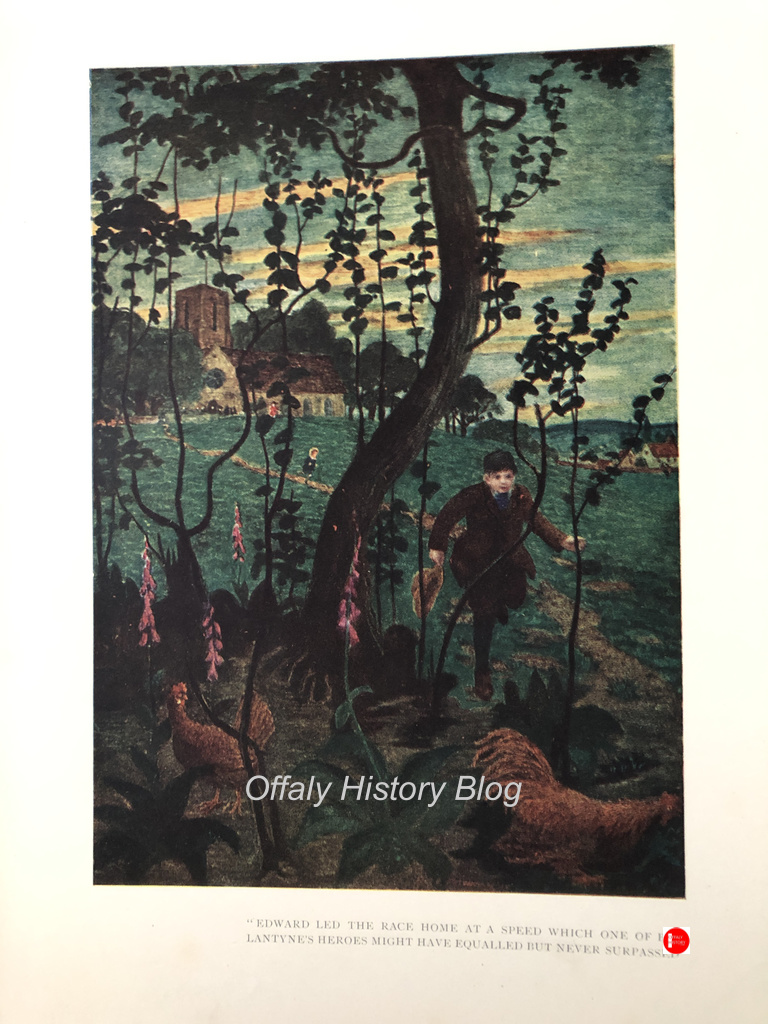
Robert left school early, and as he liked to carve he went to Burmantofts Potteries in Leeds, to try his hand as a modeller with the intention of becoming a sculptor. where he worked with the intention of eventually taking up sculpture as a profession. Instead of continuing his training he went to Paris in 1897 where he studied drawing and painting at Académie Julian until 1902. Soon afterward he exhibited his first picture at the famous Salon du Champ de Mars which had held its first annual exhibition in 1890. He then went on a prolonged sketching tour with a fellow student from the Académie Julian visiting Barcelona, Majorca, Venice and Verona before setting up home in London.
The correspondent for The Westmeath Independent in 1909 observed: “The style of painting that Mr Moony at present follows was not learned at Julian’s, but is the outcome of the decorative Arts and Crafts work he has done, as well as his keen admiration for the work of the Pre-Raphaelite School, notably the unrivalled work of Burne-Jones. His Academy picture of the year (‘The Poet and his Lady’) a water-colour, was hung on the line and sold on the opening morning. The Times gave it high praise.
There is no doubt that he was a very accomplished artist. Before he developed his own highly imaginative and individual style he worked quite successfully as a portrait painter. But it is as a landscape painter and as a painter and illustrator of mystical and romantic subjects that he is best remembered.
The Golden Age.
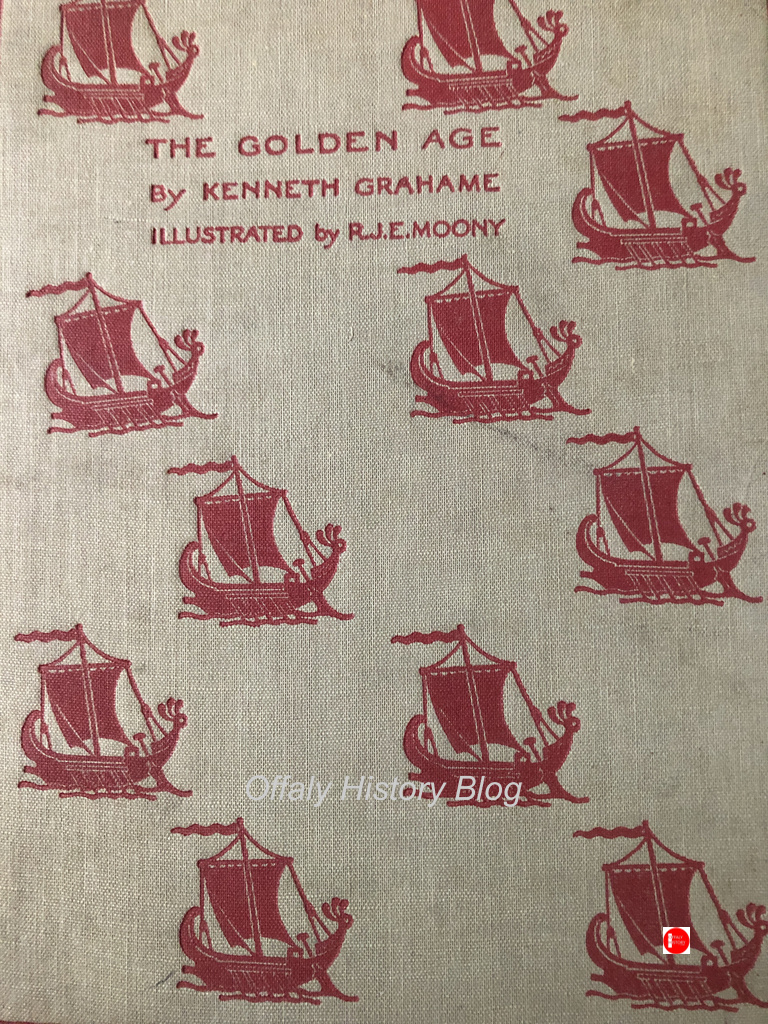
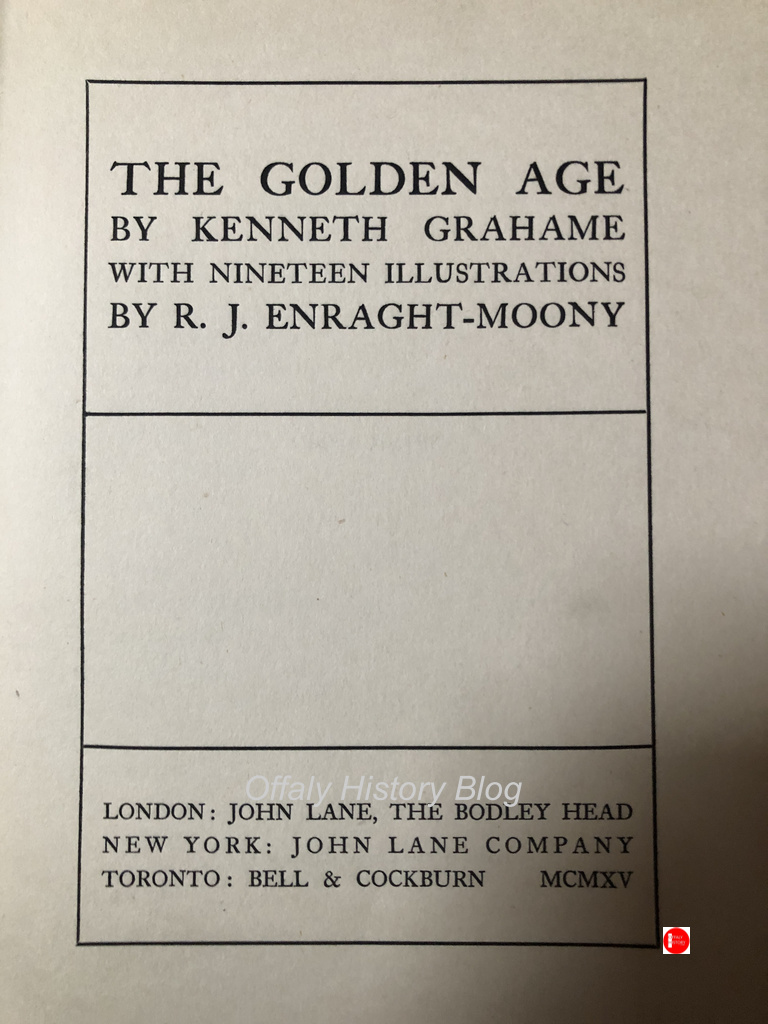
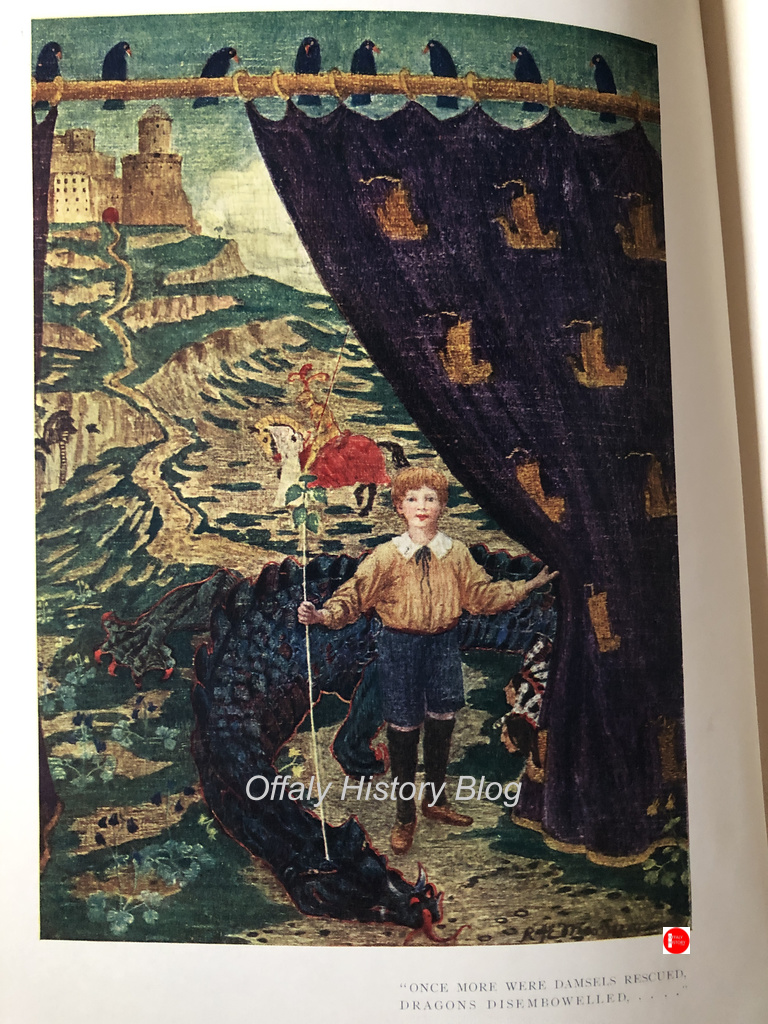
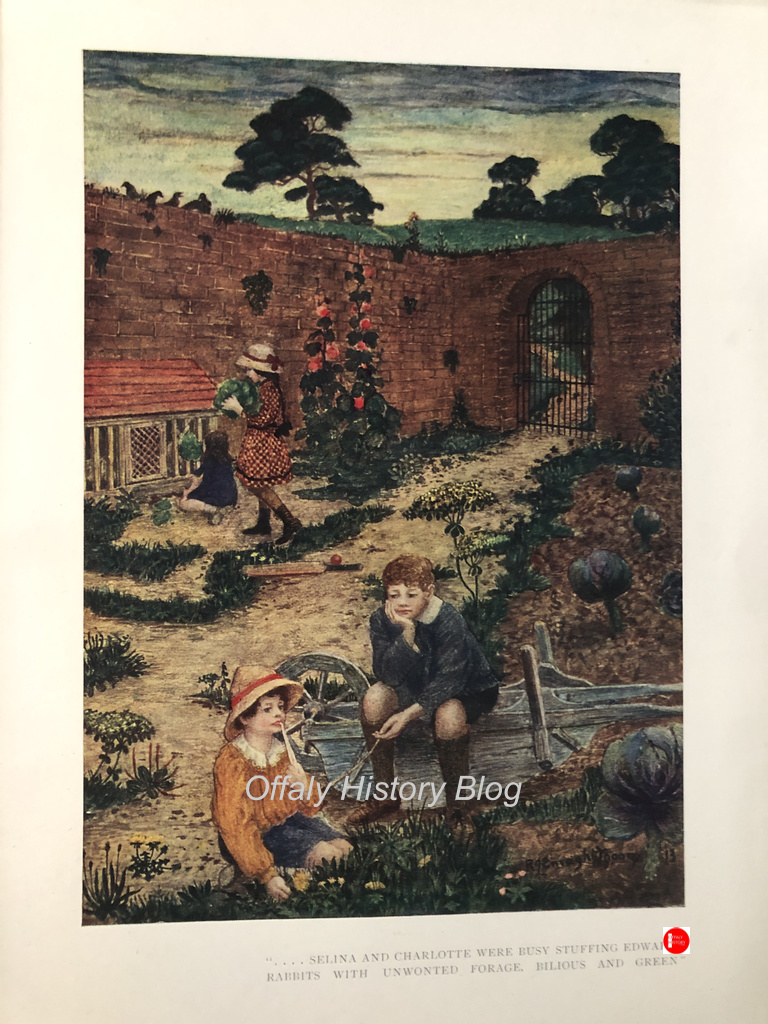
Kenneth Graham is best remembered for his book The Wind in the Willows which is perennial favourite while his other classic work The Golden Age has fallen out of favour. The Golden Age, first published in 1895, is a collection of Graham’s reminiscences of childhood. It is more a book about childhood than a children’s book. It blends elements of nostalgia, fantasy, metaphor and ancient Greek legends. The book adopts an Edwardian view of childhood as an innocent and separate world where adults are referred to as ‘Olympians’ “who have wholly forgotten how it feels to be young”. The earliest editions of The Golden Age were not illustrated, but the first edition to have full-colour pictures was that illustrated by Robert J. Enraght-Moony in 1915. His love of ancient legends and lore made him an ideal candidate to illustrate it and his Pre-Raphaelite style complemented the book extremely well. This book had nineteen full-colour illustrations and is still regarded as a fine example of the illustrator’s art.
Artist and Illustrator
A review in the Sunday Observer in 1934 of Robert’s exhibition at the Claridge Gallery in London captures the essence of his art and his inspiration: “Like all true Irishmen, Mr R.J. Enraght-Moony believes in fairies, and like all mystics and poets he lives in a land of dreams and legends…The world to him is a world of magic, peopled with spirit-like beings, which arise out of the morning mist or out of the dusk of night, play among the silver raindrops in the Spring, or dance among the gold-bespeckled meadows in the Autumn…”
We know that R.J. Enraght-Moony provided illustrations for various newspapers and journals including The Christian Science Monitor, but I have been unable to locate any other book illustrated by him.
Robert lived in London until 1927 when, after his marriage he moved to Cornwall where he had a summer house and lived and worked for the next eleven years, while possibly still retaining a London base. His first studio in Cornwall was ‘Chalcott Studio’ in Mount Hawke near Truro. He later had a studio in Chywoone Grove, in Penzance before settling in Newlyn. While living in Cornwall he was a member of the Newlyn Society of Artists, The St. Ives Society of Artists and the Sheffield Society of Art.
He first exhibited at the Royal Hibernian Academy in Dublin in 1903. He also exhibited at such major venues as Beaux Arts, London (where he exhibited 49 pictures); the Fine Art Society, London; the Glasgow Institute of the Fine Arts, Glasgow; the Manchester City Art Gallery; the New English Art Club, London; the Newlyn Art Gallery; the Royal Academy, London; the Royal Institute, London and the Walker Art Gallery in Liverpool. In all he had 24 paintings exhibited in the Royal Academy in London.
I recently came across the catalogue of The Second International Water Color Exhibition, Chicago in 1922 online. Among the other artists who exhibited in this exhibition were John Singer Sargent, Winslow Homer, Edmund Dulac, William Orpen and Arthur Rackham. Robert’s work was known and widely appreciated in America, his picture ‘The Kite’ was purchased by The Art Institute of Chicago.
When he exhibited at the Beaux Arts Gallery in the Autumn of 1933 the art critic for the Morning Post in London was very taken by his work. “Mr Enraght-Moony’s vision is troubled with the mysticism of Celtic dreams. He sees strange images in fairy-like landscapes haunted by the light that never was on sea or land…” But moving on to his more traditional landscape paintings he wrote: “But poetry is purer – that is, Wordsworthian, in his ‘Goon Vrea Pines, Cornwall’, ‘A Cornish Farm’ and in the exquisite ‘April’ [which are] painted with a refinement and exactitude never reached by the Pre-Raphaelites, except perhaps by Millais in ‘Ophelia’.
From 1938 Moony spent more time in London than in Cornwall, but according to his obituary in The Times he died in Newlyn on 5th March, 1946. His obituary in The Times described him as “A ‘Celtic’ Artist”. It went on to say that his art was “imaginative and romantic, delighting in complexities of line and a small brightness in colour, suggesting enamels.”
Offaly History adds:
He was educated at Galway Grammar School and Kingsley College, in Devon. Initially he studied modelling at Leeds but became dissatisfied with the limitations of the medium and abandoned it for paint. At Julian’s Academy, Paris he studied under Jean-Paul Laurens and Benjamin Constant. He then went on a painting tour taking in Barcelona, Majorca, Venice and Verona where, according to historian of Irish arts and crafts, Nicola Gordon Bowe, he appears to have come under the influence of the Italian Symbolist painter Giovanni Segantini, before returning to live in London.
After his marriage in 1927 he moved to live at Chalcot Studios, Mount Hawke, Truro, although he retained a London home and he exhibited with STISA at Lanham’s that same year. In 1936 he held a solo show at No 6, Piazza Studios, and a joint show with Ruth DAVENPORT the following year. He moved to Newlyn some eight years prior to his death in 1946, though he had exhibited at NAG sporadically since at least 1929, perhaps earlier.
media
Landscapes in tempera and watercolour, imaginative art, sculpture
works and access
Access to Works: Chicago Fine Arts
exhibitions
NEA (20); RA (26); RBA (55); etc.
Piazza Studio 1909, St Ives: One man show of 23 tempera works;
Lanham’s Galleries 1927;
NAG 1929 Summer: 3 paintings
1937 (with Ruth Davenport)
STISA, 1932, 1945 Touring Shows
memberships
NSA; Sheffield Society of Artists (Hon); STISA (1928-1946); RBA (1912)
references
Buckman (2006) Artists/Britain since 1945
Cornishman & Cornish Telegraph 10 Jul 1929
Hardie (2009) Artists/Newlyn & West Cornwall p242 (bibl)
Johnson & Greutzner
Tovey (2000) GF Bradshaw & STISA, Appendix 3: Principal Members of STISA (1927-1960); (2003) Creating a Splash
Whybrow (1994) St Ives (1921-1939 list)
The Doon was described in Burke’s Irish Country Houses:
Doon (The) Togher.
(ENRAGHT-MOONY / IFR). A square 2 storey house built 1798 by R. J. Enraght-Moony, incorporating a late 17th Century or early 18th Century house, which had been the dower house when the family lived in the old castle nearby. 3 bay front with single-storey portico; 3 bay side. (Irish Country Houses)
Georges Meares Stopford Enraght-Moony served as High Sheriff of King’s County in 1920 (a difficult time) and was succeeded by Charles Howard Bury in 1921. This was during the War of Independence, and instead of constabulary the assizes in both years was guarded by the military.
 offalyhistoryblog