
Polo traces its origins to the game of Chovgan, an equestrian team sport played by the aristocracy of the Persian Empire. It spread across Asia evolving along the way. By the 1400s it had arrived in India, supposedly introduced during the Muslim conquests of the subcontinent. During the Mughal period polo was dubbed the ‘Sport of Kings’ and the emperor Jalal ud-din Akbar introduced a set of rules governing the sport in the 1560s. In 1859, British soldiers and tea planters serving in India established the Calcutta Polo Club and the game was quickly introduced to Britain. When Carlow hosted Ireland’s first polo match in 1872, the local press referred to it as ‘Hurling on Horseback’. A year later the All-Ireland Polo Club was founded, with its grounds at the Nine Acres in the Phoenix Park. In 1875 the Hurlingham Polo Committee in London drew up a set of rules which would shape the polo in the century which followed. In the same year polo had migrated once again and in time the scions of Argentina’s richest families would establish that countries position as the global powerhouse of the game.
Polo in King’s County would make it home at Sharavogue, a venue with a long history of providing a base for the county’s aristocratic sportsmen. The estate had stabled the well-known race horse Freeney, named after the 18th century highwayman James Freeney. The horse’s owner colonel John Craven Westenra served as a Whig M.P and his lands played host to the amalgamated Kings County and Ormond Hunts. Westenra’s relation Lord Rossmore died from injuries received in a fall at a race in Windsor.

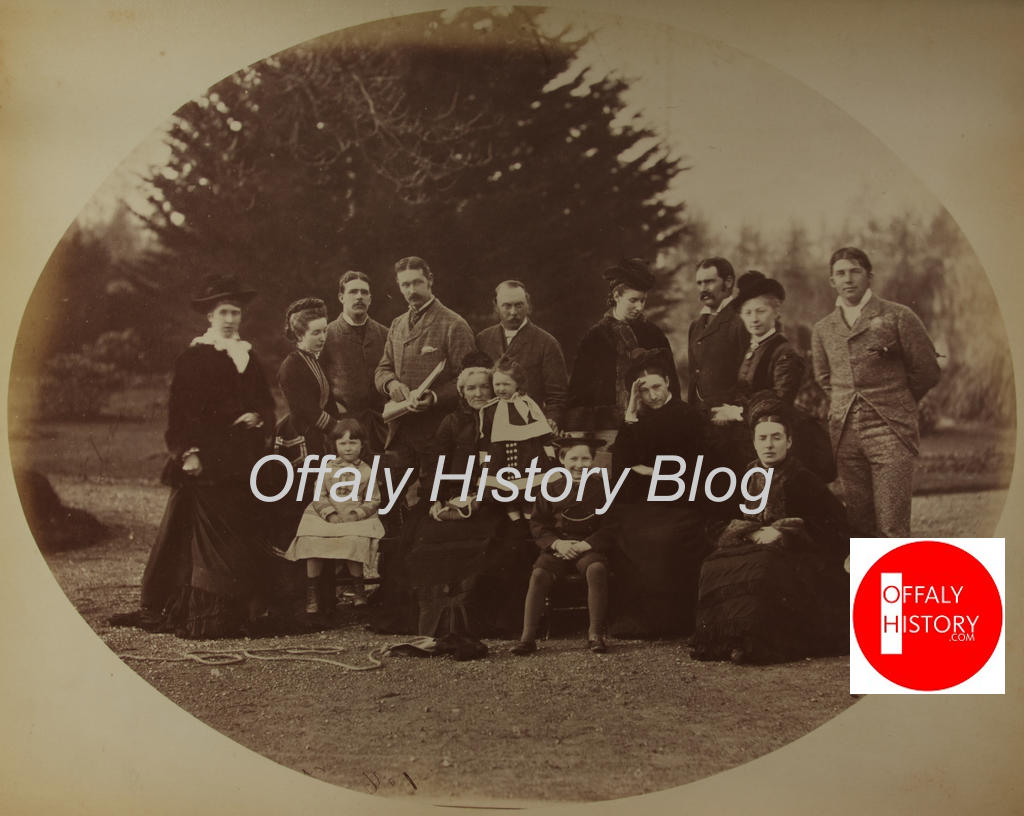
In 1867, Mary Anne Westenra married Francis Power Plantagenet Hastings the 14th Earl of Huntingdon. In time the Huntingdon’s would take ownership of Sharavogue and the Earl continued his father in law’s sporting interests. During the Land Wars the opposition of tenant farmers temporarily impeded hunting, but it was once again revived. Following the Earl’s death in 1885 his son Warner Francis John Plantagenet Hastings succeeded him at the age of 16. As Stephen Callaghan has detailed the 15th Earl of Huntingdon was at times a controversial figure. An officer in the 3rd (Militia) Battalion, Leinster Regiment he was accused of involvement in the Birr Barracks Scandal of 1894 but produced alibi evidence and was found not guilty. For a period, the Earl sponsored the Huntingdon Harriers and was later elected master of the Kings County and Ormond Hunt. In 1891 the local papers announced….

‘A polo club, to be called the “Ormonde and Kings County Polo Club” has just been started at Birr, with the Earl of Huntingdon as President, who has given permission to the members to play every Monday at his residence, Sharavogue House’ (1)
Two months later the first friendly game was played at Sharavogue, when the club took on the representatives of the Birr Garrison with whom the Earl lined out…
‘large enthusiastic audience assembled; to witness what proved a very fast game. At 8 o’clock the ball was started, and Immediately the County showed’ their superiority by carrying the ball down into their opponents’ lines, Mr Cradock and the Hon. O. Hastings being especially conspicuous. The ball waft brought back again into the centre of the ground by some good, combined play on the part of Lord Huntingdon and Major Luttman- Johnson, but Mr Cradock getting the ball well away passed it down the ground to Mr Hastings, the latter just missing the goal, the ball going behind. Not to be denied however, immediately the ball was hit out, Mr Cradock taking it all along the top of the ground and galloping away scored the first goal for the County after about four minutes play…
The game ending in a 5-2 victory for the County team.
TEAMS: The County—Mr W. E. Marshall (back); Mr Cradock (half back); Mr F. E. Saunders (1); the Hon O. Hastings (2).
Birr Garrison—Capt. the Earl of Huntingdon (back); Major Luttman-Johnson, Y. &. L. (half back); Mr Bradshaw, Y. & L. (1) j Captain Byass T.&L.(2). (2)
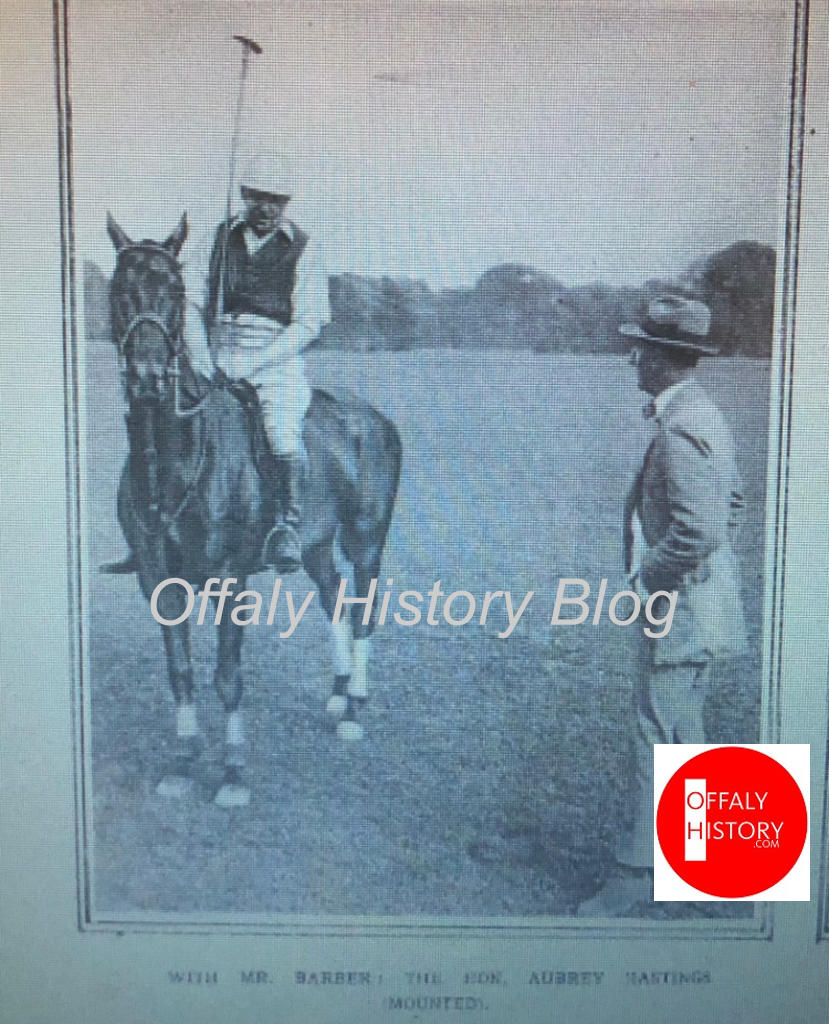
The new club (which in time dropped the Ormond name from its title) received strong support from Huntingdon’s brothers Aubery and Osmond Hastings. Aubrey himself gained distinction in the national hunt scene, training three Aintree Grand National winners including Ascetic Sliver whom he rode to victory in the 1906.
Huntingdon married Maud Maragret Wilson in 1892. Maud’s Antrim born father Sir Samuel Wilson had made his fortune as one of the Australian Squattocracy before serving as Conservative M.P for Portsmouth. The Earl’s brothers-in-law, Hebert, Clarence, Gordon and Wilfred Wilson were visitors to Sharavogue and at least some of them lined out with the Kings County side. The Tullamore distiller Captain Bernard Daly also played with King’s County, but most of his polo exploits appear to have been with a Kildare team. When teams under Huntingdon’s leadership played in London they did so as the Sharavogues.
As the club entered the 20th century, new players appeared.
A native of east Galway, Hubert A. Gairdner had come to Birr to work as a land agent but soon pivoted into horse trading at Croghan outside the town and garage ownership at Green Street. Hugely successful in selling polo ponies, he twice travelled to India to an effort to expand his markets.
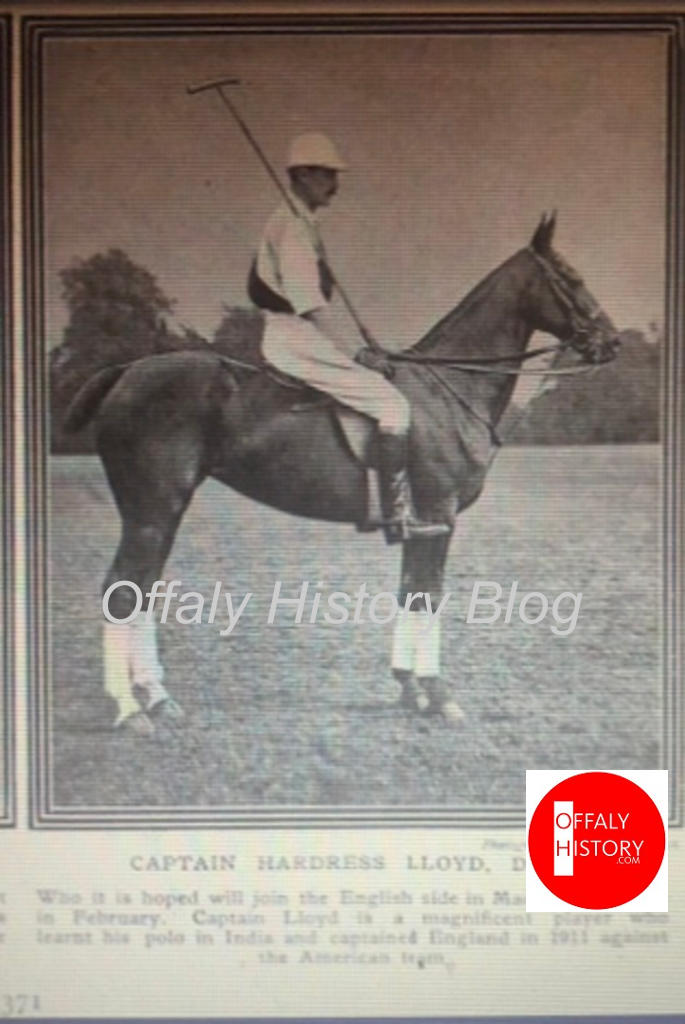
John Hardress Lloyd was born near Sharavogue at Gloster House. He honed his polo skills while serving with the Fourth Dragoons in India. In 1903, he married Huntingdon’s sister-in-law Adeline Wilson. Five years later he won a silver medal at the London Olympics as part of an Ireland side which took part in a three-team tournament. Considered an authority on the game he captained English teams which faced off against the United States in the Westchester Cup.
Having been commissioned in the Royal Horse Artillery Charles Head saw service in China, India and South Africa before returning to reside at his family seat Derrylahan House in Walsh Park.
John Arthur Burdett Trench known as ‘Crasher’ lived at Clonfert and won the 1911 Irish Grand National on Repeater II.
Numerous other polo teams, drawn from the ranks of the aristocracy and the military garrison sprung up across Ireland during the period. In 1907, Kings County overcame Westmeath 7-4 in the final of the Counties Cup. Five years later they qualified for the final again, with the Irish Independent reporting...
‘King’s Co., 5; Co. Dublin, 4. A stirring struggle between the above teams, in the Phoenix Park on Saturday, for _possession of the County Cup. ended in favour of King’s Co. by a goal, the winning point being scored just as a second extra period had been entered upon. A crowd of 30,000 people witnessed the game among the occupants of the A.I.P.C. Pavilion being his Excellency the Lord Lieutenant, who was accompanied by Lady Massereene. The result of the game came as a great surprise to many… The polo was not good. The ground was so soft that-the ball stuck often, and when it got into the hoof-tracks, which were numerous, the players were almost, helpless. Time after time ponies received knocks ns the’ ball bounced when driven from these. The small proportions of the score at the interval would be due more to the ground conditions than lo any inherent superiority of defence… There have been few more exciting periods played on the park pitch than the seventh (which was an extra} in this game. Both, teams having enjoyed the lead and Jost it in turn, were, deadly keen, and the result was an exciting series of rushes which brought cheers from the big crowd, not usually too demonstrative. King’s Co. were attacking when the bell rang, and simultaneously the whistle went for an infringement Co. Dublin. This led to a free which, being converted by Mr. Gairdner at the start of the second extra period, formed a sort of anti-climax to a memorable struggle… The teams were as follows: —King’s, Co .Mr. J. A. H.Trench, Major Head, Capt.. Lloyd, and Mr.H. Gairdner. Co.Dublin—Mr. Raynes, Major O’Hara, Mr. Johnston, and Mr. Ryan.’ (3)
Kings County Polo was on top, but the world was changing, in September 1913 a British military plane made an emergency landing at Sharavogue in a field beside where the Club were holding a game. Writing on early aviation in Offaly, Joe Gleeson suggests that was this was possibly the county’s first air crash.
A year later the club suspended play on the outbreak of War in Europe. Technology had surpassed traditional tactics, and the veterans of the elite cavalry regiments found themselves struggling to adjust to the new dispensation. Gordon Wilson was shot dead while leading the Royal Horse Guards at the first Battle of Ypres. His brother Herbert was killed while serving with the same regiment in 1917. Hubert A. Gairdner enlisted in the Army Service Corp and was wounded. Hardress Lloyd begun the War among the ranks of the cavalry but ended up playing as one of the pioneers in the development of tank warfare.
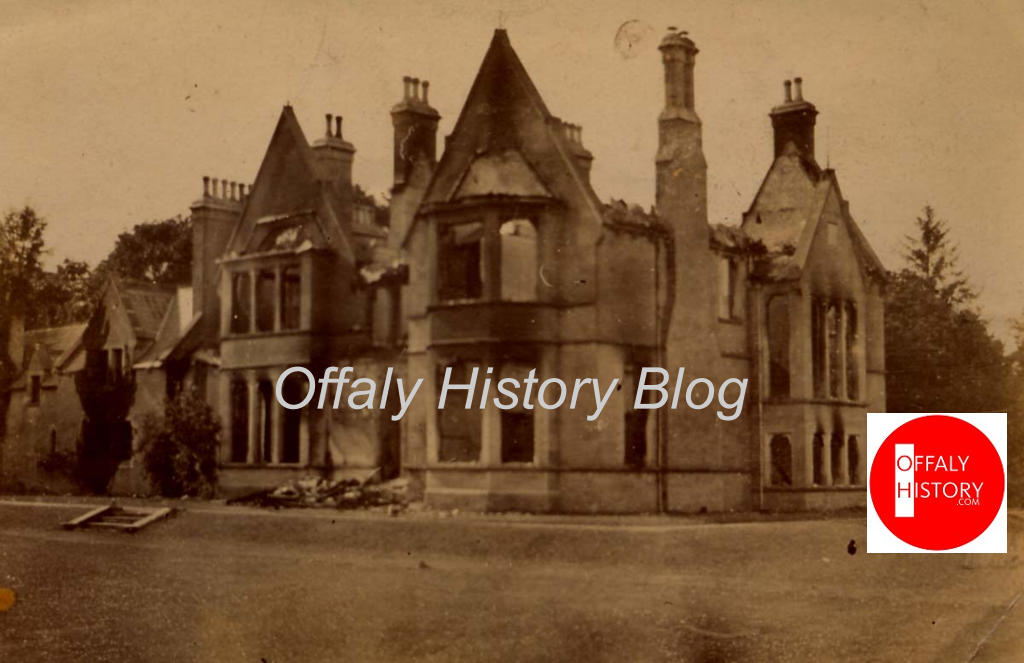
Lloyd and Colonel Charles Head attended a meeting to revive the polo club at Dooly’s Hotel in June 1919, but events appear to have overtaken such plans. On his return from the war, Head took a leading role in what remained of the Kings County Unionist Alliance. Derrylahan Park was burned by the IRA in 1921 and the Colonel relocated to Britain shortly afterwards. It was a path followed by the Earl of Huntingdon who sold his property to the Land Commission in the aftermath of the signing of the Treaty. The polo club’s pavilion was offered for sale in 1924 and the county house was later demolished, but at least one gymkhana was held on the grounds in 1925.
Captain Hubert A. Gairdner passed away in 1927 having suffered bad health for several years.
Aubrey Hastings took ill and died while playing polo at Cirencester, Gloucestershire in 1929.
His brother Osmond passed away while taking part in a shooting party on the Chastleton Glebeestate in Gloucestershire in 1933.

When the 15th Earl of Huntingdon died at his home Burton Hall, Leicestershire in 1939. The press reported that …
‘He was a former Master of the Atherstone. Ormond. East Galway, and North Staffordshire foxhounds, and it is believed that he had hunted with every pack of foxhounds in Britain. Latterly he attended local meets in a car’ (4)
J. A. B. Trench continued to support the All-Ireland Polo club and acted as master to the East Galway Hunt. In 1945, he took ill and died after riding.
Brigadier-General Hardress Lloyd continued to live at Gloster House, where his interests included forestry, gardening, Chinese literature and the management of Ettagh Church of Ireland parish. He also played a role in the early years of the British Legion and unveiled the Tullamore War Memorial in 1926. He passed away at Gloster in March 1952.

Residing in Britain, Charles Head wrote a memoir ‘No Great Shakes’ and three military histories. He passed away in October 1952. In 1976 his grandson Sir Patrick Head established a Formula One racing team in partnership with Frank Williams.
Polo continues to be played in Ireland with clubs in Tyrone, Wexford, Wicklow and of course the Phoenix Park.

Sources
- Irish Society. 6 June 1891.
- Kings County Chronicle. 13 August 1891.
- Irish Independent. 2 September 1912.
- Irish Independent. 6 April 1939.
Ian Balding. Making the Running London 2014.
Midland Tribune report March 01, 2018, on David Broderick’s ‘Getting to the Head of the matter’ lecture to the Birr Historical Society.
Stephen Callaghan ‘The 14th and 15th earls of Huntingdon of Sharavogue, Shinrone and the Birr barracks scandal.’ Online at https://www.offalyhistory.com/uncategorized/the-14th-and-15th-earls-of-huntingdon-of-sharavogue-shinrone-and-the-birr-barracks-scandal-by-stephen-callaghan
Joe Gleeson. ‘Offaly and the First Air War’ Online at https://offalyhistoryblog.com/2019/02/02/offaly-and-the-first-air-war-joe-gleeson/
https://www.irishpolofoundation.ie/ Page
Text
Irish Independent. August 24, 1907. September 2, 1912. April 6, 1939.
Irish Society. 6 June 1891.
Kings County / Offaly Chronicle. 13 August 1891. 1 September 1927. 30 May 1929. 2 November 1933. 5 March 1952.
Midland Tribune. 22 April 1897. 22 May 1897. 14 April 1951.
Pics and captions supplied by Offaly History
 offalyhistoryblog