
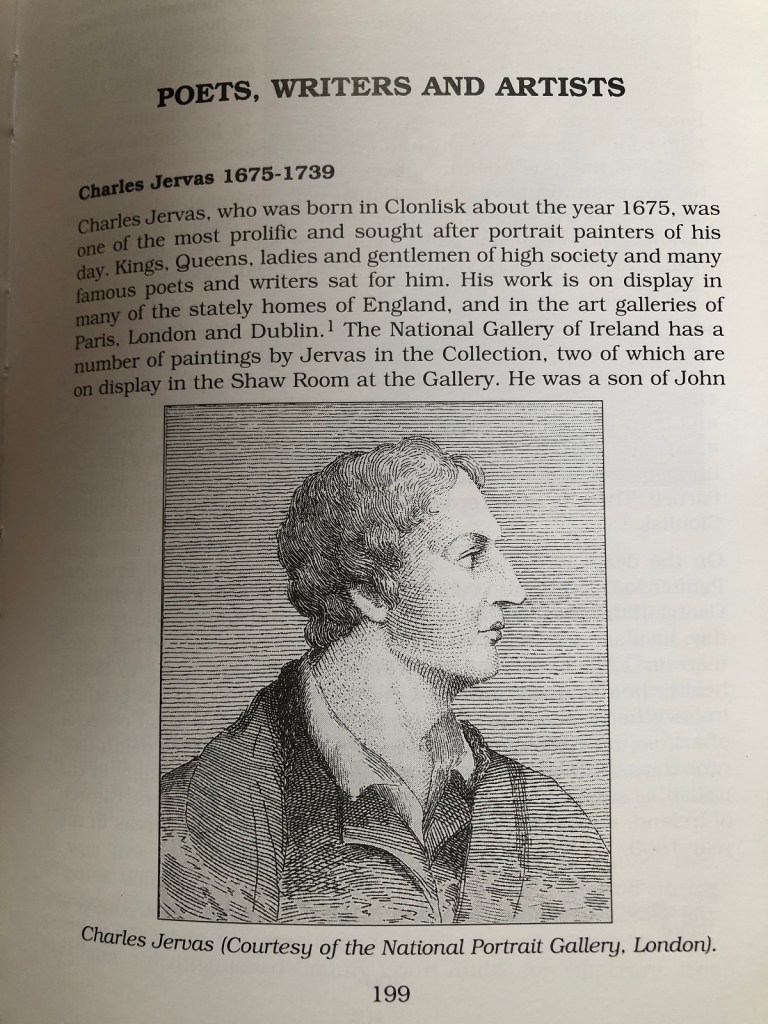
An article in the current edition of the Irish Georgian Society journal sheds more light on the Shinrone-born portrait painter Charles Jervas.[1] He was born in 1675 (or perhaps 1670) near Shinrone, King’ County (now County Offaly) and about eight miles south of Birr (Parsonstown) and was the son of John and Elizabeth Jervas (sometimes Jarvis, Jervis, Gervase and Gervaise). His mother was a Baldwin of Corolanty, Shinrone who were Cromwellian grantees. The old castle there (there are still ruins of it) was replaced in 1672 (other say 1698) by a large house – modified again in the eighteenth century and still standing. Jervas’s father, a Cromwellian, soldier-settler is said to have emigrated to America in 1688 to avoid the troubles then brewing due to the accession of a Catholic monarch and the changing power structure in Ireland as a result. He is said to have returned to Shinrone in the late 1690s and died there soon after, possibly in 1709. Another source has it that he died in America, but this seems unlikely.[2]
The Jervas family were Quakers and that would provide connections especially in America where Charles’s brother Martin settled as a shoemaker.[3] Caroline Pegum’s thesis on Jervas is of great value for local connections aside from that of his artistic work.[4] Pegum states that John Jervas, was allocated 676 acres of land at Roscorragh (Roscore) ‘with some houses thereon’, also in Corcush, Fertaun and Aghall, south of Tullamore.[5] These lands were part of the Lawrence Hamon (‘Irish Papist’) estate and were to form part of the Barry Fox estate in the nineteenth century. The Jervas family were possibly living on the Baldwin estate in Clonlisk by the 1670s.[6] Why they were living near Shinrone and not in Roscore is not known.
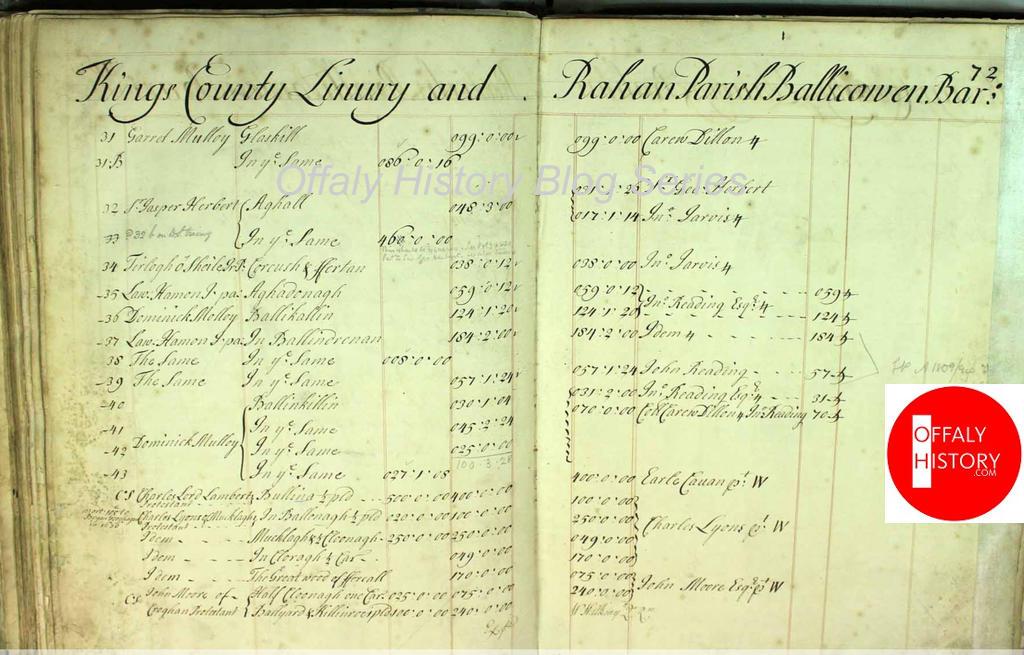
John Baldwin and Sir William Flower, other Cromwellian soldier-settler in Shinrone, were allocated 2,677 acres in the barony of Clonlisk, King’s County/County Offaly. Prior to that Bauldwin was noted as a tituladoe in the parish of Geashill in the course of the poll tax of 1660–61 and served as a commissioner for collecting the poll tax.[7] He served as high sheriff of King’s County in 1672 and died 1698/9. Several of his grandchildren were lawyers.[8] His son John served as high sheriff of King’s County in 1697 and died in 1699. A will extract has it:
BALDWIN, JOHN, Corolanty.
Wife: Elizabeth.
Daughters: Mary, Katherine, and Lucy.
Sons: Thomas, William, Bernard.
Brother: Martin.
Brothers in law: John Jervis.
Witnesses Hector Vaughan, John Jervis.
31 January 1699 Pr February 1699
Another John Baldwin served as high sheriff in 1735, but his eldest son John of Coralanty was said to be’ extravagant, dissipated the estates, and died without issue in 1754. His widow soon afterwards married Hervey, Lord Mountmorres’. The Baldwin estate (part of) was bequeathed to Trinity College by Provost Balwin (c. 1766–1758) whose memorial is in the Examination Hall of the college.[9]

In the meantime the portrait painter Charles Jervas made a successful career for himself in London and returned to Ireland occasionally where he enjoyed high profile commissions and managed the property inherited from his father. Sitters for his paintings included members of the Conolly family and the Cosbys of Laois.

The DIB has summarised his career stating that he was one of seven children and travelled to London in 1694–5 (Murray, 1693) where he studied under Sir Godfrey Kneller. Kneller was by the 1690s the leading portrait painter in England and in which he specialised. As was noted of him:
In the spirit of enterprise, he founded a studio which churned out portraits on an almost industrial scale, relying on a brief sketch of the face with details added to a formulaic model, aided by the fashion for gentlemen to wear full wigs. His portraits set a pattern that was followed under William Hogarth and Joshua Reynolds.[10]
The same was said of Jervas later. Jervas must have had powerful friends to get this introduction. Jervas was in Ireland for a while in the mid-1690s and returned to England about 1698. There he had the support of Sir George Clarke of All Souls, Oxford and with a loan and funds from his father’s estate he went to Rome and was there for ten years studying and painting. He had aristocratic friends here also and on his return to London quickly established itself as a successful portrait painter and became known particularly for his female portraits, often depicting his fashionable sitters in pastoral settings as rural characters such as shepherdesses.[11]

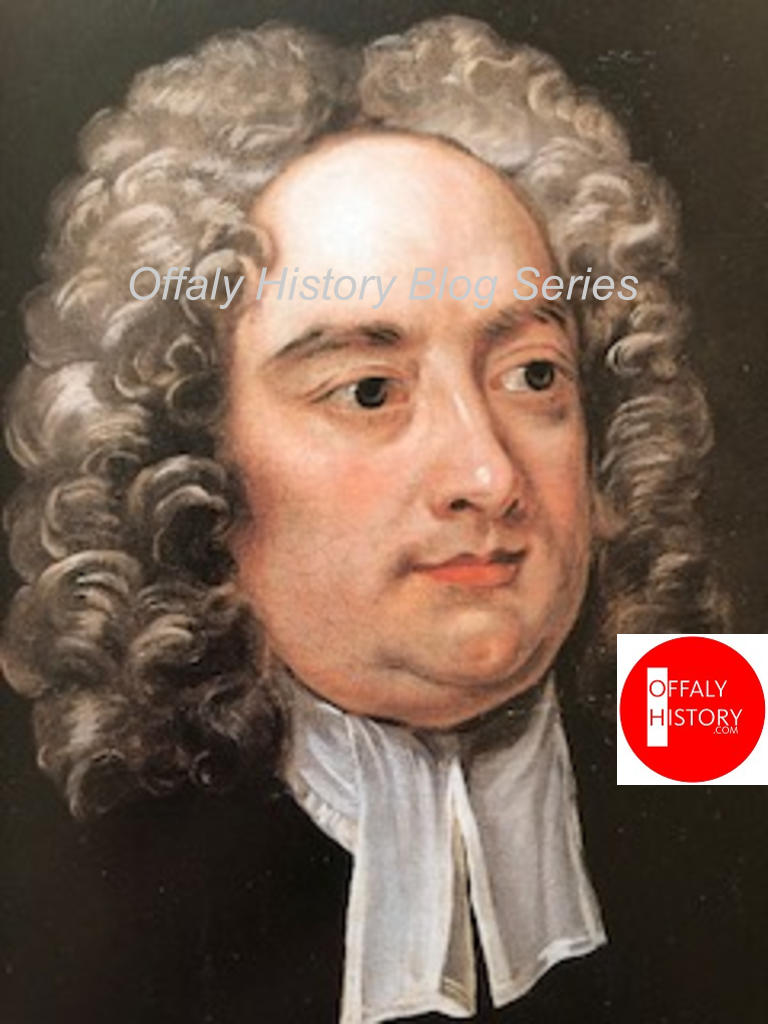
Surprisingly, he was appointed principal painter to George 11 in 1723 on the death of Kneller. He also painted Pope, Swift, Lady Wortley Montague among many others. Some of his work featured in the Homan Potterton sale (see an earlier blog) and recently two paintings of Thomas Carter, master of the rolls and his wife Mary have been acquired by the Irish Georgian Society. A fashionable address in the likes of Henrietta Street, Dublin and a portrait by Jervas were essential accoutrements for the rich and famous in that period. In London Steele and Addison of The Spectator were able to give influential puffs to Jervas.
Despite some harsh criticism such that Jervas ‘tended to be repetitious in his approach to pose and his handling of the face, rather than adept at capturing a real likeness’ he is nonetheless considered to be ‘one of the most important Irish painters of the early eighteenth century’.[12]
Jervas made his last will in 1738 and instructed that his Irish estates be sold to provide legacies for among others his brother John of Clonlisk and the five daughters of Lady Elizabeth Handcock, widow of Sir William Handcock (1654–1701). As a widow she had married secondly John Forth of Redwood (later Charleville), Tullamore and three of the five daughters were the vendors of Redwood to Charles Moore, Lord Tullamore in 1740. Of Jervas’ last days the DIB records that:
He returned in October 1738 to Italy, where he stayed in Rome until the following May in the hope of reviving his failing health. His situation did not improve and he died at his home at Cleveland Court, London, on 2 November 1739. He married (1727) a wealthy widow [according to some sources], Penelope Hume, said to have had a fortune of £20,000. This alliance may have allowed Jervas to pursue his taste for collecting. The sale of his large collection of paintings, sculpture, engravings, and maiolica took place over nine days in March 1740.
There were no children of the marriage. Back in Shinrone Jervas had extended family members born there to William over the years 1747 to 1762; the death of John Jervis occurred in 1762; William Jervais in the same year; John Jervis in 1785; William Jervis in 1800 and Mrs Jervis in 1810.[13]
How did it come about that Jervas was so successful despite his obscure social origins. He has left us no archives to answer that question. He had a leading master (Kneller) as teacher; he worked diligently in Rome for near ten years; he was a clever and enterprising businessman and painter who know how to make the best of his social contacts. For the initial advancement Pegum points to the family connection with the Baron Digbys of Coleshill, Warwickshire and Sherborne Castle, Dorset, and in particular to the patronage of the 5th Baronet William Digby (1661/2–1752). Pegum argues that the intermediary was Martyn Baldwin (1651–1725), brother to Elizabeth Jervas and uncle to Charles. Martyn was born in Geashill and was a tenant of the Digbys and they had ‘longstanding personal and business relations’ between the families which ‘places in context Lord Digby’s patronage of Jervas’.[14]
Sources (select)
Anne Crookshank and the knight of Glin, Irish portraits 1660–1860 (1969).
Nicola Figgis and Brendan Rooney, Irish paintings at the National Gallery of Ireland, i (2001), 297–311.
Anne Crookshank and the knight of Glin, Ireland’s painters: 1600–1940 (2002), 30–32.
Caroline Pegum, The artistic and literary career of Charles Jervas (c. 1675–1739), M.Phil thesis (University of Bermingham), 2009.
Noel McMahon, In the shadow of the Fairy Hill – Shinrone and Ballingarry (1998).
Peter Murray, ‘Pomp of the town: the portraits of Charles Jervas’, Irish architectural and decorative studies, xxvii (2024), pp 14–45.
[1] Peter Murray, ‘Pomp of the town: the portraits of Charles Jervas’, Irish architectural and decorative studies, xxvii (2024), pp 14–45
[2] Caroline Pegum, The Artistic and Literary Career of Charles Jervas (c.1675–1739) (M.Phil, University of Bermingham, 2009) pp 7–8; P. Beryl Eustace, Registry of Deeds: abstracts of wills, vol. I (1956), p. 267.
[3] Murray, ‘Pomp of the town: the portraits of Charles Jervas’, p. 21.
[4] Caroline Pegum, The Artistic and Literary Career of Charles Jervas (c.1675–1739) (M. Phil, University of Bermingham, 2009).
[5] Ibid., 2–3.
[6] Ibid., 5
[7] Ibid., p. 3
[8] T.U. Sadleir and ors, King’s Inns Admissions Papers, 1607–1867.
[9] Thomas Lalor Cooke, History of Birr (1875), p.190; see T.U. Sadleir in appendix to Montgomery Hitchcock, Midland Sept of the Pale
[10] Wiki, viewed 6 June 2025;
[11] DIB entry on Charles Jervas by Rebecca Minch.
[12] DIB; Nicola Figgis and Brendan Rooney, Irish paintings at the National Gallery of Ireland, i (2001), 297–311; Anne Crookshank and the knight of Glin, Ireland’s painters:1600–1940 (2002), 30–32.
[13] Information from Offaly History Centre.
[14] Caroline Pegum, ‘The Artistic and Literary Career of Charles Jervas (c.1675–1739)’, pp 106–112.
This series is supported by Offaly County Council’s Creative Ireland community grant programme 2025-2027.


 offalyhistoryblog