
Hello again.
I have good reasons to write a follow up article to my blog of September 2023 on the above topic, as have Four Courts Press to produce a paperback version of my book Adomnán’s Lex Innocentium and the Laws of War (Dublin, Four Courts Press, 2020). This welcome decision was made, not only because the hardback version is now out of print, but because world events since 2020 have given the book an urgent relevance for our modern times.
First a quick recap: In the last blog I told the story of the great assembly in Birr in 697 AD of ninety-one leaders of the Irish world, lay and ecclesiastical, which proclaimed this law for the protection of non-combatants or innocents in time of war. The inspirer and driving-force behind it was Adomnán of Iona, a man with an unique awareness of the suffering of the innocent victims of war, and a leader who had the moral authority to persuade his peers, many of whom strongly resisted, to travel to Birr from all over Ireland and northern Britain to formally accept and guarantee the law. We saw that this law was unique for its time and, indeed, for many centuries thereafter. It was not until the Fourth Geneva Convention of 1949 and additional protocol of 1977 that the nations of the world, having learnt the lessons of two world wars in which millions of innocents were killed, that a comprehensive law for civilian protection was agreed. Down through the centuries innocents have always suffered greatly in war; the sheer scale of their suffering in the first half of the twentieth century impelled nations to take steps to limit it.
Since I wrote my book, we have experienced the indiscriminate slaughter of innocents in Putin’s war on Ukraine and the sheer savagery of Israel’s war on the Palestinians of Gaza. In the latter the proportion of innocents killed to the total population is far higher than during the two world wars [see Cormac Ó Gráda, The Victims of War: civilian casualties of the two World Wars (Princeton, Princeton University Press, 2024), p.402]. We have witnessed this with our own eyes on our television every night. Women and children have been indiscriminately bombed, shot and starved and, to a large extent, the world has stood by. Nations that we thought had some commitment to the Geneva conventions have aided and abetted this inhuman slaughter, not only by standing idly by but by supplying arms and bombs to be used against the innocents.
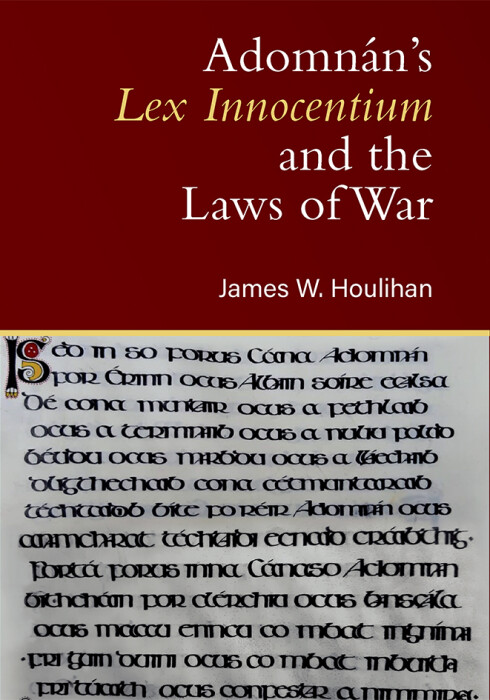
For this reason, Four Courts Press could not allow a book that told the story of our Law of the Innocents to be unavailable at this crucial time. We must not only draw on the lessons of history but be inspired by it. When humanitarian law is under attack, we must defend it and use our history of humanitarian endeavour to fortify us in the struggle. When the book was first published in 2020 it received insightful and laudatory reviews. It is interesting to note that a new review appeared recently, by Professor Thomas O’Loughlin of the University of Nottingham (Speculum 101/1, January 2026), in which he refers to the Law as ‘an inspired taste of modernity’.
On a wider note we will all be aware of the view being recently expressed by some on the right that all that matters is force and power: that might is right and that weakness and vulnerability are wrong and to be despised; that this is how it has always been in history These are the values of many powerful leaders in today’s world. For these people our Law of the Innocents would be considered as woke. Adomnán’s law tells us that this is not so. There have always been people who have civilized values and there always will be. We must, now, stand up and be counted.
The idea that warfare should be confined to combatants and that non-arms-bearing people should not be involved is not new. Afterall, innocents are not a danger so why involve them? What is remarkable is that protagonists, enemies, could agree this and support a law that protects innocents. This recognises our common humanity and is a manifestation of civilized society. The contrary view that might is right is inhuman and a denial of our shared humanity.

We as a nation are fortunate that the text of the law, written in our own Irish language, and clearly defining the concept of the innocent, has survived down through the centuries. It is a very important part of our national heritage and places a responsibility on us to strongly support and to energetically advocate for international humanitarian law against the attacks of those who believe might is right. Adomnán and his law proved them wrong 1329 years ago.
A note from Offaly History Blog editor on the just issued paperback of The Law of the Innocents which is available from Offaly History Centre History Bookshop at Bury Quay and the online shop at http://www.offalyhistory.com.
This book studies the Irish law dating from AD 697, called Lex Innocentium or the Law of the Innocents. It is also known as Cáin Adomnáin, being named after Adomnán (d. 704), ninth abbot of Iona, who was responsible for its drafting and promulgation. The law was designed to offer legislative protection for women, children, clerics and other non-arms-bearing people, primarily though not exclusively, in times of conflict. Since this volume was first published in hardback in 2020 serious breaches of the laws of war have occurred, particularly in Ukraine and Gaza, giving this book a grim relevance for the present day. The author cautions the reader to remember that the horrors of war are not just a phenomenon of the past.

James W. Houlihan practised law as a solicitor in the Irish midlands for many years. On his retirement he completed a MA and a PhD in University College Dublin.
 offalyhistoryblog