
Introduction:
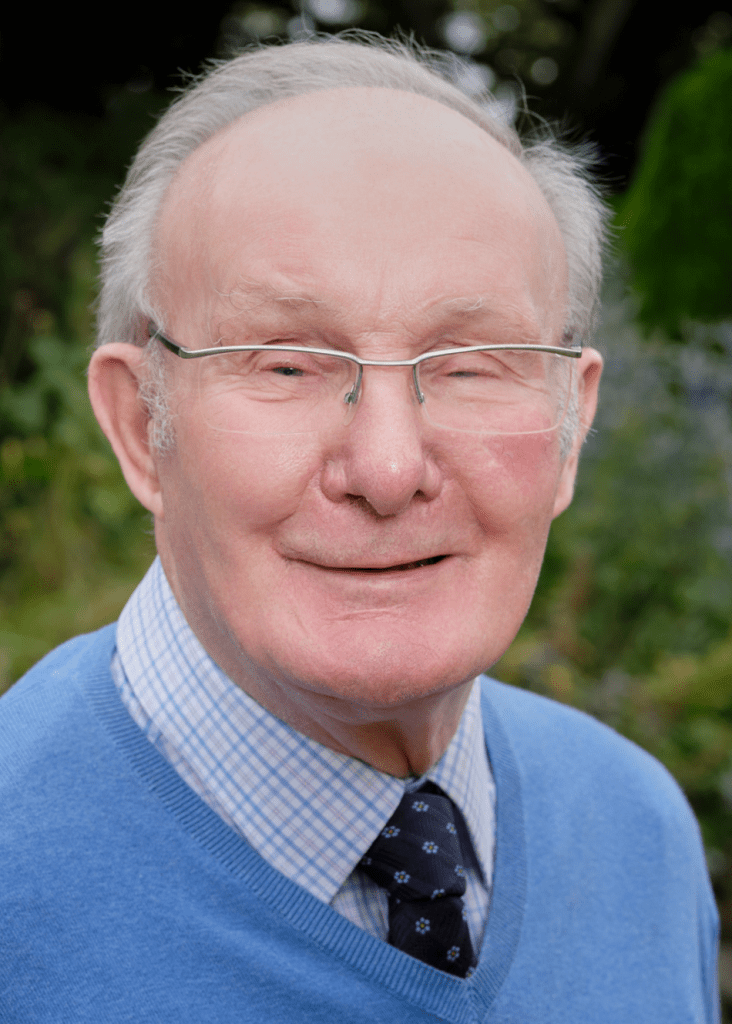
Noel MacMahon passed away on 4th March 2026. Noel was born in Shinrone, Co. Offaly, in 1934, into a family where education was the primary vocation. He attended primary school in Shinrone where his parents were principals of the local boys’ and girls’ schools. He attended St Flannan’s secondary school in Ennis and later attended University College Galway (UCG), earning a B.Comm. He entered national teaching somewhat “on the spur of the moment” in 1952 when a new rule allowed graduates to qualify with one year at St. Patrick’s College of Education, Dublin. Following his graduation and after three years as principal in Coolderry, he returned to Shinrone in 1959 to succeed his retiring father. Noel retired from teaching in 1997 but continued to contribute to parish life by publishing a number of books on the history of the area.
Oral Historian:
Starting in 1994, Noel recorded interviews with 31 local residents of Shinrone, including blacksmiths and estate workers, to preserve their knowledge before it was lost. These interviews are now available on “Voices of Offaly” which can be accessed from the homepage of the Offaly History website (www.offalyhistory.com)
Interview:
In February 2008 Noel was interviewed by Maurice O’Keefe for the 4th Offaly Oral History Series. This interview and transcript can be accessed on Voices of Offaly via the Offaly History homepage. What follows is a summary of that interview. Noel reflects on his family background, the social and economic life of the village, his education, his long teaching career, and his later work documenting local history. His recollections offer a vivid portrait of mid‑20th‑century rural Ireland, capturing the rhythms of village life, the hardships and simplicities of the era, and the deep sense of community that shaped his upbringing
Family Background and the Teaching Tradition
Noel was born into a strong teaching lineage. Both his parents were national school teachers, and his father served as principal of the boys’ school while his mother was principal of the girls’ school. As Noel remarks, between himself and his parents they accumulated 134 years of teaching experience. His mother, Mary O’Dea, came from Tulla, County Clare, and his father from Killaloe. Both were part of a tradition in the Diocese of Killaloe whereby teachers from Clare were often appointed to schools in Tipperary and vice versa.
The family lived in the village itself, and Noel grew up immersed in the life of Shinrone. His parents were well‑respected teachers, and their careers shaped the rhythm of family life. They cycled weekly to Birr for shopping, regardless of weather, wearing waterproof capes that covered both themselves and their bicycles. Their involvement in the INTO (Irish National Teachers’ Organisation) also influenced their choice of Birr over the nearer town of Roscrea.
The Village of Shinrone: Social and Economic Life
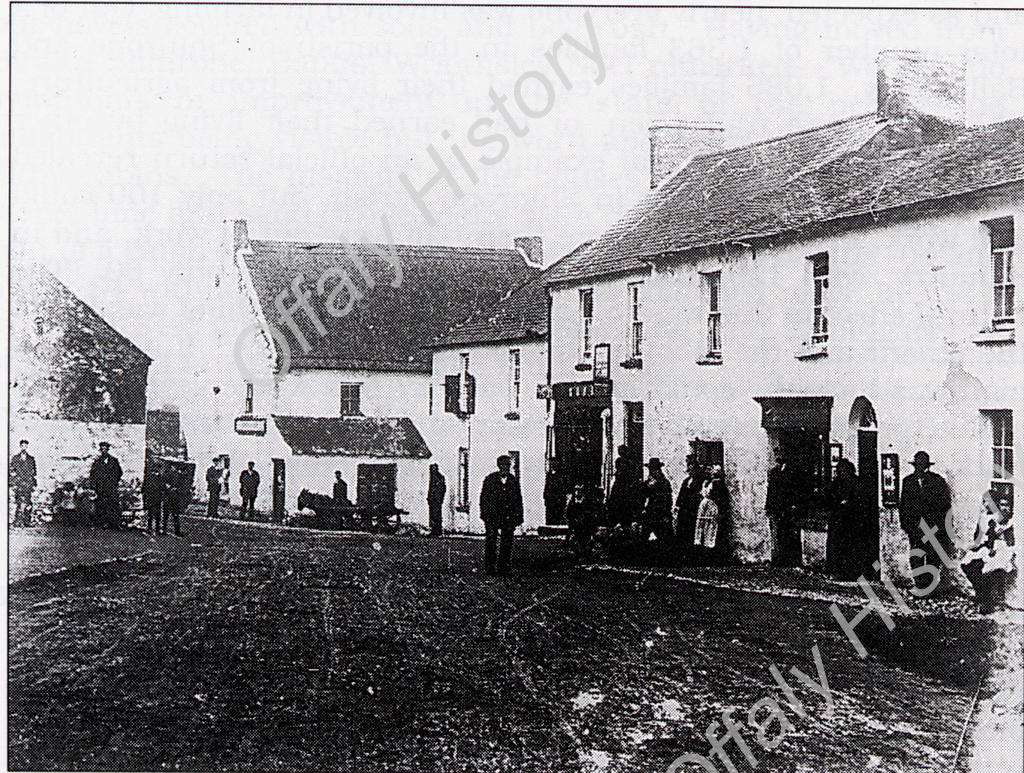
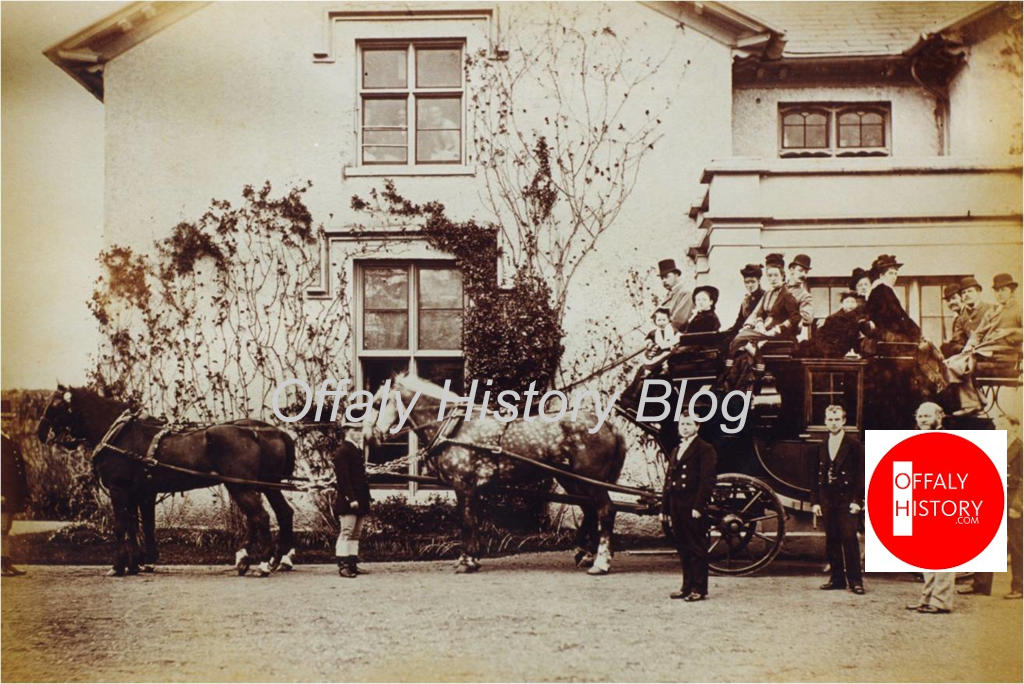
Noel describes Shinrone as a long, winding street with 18th‑century façades still visible in his youth. The parish included three villages—Shinrone, Ballingarry, and Brosna—and stretched across parts of Offaly and Tipperary. The village population consisted of shopkeepers, tradesmen, small business owners, and farmers. The largest employers, however, were the big estates—the Kennys, the Wallaces, and others—whose holdings could reach up to a thousand acres. These estates employed carpenters, blacksmiths, gardeners, servants, and labourers, forming the backbone of local employment.
Shinrone had four pubs, a number that remained unchanged at the time of this interview (2008). In Noel’s youth, pubs served multiple functions: they bottled their own stout from large wooden barrels, sold groceries, tobacco, clothing, and even ice cream after the arrival of electricity in 1949. Shops were often run from back rooms of houses, and customers rarely paid cash. Instead, purchases were written into “the book” and settled when wages arrived. Goods were sold loose—tea from chests, sugar from sacks, butter cut to order, and bacon sliced from half‑sides delivered from Roscrea.
Milk was purchased by bringing a jug to a shopkeeper or nearby farmer, who measured it with a tin ladle made by the travelling tinsmith. The tinsmiths, or “tinkers,” were part of the itinerant population who passed through the area. Noel recalls the Hutchinson family as the main travelling group in the region, and he vividly remembers a legless man who propelled himself along the road on a homemade wooden cart.
Smoking was widespread, and labourers often smoked Woodbines or plug tobacco. Noel recalls men expertly spitting on the cement floors of pubs— “They’d kill a fly at ten metres,” he says—an accepted but unhygienic habit of the time.
Home Life and Domestic Conditions
Homes in the village were simple. Many had cement floors until linoleum became affordable. Walls were whitewashed, and Noel remembers his family using “distemper,” a type of paint, in colours he found garish—particularly a “horrible pink” in their kitchen. Farmers’ houses were similarly plain, often whitewashed inside and out, especially before hosting religious “stations.”
Heating and sanitation were basic. The school where Noel later taught had only one tap in the porch and a single light bulb hanging from the ceiling. Outbuildings, including toilets, were often muddy and poorly maintained, as noted in old inspector reports.
Entertainment and Social Life
Entertainment in Shinrone was limited but memorable. A travelling show would arrive periodically, setting up a tent on the Green opposite the school. Inside, villagers sat on wooden benches to watch silent films, reading subtitles or listening to the showman narrate the action. Noel recalls the whirring of the projector and the beam of light cutting through smoke. Films were often serials, encouraging children to beg their parents for permission to attend each night.
Plays were also performed, including a dramatic version of Frankenstein. Noel recounts a humorous moment when the local postman shouted, “That was coming to you for a long time!” as the monster met his end.
The courthouse in Shinrone also hosted entertainment, including music and dance competitions. Noel remembers a man who played beautiful music on a handsaw using a bow, and he recalls talented Irish dancers like Maureen Gunning and Paul McLoughlin.
Because few people owned cars—only the doctor and parish priest had them—villagers rarely travelled far. Social life centred on local events, the church, the pubs, and the occasional travelling show.
Education: From Student to Teacher
School Days in Flannan’s
Noel attended St. Flannan’s College in Ennis, following a tradition encouraged by the Diocese of Killaloe. The hope was that boys might enter the priesthood, though Noel admits this was “very unlikely” in his case. His early excitement at receiving a new suit, hurling boots, and a hurley faded quickly. Discipline was strict, food was poor, and winters were harsh—he remembers breaking ice in the wash basin each morning. Students rarely went home, as transport was limited.
However, sport eased his adjustment. Good hurlers and footballers were valued, and Noel played on successful teams, winning the Dr. Harty Cup. He later attended St. Patrick’s College in Dublin, where he again played on strong teams, winning the Dublin Intermediate Football Championship alongside notable players like Tom Long (Kerry), Fintan Walsh (Laois), Donie Nealon (Tipperary) and Mattie McDonagh (Galway).
University and the Path to Teaching
After Flannan’s, Noel studied commerce at UCG (University College Galway) and began a BA, intending to pursue post‑primary teaching. But a new rule in 1952 allowed graduates to qualify as national teachers with a single year in St. Patrick’s College. A close friend, Denis Gardiner, decided to take this route, and Noel joined him “on the spur of the moment,” changing the course of his life.
Teaching Career
Noel’s first appointment was in Coolderry in 1955, largely because he was a strong hurler and the parish priest, Father Vaughan, was eager to strengthen the local team. Noel won a championship with Coolderry in 1956. After three happy years there, he faced a difficult decision when his father retired from Shinrone school. Ultimately, he returned home to continue the family tradition.
Teaching conditions were primitive. His father had once taught two classes in a single room with no partition, enduring constant noise. Learning was largely by rote—poetry, catechism, arithmetic tables—and infants wrote on slates. Ink was mixed from powder and stored in porcelain inkwells. Discipline included corporal punishment, and Noel remembers being sent to fetch sticks from the ditch, only to find mischievous pupils had half‑cut them so they would break on impact.
Despite hardships, academic standards were high. Many pupils won county scholarships, and subjects like algebra and seventh‑class history were taught. However, few students progressed to secondary school; most left at 14 to work on farms or emigrate.
Poverty and Clothing
The poverty of the era is captured in a poem by Frank Spencer, a former pupil, which Noel quotes. One excerpt describes a shirt made from Odlum’s flour bags:
“A shirt that was made from a flour bag,
White‑fronted and perfectly clean.
On my back was a red and blue circle,
The trademark of Odlum’s Cream.”
Children often wore patched trousers, mismatched shoes, and hobnailed boots. In summer, many went barefoot.
Religious Instruction and the Bishop’s Visit
Religious education was central to school life. Pupils memorised the Penny Catechism, catechism notes, and Schuster’s Bible “from front page to back page.” Even weaker pupils excelled in religion, largely due to parental emphasis.
The bishop’s triennial visit for confirmation was a major event. He examined pupils publicly, sometimes criticising teachers in front of the congregation. Noel’s mother collected questions asked in other parishes to ensure her pupils were prepared. Children took an extra confirmation name, and Noel recalls choosing “Brendan.”
The bishop, dressed in full red regalia, was addressed as “My Lord,” and children knelt to kiss his ring.
Local History and the Importance of Memory
In later life, Noel became deeply involved in documenting the history of Shinrone. Concerned that the memories of older residents would be lost, he began recording interviews in 1994. He completed 31 taped interviews, focusing on individuals with specialised knowledge—blacksmiths, horse breeders, estate workers, and others.
He found people eager to share their stories, especially in old age when, as he says, “you look backwards more so than forwards.” His familiarity with the community and his reputation as a trusted teacher helped him gather photographs and personal accounts that others might not have shared.
Examples of Local Trades and Crafts
One interviewee, blacksmith Jack Carroll, described the process of shoeing wooden cart wheels. Noel recalls watching the blacksmith heat an iron band in a turf fire, place it over the wooden wheel, hammer it into place, and cool it with water so it contracted tightly.
He also interviewed carpenters and estate workers who described life “upstairs and downstairs” in the big houses—the food, clothing, hunting traditions, and social hierarchy.
Historical Sites: Glasshouse and the Rollestons
Noel researched the Glasshouse townland, named for a 17th‑century glass factory established by Huguenot refugees, the Bigoes, around 1620. The area had the necessary materials—sand, lime, and timber—and remnants of the furnace still exist. Archaeological digs have uncovered additional furnace remains.
He also studied the Rolleston family, prominent landlords in the area. Their private burial ground still stands, though it was overgrown when Noel first visited. He recounts bringing FÁS workers to clear it and having his new car kicked by a curious cow. Later, he met the grandson of poet Willie Rolleston, who visited Noel after hearing of his research and provided a 1921 photograph of the burial ground.
Books and Photographic Collections
Noel published two books:
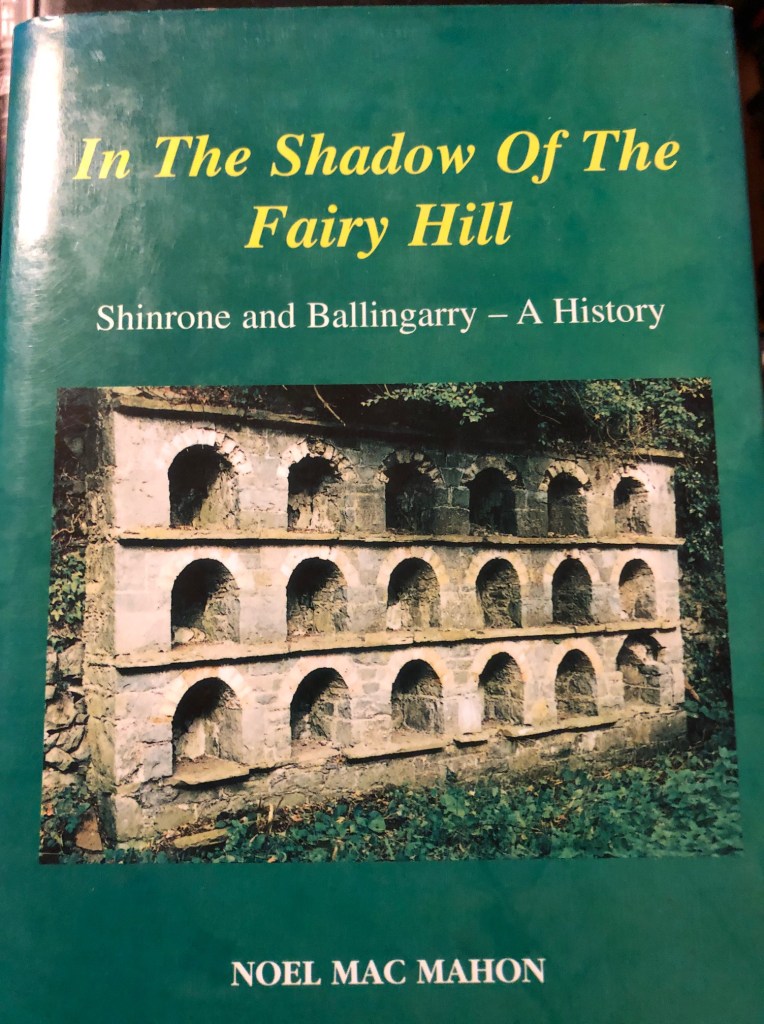
- A historical study, In the Shadow of the Fairy Hill, based on his research.
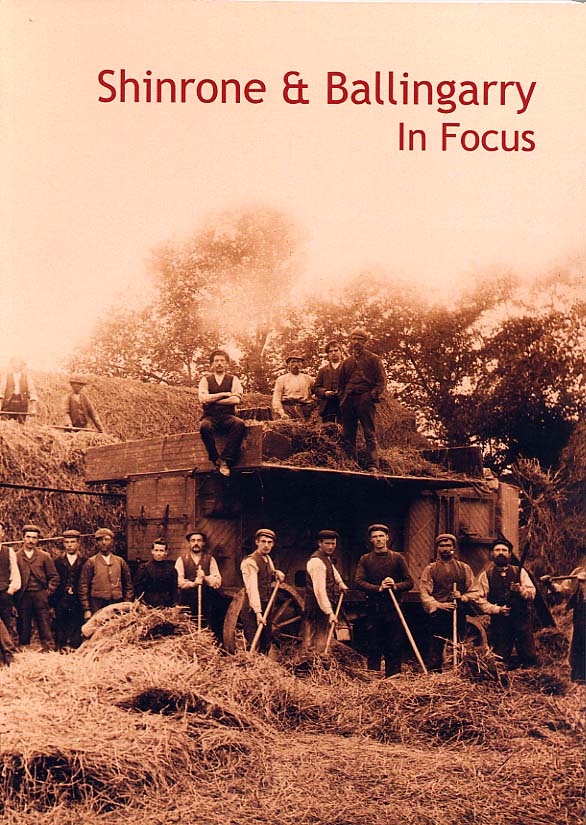
- A photographic collection, which proved extremely popular. It included images from the 1800s and early 1900s—school groups, threshing scenes, wartime adaptations such as a car converted into a horse‑drawn trap, and local hurling teams.
People trusted Noel with family photographs, knowing he would return them safely. This trust was rooted in decades of teaching and community involvement.
Reflections on Teaching and Community
Noel expresses deep affection for the people of Shinrone and Coolderry, describing them as kind, generous, and supportive. He feels fortunate to have taught in both places and believes he did his best to give pupils a strong start in life. He acknowledges the responsibility of shaping generations but does so with humility and humour.
Personal Life
Noel met his wife, Margaret O’Driscoll, from Ardfert, County Kerry, while she was working in a bank in Birr. They married and had three children—two daughters who now work in Dublin’s Mater hospitals, and a son who became an actuary in London but sadly died of cancer, a profound loss for the family. Margaret left her job upon marriage, as required by law at the time, and Noel credits her as an exceptional support throughout his life.
Legacy
Noel’s recordings and research are now available on “Voices of Offaly” via the Offaly History website preserving the voices and memories of a rural community undergoing rapid change. He hopes future researchers will build on his work, noting that he has “only scratched the surface” of Shinrone’s history.
His interview closes with gratitude for the opportunity to share his story and a hope that his recollections will be of value to others seeking to understand life in rural Ireland during the 20th century.
 offalyhistoryblog