Tullamore in the Sixties was launched to great acclaim on 6 December. Most of the contributors living in Ireland participated in the proceedings with three to five minute talks. The book was launched by architect, town planner and artist Fergal MacCabe. A few of his own watercolours grace the contents of this 450 page book with extensive essays (from 18 writers) and 350 pictures. The book is available from Offaly History Centre, Bury Quay, Tullamore and Midland Books and the pop up at Bridge Centre. It can also be ordered on line.
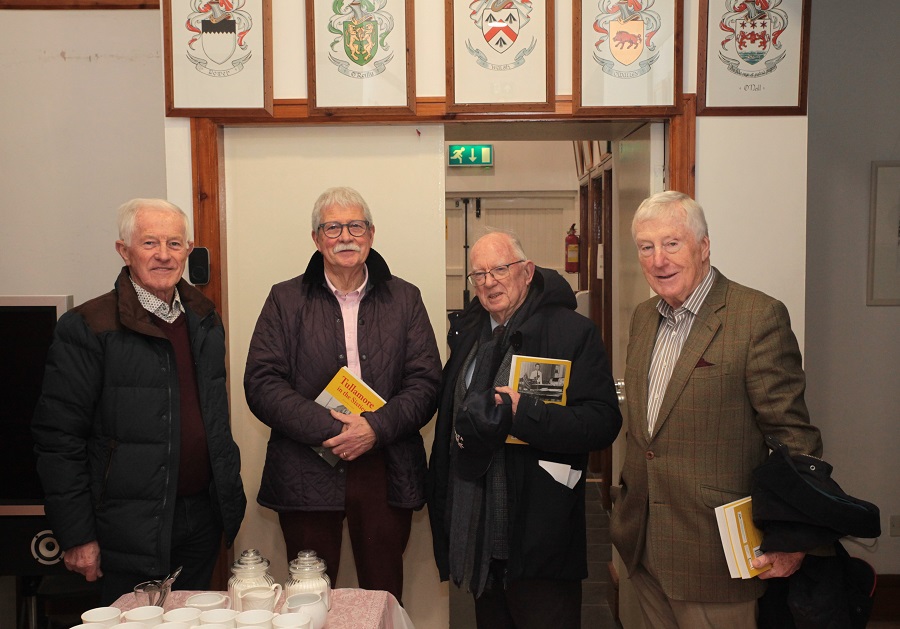
Some of the contributors to Tullamore in the Sixties
The Banagher Brontë Group will round off a great inaugural year with two events this coming weekend. On Saturday 7th December the group will launch Martina Devlin’s Charlotte at 2.30 p.m. in the Crank House, Banagher. The book will be launched by Nigel West whose ancestors lived in Hill House, (now Charlotte’s Way, a well-appointed guesthouse), until 1959 when it was sold to the local Church of Ireland community.
One of the essays in the new book on Tullamore in the Sixties to be launched on Friday 6 December 2024 at 7.30 p.m. at Offaly History Centre (beside the new Aldi store in Tullamore, all welcome) is that by Terry Adams on his beloved Cormac Street, Tullamore where his family have been located for 150 years or thereabouts. Terry’s is an evocative piece and one of 29 essays in this new book on Tullamore with over 300 pictures.
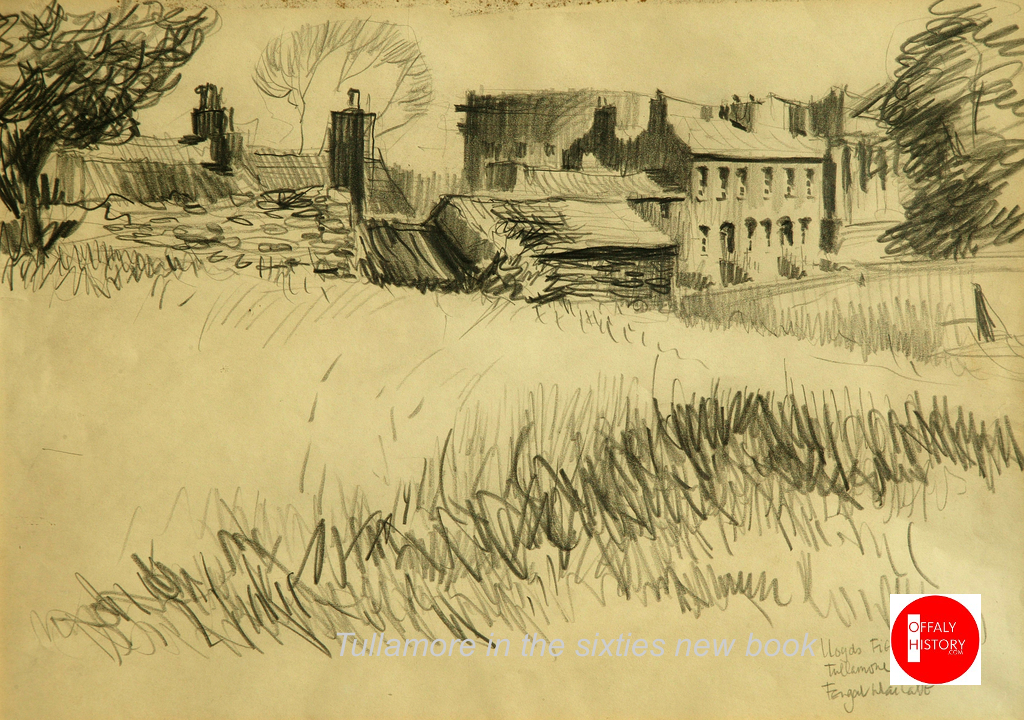
I stood with my back to Lloyd’s field, surrounded by memories of childhood and family. On my left, back towards the town, my Grandmother Egan’s family home, The Hall, now the municipal council offices, nestles behind its railings and garden. Opposite, on the junction of Cormac Street and O’Moore Street, stands the building I was born in, now home to my brother Brian. My Adams grandparents’ house faces me across the street. Further along the imposing old courthouse and jail buildings sit in their solemn majesty.
The view from Kilcruttin Hill courtesy of Fergal MacCabe
Cormac Street, my street, even if I have not lived here since 1981. When I think of home it is to this street, to these buildings, my mind roams. It is a major part of me, of my identity, of who I am, of who I always will be. I look back towards the town centre, the street has changed little since my childhood. The house exteriors, excluding The Hall, have not been radically altered but most of their old occupants have left us: my father, also Terry, Frank and Carmel Egan, Ray and Sylvia Courtney, Ray and Emer McCann, Mr and Mrs McNeill, Mr and Mrs Brennan, Bridie Byrne, Jimmy and Marcella Byrne, Mrs Behan, Paddy and Mrs. Lloyd……
As we wait the outcome of the General Election today (30 Nov. 2024) we could look back to 1969 when Offaly returned three TDs in the five-seater Laois Offaly Constituency.[1]
How many in Offaly did not vote yesterday? We should recall that between 1885 and 1922 there was no opportunity to vote in North Offaly save in the Adams- Graham by-election of 1914 when Graham won by 79 votes as an unofficial candidate not backed by the Irish Parliamentary Party.
For the 1969 general election the slogan was ‘Let’s back Jack’. It was a campaign in which Fianna Fáil ran five candidates and secured three seats in Laois-Offaly. Tom Enright of Fine Gael picked up the O’Higgins seat. None of the winning candidates was from Tullamore. It was a reflection of the fact that Fianna Fáil (F.F.) back to the late 1920s, was strongest in Clara, Ferbane and west Offaly. In the event Offaly secured three new TDs and a first for the towns of Clara and Birr where Ber Cowen (F.F.) and Tom Enright (F.G.) were elected while Ger Connolly of Bracknagh was elected for F.F., having been added to the ticket. Fianna Fáil, with the help of some adroit redrawing of boundaries, secured two more seats than they had in 1965, and Labour had set itself against a coalition. Fianna Fáil won 51.7 of the seats with 45.7 per cent of the votes.[2]
This volume of essays brings together the contributions of eighteen people who kept a keen eye on developments in Tullamore in the 1960s. Perhaps none more so than the late Joe Kenny who came to Tullamore in the 1950s as a vocational schoolteacher and was held in high esteem for his sound judgement and abilities as an impartial chairman. In that capacity he was the inaugural president of Tullamore Credit Union in 1963. Fergal MacCabe, as a Tullamore native, with a professional life in architecture and town planning in Dublin, brings a unique contribution by way of his recollections of Tullamore in the 1950s and his review of the first town plan of the 1960s. The same can be said of Vincent Hussey as a planning officer with Offaly County Council with his recollections of Tullamore since the 1960s. Niall Sweeney, an engineer and former Offaly County Manager, takes a close look at the provision of public infrastructure in Tullamore over the period from the 1960s to 2014. The late Jack Taaffe, as town clerk in Tullamore in 1970–72 demonstrates just how underfunded urban authorities were in those years. He went on to become county manager in Westmeath presiding over the progress of the county from 1981 to 1988. Michael Byrne looks at the history of business in Tullamore and sought to cover the principal enterprises of the 1960s in manufacturing, distribution, shopping, entertainment and dancing. Noel Guerin, as a former employee of ‘the bacon factory’, was able to write of a company that employed up to 100 people in Tullamore over forty years and made the name of the town famous for the Tullamore sausage. Ronnie Colton, from his own extensive involvement in the motor business brings a knowledge from the garage floor and sales yard that few others can match.
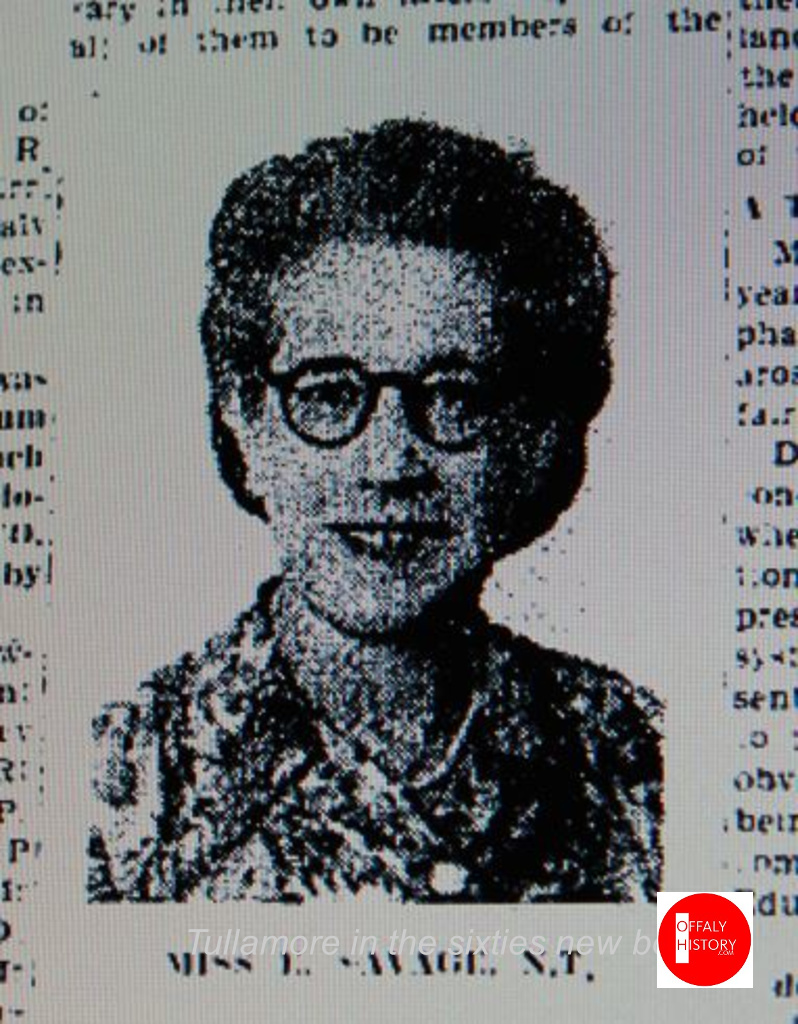
Miss Savage, a well-loved teacher in the Mercy primary school
Alan Mahon, as the grandson of an innovative cinema proprietor, recalls two cinemas in Tullamore whose cultural contribution is perhaps forgotten now but was all important to the people of Tullamore and district over a period of sixty or seventy years, if one takes it from the commencement of the Foresters cinema (later the Grand Central) in 1914.
Sport, so important to so many, brings us to the essay by Kevin Corrigan who looks at a formative decade leading on to the GAA Senior Football All-Ireland victories in the 1970s. Kevin had the challenging job of reducing to a short essay what could fill twenty books were one to address in detail each of the sporting activities that came to the forefront in the sixties.
The recording of my mother Josephine was made in 2006 as part of my research on local history and my mother’s interpretation of it. At the time, little did I know the significance that it would have, not just from a local history record perspective but also in a deeply personal context.
Our family connection here in Tullamore began in 1923, when a young Dublin native, Josephine Moore came to work at McCann’s as a housekeeper. This building later became the Tullamore Enterprise board ( now occupied by Jigsaw) Cormac Street. She married William Gorman, a local man. My mother, also called Josephine, was born in 1928. Mum left school aged 14 and she would have been the first to admit that she lacked a proper education. In those unkinder days, walking to school barefoot and being put to clean up in the home economics room by the nuns after the wealthier girls had cooked was all too often a regularity. She would have liked to have had a career as a nurse she often said.
The 1824 Survey of Irish schools and the reason it was carried out must be put in context. That context probably can be traced back to the Gavelkind Act, enacted in the Protestant Irish Parliament 120 years earlier in 1704. This act brought into force what became known infamously as the Penal Laws.
The Penal Laws were intended to protect the interests of the Protestant Ascendency from any future threat from the Catholic majority. Amongst these laws was one stating that “No Catholic may attend a university, keep a school, or send his children to be educated abroad. £10 reward is offered for the discovery of a Roman catholic teacher.”
These laws were severe, but as time went by, were more observed in the breach. Teachers, many of whom lived an itinerant lifestyle for fear of discovery and arrest, moved around the country, being sheltered by families in the areas where they would provide lessons for local children, often in outdoor, secluded areas, protected from view by hedges and the alert observations of a well-positioned look-out. This led to the use of the term ‘hedge school’, the convenor of which was known as the ‘Hedge School Master’.
At one time I didn’t think, but now I definitely do think, that the pleasantest way of seeing Ireland is from a seat in a bus. I do not mean one of those eight-day bus tours, conducted and excellent and comfortable as they may be, I mean the couple of hours spent bussing from one country town to another. [So announced Lennox Robinson in an article first published in the Irish Press and later in his compilation I sometimes think (Dublin, 1956). He would possibly have been amused to know that bussing has another meaning nowadays when students get together in a college dorm. Robinson was not inspired by some of the women who joined his Tullamore to Banagher and Birr bus. Now read on.]
If you travel in a friend’s car, you are cribbed and confined, he or she has to make talk with you and you have to return the ball of conversation; a train nearly always looks for and finds, the most poor and uninteresting country to travel through, and when it reaches an interesting town, Portarlington, for instance, is careful to stop a mile away from the place, John Gilpinish.
But a country bus swirls along, is very swift, and yet can be leisurely, picks up a parcel here and delivers a bundle of papers there.
We are, back in the old coaching days : the conductor knows everyone-or nearly everyone-and has a friendly word for each on-comer or down-getter. He sets down Mrs. Maloney at the Cross and helps an old Jack who is off to spend the day, his pension-day, in the town: yet he can be severe and inexorable on the question of accepting bikes.
I am beginning slowly to fall in love with the midlands slowly, because there is nothing tempestuous or flashy about them. The vivacity of Kerry and Donegal, the cuteness of Cork and Antrim-these are lacking, and instead there is a lovely autumn-afternoon placidity, golden and Veronese-woman-like atmosphere. The very names of sleepy; they are bees in August Lime-trees: Birr, Clogher, Ferbane, Clara, Mountrath.
It was a big day for Offaly at the Heritage Week Awards held in the wonderful Royal Hospital Kilmainham on Friday 15 November 2024. As Amanda Pedlow, the Offaly Council Heritage Officer noted:
It was Offaly’s day at The Heritage CouncilHeritage Week Awards in Kilmainham today. James Scully is the well-deserved winner of the national Heritage Hero Award.
Lemanaghan Bog Heritage and Conservation Group were runners up in the Intangible Cultural Heritage Award (The Mícheál Ó Muircheartaigh Award) for their project recording traditions and folklore of Lemanaghan.
Very soon now Tullamore will have a new Aldi Store at Tay Lane/O’Connell Street, Tullamore. This is the company’s second store in the town/The first was opened in 2000 at Cloncollog and preceded Tesco in 2004 (who once occupied the adjoining Tay Lane site and are near neighbours of Aldi at Cloncollog). Lidl and Dunnes already have two stores each in Tullamore and now Aldi will join this grouping with an investment in Tay Lane of close on €20 million when all expenses are taken into account.
Tea Lane (‘Tay’ Lane) is a popular old street name in Tullamore and most people seem to know that it was the area from the Al Conroy Printing Works (now again Stella Press under Brian Conroy) as far as the Offaly History Centre on the corner of Bury Quay and the former bonded warehouse (the Tullamore DEW Old Bonded Warehouse, 2000–20) and since December 2022 the Old Warehouse bar and restaurant (proprietor Shane Lowry). The name was in existence as early as 1821. The northern part of the lane was called the Old Fair Fields on a 1791 lease map. More changes are now in hand with the opening of a new Aldi store in late November 2024, following on the demolition of all the Irish Mist warehouses (erected from 1970 to 1985) and the great oats store of 1929. Irish Mist and Williams constituted the third layer. The first was that of long gardens from Patrick Street to almost the canal bank and before the canal (1801) the old fair fields. The second was the Williams buildings on these lands post 1897 and before their demolition for the new Irish Mist buildings of 1970-1985. Now Aldi will provide the fourth layer.



 offalyhistoryblog