In the first two articles in this series we looked at the leasing of the sites in O’Connor Square and who built the houses. Today we look at the timeline and we have added more recent detail on occupiers and uses. There are sixteen properties to cover from the four on the west side to twelve in the main part of the square.
Commerce, community, and creativity are all part of the weave.
Golden, sophisticated, with a dash of mystery Irish Mist occupies a special place in the history of Irish distilling.
Ireland’s legendary liqueur might well be described as the accidental offspring of Tullamore Dew.
First produced in 1947 in response to the urgent need to make economic use of excess stock of whiskey it proved to be an inspired idea by Desmond Williams, grandson of the founder of the Tullamore Dew whiskey company.
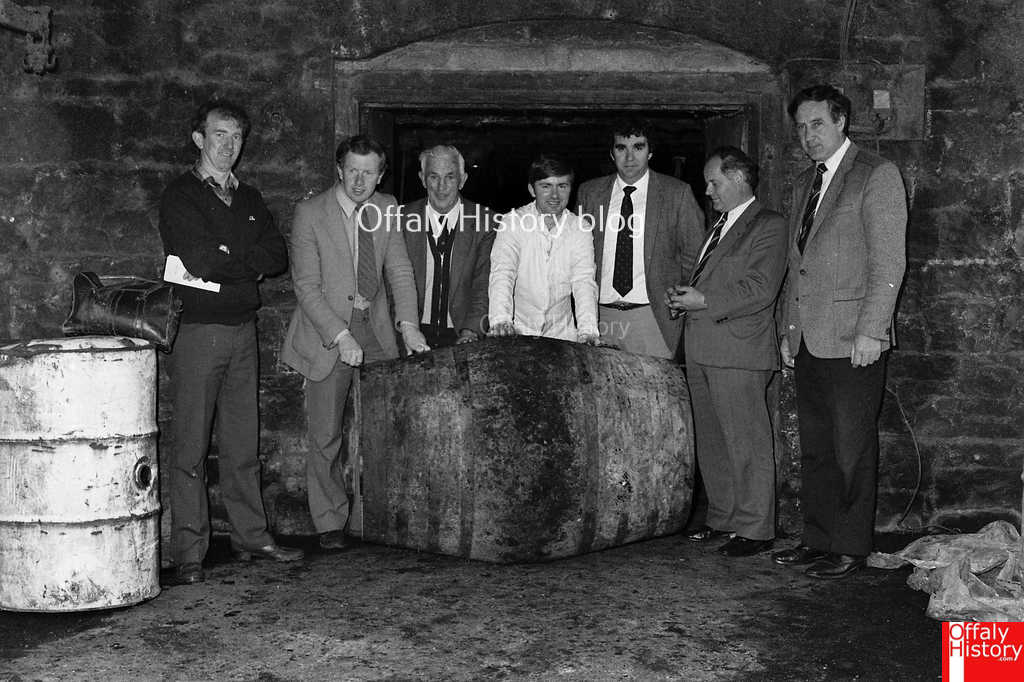
Rolling out the barrell – the last whiskey is the famous Sally Grove warehouse in Water Lane – now called Main Street with Irish Mist staff and the officers of the Excise in 1983.
The history of Irish Mist involves a secret receipt from a mysterious Austrian distiller, celebrated through the famed ceramic figure made by Coronetti, Cunardo, Italy.
Now a collector’s item the splendid figurine is a replica of an Irish officer in the Austrian army from the 1750s.
In the first half of the nineteenth century all of the original buildings in O’Connor Square were three-storey with the exception of the market house and the house where PTSB is now located (GV 8). The finest house was that of Pim/Wilson (GV 7) of c. 1740–48 (demolished 1936) and not unlike the fine houses in the square of the Quaker settlement of Mountmellick where the Pims and Wilsons would have had connections.
Over a series of articles, it is intended to examine the evolution of the ‘market place’, Tullamore to the fine square it is today. It is intended to look first at the evolution of the square over the period from 1713 to 1820 with additional comments on the building history in the last 300 years in the second article. This will be followed with analysis of the return for the 1901 and 1911 censuses and thereafter case studies of two of the houses in the square. Both are public houses, the Brewery Tap and The Phoenix, and business is conducted in the original houses albeit that both have been extended. Both are well known with the Brewery Tap one of the oldest pubs in Tullamore and The Phoenix the newest. The Brewery Tap house can be dated to 1713 and The Phoenix as a house to 1752.
Ireland has been associated with the loss of its people through migration for centuries. The analyses by the Central Statistics Office identifies that the famine of 1845 – 52 led to a peak in migration and changed the country’s demographic, political, and cultural landscape. Related themes of endemic poverty and religious intolerance were reasons why others left Ireland’s shores trying to find a better life. Literacy rates in 1841 were 47% but by 1911 had risen to 88%. Limited literacy hindered emigrants maintaining contact. Migration could mean that when someone left, they were gone for good and it was unlikely they would ever again speak to or see friends or family back home. Apart from emigration, Irish demographic anomalies, such as late marriage and large families led to people being dislocated from their families. The age gap between parents, particularly fathers, and children was frequently such that being orphaned in childhood was common. Often, there was also a large age gap between older and younger siblings, with the latter hardly knowing brothers or sisters who had left home or emigrated while they were still in infancy. [i]
This context helps me to understand a phrase my mother used when she reminisced about her family life with three sisters and parents, growing up in the Midlands as workers at the ‘big houses’. They would join friends and listen to fiddle playing in the evening occasionally. When I asked her about someone she had described and what happened to them, she would sometimes say ‘Oh, he just walked’ often adding ‘it was very common then’.
So far we have looked at the 1821 and 1901 censuses for Castle Street, Birr together with traders in the street in the nineteenth century (see previous articles by going to the blog section on http://www.offalyhistory.com.) There were a lot of new families in Castle Street in 1911 when compared with 1901 based on the surname of the occupiers – not always a reliable guide. Families where there was continuity included that of John Wall, James Sammon, Patrick Connors, Laurence Kennedy, Owen Gaffney and Elizabeth Watterson.
In my previous article (Part 4) on the history of the Ballyduff quarries I looked in more detail at one of the Wrafter families involved in stonecutting at far back as at least 1807. In this article I will relate the story of two other Wrafter families of stonecutters. Members of these families are still active in the cutting, carving and sculpting of stone.
Wrafter family #2
This Wrafter family were also from Ballyduff and were heavily involved in the stonecutting trade at least from the 1850’s onwards. Between 1850 and the 1950’s at least 12 men from three generations of this family were stonecutters and most of them had at one time or another lived in Ballyduff and learned their trade at the nearby quarries. The lack of older records makes it impossible for me at present to say to what extent this family, and indeed even the other Wrafter branches, were involved in stoneworking before 1800.
Belonging to the earliest generation of stonecutters were Thomas (b. 1835, d. before 1882) and Patrick (b. ab. 1842, d. 1889). Five sons of Patrick Wrafter and his wife Katherine (nee Walsh) became stonecutters (John, Patrick, Jim, Joseph and Alec). After learning their trade in Tullamore Jim, Joseph and Alec practised their trade for extended periods in Cork and Dublin.
John worked a quarry of his own in Ballyduff in the late 19th – early 20th century. Patrick worked a quarry together with some employees in the neighbouring townland of Arden until at least 1928. Alec returned to Tullamore and also worked part of the Ballyduff quarries up to the 1950’s.
Stonecutters from this Wrafter family worked on the building of the new Catholic Church in Tullamore circa 1906. In 1908, they carved the stone tracery for a new stained-glass window for St Catherine’s Church (Church of Ireland) in Tullamore. Several of the Celtic cross grave monuments at Clonminch cemetery in Tullamore bear the names of John and Patrick Wrafter, and can arguably be considered works of art.
Clonminch, Tullamore 2
Fig. 1. Celtic cross headstones sculpted by John Wrafter (1866-1941). Erected in or around 1910 in Clonminch cemetery, Tullamore. The monument in the photo on the right (2) was made by John for his own family; three of his children and his wife are named on the headstone.
Four of the Wrafter brothers (John, Jim, Alec and Joseph) were active in the Stonecutters’ Union of Ireland, a trade union for stonecutters. The photo below is of representatives of various branches of the Stonecutters’ Union of Ireland, as well as of the union’s central organisation. The picture was taken about 1905. Two of the brothers feature in the photo:
John Wrafter (b 1864), representative for Tullamore and Alec Wrafter (b 1879), representative for Dublin.
Fig 2. Photo of members of the Stonecutters Union of Ireland (obtained from Barry Wrafter). Alec Wrafter (Dublin) back row, 2nd from the left. John Wrafter (Tullamore) back row, 2nd from the right.
James (Jim) Wrafter (b 1872) was Treasurer of the Union (perhaps the Dublin Branch) about 1909.
Joseph Wrafter (b 1882) was elected Annual Auditor of the Stonecutters’ Union of Ireland in 1907. Joseph was not living in Dublin at the time so involvement in the union would have meant regular trips by train to Dublin to attend meetings in Capel St. Several years later Joseph moved to Dublin and by 1932 he had been elected the General Secretary of the Stonecutters’ Union of Ireland. He died in Dublin in 1936.
Among the members of the Tullamore Company of the Irish Volunteers in 1916 were several stonecutters and masons from the Bracken, Wrafter and Molloy families. Joseph Wrafter was an active member and played a big part in the events of 20 March 1916, which became known as the “Tullamore incident”. In a skirmish, shots were fired and a bullet from the gun of Peader Bracken (another stonecutter) hit police sergeant Ahern. Joseph and his fellow volunteers were tried by a military court and ultimately released without conviction. Joseph was the father of the late Sister Oliver, who was a Presentation nun in Rahan and a keen local historian.
Recurring issues at the Union meetings reported by the press were demands for the use of Irish limestone in construction and the employment of Irish stonecutters in quarrying and dressing stone. Another demand was that available jobs should go to trade union stonecutters.
In 1896 stonecutters of the Stonecutter’s Union at the Ballyduff quarries went on strike over demands for higher wages and a half-day on Saturdays. The strike was short-lived as a settlement was promptly reached. Three decades later in 1922, there was another dispute over wages. This time the settlement resulted in a reduction of wages of stonecutters by 5 shillings to £3-10s, and of quarrymen by 2 shillings to £3. This may have reflected a decrease in the demand for quarried stone. In the early years of the 20th century concrete blocks began to replace stone for construction purposes, a development that was much criticized by the Stonecutter’s Union.
Several of the next generation of the Wrafter family entered the stonecutting trade. I will mention just two of them here. Patrick Joseph, born c. 1899, son of James, emigrated to America. He states his occupation as stone carver on his wedding certificate of 1922 in Albany, New York State.
John born 1891, son of John (b 1864), became a stonecutter/sculptor in Tullamore. By the 1930s he had left the stone trade and became a grocer and publican, with premises on Harbour Street (Wrafter’s Harbour Bar).
The latter half of the 20th century saw the continuing decline of the stonecutting trade. The carving of headstones was one of the few activities that survived for the employment of stonecutters. Among the Wrafters of Tullamore the trade died out. Four or five decades passed without a Wrafter putting his signature to a piece of stonework. Then in the late 1990s the Wrafter name appeared once again in connection with stonework. Barry Wrafter, the great-grandson of stonecutter John Wrafter, born 1864, and grandson of John Wrafter of the Harbour Bar, revived the family tradition, and has made a name for himself as a sculptor and stone carver.
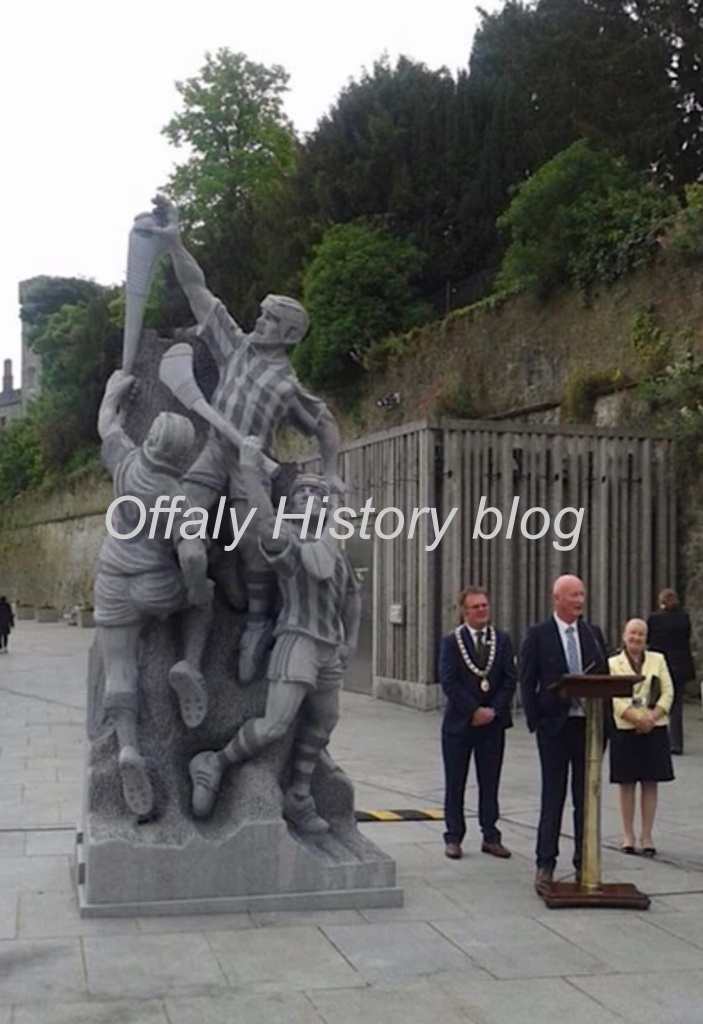
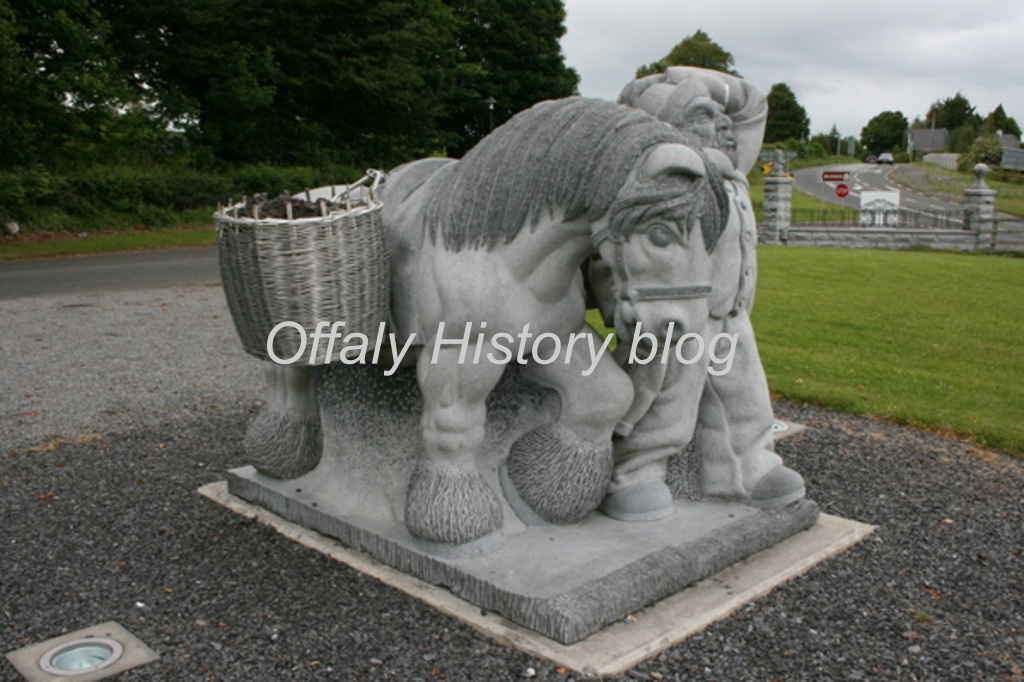
Growing up in Ennis, Co Clare, Barry returned to the trade of his forefathers as an outlet for his creative talent. He became interested in stone carving and sculpting after learning about the history of stonecutting in his family. Barry is one of only a few stone carvers using traditional methods and skills operating at the current time in Ireland. Since 1999 he has been commissioned to produce several public works throughout Ireland. His most ambitious work to date is undoubtedly the hurling sculpture in Kilkenny city (Fig 2), which he worked on in 2016-17. Closer to the home of his ancestors is “The Turf Cutter” from 2007, which is to be seen at the entrance to Belvedere House Garden and Park, near Mullingar (Fig 3).
Fig 3. Barry’s major work, the Kilkenny Hurling sculpture in Irish limestone completed in 2017. (Photo: http://www.barrywrafterart.com)
Fig 4. The Turf cutter sculpture at the entrance to Belvedere House and Gardens. (Photo: http://www.mckeonstone.ie)
More recently (in 2022), Barry was employed in the restoration of the Primark store (also called The Bank Buildings) in Belfast. The building, made of red sandstone from Scotland and completed in 1900, was ravaged by a fire in 2018. Some of his work can be seen in the photos below.
Fig 5. Pieces of carved sandstone ready for mounting into place in the Primark department store in Belfast. (Photo: Barry Wrafter)
Fig 6. Part of the facade of the Primark department store in Belfast during restoration. (Photo: Barry Wrafter)
Wrafter family #3
The third Wrafter branch involved in stonecutting may have started with Timothy Wrafter, born about 1804. Timothy, who lived in Aharney (a townland about 6 km northwest of Tullamore), was a stonecutter and farmer. He married Bridget Houghran in 1839 and had a large family; they had at least 11 children between 1840 and 1861.
At least two of the sons became stonecutters. John, born 1840, had settled in Chicago by 1880. He was married to Mary Molloy. He died in Chicago in 1904, age 65, occupation “Stone cutter”.
Another son, Timothy, born in 1849, married Anne Somers in 1877 and emigrated with his wife and two young children to Australia in 1883. They settled in the Brisbane area, where Tim continued his trade as a stonemason. Before leaving Ireland he probably worked for John Molloy at the Ballyduff quarries.
Timothy’s nephew, also called Tim, was a stonecutter according to the 1911 census. He was living with his parents in Ballykillmurray, close to Tullamore and the quarries, according to the same census. A couple of years later, in 1913, Tim made the same journey as his uncle had done 30 years earlier. He arrived in Brisbane, Queensland on 19 December 1913 on the ship Perthshire. Working with his uncle Timothy, the younger Tim learned the ropes of the trade.
Timothy eventually procured the business from his uncle and together with his two sons, Denis and Joseph, who were apprenticed as stonemasons, they founded the firm, T. Wrafter & Sons in Brisbane. It is still owned and run by the Wrafter family. They are the fifth or sixth generation of this Wrafter family involved in stonecutting. The company produces monuments, memorials, public works, and carries out church work, stone artworks and heritage restorations.
One of their most recent works is a 5-meter-tall Celtic cross standing on the grounds of Nudgee College in Brisbane. The monument, erected in August 2021 to mark 130th anniversary of the college, celebrates the school’s Irish Catholic heritage. Peter Wrafter, Company Director and a qualified stonemason, is a former pupil of the school. The material sought after for the cross was one that would exhibit good weathering properties and would have a colour resembling crosses in Ireland. Australian black granite was chosen and after a sandblast finish resembles the colour of Irish limestone. This beautiful work of art is a testament to the legacy of the Ballyduff stonecutters.
Fig 7. A recently erected Celtic cross on the grounds of Nudgee College in Brisbane made by T Wrafter and Sons, Stonemasons. (Photo: https://twstone.com.au)
Fig 8. An example of one of many public works in stone designed and produced by T Wrafter and Sons, Stonemasons., Brisbane. (Photo: https://twstone.com.au)
Given the prevalence of the name Timothy in this family there may be a link with another Timothy Wrafter who died in 1815 and whose headstone can be found in the graveyard of the old Church of St Carthage in Rahan. The tombstone is ornately carved as can be seen below.
Fig 9. The gravestone of Timothy Rafter who died in 1815, aged 33, in the graveyard of the old Church of St. Cartage in Rahan. (Photo: Paul Stafford. From booklet Offaly Tombstone Inscriptions. 1. Rahan Graveyards)
Thomas Wrafter is another Wrafter stonecutter that emigrated to Australia in the 19th century. Thomas ran a quarrying business on the outskirts of Adelaide in South Australia in 1880. He employed several stonecutters. He may be the same Thomas Wrafter that emigrated from Ireland and arrived in Brisbane in 1866. I have not been able to link him to any specific branch of the Wrafters.
Conclusion
In my research into the quarries and stonecutters of Ballyduff and Tullamore a picture has emerged that shows that the limestone quarries of Ballyduff produced some of the finest building and monument stone in Ireland. Moreover, the stonecutters that originated in Tullamore were widely recognized as some of the best in the country, and those that left Ireland (mainly to Australia) found that their skills were highly valued in their new homelands.
Many thanks to John Wrafter for these articles. Great research and we look forward to a printed publication in due course, Ed.
On several walking tours of High Street, Tullamore in 2023 what stuck one was how good the architecture is, the plan of the street, how much has survived, and the extent of reforms and repairs needed to houses that have become dilapidated. This article is about no. 29 High Street, the former Motor Works, and a dwelling or manse for the Presbyterian minister for over thirty years from the early 1900s. The number 29 is derived from that in the first printed Griffith Valuation of 1854.
The former Motor Works, 29 High Street, Tullamore. The signage has now been removed. If the shop fronts were removed, walled area restored and sash windows inserted etc etc.Lived in and looking well will be a good compromise in these times when so many fine town houses are strugglingfor life.The garden once ran to Moore Hall and behind it. The two houses to the left were also built on this generous leasehold. But then what would you not do for your doctor?
No 29 is the first house on the upper east side of High Street and occupies an important visual position when seen from Cormac Street and in the distance from the old road as one walks out of Charleville Demesne. The house is of five bays and three storeys, and has ‘gable-ends with rough cast battered walls and a high pitched, sprocketed roof. The windows are small and have a good rhythm which slows towards the centre. However, they have lost their original glazing-bars. The house has a simple round-headed, architraved doorcase which is probably later in date. (Garner, 1980).
In 2022, Barry Wrafter, sculptor and architectural stone carver, was interviewed about his work on Clare FM local radio. Among other things, he talked about the value of using traditional methods and skills in working with stone. Barry is the latest in a long line of Wrafters who have made their living by working with stone. The Wrafter involvement in quarrying and stonecutting in Ballyduff and Tullamore goes back almost certainly to the 18th century which means that the Wrafter name and its association with stonecutting has spanned four centuries.
I have identified three distinct branches of the Wrafter family that were involved in quarrying, stonecutting, and stone carving. In this article, I look more closely at one of these families. The other two branches will be dealt with in a separate article.
In earlier blogs for Offaly History (March 19 and April 20, 2022) I mentioned my great-great-grandfather John Wrafter (b 1794) and his role as sculptor in the building of the county gaol in Tullamore, in 1826. I mentioned his involvement in the making of the windows of the Catholic church in Birr in 1842, and the windows of St Laurance O’Toole church in the centre of Dublin in 1848. John was also contracted to build the workhouse in Tullamore in 1841. I also touched on his son John (b 1828) who, among other things, provided chiselled stone from Ballyduff qurries for a Presbyterian church in Mountmellick. Below I take a closer look at their involvement in stonecutting and the Ballyduff quarries.
The growth of the soccer club and the rugby club from the mid-1960s led to increased pressure on the grounds such that from time-to-time fixture lists had to be substantially revised so that a pitch would be available. The soccer club enjoyed a tremendous burst of success right through the 1960s while the rugby club was fielding a 2nd XV from the mid-1960s. It was this pressure on the resources at Spollanstown that, more than anything else, led to the dissolution of the Sports Club in 1971. But a secondary factor was the collapse of the carnivals and marquee dancing as a profitable venture from 1966. Thereafter for some five years substantial revenue was earned from Saturday night dancing. These Saturday night hops were largely the responsibility of the rugby club and the profits generated made the argument for independence irresistible. In January 1968 the rugby committee noted that the Sports Club had had a disastrous year financially and would be down £300 but for the profit of £540 from the Saturday night dances. The view of the meeting was that the rugby club wanted a home of its own even if this meant leaving Spollanstown. Soon after the Sports Club met and agreed to dispose of the bungalow built for the caretaker adjacent to the grounds for the sum of £2,650 to pay off the liabilities of the trustees.
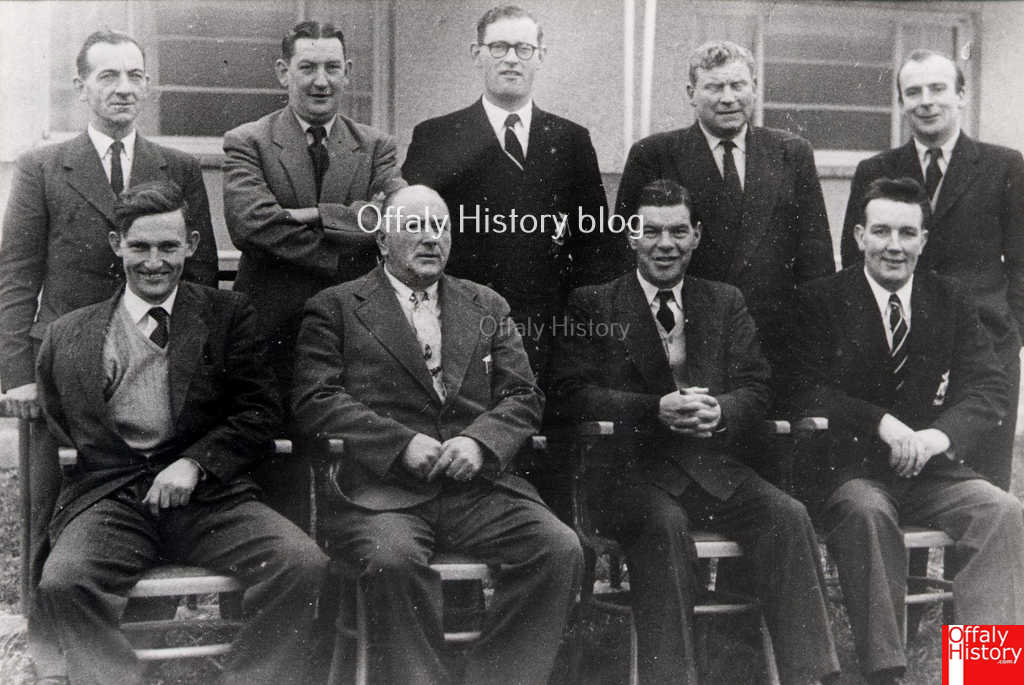
First trustees of the Tullamore Rugby and Soccer Club, 1956. Back row: T. Kelly, G. Smyth, H.L. Egan, W. Champ, D. Kilroy; front row: Terry Adams, W. Stephens, J. Kilroy, O. McGlinchey.(more…)





 offalyhistoryblog