James Weale was appointed to the position of clerk in charge of Irish land revenue in the Commissioners of Woods, Forests and Land Revenue in 1827. The Commissioners managed the English kings’ estates. His actual position was that of the tenth clerk in the London Office but that did not describe his role in Ireland. Prior to his appointment these lands had been managed by officials in the Treasurer’s Office in Dublin Castle but following the Union of 1800 many Dublin offices were amalgamated with their counterparts in Whitehall. The Woods Commissioners were aware that the lands had been poorly managed in Dublin and were determined to introduce a better administrative structure. Weale continued to live in London but spent some months in Ireland from his first visit in 1826 till he died in Dublin in 1838. Weale had been secretary to Lord Sheffield prior to his appointment as an administrative clerk in the Woods Office in 1810. From 1827 he supervised the sales of many of the Crown’s remaining Irish estates. Further, he was the principal organizer in the few attempts to reform and regenerate life on ailing estates like Kinnitty, King’s County and Kingwilliamstown (now renamed Ballydesmond) in northwest Cork. In his management of these estates, he ran afoul of many of Ireland’s most powerful and influential landowners and encountered opposition from some of the personnel in Dublin Castle who resented the new management from London. Weale’s role in Ireland has been largely misunderstood but mainly ignored.
The 1937 Pulitzer Prize winning book and subsequent Oscar winning movie were set in Clayton and Atlanta, both in Georgia, during the American Civil War and Reconstruction Era. It depicts the struggles of young Scarlett O’Hara, the spoiled daughter of a well-to-do plantation owner, who must use every means at her disposal to claw her way out of poverty following Sherman‘s destructive March to the sea.
The author of Gone with the Wind was Margaret Mitchell. While Margaret Mitchell’s Irish heritage is well known, most of the focus has centered on her maternal great-grandfather, Philip Fitzgerald. It’s believed Philip emigrated from the Fethard area of Tipperary and eventually settled on a plantation near Jonesboro, Georgia; where he had one son and seven daughters with his wife, Elenor McGahan, who was from an Irish Catholic family.
208 years ago, the Battle of Waterloo took place in Belgium. The armies under the command of the Duke of Wellington defeated Napoleon, putting an end to the Napoleonic Wars, which had begun in 1803. To mark the victory and acknowledge the men that fought at the battle, a campaign medal was decided upon by the House of Commons. Rather than given for acts of bravery, it was given to all those involved in the campaign. Similarly, other counties in the coalition issued medals of their own, however the medals issued by the British were named to the recipient, making it possible to trace them. In today’s post, we will look at one of these Waterloo medals, which was awarded to Private John Dargin of the 54th Regiment of Fo
John Dargin was born near the parish of Kilbride or Tullamore. He enlisted in the British Army on 6 May 1812 and was a labourer. Assuming he would have been around 18 years old at the time of his enlistment, this would place his birth around the 1790s.
This week we provide an extract from the book to be published in November 2023 on Irish Mist Liqueur, a unique Tullamore-based product for almost forty years. Many homes have the Irish Mist Soldier in pride of place on a dresser so here is some more information about it from John Flanagan, the production manager with Irish Mist for twenty-five years. The book will be published in the autumn. You can email us to reserve a copy for you. No money now thanks. The book has support from Creative Ireland and Offaly County Council.
The Irish Mist ceramic figurine was made by Coronetti, Cunardo, Italy. Each one was individually hand-painted by different artists in the factory. The figurine is a replica of an Irish soldier (officer) in the Austrian army about 1756. The Austrian connection is associated with the founder of the recipe for Irish Mist Liqueur who was Austrian. Irish Mist was known as the Legendary Liqueur.
The closure in 2012 of Offaly Express, where I served as a staff reporter from 1988 to 2007, marked the end of an era in local journalism.
When I was a schoolboy, living in Tullamore, the dominant local paper was the Offaly Independent, though the Midland Tribune circulated to a degree from Birr. The growth of Tullamore led to a feeling that a specifically local paper was needed, and in 1978, the Tullamore Tribune was launched, under the editorship of the late Geoff Oakley. He remained in that post until he retired in 1994, when he was succeeded by Ger Scully.
The Offaly Express emerged as a sister paper of the Portlaoise-based Leinster Express, which began to circulate around Tullamore in 1984, though it already had a presence in Edenderry and the eastern half of Offaly. Much of the credit for the Offaly edition must lie with the late Kevin Farrell, who would surely have enjoyed the irony of the fact that his death in July 2012 took place the very day on which the Offaly Express ceased publication and that it had to hold on to report the sad news of his passing.
We are drawing to the end of a period of remembrance and reflection on the events that took place during the period 1912–1923 and the emergence of the Irish state as we know it today. These commemorative events have been referred to as the Decade of Centenaries (www.decadeofcentenaries.com)
As we proceeded through the decade of commemoration, it became apparent that little was known or reported about the many women who were active throughout this period, with some notable exceptions such as Constance Markievicz and Mary MacSwiney, but including thousands of other women. Mary McAuliffe has pointed out that there has been a failure to see the women of 1916 and the subsequent years as historical figures. An additional strand has been added to the Decade of Centenaries online resource. ‘Mná 100’ is an online women’s initiative for the final phase of the Decade of Centenaries Programme and continues to work in highlighting the role of women in the revolutionary period (www.mna100.ie). Caitlín Kingston was one such woman.
Caitlín Brugha (nee Kingston)
Caitlín Kingston was born in Birr, Co Offaly, in 1879 to William Kingston and Catherine Roche. The Kingstons were quite prosperous and owned a large store in Main St, Birr dealing in groceries, spirits and delph. They also owned land outside the town. Caitlín had two brothers, John was a Holy Ghost priest in Rockwell College and Charles was Offaly County Secretary during the difficult period of 1900 to 1921, steering the county through the minefield that was local government during the transition from British rule to Irish rule. She had two sisters, Máire who went to live with Caitlín and helped her raise her family after the death of her husband, Cathal Brugha, and Hanoria/Nora who joined the Sacred Heart order of nuns in Roscrea. Caitlín herself was educated in Roscrea. On the death of her father William in 1904, Caitlín helped her mother to run the business. However, they sold that business in 1910 and moved to Dublin.
High Street is still the principal street in Tullamore and this has been so for the past two hundred years. It, together with Bridge St., O’Connor Square, O’Moore St., and Cormac St., deserve detailed attention because of the quality of the surviving urban fabric. The same might be said of the terrace in Church St. and Bury Quay/Convent Road Terrace. Patrick St. has a few houses of very high quality. The designation of principal street applies to the quality of the surviving houses and not to extent of business, or the number of those living in the houses as owner occupiers of the original residences. A walking tour of O’Connor Square and High Street, Tullamore organised by Offaly Historical and Archaeological Society on 18 June 2023 has promoted this review of what we have published so far on High Street (see the articles listed in the appendix to part 2 of this article (next week) and all online at http://www.offalyhistory.com). This work is supported by the Heritage Council.
Bracknagh a small village in east corner of Co. Offaly, formerly, in the Barony of Coolestown. While originally part of the parish of Clonsast, today it forms part of the parish of Clonbullogue. It borders Co Kildare to the east, lying approximately six kilometres from Rathangan, and borders Co Laois to the west, situated seven kilometres from Portarlington. Geographically it is located on the Figile River and fringes the Bog of Allen.
While Bracknagh village is the focal point of the settlement, the area of Bracknagh includes the hinterlands of Ardra, Clonsast, Clonshannon, Ballinrahan, Ballinowlart, Ballyshane, Nahana, among others.
We are used to hearing of the formal gardens at Birr Castle Demesne and the famous box hedges. The landscape of the demesne has been manicured since the time of Mary, the third Countess of Rosse in the 1840s and 1850s. Later the fifth, sixth and the present seventh earl have devoted much time to demesne improvements. The Illustrated London News in an issue of 1843 was the first periodical with an international circulation to devote space to the demesne (see our earlier blog). In the mid-1960s it was Country Life with the distinguished architectural historian , Mark Girouard, who wrote up three articles on the castle and one on the town of Birr.
A contribution to Tullamore 400 and the Living in Towns initiative of the Heritage Council. Sit down and have a cup of tea with this blog!
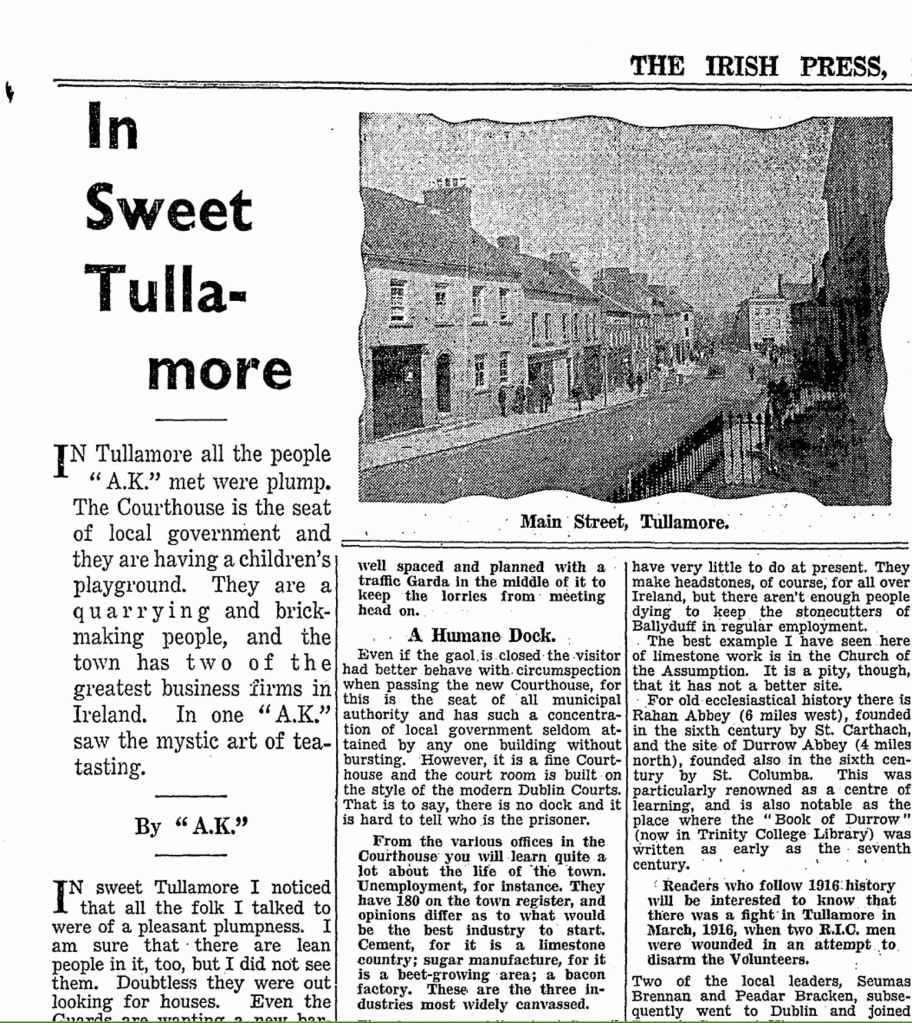
A visit by an Irish Press journalist to Tullamore in 1933 provided a nice puff for the Williams tea business and its brand Red Cup Tea. At the time Williams provided regular advertising in the Irish Press for its tea and Edmund Williams (d. 1948) was a founder director of Irish Press. D.E. Williams’ interest in tea can be traced back to 1895. In the Chronicle and the rest of the local press for February 1895 advertisements appeared in connection with the opening of a wholesale tea business by Daniel E. Williams. In a comment the Chronicle stated that most of the blending was done in London where D.E.W. had larger stores than hitherto. The draft 1917 accounts for DEW Ltd show sales at £8,324. This had risen to £13,807 by 1923. The business was much expanded in the 1930s led by the blender, a Mr O’Shea.
From the Irish Press, 5 May 1933. The picture is from an old postcard rather than sending a photographer.(more…)

 offalyhistoryblog