Over the years, Tullamore has been known as ’Towllaghmore’,‘Tullaghmore’ or ‘Tullymore’ -all anglicizations of ‘Tulach Mhór’ and most likely deriving from the high land to the south of the river. By the middle of the 19th c. the name of the now extensive town had morphed into ‘Tullamoore’- reflecting the influence of the Moore and later the Bury families and their ownership of all the lands around.
As urban developers, these skilled entrepreneurs with cultural pretensions reached their highest point during the overlordship between 1785 and 1835 of Charles William Bury, the first Earl of Charleville. Whether motivated by commercial considerations, a desire for social prestige and the admiration of his peers or by pure aesthetic sensibility, the development of Tullamore as promoted by Charles William, resulted in a coherent urban form which survived without much amendment into the middle of the 20th c., largely still exists today and will influence any future reconfiguration of the town centre.
This is the second of two Heritage Week 2021 blogs by Dr Perry McIntyre AM, a Sydney-based historian, who has used the Birr Workhouse registers to research the lives of workhouse girls who emigrated to Australia under the ‘The Earl Grey Scheme’ during the Great Famine. An accompanying podcast featuring Perry in conversation with Lisa Shortall, Offaly Archives, is available here. The Heritage Council has generously supported the conservation of the Birr Workhouse registers by way of a Community Grant.
My previous blogs have told some stories of these girls and the last one related the sad fate of Elizabeth Walsh. This time we hear about two sisters who remained together for their lives in Australia and had a good outcome.
Sisters, Eliza and Catherine Dooley arrived in Sydney from the Parsonstown (Birr) Workhouse on the Tippoo Saib on 29 July 1850. They were two of the 35 young ‘orphan’ girls who left that workhouse in on 27 March 1850 and travelling by train to Dublin to catch the steamer to Plymouth to meet the sailing of the ship on 8 April 1850.[1]
Our favourite week of the year has rolled around again – Heritage Week 2021 – and we are delighted to publish the first of two blogs by Dr Perry McIntyre AM, a Sydney-based historian, who has used the Birr Workhouse registers to research the lives of workhouse girls who emigrated to Australia under the ‘The Earl Grey Scheme’ during the Great Famine. An accompanying podcast featuring Perry in conversation with Lisa Shortall, Offaly Archives, is available here. The Heritage Council has generously supported the conservation of the Birr Workhouse registers by way of a Community Grant.
In Ireland, once a person emigrated they were often lost to local memory, but records in Australia can provide wonderful details of their lives in their new homes. This blog gives an outline of the life of one of the thirty-five young women aged between 13 and 18, who were selected from the Birr workhouse for emigration to Australia as discussed in a previous blog in January 2020. Thirty of the thirty-five were listed in that blog, the others being more difficult to identify because of the nature of their native places enumerated on the shipping list of the Tippoo Saib. This was the last of twenty ships which conveyed young women from Ireland to Australia during the Famine years of 1848-1850 under what has become to be known as ‘The Earl Grey Scheme’.
There’s no shortage of very ordinary towns in Ireland but Tullamore certainly isn’t one of them. How could it be? After all it has its proud legacy as one of the original trading and transport hubs on the Grand canal from its arrival in the town in 1798. That early advantage over competing centres like Birr and Daingean was reinforced with the coming of the railway in 1854, allowing Tullamore to build on its status as an important transport hub and retail, administrative and merchant centre. On this basis, the town maintained at least the appearance of prosperity up to the present era. This early pre-eminence is reflected in the town’s exceptionally fine architectural legacy including an assemblage of late Georgian town houses, the civic space at O’Connor Square and individual gems such as the Tullamore Dew Whiskey Heritage Centre along with J.B. Keane’s Neo-Classical Courthouse.
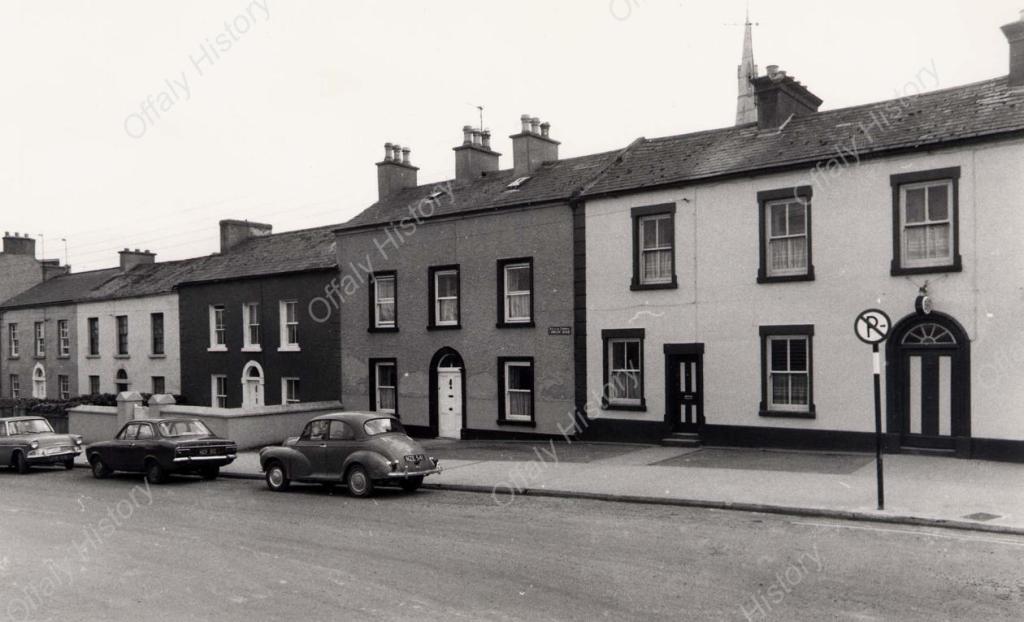
Late Georgian Terrace at Bury Quay/Convent Road, Tullamore. Mid1970s
So, while future prospects are certainly influenced by the legacy of the past, for urban centres like Tullamore factors such as economic performance and civic leadership will figure as the more immediate drivers.
There are only a few studies available on the development of retailing in Ireland, either of a general nature or in connection with particular firms. It is well known that in the first half of the nineteenth century and up to the Famine years retail outlets were not widely available and many in the smaller towns were no better than huxter shops. There were exceptions and that is clear from the photographs of c. 1900 of shops such as Williams. Egan, Goodbody and Lumley (in Tullamore); O’Brien in Edenderry and O’Meara and Fayles in Birr. In looking at the revolutionary period from 1912 to 1921 to mark the decade of centenaries it is also worth looking at revolutions in other areas such as transport, energy and shopping. Like the political revolution retailing exhibited signs of stress after 1921 and did not recover until the coming of the supermarkets to the provincial towns in the 1960s.
The Williams head office with the Barrack Patrick Street shop to the right before more intensive motorised transport from 1915.Branch house managers were appointed of which the last under the old system (before the switch to supermarkets) was T.V. Costello.
The trade directories, and from the 1840s the valuation records, will facilitate investigation of retail outlets. By the 1860s living standards had improved and this is reflected in the increasing number of shops; per capita tobacco consumption rose to English standards about 1870 and per capita consumption of tea was not far off the English level by the end of the 1870s. The considerable economic progress of the early 1870s, began to slow down by the end of that decade. The 1880s is looked on as a period of industrial crisis with industries closing down in all the principal towns, or destroyed by fire as with the Goodbody tobacco factory in Tullamore and the Birr distillery in 1889.The railways and the canals (especially in the midlands) facilitated the easy removal of heavy goods and livestock from towns all over Ireland, but it also left it easier to import foods easily and cheaply. As a result, the Irish industrial base (such as it was, especially in southern Ireland) receded while the retail and services sector began to grow albeit slowly.
We welcome Pat McLoughlin this week as a new contributor writing about attacks on trains in the Clara-Ballycumber area during the War of Independence. Pat writes: I grew up between Clara and Ballycumber in the townland of Clonshanny. Thomas Bracken who was Adjunt Officer 1st Battalion, Offaly No. 2 Bde. is my grandfather, Brigid Bracken (née Reilly) Cumann na mBan is my Grandmother. The Bracken family who at that time lived in Erry, Clara were all involved on the War of Independence. My neighbours Tommy and Annie Berry (née Morris) and John Minnock were among many veterans in that community. The War of Independence I grew up with was fought in Clara, Ballycumber, The Barney Bridge, The Island, on the Banagher line, the people who fought it were the people we lived alongside. The people and stories were part of our lives, then came funerals with Tricolour draped coffins, Military honours for Irish War Heroes and life moved on. 100 years on the Military Archive maintained by the Irish Defence Forces gives me an opportunity to recreate some of the history of the community where I grew up.
Offaly History welcomes this contribution from Pat Nolan and is delighted to be able to include it in our Fifty Blogs for the Decade of Centenaries. This story, and much more, will soon be uploaded to our new Decade of Centenaries platform on www.offalyhistory.com. The portrait is from chapter one of Pat Nolan’s ‘The Furlongs – The Story of a Remarkable Family’, published by Ballpoint Press in 2014. Our thanks to Pat and his publisher.
At around midday on a Thursday afternoon in July 1921, up to 20 IRA members parked their bicycles not far from New Ross post office. A number of them surrounded the building on all sides while others filed inside, dressed in their civilian clothes and without any form of disguise. The staff had just finished sorting the morning mail and the town was relatively quiet. At first they didn’t pay any heed to the men, presuming they were linesmen – post office officials who had charge of the telegraph system. However, when they drew out their revolvers and yelled “hands up” the innocence of the staff’s initial impression was laid bare.
Welcome to this our 48th blog for the Decade of Centenaries. All of them will soon be posted to the Decade of Centenaries site hosted on www.offalyhistory and with thanks to all our contributors and partners and especially Offaly County Council, Offaly Libraries, the heritage office and Offaly Archives. We have now posted 302 blogs since 2016 and reached 304,000 views. Our contributors grow in number and so does this body of knowledge, free to use and enjoy across the globe. We welcome new contributors via info@offalyhistory.com.
The coming into force of the Truce in the war with England on 11 July 1921 marked the end of an era in that the struggle with our powerful neighbour was to cease. The editor of the Midland Tribune, James Pike, of Roscore, Tullamore, saw it as grounds for optimism. The Offaly Independent was burned out by the British security forces the previous November. The Chapman family paid a heavy price for their advocacy of Sinn Féin. The Birr King’s County Chronicle, as a staunchly loyalist newspaper, cannot have been much pleased with the outcome but it was accepted.
The administration of law in Ireland in 1914–19 was pervasive with petty sessions’ courts across the county in the smallest villages and towns. These were attended to by paid resident magistrates and on a voluntary basis by local gentry and merchants, both Protestant and Catholic, who had been deemed suitable by Dublin Castle for the conferring of a commission of justice of the peace. After 1916 it was becoming a doubtful honour and many nationalists, including P.J. Egan of Tullamore (chairman of the town council 1916-24 and managing director of a large business), resigned the commission when the War of Independence in 1919-21 intensified. The country had been subject to the Defence of the Realm Act (DORA) since 1914 but it was not much invoked in Offaly before 1916 and the civil courts of petty sessions, quarter sessions and assizes (usually held in Tullamore, but often held in Birr from mid-1916 to 1921) continued in the county. The Sinn Féin courts will be the subject of a later blog.


 offalyhistoryblog