As a Ferbane student wrote in the School Folklore Collection: “There’s a large amount of bogland in the locality round here.” County Offaly is a place covered in peatlands–more than a third of the county was classified as peat soil by in the National Soil Survey of Ireland published by Teagasc in 2003. Offaly is also the county with the highest proportion of homes using those bogs for turf. At 37.9% of households heated with turf according to 2016 Central Statistics Office data, Offaly outcompetes the next county highest county, Roscommon, where 26.6% of households have the turf fire burning. The prevalence of bogs and bog-connected people is what brought me to live in Tullamore for a year.
Yes we are extending our events to conclude on 31 August with the Mary Ward book launch about which more in our blogs of 24 and 31 August. In the meantime you
can download a PDF from Offaly County Council Heritage Officer Amanda Pedlow of all the county events. Lots of things including book launches in Geashill and Banagher. Read below about the very special Mary Ward book launch and commemoration in Birr on 31 August. It will be available at the launch and from 1 September at our bookshop. Order now so as not to be disappointed. Here we look at events being organised by Offaly History and with a note from Amanda Pedlow, county heritage officer. (more…)
Offaly History has organised a walking tour of Tanyard Lane on Sunday 18 August as part of Heritage Week at 2.30 pm meeting at the Library. The place has changed over 270 years right up to 25 July when the new Lidl store opened largely on site of the laundry, glass factory/wholesale and part of the creamery/bacon factory – the latter all post 1907.
Passing through Tanyard Lane, Tullamore today is to see almost total change since the 1970s. At that time it was full of old malting and grain stores the last of which to be built was also the first ferro-concrete building in Tullamore and one of the earliest in Ireland – that of Tarleton’s and now Oisin O’Sullivan Furniture, in about 1908. Beside it is another later grain store and now Robbins Limited of 1901. Below them is the plumbing store of zz, also housed in a former grain building. These are the only old buildings left now of an industrial legacy stretching back to 1750. Older photgraphs show the malting houses there with their louver chimneys (4).
For the past 51 years Birr Vintage Week has commenced around the month of August, with only in recent years it taking in the August bank holiday weekend. While the festival is in its 51st year, 100 years ago on 4 August 1919 the army at Birr Barracks had organised a program of military sports and spectacles. An antecedent of Birr Vintage Week perhaps?!
The events took place on the military training grounds adjacent to the barracks, the ‘Fourteen Acres’. The events kicked off at two o’clock. While the weather was not desirable it held dry until the events had finished up. The program was organised and promoted by Lieutenant Noel Edward Fasken, while Lieutenant Leslie M. Codner was responsible for the ground arrangements. Both officers were members of the Royal North Devon Hussars. The day’s program consisted of 26 events which lasted beyond six o’clock. While the barracks occasionally held large events and concerts, one of this scale was likely not seen before.
Looking south-east from cemetery road towards Leinster Villas where the military air field was located. (Photo: Stephen Callaghan)
One of the main spectacles was the air display by Captain Brooks. ‘His daring feats in the air were witnessed with interest and admiration, and showed the possibilities of a flying machine in the hand of a capable pilot.’ Captain Brooks was likely piloting an Avro 504k, a two seat trainer biplane. The airfield in Birr had only been constructed in February and consisted of a detachment of six aircraft from 106 Squadron, Royal Air Force. The airfield was dismantled in October of that same year 1919..
Men under the command of Second Lieutenant E. A. Grainger and Sergeant W. A. J. Leonard enacted a battlefield play, entitled ‘The Sacrifice’. The demonstration was reminiscent of a scene from the Great War. It was apparently not without a sense of humour! The centre of the sports ground was chosen for this display, it had been mocked up to look like ‘anywhere on the battlefield’; there were sandbagged trenches, mines, and a ‘shattered’ house. The house had been temporarily erected for the event. It is quite likely that the sandbagged trenches were in fact the practice trenches dug to training men during the Great War. These trenches were excavated during August 2018.
Second Lieutenant Grainger took command of about twelve British soldiers, while Sergeant Leonard played the role of a German officer and took command of twelve ‘enemy’ soldiers. The battle was set as if it had taken place three hours after dawn. The idea was that at dawn that morning a line of trenches had been captured from the enemy.
Aerial view of the ‘Fourteen Acres’, looking north-west, where the day long events would have taken place
The ‘shattered’ house was occupied by a ‘British’ gun team, they had defended against a ‘German’ attack which had attempted to recapture their old trenches. The attacked opened with the explosion of mines, the ascension of rockets and the crack of rifle and Lewis gun fire. The outpost was supplied with ammunition by courageous runners.
The lone outpost held out until the very last man gave his life in its defence, thereby giving their comrades time to prepare for a counter attack. The display was well preformed and a stark reminder of the horror of the recent Great War.
Another item of interest was the physical training exhibition by a squad of the Royal North Devon Hussars under Corporal Snwothey.
Humour was provided in the form of Corporal Hatch and Private Ash acting as gentlemen the worse for ware, another soldier acting as a lady. Hatch and Ash both competed for the affection of ‘the lady’.
The day long events were reported in the King’s County Chronicle as a ‘splendid source of entertainment’, with the events being well attended by the people of Birr and the surrounding areas. The events themselves were also well patronised by competitors. Prizes for the sports were presented by Brigadier General James Graham Chaplin.
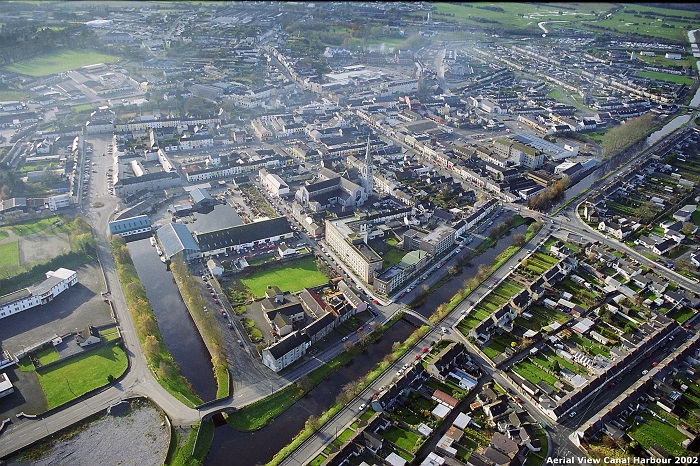
All over the world, as maritime trade moves downstream and heavy goods are transported by motorway, redundant docks and harbours have become prime targets for urban redevelopment. In my work as a town planning consultant, I visited renewal schemes from Buenos Aires to Barcelona and from Boston to Bilbao. Some have been very successful – others less so. Two common problems with many schemes is that they are either remote from the centre of the city with consequent costs and difficulties in integrating them seamlessly into the urban fabric or else they have to be developed as stand-alone districts; which can tend to have a rather soulless character- particularly if the dominant use is commercial offices.
With a few notable exceptions (Liverpool and Galway certainly, but even these are on the edge rather than within the centre of the city) the opportunity to integrate a large waterbody into the very heart of an urban area is rare, if not unique. That is why the now mooted redevelopment of Tullamore’s canal harbour is of such significance and offers such extraordinary opportunities.
The Old Harbour
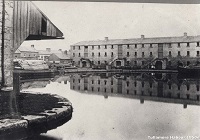
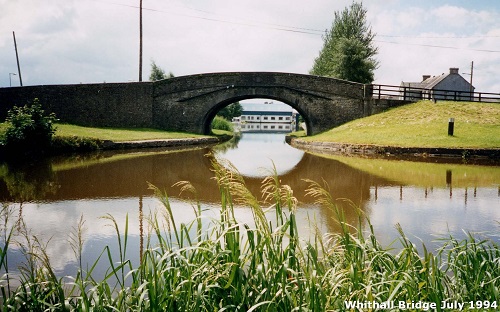
When I was growing up in Tullamore in the 1950s, commercial traffic on the Grand Canal was at its height as barges brought Guinness to Limerick and turf to Dublin. Recreational boating was rare but increasing and the arrival of a visiting cruiser was still an event. Though it was a busy place, my recollection of the harbour is that it was relatively open and accessible and was so public that some of us kids made rafts and sailed or swam around it.
Sometime in the 1960s, the harbour became the central depot for the maintenance and repair of the waterways network in the Midlands. Surrounded on all sides by high walls and rendered virtually invisible, it became an enclosed commercial property and public access or activity was discouraged. Over the years the memory of it as an attractive and vibrant part of the town gradually died.
A New Quarter for the Town
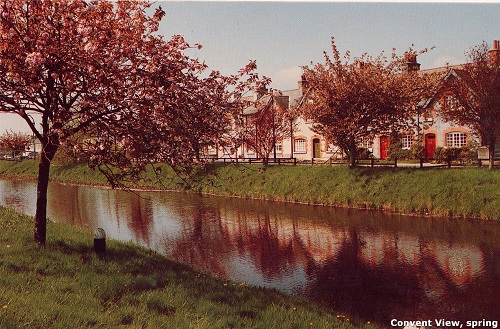
Gladly, change is at last at hand. The redevelopment and reintegration of the harbour into the heart and life of the town has become a priority project for the bodies that matter. Identified by the recently adopted Eastern and Midlands Regional Strategy as a key driver in the renewal of the centre of Tullamore, it will be eligible for renewal funding from the Regeneration and Development Fund. Offaly County Council and the owners of the harbour, Waterways Ireland are combining their skills and powers to deliver the project.
Though it may have to await the next tranche of funding in 2027, it is now possible for the people of Tullamore to begin to imagine the enjoyment of a development of hopefully world class quality. Like any major but worthwhile project, there will inevitably be setbacks and disappointments, but by making it a designated objective in the regional and local plans, the right initial steps have been taken and it is now only a matter of time before things begin to happen. What are the likely next steps?
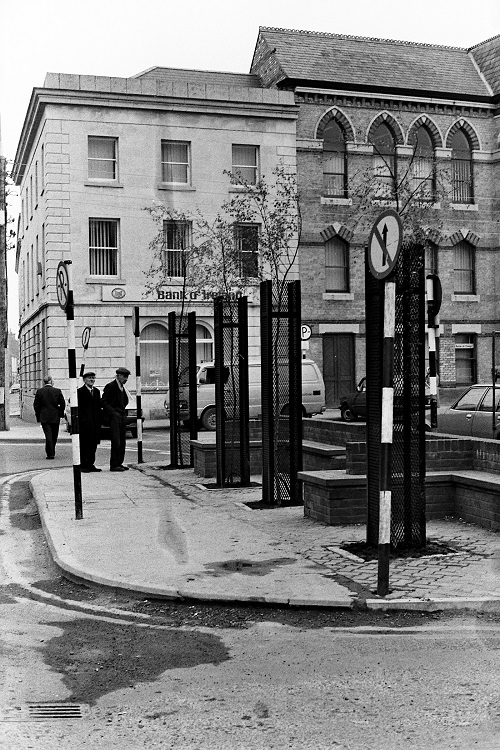
I once again visited my old friends in Tullamore in the last few weeks. I was down from D4 to sort out a charity account with Bank of Ireland in O’Connor Square. I had to make my way through the bollards with the footpath widening. I came on the train of course (thanks Charlie, nice one). I was reminded by a customer that the Bank of Ireland opened in Bridge Street in the summer of 1979. At the time of my visit I was too busy to pay attention because between money laundering forms and this new GDPR stuff I was fit to be tied. And the account is 60 years old. What is all the fuss about small money. Now the new bank of 1979 is so different to the one I remember in High Street where Hoey & Dennings are now.
Fr Willie Cleary died after a short illness at Tullamore hospital on Sunday 19 July 2015 aged 80. He had been parish priest of Tullamore from December 1989 until his retirement from that post in September 2004. He was then transferred to Laytown as a curate and was serving there at the time of his death. His last days in Tullamore hospital were entirely appropriate in that while he loved his work and the people of Laytown it did seem to some that his heart was still in Tullamore and he liked nothing more than to meet friends from the parochial house ‘team’ both current and in the 1990s and call on some of the parishioners of his old parish that he knew well. Fr Willie was appointed parish priest of Tullamore of Tullamore in December 1989 in succession to Fr Pat Fallon who had carried the burden of building the new church following the fire in 1983. Fr Willie was a native of Rathwire/ Killucan and was ordained in Maynooth in 1959. After a short time on loan to Ossory diocese he spent 21 years in Mullingar of which 7 years was as parish administrator in what is the bishop’s parish. His work in Mullingar has been recently recalled in that town.
Columba, son of Eithne, daughter of Mac Naue, and Fedelmid mac Ferguso, is one of the most important Irish saints, and the strength of his saint’s cult in the centuries after his death on June 9th, 597 attests to this. Columba, or Colmcille, meaning the dove of the church, was born around 520 as a prominent member of the Cenél Conaill, This was a branch of the northern Uí Néill, a powerful dynastic grouping tracing its origins back to Niall of the Nine Hostages and based in north-western Ireland (Tír Chonaill takes its name from the Cenél Conaill). Columba’s influence extended into political matters as well as the religious sphere, but he is remembered as a monastic saint above all else. Like most early Irish saints, he was never formally canonised.
Ruth Baldesera is Quality Engineer at CAP Works, Newcastle, Tyne and Wear, where Sir Charles Parsons (1854-1931), son of the 3rd Earl of Rosse, founded his world famous engineering works. Sir Charles is best-known for inventing the steam turbine which revolutionised marine transportation and the mass production of electricity. Over the past few years Ruth has spearheaded a heritage project in Newcastle dedicated to the achievements of Sir Charles Parsons and in this article she outlines the scope and outcome of the project.
The Factory
Sir Charles Algernon Parsons “…the first Engineer to use a steam turbine to produce large amounts of power for electricity generation and driving ships”.
In 1889, Charles Parsons established C. A. Parsons & Company in Heaton, Newcastle, to produce turbo generators to his design. In the same year he set up the Newcastle and District Electric Lighting Company (DisCo) and in 1890, DisCo opened Forth Banks Power Station, the first power station in the world to generate electricity using steam turbo generators. (more…)
Tullamore is still to this day a vibrant and friendly Irish market town which has never lost sight of its commercial heritage. It’s one of the very few Irish towns that still preserves that friendly main street social-commercial atmosphere that I spoke about earlier. Today, The Bridge House is one of the largest town centre hotels in the midlands and it is really great to see the way that the modern owners show their appreciation of the past by maintaining the look and utility of the building facade. With Egan’s and Tullamore D.E.W.‘s combined influence still so visible in today’s town, surely it is only a matter of time before a whiskey savvy historian develops a Tullamore Town Whiskey Walking Tour. (Stuart McNamara in a recent blog on Egan’s whiskey).
Tullamore has its town guides and an app but, as yet, no whiskey trail. What with over 50,000 visitors to Tullamore DEW Old Bonded Warehouse every year it would be good to assist those visitors to see other parts of Tullamore connected with the story of Tullamore’s whiskey traditions. The commercial heritage of Tullamore is closely linked with the town’s malting, brewing and distilling history.



 offalyhistoryblog