Our architectural heritage may be defined as those structures which by their very great beauty, important historical connotations or unique scientific value contribute to creating a memorable experience.
To be frank, the town centre of Tullamore contains few buildings or spaces which meet these criteria but it does have its own distinct local qualities and is a decent if unpretentious town whose stock of late 18th and early 19th c. buildings are worthy of consideration.
Yet, over the past eighty years many fine buildings which contributed to the architectural heritage of Tullamore have been lost. The removal of the Tarleton House in 1936 radically changed the spatial character of O’Connor Square. The Grand Canal Hotel which closed the vista on the Daingean Road and the wonderful Tudor style castellated Mercy Convent were removed in the 1960s and early 1970s. The architectural quality of both the former Charleville Estate office by Richard Castle and the facade of D.E. William’s shop on Patrick Street by Michael Scott was compromised and the wonderful Modernist Ritz Cinema partially demolished. The landscaped setting of the County Hospital was built over. Many original shop fronts were replaced.
As Andrew Tierney has observed in his ‘Buildings of Leinster’ a lot of the original features of Protected Structures around the town have now been removed or insensitively altered.
The building behind the Mr Price facade in High Street, dating to about 1750. This picture in 1959(more…)
Recently nominated by the Irish Times as amongst the twenty best places to live in Ireland, Tullamore earned the accolade because of its central location and its excellent recreational amenities and services. However, neither its built or natural environment figured as deciding factors in the survey.
Regrettably, my home town lacks the physical drama of Kilkenny and Lismore dominated by fortresses standing on cliffs, the waterside charms of Kinsale and Carrick on Shannon, the mystery of the mediaeval alleyways of Galway and Carlingford or the suave urban quality of Westport, Clonakilty and Birr. Nevertheless, it’s qualities, modest as they are, have always inspired me and I have often tried to capture them in drawings. Tullamore’s few architectural setpieces were my first introduction to the notion that a town or a village could be a beautiful artefact as much as a painting or a piece of sculpture.
We are so delighted to see Offaly feature in this week’s episode of Droichid na hÉireann. Lochlann Ó’Mearáin will visit one of Europe’s oldest surviving suspension bridges at Birr Castle before stopping off at Shannonbridge to learn all about the historical importance of the bridge in the villag
All this and more on Monday the 31st of January at 7:30pm on RTÉ One. #visitoffaly #offalyhistory #droichidnahÉireann #RTÉOne
Having looked at the programme check out the bridges of Offaly. You can download Fred Hamond’s study of the bridge of Offaly from the Heritage Section of the Offaly County Council website.
More on Monday night
Fred Hamond writes in the first of his two books:
Bridge builders
4.1 From the early 1600s until the late 1800s, the Grand Jury financed most of Offaly’s road bridges. In 1898, responsibility was transferred to Offaly County Council. In the more recent past, the National Roads Authority has assumed responsibility for bridges along the national primary routes.
4.2 In the late 1700s and early 1800s, the Grand Canal Company erected numerous bridges in connection with the cutting of a canal from Dublin to Shannon Harbour via Tullamore. Bridges are also associated with the Edenderry and Kilbeggan branches of the Grand Canal. The Shannon Commissioners also erected a number of bridges during improvements to the navigability of the River Shannon in the 1830s. 4.3 In the 1850s, major drainage schemes throughout the county led to the construction of many bridges by the Board of Public Works. A second phase of drainage and bridge construction was undertaken by the Office of Public Works in the 1950s.
4.4 Various railway companies also erected bridges in the later 1800s, notably the Great Southern & Western Railway with lines from Portarlington to Athlone (1854-59), from Ballybrophy to Limerick (1863), and a branch to Banagher (1884). The Midland Great Western Railway opened a branch to Clara in 1863 and to Edenderry in 1877. There were also two minor companies: the Roscrea & Parsonstown Railway (1858) and Parsonstown & Portumna Bridge Railway (1868). Iarnród Éireann is now responsible for all railway bridges along the lines still in use and has recently been engaged in the replacement of level crossings with bridges
. 4.5 Since the 1950s, Bord na Mona has been extracting peat from bogs in the northern half of the county. This necessitated the construction of mineral railways for the transfer to the peat to power stations and briquette factories, and the erection of bridges over rivers and under roads.
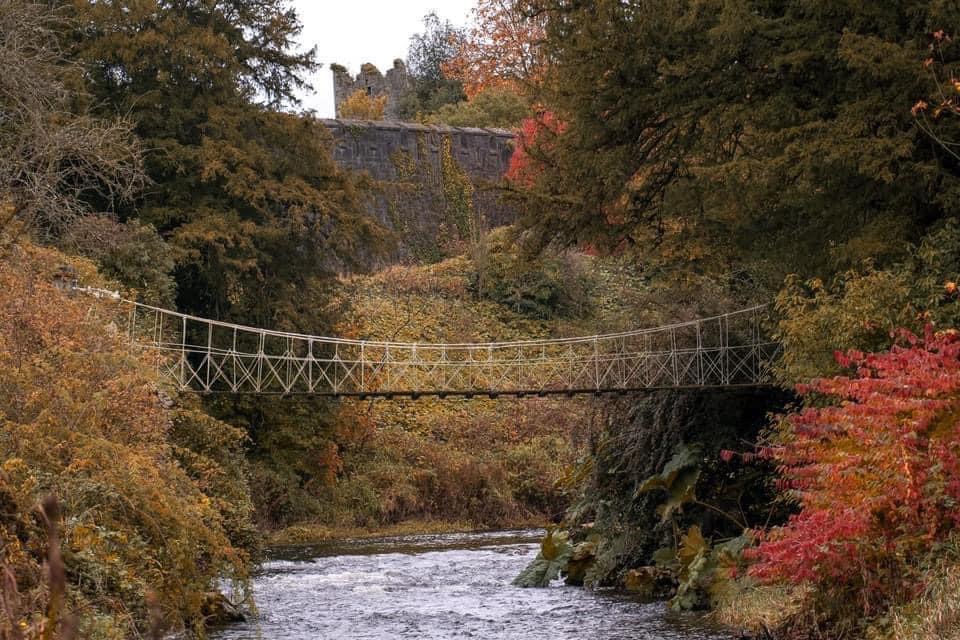
4.6 Several of Offaly’s many demesnes also have significant bridges, notably at Birr, Kinnitty Castle and Charleville. Birr boasts the earliest surviving wire suspension bridge in Ireland (c.1825). Ardara Bridge, near Cadamstown, is the oldest surviving bridge in the county and possibly dates from the 15th century. 5. Heritage assessment and protectio
In Tullamore alone there are so many: that at Bridge Street may date from the early 1700s. Then there is one at Church Road known as Pound Bridge that may date to 1795. Clara Road is a canal bridge called after an owner of land at Tinnycross – Cox just at that at Whitehall is after Charles William Bury. Who has not heard of Digby bridge in recent weeks. In Birr there is the suspension bridge in the demesne and Oxmantown Bridge of 1817.
Anyway, take a look at the series on Monday 31 Jan. and read your Hamond.
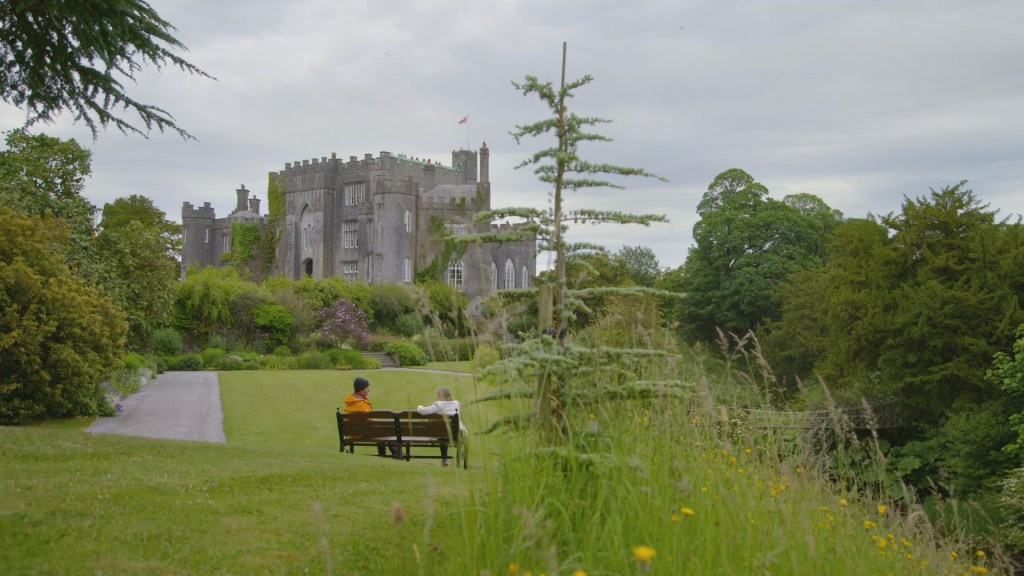
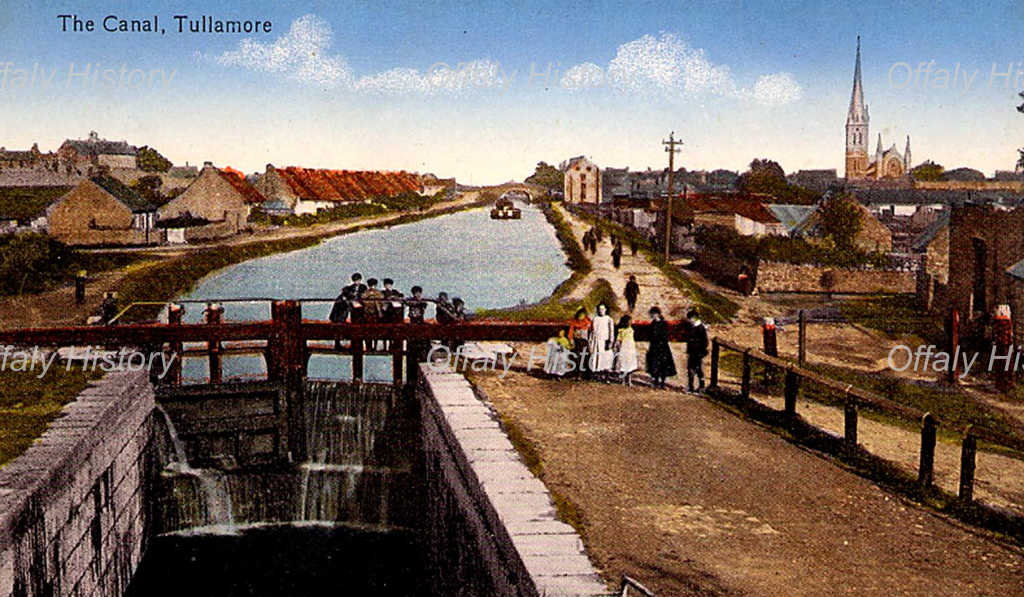
Birr Castle and the suspension bridge to the rightThe old Kilbeggan bridge in the distance over the Grand Canal at Tullamore, about 1910. Well before the new bridges of 2013.
In a new six-part series for RTÉ One, Droichid Na hÉireann tells the story and history of Ireland’s beloved bridges. Presented by actor Lochlann Ó Mearáin, the series explores the history, architecture, landscape and above all the people behind these extraordinary bridges and the pivotal role they have played in historic events and in modern day society.
From road to railway bridges, viaducts to footbridges, these man-made structures have long been an integral part of our country’s infrastructure. But beyond their primary function, how much do we really know about these structures?
Travelling across the length and breadth of the country, Lochlann explores century old stone bridges to modern contemporary designs from natural geological formations to great engineering feats, to reveal their hidden history and impact, far greater than just bricks and mortar.
He rediscovers the remarkable tales behind our bridges through a wealth of fascinating human stories told through expert commentary and local storytelling.
On his breath-taking visual journey through some of Ireland’s most beautiful landscapes, Lochlann ventures to the hills of Donegal to Poisoned Glen under the shadow of Mount Errigal, visits the beloved Shakey Bridge in Cork City, walks across Ireland’s longest rope bridge in Kells Bay and explores one of Europe’s first examples of a suspension rope bridge in Birr Castle. In the walled city of Derry he visits a structure that bridged communities together, he listens to a unique musical performance at Bellacorrick Musical Bridge in Mayo and travels to Connemara to visit the iconic Quiet Man Bridge. While in the midlands he explores one of Europe’s finest examples of a suspension bridge in Birr Castle and travels to the Drogheda to visit a Victorian bridge supposedly built on foundations of cotton wool.
Droichid na hÉireann explores the rich architectural and historical heritage of Ireland’s most fascinating and visually spectacular bridges
A new attraction on Offaly’s Shannon boundary
Uncivil engineers at Meelick weir relief bridge
03-01-22
Episode 1: Dublin
In the first leg of his expedition around Ireland, Lochlann O’ Mearáin explores some of Dublin’s iconic bridges. Starting of in the leafy suburbs in the Strawberry Beds, Lochlann visits Farmleigh Bridge and learns about the inventiveness of the Guinness Family. He ventures to Lucan to discover what wildlife live under the shadow of Lucan bridge. He travels to Clontarf to learn more about Dublin Bay and biosphere. Back in the bustling city, along the River Liffey, he takes a trip to the elegant and iconic Ha’Penny Bridge. He visits the striking and contemporary harp shaped Samuel Beckett Bridge and takes to the water to marvel at the design of Spencer Dock Bridge.
10-01-22
Episode 2: Mayo/Galway
From the soft and craggy bog lands of Mayo to the vibrant City of Tribes, Lochlann ventures West this week. He will discover the history behind the construction of Newport Railway Viaduct, listen to a unique musical performance in Bellacorrick and learn about the famine at Bunlahinch Clapper Bridge. Lochlann travels to wild and beautiful Connemara to visit Carricklegaun Bridge in Leitir Mor and follows in the footsteps of American actor John Wayne as he visits the iconic Quiet Man Bridge in Oughterard before finishing his travels in the heart of Galway city at O Brien’s Bridge.
17-01-22
Episode 3: Clare/Kerry/Limerick
Starting off at the most westerly point of County Clare on the Loop Head Peninsula, Lochlann learns about the geological formation and power of the Atlantic Ocean at the Bridges of Ross. He makes a short trip to the village of Bunratty where he discovers the significance of the renowned Durty Nelly’s pub and Studdert Bridge. He learns about the Treaty Stone at Thomond Bridge in Limerick City and heads to the Kingdom County to marvel at Lios Póil Viaduct and visit Ireland’s longest rope bridge in the sub-tropical gardens of Kells Bay.
24-01-22
Episode 4: Cork/ Waterford
This week Lochlann heads to Ireland’s most southerly point to view the spectacular Mizen Head Footbridge and then heads to the Rebel County to learn how the Shakey Bridge acquired its name. Over the River Finisk, Lochlann visits the Hindu-Gothic Bridge at Dromana. Hopping on his bicycle he gets a taste of the Waterford Greenway whilst crossing over the Ballyvoyle Viaduct and finishes his epic adventure at the Rose Fitzgerald Kennedy Bridge, the longest bridge on the island of Ireland.
The suspension bridge in Birr demesne. Courtesy of Paul Moore
31-01-22
Episode 5: Offaly, Westmeath, Meath, Louth
On this week’s episode, Lochlann will reveal some of the most breath-taking bridges in the heart of Ireland. Starting off by viewing one of Europe’s oldest surviving suspension bridges in Offaly, he will sail along the River Shannon to gaze upon The Athlone Railway Bridge before walking across the Joe Dolan Memorial Bridge. Finishing his travels on the River Boyne where he marvels at the great engineering feat of the Boyne Viaduct and discovers if there is any truth behind the viaduct being built on a foundation of cotton wool.
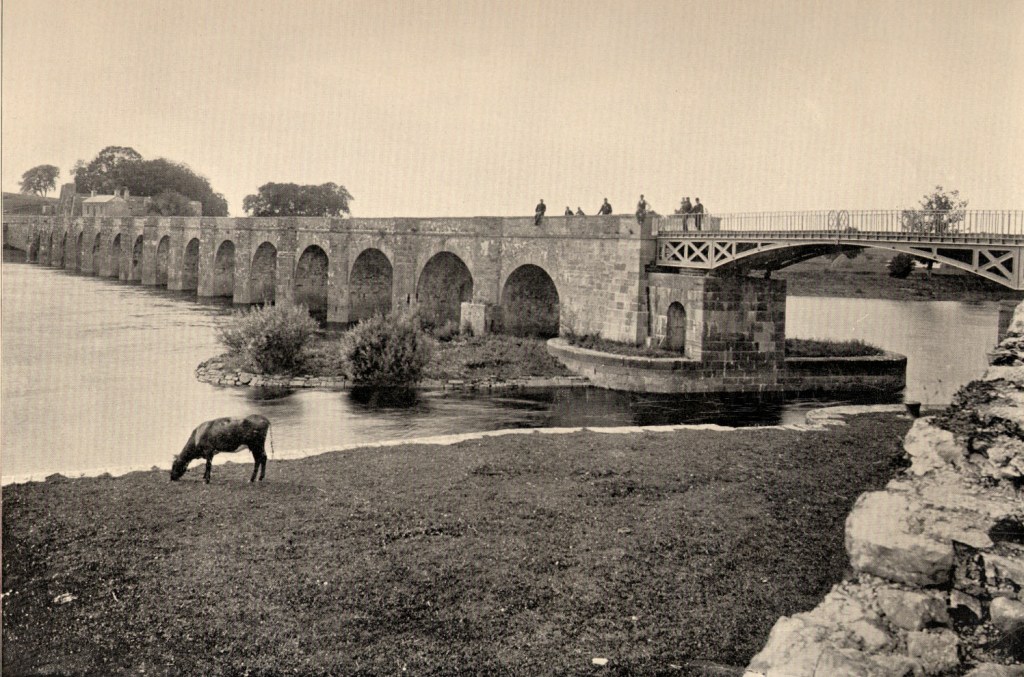
Shannon bridge about 1897. A beautiful Lawrence compositionfrom the bumper published volume.
07-02-22
Episode 6: Donegal/Derry
This week Lochlann heads north to picturesque Donegal. He will try his hand at the traditional game of handball at Bundoran Bridge, take a look at the history behind the disappearance of the Donegal railway line and catch up with musician Mairéad Ní Mhaonaigh under the shadow of Mount Errigal. He will then travel to the walled city of Derry where he will sail along the River Foyle to learn about how one modern structure has built bridges between two communities.
We hope to have a full blog on Shannonbridge of the 1750s very soon and also the ‘oldest bridge in Ireland’ at Clonmacnoise. After that we have Banagher of 1690 and that of 1843.We have also to do the suspension bridges at Kinnitty and Birr and, of course, that at Cadamstown.We need more contributors please.
Skating on Charleville Lake, Tullamore was a popular pastime when I was a young lad. I remember the cold icy winters of 1962, 1982 and 2010. I can recall as a young man the Tullamore people skating on Charleville Lake in 1962. I am a long time now in D 4 but I got down a few weeks before Christmas to the nice butchers in Tullamore – old Tormey’s is still going strong and now you have, Hanlon’s, Crossan’s of Main Street, Ray Dunne and Fergus Dunne, and a few more I would not know. I was sorry to see Grennan’s shop closed for now. I miss Paddy Mac’s, Cleary’s and Joe ‘the Butch’ Kearney and not forgetting Dunne’s butchers off the Square. It was Treacy’s later. Liver we got a lot of and sheep’s hearts in that fine shop. Many old friends gone to the heavenly pastures. I always like to get my turkey in Tullamore and a nice ham even though I am out of the town now for over forty years. What with the bacon factory open until 1989, and now Tullamore Meats, the town has a long tradition in fine food. Come to think of it the bacon factory did a huge business in turkeys back in the 1940s and 1950s when my father was rearing same.
Tim Guiney, late of Cork and Tullamore died at Tullamore Regional Hospital on 15 October 2021. It was only a few weeks earlier – on Sunday 5 September – that we gathered in Tullamore Golf Club for the launch of a 125th anniversary publication on the club. Tim had led a team in publishing this book which was a follow on from the very fine history of 2010 to mark the centenary fourteen years earlier. Others had started the work on the 2010 book but Tim brought it to conclusion. He would put his team forward but it was he in his quiet persuasive way that ensured its completion. A doctor of science he brought his skills to the big 2010 history. This book will prove its worth for the social history of Tullamore in years to come.
‘Catherine Maria Bury and the design of Charleville Castle’ is the title of an online lecture via Zoom provided by Offaly History for Mondy 20 September at 7. 30 p.m. Our speaker is Dr Judith Hill. She has kindly provided this note for Offalyhistoryblog readers on her forthcoming lecture.
When I started researching my PhD on Gothic revival architecture in Ireland after the Union I had no idea that Charleville Castle, one of the first and most impressive of the castles of this period, owed its inspiration to a woman. I wanted to compare the castles at Birr and Charleville, and was very much aware that their (male) owners had voted on different sides for the Union and that they came from different political traditions. Would this play any part in the designs for the castles that they built, or in the case of Sir Laurence Parsons, remodelled in the very first years of the nineteenth century?
Women at that time played no direct role in politics. They are also relatively (though not entirely) invisible in the historical record. It is only when you can look at family papers that you might find some evidence of what a woman might have done. Catherine Maria Bury’s letters have survived; some of these were published in 1937. They tell us about Catherine (later Lady Charleville) as a person, her friends, her interest in literature. They are tell us that she was close Charles William Bury, and that when he (for it was he) went to see how the building of the castle was progressing he would send detailed descriptions to her. Although he does not ask her directly for her advice, it is clear that when they were together they discussed the project.
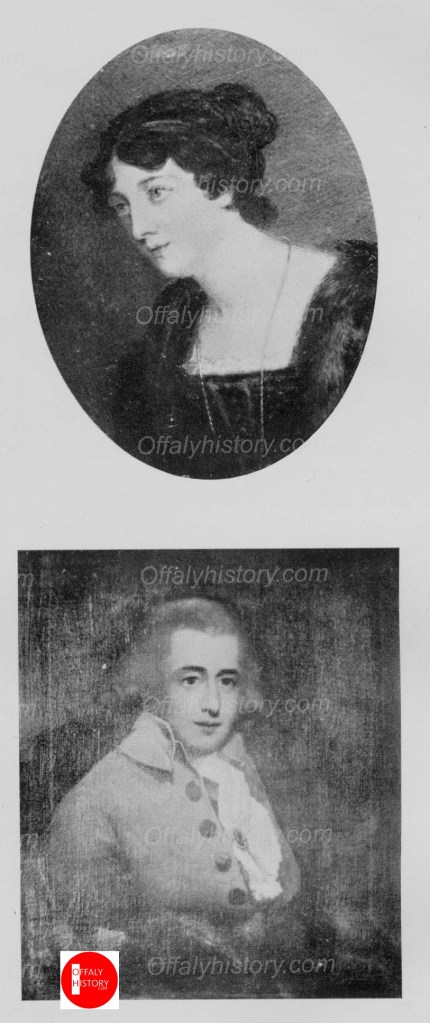
Catherine Maria Bury and Charles William Bury(more…)
Tullamore made the switch from gas lighting to public lamps powered by electricity on 27 September 1921 and Birr about a week earlier. The change in Tullamore was coming for over twenty years and Charleville Castle and D. E. Williams both had electric light from about 1900 and earlier. Lord Rosse had it in Birr Castle in the 1880s. Birr was earlier to have public lighting by gas lighting than Tullamore and had a town supply and town commissioners in 1852.
Tullamore elected its town commissioners and adopted gas lighting in 1860. Before that public lighting was non-existent in Tullamore with just one candle lamp in Charleville/O’Connor Square in 1854. By the beginning of the First World War the number of gas lamps in Tullamore was almost 80 and the lighting system had been greatly improved with ‘the illuminating power of the lamps having been greatly increased by the adoption of inverted incandescent burners’ (1915). The gas was supplied by a private company comprised of local merchants who were the owners and directors. Change was flagged in 1913 but little progress could be made during the war. In 1918 Birr registered a company to take charge of the local public lighting undertaking and Tullamore did likewise in 1920-21. Birr business contributed £9,000 and Tullamore £13,000 to the new undertakings. The lighting was switched on in Birr in 1920 but only for short time and was not finally in place until a week before Tullamore in mid September 1921. Roscrea had electricity at least a year earlier via a tender from Roscrea Bacon Factory. The Tullamore investors included D.E. Williams £5,000, P.J. Egan €1,000, P & H Egan Ltd £1,000, Fr Callary £500, Sisters of Mercy £200 and others. What is striking about the list of promoters of public lighting is that where Quaker and Methodists businessmen led the way in 1860 (Goodbody and Lumley), in 1921 it was Catholic merchants and Catholic institutions (Egan, Williams, the parish priest and the Mercy nuns). The 1921 directors were all Catholics save the Methodist W.C. Graham.
Tullamore’s High Street with Sergeant Ahern talking in what is now the Dew Inn (former Bus Bar), about 1910. Courtesy of NLI.
A Tullamore school boy records the date in his diary
Patrick Wrafter, better known in later life as P. A. Wrafter, kept a short diary relating to national and Tullamore events during the War of Independence and the Civil War. For its simplicity and directness, it is attractive and provides an insight into how crucial events in Ireland’s history impacted on the mind of a thirteen-year-old boy. Most of the diary entries were about the War of Independence and the Civil War. The move to electricity began during the War of Independence and was completed during the Truce period, i.e. when negotiations had started but before the delegation went to London. Wrafter wrote:
Started to build the Electric Light Shed over in the square on the 3rd January 1921. The same day as we went back to school. [This was the shed used to house the electricity generating equipment in the Market Square. The ESB acquired the Tullamore Electric Light Company in 1930 and the shed was demolished in 1999.]
Alo Brennan, Church St., Tullamore, was arrested on the 18 January 1921. [Later of Cormac Street, he was prominent in the Volunteers.]
Masked and armed men entered the Post-Office in Tullamore on the 20th January 1921 and took away the mails for the R.I.C.
Peace Conference started on July the 3rd 1921, in the Mansion House, Dublin.
Mr D. E. Williams, Tullamore died on the 3rd July 1921 aged 72 years. R.I.P.
Truce declared in Ireland in July 1921. [9th July.]
At least 80 prisoners escaped from the Rath Camp, Curragh by a subterranean tunnel 50 ft. long dug by themselves with pieces of iron etc. Sept. 1921 [LE, 17 Sept. 1921.]
Electric light was lit in the streets and houses on September the 27, 1921.
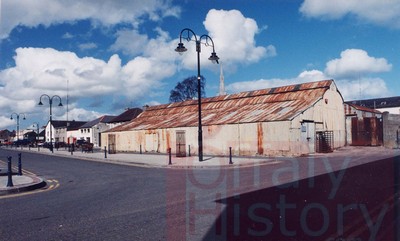
The electricity generating shed in Market Square, Tullamore, 1921-1999.It was to the rear of the old gas company buildings
Young Patrick Wrafter might have added that the poles to carry the electric cable were in course of erection in the streets of the town from July 1920. These were not the first of many poles to ‘grace’ the streets as those for telephones had been provided from about 1908–11. Of the 80 or so gas lamp standards in Tullamore only one survives at Moore Hall, O’Moore Street. The Truce of 11 July 1921 was holding with a Truce dance in the Foresters new hall over the co-operative bakery in September and a big meeting in Tullamore on 2 October to welcome Dr McCartain. In the same month a young girl of 20 was tied to the railings of Tullamore church with the word ‘Immorality’ written on a card attached to her. Two more girls were chained to the new electric poles near the church with the card attached ‘Beware of I. . . There are others too’. Presumably these were girls who had been overfriendly with the occupying forces, or it may have been the highly moral new republican police acting on possible sentencing in the Dáil courts.
The provision of public utilities in a town is a measure of its civility. Here we are talking of lighting, water, sewerage, roads, footpaths, a market house, and nowadays a public library (see OH blog of May 2021), and a swimming pool. Arts centres, public archives and museums would be down the list, but even here we are well on the way with only the county museum missing from the galaxy of facilities. Hospitals, courthouses and jails were early on the list of institutional facilities with a county hospital of sorts in Tullamore from 1767.
In a blog on 20 October 2020, we wrote that the start-up of the Tullamore Gas Company was in 1859 and the company survived until September 1921. Gas lighting for Tullamore had been mooted as early as 1845 but it took sustained pressure from the local press and the business acumen of the Goodbody brothers of the Tullamore tobacco factory to get it done. Others who helped were Alfred Bury of Charleville (later fifth earl) and the young Tullamore-born barrister Constantine Molloy. Initial opposition had come from the parish priest Fr O’Rafferty (died 1857), and later from the ratepayers led by the Acres family – the principal tenement property owners in Tullamore. Birr had street lighting from 1852 and Mullingar and Newbridge by 1859. The completion of the new railway connection to Tullamore in September 1859 was another boost to forward thinking about the status of Tullamore and its potential. The opening of the streets for lamps meant the adoption of a small measure of local government and the provision of town commissioners – the first town council in Tullamore from 1860. It did not mean that buildings were to be lighted and places such as Tullamore courthouse were still without gas lighting in 1868, as was much of the workhouse in 1897. The latter was using 36 lbs of candles per week in the late 1890s. Gas was later provided but as late as of 1910 the infirmary section of the workhouse was still lit by oil lamps.
The question of lighting Tullamore by electricity surfaced as early as early as 1897. Daniel E. Williams, who was the first to have a motor car in Offaly, introduced electrical generation in his own business in the 1890s. In 1909 the Tullamore town clerk, E.J. Graham, estimated that it would cost £4,000 to bring electricity to Tullamore. At the time the town was serviced by 69 lamps at £2 each per year. This would increase to 78 lamps by 1916. By this time the council had spent large sums on waterworks and housing but less so on sewerage. Economy was a watchword and, as noted, the gas lamps were not activated on moonlit nights. The Tullamore rector, R.S. Craig wrote to the press in early 1914 in the aftermath of the rejection of electric light for Tullamore in 1913 on the grounds of the need for a town sewerage system needed to have a prior call on local expenditure.
The public lighting of Tullamore is not in the hands of the Urban Council as it should be. It is farmed out to the local Gas Company, and one of the conditions – economic conditions – is that there is no occasion to light the lamps on moonlight nights. This is a condition , as the Rev Mr. Craig very aptly says, has nothing to commend it, but ancient precedent. The same bad precedent in the matter of this arrangement is followed in Athlone, and many of the other provincial towns. On the nights when we should have moonlight, but very often have not, there is no public lighting, and pedestrians and visitors or strangers doing business within our gates move about to the imminent danger of breaking their necks. There was the recent case in Tullamore when on the occasion of the great National Demonstration many thousands of people were gathered in the town. Before they could get out of it nightfall overtook them. The business houses were, of course, closed, and there was no assistance to be had from friendly shop windows. The moon was expected that night to give light to the wayfarer, but was in no particular hurry in coming to our help. The Gas Company economised according to their arrangement with the Urban Council and did not light the gas lamps. The inconvenience of the situation need not be emphasised.
Rector Craig’s letter was an expression of his frustration at the council not being able to proceed with the change over to electricity in 1913. The big shops already had electric power and were in no rush to suffer a possible rates increase from the council to provide the funds for the new scheme. It was only in 1917 that Griffith of the new Turf Works in Pollagh agreed to give his expertise to assisting in getting electricity going in Tullamore.
The provision of electric lighting in the smaller towns and villages was slow in coming. A Banagher writer in late 1921 noted that the town was in the dark: ‘The only bit of light we have had for the past three or four years was that provided on the night of Dr McCartan’s arrival’. McCartan was the last MP elected for King’s County/Offaly and the first for the Sinn Féin Party (April and December 1918). Electricity for Banagher lighting had been mooted as early as 1911 by the local improvement association. The visit of Dr McCartain to Tullamore on 2 October 1921 may have been the incentive to get the electric light installation completed in time for the big welcome.
From the Midland Tribune, 1 October 1921
No less than six Offaly based private companies were taken over by the ESB over the period 1928 to 1956. The Tullamore company with 240 customers in 1930 (about one-third to one quarter of the number of houses) was taken over by ESB in that year. In 1929 Birr had 342 customers, rising to 596 in 1947 when transferred to ESB. The Edenderry business was transferred in June 1928, but the number of customers is not now known. Banagher obtained the ESB Shannon supply in 1930 and Clara in the same year.
The offer for subscribers for shares in the new Tullamore company. It was alongside the obituary for Terence MacSwiney. Sgt Cronin of Tullamore was shot a few days laterin reprisal.Ordinary life and the War of Independence coexisted side by side in a strange way.
Disputes with staff working for the Tullamore Electric Light Company started within months of the light being switched on and a strike was called off in November 1921 when the three men employed by the company agreed to accept £3 7s. 6d. per week for a 56-hour week, in lieu of the £3 10s. demanded. The town council was the main customer and was paying up to £300 per year for 75 lamps. No great change in public provision from the days of gas. We do not know at this point what was the take up of power from the private and domestic sector. In the home it would have been for lighting only and that sparingly in many houses up to the 1960s. At the time of the move to ESB in 1930 and the takeover of the local provider it was reported that ESB men were preparing posts to replace existing standards where necessary. Also that ‘Mechanics are affixing electric fittings in several houses’. The firm of Siemens Schuckert was finishing the installation of electric light in the Catholic church and that Oppenheimer was finishing mosaic work to sanctuary. Dreamy altar boys will recall these mosaics with St Brendan navigating the billowing sea and which were destroyed in the fire of 1983.
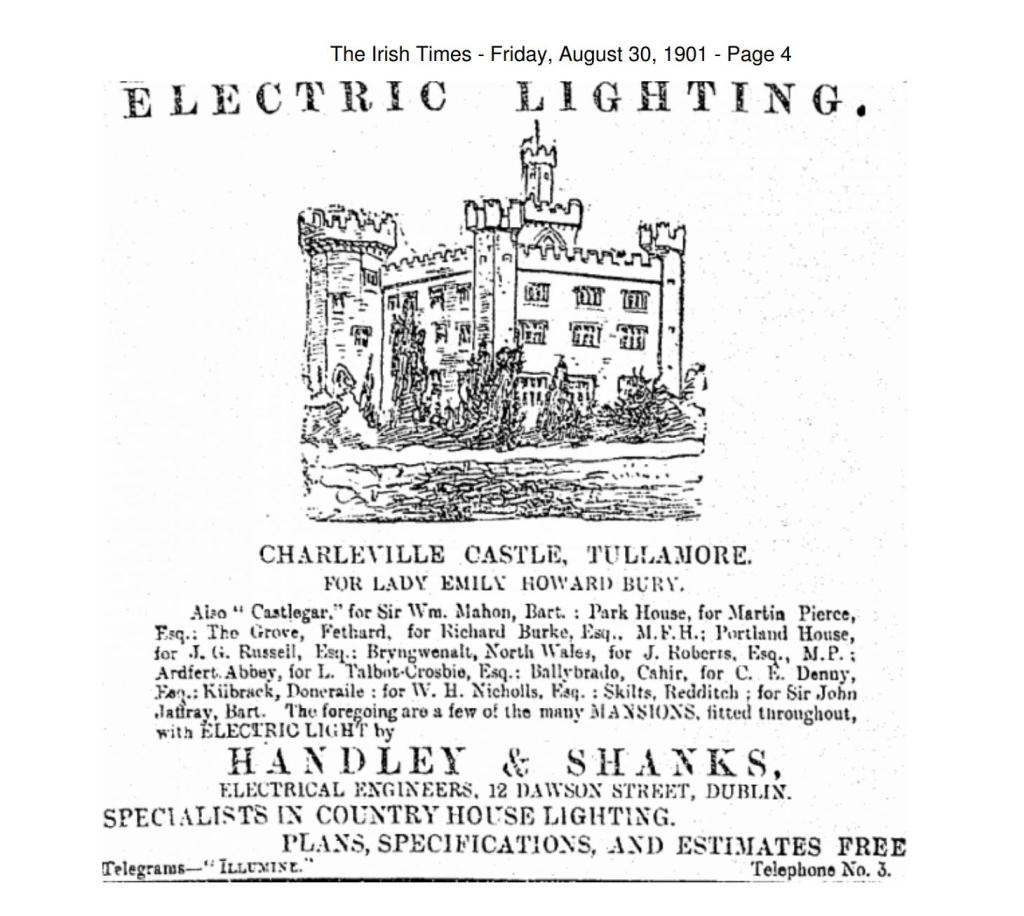
A 1901 advert for a supplier featuring Charleville Castle. By 1912 the castle had been largely vacated by its owner Lady Bury. Courtesy of Irish Times
It is hard to believe now that before the 1850s there was no public lighting in any of the Offaly towns. Neither was there any on moonlit evenings up to 1921, or after 12 midnight up to the early 1960s. Visitors to the Aran Islands will recall walking on its pitch-black roads, and, nearer home, those living in the countryside experience it every evening if making a short journey on foot. Rural electrification did not follow the towns until the late 1940s in many areas in Offaly and this has been documented in lectures at Bury Quay and the records of interviews now in Offaly Archives. See also a useful piece on the arrival of ESB provided electricity on http://www.esbarchives). Surprisingly there is nothing surviving of the minutes of the local gas companies in Offaly or the private electricity companies that were taken over by ESB in c. 1930. The company’s dealings with the urban council can be followed in the local press and in the minute books of the council (now in Offaly Archives). The Tribune was the only Tullamore newspaper in 1921 as the printing works of the Offaly Independent had been destroyed by the British military in November 1920. It reported the switch-on while the Birr Chronicle did likewise a week earlier.
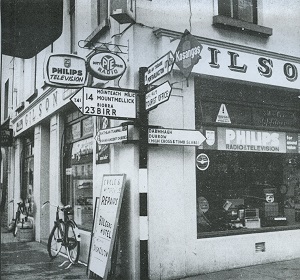
Sales of electrical goods took off only in the 1960s. Here the well-known Tom Gilson’s shop, Tullamore
Next blog is on Saturday 18 on Charleville by Dr Judith Hill. Email info@offalyhistory.com for the link to the Monday lecture.
On 25 Sept. Dr Mary Jane Fox on Columcille and copyright disputes








 offalyhistoryblog