I first began to take notice of things in the village when I started school in 1926. Kinnitty was very different then to what it is now and indeed even twenty years after I started school there were already many changes taking place. It was a very busy and prosperous place in those times and it had a great array of businesses and personnel.
Tullamore is a well-preserved town and is the county town of Offaly since an act of parliament in 1832 displaced Philipstown (Daingean) which had been the county town since the shiring of Offaly as part of the new colonial government policies in 1557. The new county to be known as King’s County was then comprised of the baronies reflecting the Gaelic lordships of the O’Connors and that of the O Dempseys. The king in question was none other than Philip II of Spain married at that time to the tragic Queen Mary of England (1553–58) hence the new forts of Philipstown and Maryborough (Portlaoise). The county was extended about 1570 to include the territory of the O Molloys (now to be the baronies of Ballycowan, Ballyboy and Eglish) and also that of the Foxes in Kilcoursey and the MacCoghlans in what would be called Garrycastle. In 1605 the territory of the O Carrolls (to form the baronies of Ballybritt and Clonlisk) was added, as also was the parish of Clonmacnoise (1638) at the behest of Terence Coghlan of Kilcolgan. Those looking for an exciting seventeenth-century history for Tullamore will be disappointed as the surviving evidence of town growth in that troubled century is thin. This week we continue to series to mark the 400th anniversary of Tullamore as a town.
“Some of old stonies will hold their heads high, and carry with them to the grave the feeling that they have left their mark on many a church, and on many a building, and that in years to come, there will be people to admire the work they have left behind them, as we of this generation respect and understand the work of the men of long ago. All men hope for praise of some sort, and it is a nice thing to see a man smile when he knows you are in earnest in liking his work. We become children again, and are mightily pleased with ourselves and want to show that we can do even better.”
From the book Stone Mad by Seamus Murphy, stone carver, 1966.
In this article, I write about some of the fine buildings and monuments in other parts of Ireland built using limestone from the Ballyduff quarries. There is a section on aspects of the lives of stoneworkers in Tullamore in the 19th century, and finally I have a look at a couple of Tullamore families that were prominent in stoneworking over long time periods.
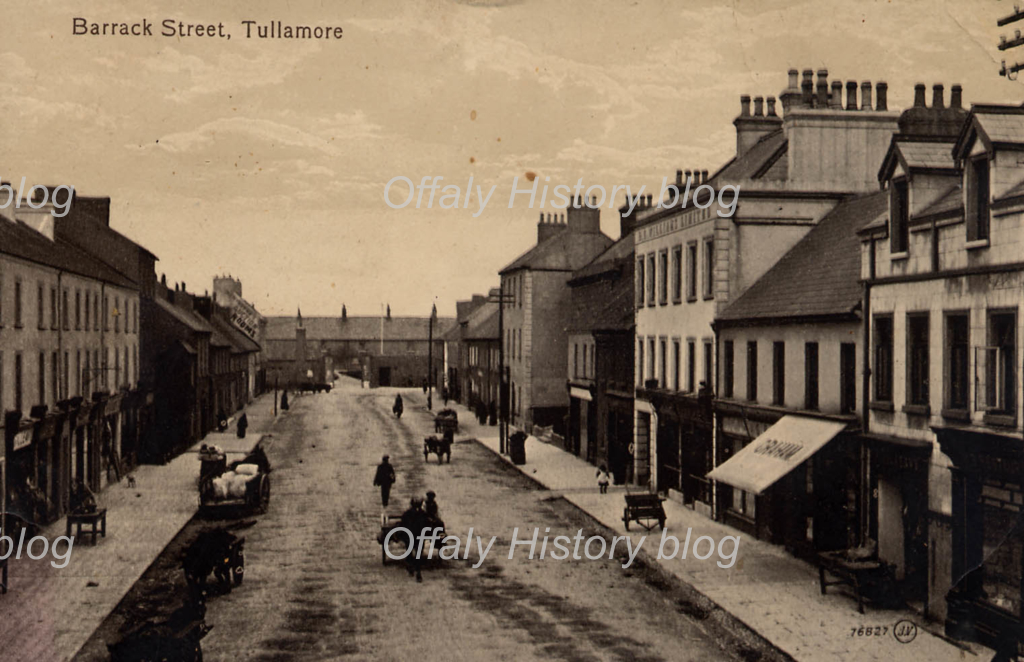
The barracks of 1716 was at the western end of Patrick Street and Hayes Hotel, dating to 1786, at the eastern end on the corner with Church Street and Bridge Street (now Boots Pharmacy). The barracks was destroyed in July 192 2on the retreat of the Republican soldiers from the town during the Civil War. Within fifteen years the site was fully taken up with urban council housing and a garda station built here in 1937 and rebuilt in 2002. The military barrack of 1716 brought about 100 soldiers to the town and is thought to have been a major factor in the town’s growth because of the increased demand for goods and services that followed its construction. After the 1870s, soldiers were stationed at Tullamore only at infrequent intervals.
Barrack/Patrick Street, Tullamore about 1910. The barracks dated to 1716 and destroyed in 1922.
The police moved into the old barracks about the year 1899. The building was occupied by the old I.R.A. in March 1922 when the British army quit the town as part of the Treaty settlement and was destroyed some four months later as the Republican soldiers left town in the course of the Civil War and before the arrival of the Free State army. Parts of the old walls survive and one can see the star-shaped fort pattern in the part of the wall opposite DNG Auctioneers.
Part of the old star-shaped fort style for the new barracks of 1716 erected in Tullamore(more…)
Thomas Armstrong, son of Andrew Armstrong and Lucy Charnock, was born on 22nd August 1702 and when he retired from his position as First Director of his Majesty’s Engineers, Chief Engineer of Minorca and Senior Engineer in the service, purchased the estate of Moorock and built a house there. He died in 1747, unmarried and the estate passed to his brother Warneford Armstrong.
On the 9th October 1793, Warneford Armstrong (1699- 1780) made a lease agreement for three lives and thirty one years of the House, Gardens and Land of Moorock to Richard Holmes, a gentleman of an old King’s County family based in nearby Prospect House. The 390 acres had been leased to James and John Reamsbottom. In 1795 Warnesford Armstrong demised the whole estate of Moorock to Richard Holmes of Prospect House for “lives renewable forever”.
As a native son of the county, it gives me great pleasure to be invited to launch Westmeath: History and Society. Interdisciplinary Essays on the History of an Irish County, the 29th volume in the Irish County series; this volume of thirty-five essays covering themes from the prehistoric to the present era utilises a multidisciplinary approach to explore at the county level broader regional and national themes. It contains contributions from historians, geographers and cartographers, archaeologists and Irish scholars (Cathal O Háinle –Westmeath Bardic Poetry). It charts the economic, social, religious and political life of the county. The aim is to achieve an understanding, rather than to produce desiccated informatio
The memorial to the Offaly Volunteers who fought in the War of Independence was unveiled on the lawn of the county courthouse, Tullamore in 1953. It was Peadar Bracken (1887–1961) former OC Offaly Brigade and from 1922-3 the Tullamore district court clerk who ensured that the IRA Volunteer monument was placed on the lawn of the courthouse. Besides, a site in O’Connor Square was not an option from 1926 when the war memorial was completed. Given that it was principally to the Tullamore courthouse that the feared judges of the assizes would arrive it has strong symbolism. The Volunteer monument was completed in 1939 but not unveiled until 1953 due to the difference between the Free Staters (National Army) and the Republicans.
Memorial to members of the Old IRA at the county courthouse, Tullamore
As noted in an earlier article in Offalyhistoryblog the last of the assizes was held in July 1921 with Judge Wiley presiding and a large force of military to protect him as the symbol of the British state. Now with the marking the 100th anniversary of the Treaty and the departure of Crown forces from Ireland it seems appropriate to look again at the twice-annual display of British power in the assize towns of Ireland.
Today, 23 March 2022 we mark the 170th anniversary of the death of John de Jean Frazer (1804–1852). A poet and a cabinet-maker, a native of Birr county Offaly he was born into a Presbyterian family. While `J. De Jean` was his preferred nom-de-plume, he also used pseudonyms `Z`, `Y`, `F` and `Maria`.
His first major poem was Eva O`Connor published in 1826, by Richard Milliken, Grafton Street, Dublin. During the 1840s individual poems, increasingly expressing radicalised politics, appeared in newspapers and periodicals of the day including The Nation, The Dublin University Magazine, The United Irishman, The Felon and The Freeman`s Journal.
In 1845 a substantial number of his poems were gathered together and published as Poems for the People by J. Browne, Nassau Street, Dublin. This collection contained eighty-two poems, a mixture of lyrical and polemical pieces.
[An article on de Jean Frazer appeared in the 1903 issue of Tullamore’s Ard na hEireann magazine by Sean MacCaoilte (Forrestal, d. October 1922) and as such was part of the cultural context for the Gaelic League and the Irish Cultural Revival in the Tullamore locality. Thanks to Offaly Archives which holds a copy. Ed.]
When we in Offaly History set out early in 2021 to mark the Decade of Centenaries in Ireland in our eighty plus contributed blogs on the Decade last year little did we think that an article on Belgian refugees to Ireland and the First World War would have resonance in the Ireland of 2022. Now we are talking of at least three million people forced out of Ukraine and have concerns about a third world war. Our efforts for the Belgians in 1914 look very slight when put beside what is needed today. In 1914 we were wholly reliant on the printed newspaper with no radio or social media.
In the first issue of the Athlone-based Offaly Independent on 4 February 1922 (about fifteen months after the destruction of the newspaper by Crown forces) an article appeared setting out the changes in public health administration in County Offaly, settled in 1921. This involved the closure of the workhouses in Edenderry and Birr and the adaptation of that in Tullamore as ‘the County Home’ and Offaly County Hospital. The workhouse infirmary in Tullamore was re-named the County Hospital and the Tuberculosis dispensary and beds in the new (1915) building at the back of the old county infirmary in Church Street was to continue to operate there at least for a time. The closing of the county infirmary in Church Street, Tullamore in 1921 (first opened on that site in 1788) and having about thirty beds in use at any time, and a dispensary, did not even get a mention in the 1922 review. The change over in the administration involving the switch from Local Government Board to Dail funded management based on local rate collection was a remarkable achievement.



 offalyhistoryblog