The Summer of 1921was heralded as having some of the best Irish weather days in ten years.1 Many people used the opportunity to cycle their bicycles along the countryside roads and lanes, whilst keenly observing the fields of green and gold ripening barley. The slight breeze gently blowing the ears of grain with the browny blue hues of the Slieve Bloom mountains to the southwest as background. The farmers were looking forward to a decent crop that year, and to attract good prices when selling to the local malt houses, brewers, and distillers. They would be able to take on additional seasonal labour to get the harvest in on time. After yet another long Winter, much needed outdoor activity and laughter was a recipe for relief from the underlying and not too far off reality of political turmoil, criminality, and civil strife. ‘The Truce that came into effect on 11 July 1921 officially ended what is now most often referred to as the War of Independence and came as the culmination of the most violent six months of the war.’2 ‘Relieved civilians celebrated the arrival of peace and Volunteers returned home to bask in newfound freedom, safety, and adulation.’3 But sadly, it was to be a summer that would be remembered not for the good weather alone.
Change is always about but perhaps more so since ‘Nine Eleven’ 2001 and March 2020 than we care to appreciate. Changes in eating out in Tullamore’s streets in recent days would have come as a shock to our predecessors of 1914. We are not Spain as Brewery Tap owner, Paul Bell, recently remarked but the fine weather and the adoption of coffee over tea are all helping. In the interior things are changing too. The love of banking halls is gone and now it is all doors and screens as new ways of working come in. The new county offices inTullamore (2002), and in many other buildings, may yet have to be reconfigured, and as for nightclubs what are we to do. On top of that some Tullamore municipal councillors are talking of revisiting our list of Protected Structures to remove those buildings that cannot be sold and are falling down.
All this talk of change, inside and out, suggests that we look again at what we had in the way of streetscapes before that period of great turbulence when Ireland was on the verge of Home Rule and Partition was unmentionable. It was ‘The Sunday before the War’ time. Thanks to the work of photographer Robert French (1841–1917) and the Lawrence Studio (1865–1942) we can look back, not in anger or nostalgia, but in awe at what was achieved in our towns over the period from the 1740s to 1914, but more especially in the years of growth and prosperity from 1891 to the First World War.
The Lawrence Collection of some 40,000 photographs are well known. Perhaps less so that the online catalogue from the National Library (nli.ie) is in large format, high resolution, for the Offaly towns, allowing us to dig down/zoom in to see the detail that escapes one looking at the ubiquitous printed photograph in the pub or the tablemat. There are almost 200 Lawrence photographs for the Offaly towns and villages. For Tullamore there are at least 17, for Birr over 70, Banagher 3, Clara 20, Edenderry over 16, Portarlington 18, Kilcormac 12 including four placed in County Cavan, Clonmacnoise at least 33, Kinnitty 3, Mountbolus 1, and perhaps more to be identified. These figures are estimates and likely to change such as one of the earliest for Tullamore (late 1890s perhaps) that became available in recent years, or at least better known and the subject of this blog.
A very fine book from Kieran Hickey and Allen Lane (1973)(more…)
There are many people of note from Clara, but two particularly can be seen as associated with the period of Partition; David Beers Quinn and Vivian Mercier. Despite the ongoing War of Independence, the British government passed the Government of Ireland Act in December 1920, providing for the setting up of two parliaments in Ireland. The 3rd May 1921 marked the formation of the United Kingdom of Great Britain and Northern Ireland, so partitioning the island of Ireland. Vivian Mercier and David Beers Quinn had just reached their 2nd and 12th birthdays respectively. Although born a decade apart, in terms of Protestant identity, they represent different socio-economic backgrounds, illuminating what it was to be Protestant and Irish in the South of Ireland.
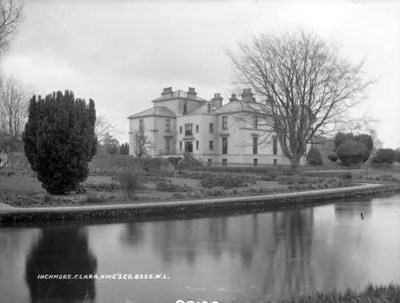
Inchmore where David Quinn worked as a gardener.
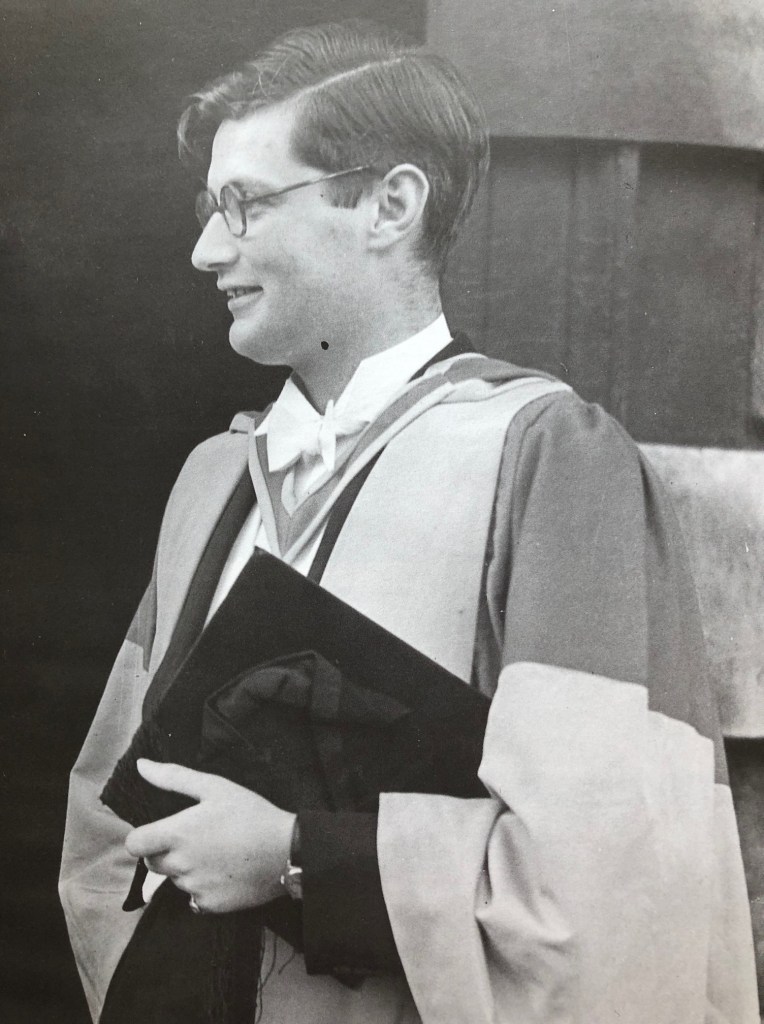
David Beers Quinn’s father, also named David, was a member of the Church of Ireland from Tyrone, He was employed as a gardener at the Goodbody house, Inchmore. His mother, Albertina Devine was also a member of the Church of Ireland from Cork with English parentage. Mercier’s father was from a Methodist family of Huguenot origin and his mother from a Church of Ireland clerical background from Monaghan. They lived in Cork Hill, Clara. The Mercier family, like the Goodbody family, were millers. Mercier’s father was born in Durrow, near Abbeyleix, Laois and was employed as a commercial clerk in jute manufacture at the Goodbody mills.
Vivian Mercier
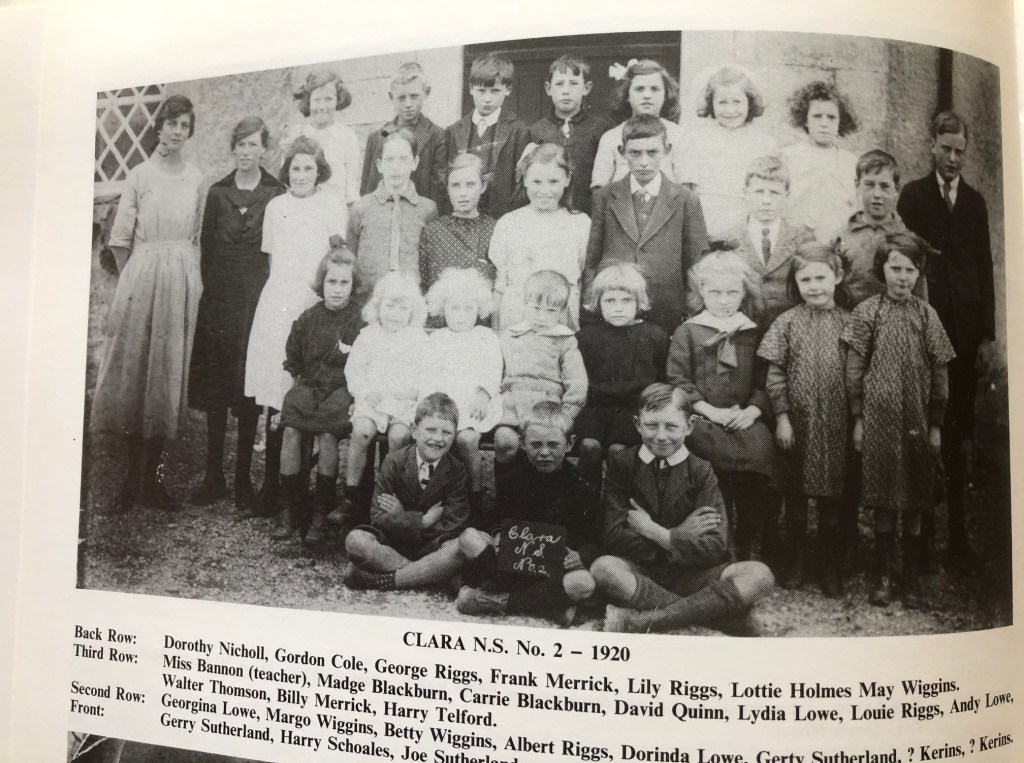
The partition of Ireland affected the education of Quinn and later Mercier. Quinn and Mercier attended Protestant National Schools, Quinn attending Clara No 2 Protestant school and Mercier, Abbeyleix South National School. Why Mercier attended school in Abbeyleix is unknown as the Clara National School was still under the tutelage of Miss Bannon who taught Quinn. However, it is known that Mercier corresponded regularly with Mrs Thompson, a later teacher at the school in Clara. Possibly the Mercier family had moved out of Clara due to unrest to the comparative safety of his father’s family home in Abbeyleix, approximately 60km south.
David Beers Quinn taking a look at one of his editions of Drake’s Voyages for the Hakluyt Society.
Quinn’s parents came to realise that their son was gifted. Finding good Protestant Irish education for a child from a working-class family was almost impossible if they stayed in rural Southern Ireland. The family moved to Belfast in 1922 where his father gained employment and in 1923 Quinn was able to attend the prestigious Royal Belfast Academical Institution. He continued his studies as an undergraduate at Queen’s University, Belfast between 1927 and 1931.
Mercier similarly left the South for Northern Ireland for his secondary education, attending the Portora Royal School in Enniskillen, one of the Public Schools founded by Royal Charter in 1608 by James I. Samuel Beckett (1906 –1989) was a former pupil. Critique of Beckett’s writing, particularly ‘Waiting for Godot’ was to shape much of Mercier’s career. Mercier and Beckett shared an affluent background and Huguenot descent in common.
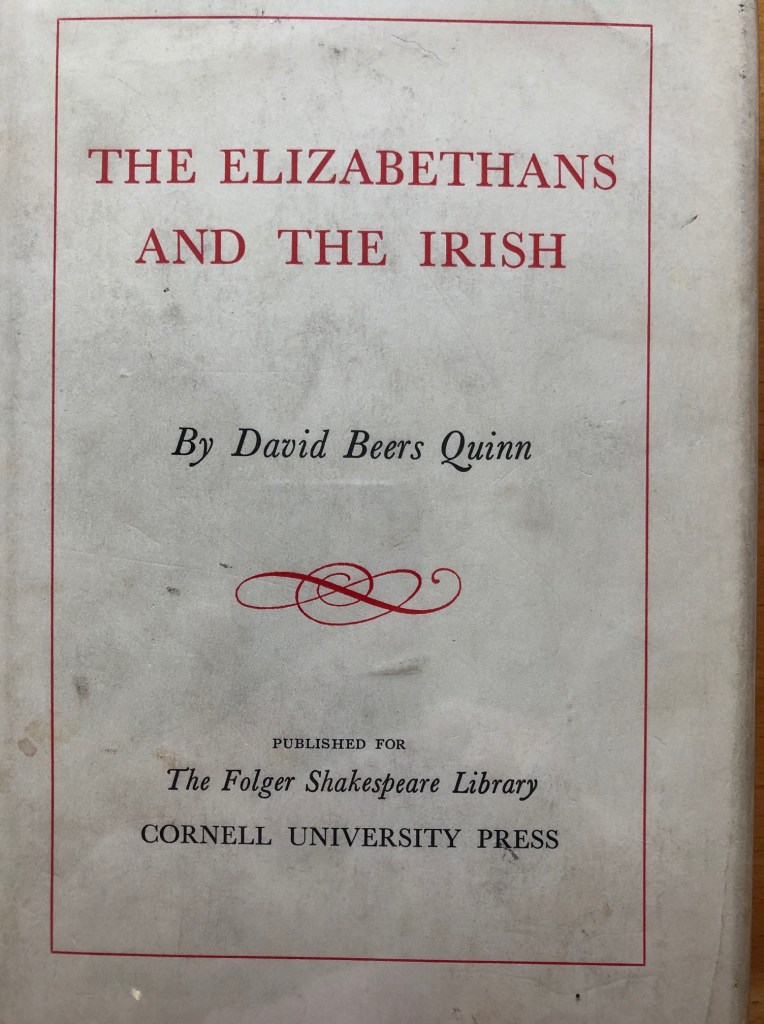
Quinn attended Queen’s College, Belfast (QCB) from 1927 to 1931 and then went to London University for his Masters’ Degree which he was awarded in 1934. There followed an academic career starting at Southampton (1934–9) and QUB (1939–44). After wartime secondment to the BBC European Service in 1943, Quinn moved to University College, Swansea the following year where he remained until 1957 when he moved to Liverpool university until 1976. Between 1976-1978 and 1980-1982 he was Senior Visiting Professor at St Mary’s College of Maryland. Alongside his academic teaching career, he wrote extensively on the voyages of discovery and colonisation of America. Many of his publications appeared as volumes of the Hakluyt Society. However, he continued to engage with Irish history writing The Elizabethans and the Irish (1966). Quinn also contributed substantially to both the second and third volumes of the New History of Ireland series (1987, 1976). However, his enduring influence on Irish history has been to link England’s involvement in Ireland with concurrent adventures in the Atlantic. Quinn married Alison Robertson whom he met whilst at Southampton in 1937. They were both politically active in radical politics. Alison worked with him particularly after their children grew up. She moved beyond indexing his work to becoming co-author and co-editor of several of his later publications.
One of Quinn’s first books. Still well thought of and now rare.
Mercier attended Trinity College, Dublin between 1936 and 1939. In 1940 he married American, Lucy Glazebrook. Whilst studying for his PhD, he worked as a journalist for the Church of Ireland Gazette and contributed to the Bell, a magazine of literature and taught at Rosse College. Mercier pursued an academic career at Bennington College, Vermont City (1947–8) before moving to City College, New York, where he taught English 1948–65. He married Gina di Fonzi in 1950. He became known as an academic who enjoyed teaching. He co-edited, the anthology A thousand years of Irish prose (1952), which became a standard teaching resource. He also compiled Great Irish short stories (1964). During regular visits to Dublin in the 1950s, Mercier studied Irish with Trinity and UCD academics. These studies gave rise to The Irish comic tradition (1962), dedicated to Gina, which broke new ground by combining Irish-language and Anglo-Irish material in support of its central thesis that comedy preceded tragedy in Irish literature and that it was possible to trace a degree of continuity between work in both languages, paying particular attention to Swift and Beckett. Although initially receiving a hostile response, the book is now generally regarded as a key text in the development of Irish studies. In 1965, due to Gina’s declining health, Mercier moved to the University of Colorado as professor of English and comparative literature. Gina died in 1971. In 1972 Mercier was visiting lecturer at the commemoration by the American University of Beirut of the fiftieth anniversary of the publication of Ulysses. Mercier married the Irish author, Eilis Dillon in 1974 and took up his last academic position as professor of English at the University of California, Santa Barbara. During these years Mercier and Dillon moved between California, Italy, and Dublin. Mercier retired in 1987 and he and Dillon moved permanently to Ireland. Here he reviewed books, contributed to literary journals and was a popular speaker at summer schools. He was writing a summative two-volume study of Modern Irish Literature when he died and his wife edited it and had it published in 1994.
Vivian Mercier
Quinn’s obituary in the Irish Times at the time of his death in April 2002 suggests his initial interest in the history of colonisation may have derived from his childhood years. He came from a Church of Ireland ‘colony’ within a ‘colony’ of the Quaker Goodbody family set inside a predominantly Catholic town. In 1998 Quinn wrote an affectionate account of his childhood years growing up there, explaining the relationships between different sectors of the community.
Mercier similarly was influenced by growing up in Clara, believing his experience of going to school ‘under the curious gaze of Catholic contemporaries whose world differed so widely from his own’ as separating him from the Protestant populations around Dublin who were confident in their own identity.
David Quinn at School through the Fields, Clara 1920with Miss Bannon (teacher) and a former OH member May Wiggins. The roll books are now in Offaly Archives.
David Quinn died 19 March 2002, predeceased by his wife Alison who died in 1993. He was survived by his three children. Mercier died whilst on a visit to London on 3 November 1989. He was buried with his parents in Clara after an ecumenical funeral service at St Patrick’s cathedral, Dublin. He was survived by his wife and three children. Quinn and Mercier had diverse careers but it would seem that growing up as Protestants in Clara at a time of when religious communities were divided, influenced the work of them both. Their legacy to Irish scholarship is significant.
Sylvia Turner, May 2021 with thanks to James Gibbons for additional material
Bibliography
N. Canny and K. O. Kupperman, ‘The scholarship and legacy of David Beers Quinn, 1909–2002’, The William and Mary Quarterly, lx (2003), 843–60; ODNB
The grand jury system in Ireland was a precursor to the county council or local authority system we know today, and the records generated by the grand jury and its offices reveal the history of towns, cities and boroughs all over Ireland. Unfortunately this body of records suffered significant losses during the twentieth century. On 25 May 2021, Beyond2022:Virtual Record Treasury of Ireland in association with Local Authority Archivists and Records Managers (LGARM) hosted a research showcase to mark the centenary of the burning of the Custom House during the War of Independence, an event which resulted in the destruction of the archive of the Local Government Board for Ireland. This event was echoed just over a year later with the destruction of the Public Record Office of Ireland at the beginning of the Civil War and whose losses in terms of documentary destruction is being valiantly and virtually rebuilt by the Beyond2022 team. The top floor of the PRO was where the grand jury records from all over the country were kept and ultimately perished during that terrible fire. Between the fire in the Custom House and the more well known 1922 PRO(I) fire, vast quantities of records relating to local government were destroyed.
An Englishman, Wilfrid Ewart (1892-1922), walked from Cork through the Irish midlands to Belfast during the War of Independence in April-May 1921. His book A Journey in Ireland 1921 (London, April 1922) was his account of that dangerous journey through the Irish heartland. Ewart commenced his journey on 18 April 1921 and finished it on 10 May. How did he escape abduction or shooting as an English spy? He might have come close to meeting death near the Blue Ball. Ewart was born in 1892 and died in 1922 – the year of the publication of his book, killed by a stray bullet in Mexico city on New Year’s Eve 1922. So Ewart lived dangerously as is clear from his passage through County Offaly the year before his death. His account is one of the best we have of feelings in Birr during the height of the War of Independence and on the eve of the killings at Kinnitty and Coolacrease, not to mention so called spys.
The jacket of the first edition of 1922
Ewart was possibly near death at the Blue Ball and surprisingly escaped that fate. He must have had great connections and credentials from both sides in the War of Independence to escape a violent death. He was surprised at how normal life was in Birr and contrasted the scene with the situation in Tullamore, where curfew had lately been imposed. Shots had been fired at the RIC and Black and Tans in the town of Tullamore in early April and one volunteer killed. In making the trip Ewart was out to discover for himself just what justification there was (if any) for British actions in Ireland.
In Birr Ewart met Archdeacon John Ryan who succeeded in 1917 on the death of Dean Scanlan in December 1916 and was parish priest there for 31 years until his death at the age of 96 in 1948. Ewart in his 1921 interview with Ryan described him as:
One of the most picturesque personalities I came across in this part of Ireland was Archdeacon Ryan, of Birr. Indeed, there was not a little in common between this fragile-looking, shy-mannered and unworldly priest and the steel-fibred leaders of Sinn Fein whom I had talked with in Cork. There was the same – how shall one say? – delicate adjustment of mind, softness of voice and manner, strain of poetry, faint perfume of idealism which mollifies, or appears to, the rigid nationalism.
Ewart went on to note that Archdeacon Ryan considered the IRA to be motivated by pure patriotism. Ewart in his interview with John Dooly did focus on the immediate cause of Dooly’s removal from the chair of the King’s County Council in June 1918, but perhaps ought to have got a lot more. The change in public mood in the county did not affect Dooly’s standing in Birr and he continued to be elected as chair of the Birr Urban District Council up to his death in 1924, a record of twenty-four years. Ewart met three other people perhaps including the agent to the Rosse estate. What was emphasised was how law abiding the town was. The county was at that time outside of the martial law area and the markets were functioning. In neither Birr (nor Tullamore, though described as hotter that Birr politically) did Sinn Féin have an outright victory in the urban elections.
For many the habit of reading started with the local library and has never left us. Recollections of the several libraries we have had in Tullamore remind us that so far as reading and comfort goes we have never had it so good. This is the time to recall the first public library in Tullamore started in May 1921, just 100 years ago. For that we have to thank an unsung hero E. J. Delahunty, a native of Clonmel, who was in charge of technical education in the county from 1904 to 1930 and died in 1931. He organized the first ‘students’ union’ in Tullamore and a superb lecture series on the great issues of the day in the 1916–21 period, and with mostly well-known speakers with a national reputation. The Midland Tribune gave the opening of the library an editorial and regretted that the lecture series had to be abandoned that year. Delahunty was shrewd and had the Tribune editor, Seamus Pike, on side. Another unsung hero of the revolutionary decade was Revd John Humphreys, a Tullamore-based Presbyterian minister, and great advocate for technical education. These are three people who need to be included in the Offaly Dictionary of Biography.
Teresa Wyer was born in Ballykeenaghan, Rahan, Tullamore, County Offaly on 29 November 1868. She was the third youngest of eleven children of Michael and Anne Mary Wyer. Teresa Wyer went to Rahan National School and thereafter to Killina Secondary School. She joined the Convent of Mercy Athy, County Kildare on 22 February 1890 where she was called Sr Mary Baptist. She left the convent in 1900 and ran a shop and public house at No 6 Church Street bought by the first author’s grandfather, Owen Wyer, brother of Teresa Wyer, from Abraham Colton, the Tullamore auctioneer and hotelier in early 1901. Owen Wyer was also a Sinn Féin activist and chaired a great Sinn Féin meeting in Rahan in September 1917.
Drama in Tullamore from the Gaelic League, c. 1906 with a backdrop of a painted view of William/Columcille Street. Owen Wyer is second from the right in the back row.
Church Street was a busy commercial street at that time with at least five public houses, a hotel and a number of private residences. Wyer’s neighbours included the long-established Warren family drapery stores with two shops. In 1901 Teresa Wyer (then describing herself as 30) was living with her brother over the public house and they had a shop assistant and servant living with them. Owen Wyer was a maltster with the Egans of Tullamore and she a publican. By 1911 she described herself as a grocer and aged only 36, single and with four assistants living over the shop. Teresa Wyer married James Wyer from Ard, Geashill on 24 February 1914.
‘Early April 1921. There was an ambush outside our house, in which a Black and Tan was shot dead. The Black and Tans forced their way into our house, searched every inch and left a huge mess. They also left my terrified mother, father and five brothers and sisters. Three weeks later, I was born & my mother often recounted the fact that after my birth I was a very jumpy baby.’ Nuala Holland (née Mahon, Charleville Road, Tullamore).
Nuala Mahon was referring to the attacks on the RIC in Tullamore in April 1921 that are matter-of-factly referred to by Sean McGuinness of Kilbeggan in his witness statement, now in the Military Archives (online, p. 29 in the pdf), in what he called ‘onslaughts on Tullamore RI.C. patrols at Charleville Road, New Road, Hayes Cross and Barrack Street, all on 1 April 1921 in which policemen and I.R.A. men were wounded and killed’.
Ethel Kerin was born on 11 January 1922 in Clara, County Offaly. Her mantra in life was to ‘keep your head down’ learned from her parents who worked as servants on the estates of affluent Protestants. Ethel kept her head down in terms of her parents’ employers as she depended on them for food and shelter. When she came to live in England in the 1940s, she kept her head down as she was Irish.
Ethel Kerin was my mother. She was born into a family of Protestants who worked in service. Little I have read or seen in Ireland relates to the type of life she and her family led. It was a hand to mouth existence, of feeling inferior and beholden to her father’s employers who were Protestant business families or landed gentry. In the post Partition decades of the 1920s and 30s, the lives of the family were frequently interrupted by termination of service and relocation. Apart from the Quaker families they worked for, their employers treated them with little regard, deciding to close down their houses and leave Ireland at short notice, returning to properties they held in England. My grandmother kept in touch by letter with the many friends she made, both Catholic and Protestant, across the Midlands and east of the country till the end of her life. The correspondence gives a sense of sadness of having to move and set up home again as well as the vagaries of their employers. However, simple pleasures of going out for picnics and evenings with neighbours that involved laughter and fiddle playing were clearly high points in their lives. Overall, there is a sense of making the best of things under difficult circumstances. Despite church and school attendance at the Church of Ireland, the family’s lives were more related to their neighbours, regardless of religion, than they were to that of their Protestant employers.
The now permanent release online with free access of some 11,000 lives in the Dictionary of Irish Biography (DIB) will be a huge bonus to historical research. And yet there will be many people at county level who will not feature but deserve to have their work recorded in dictionaries of county biography. Offaly History began this process in its publication Offaly Heritage 9 (2016) but more so in the recent issue of Offaly Heritage 11 (2020) where the following ‘Brief Lives’ were recorded by way of:
Short biographies of revolutionary figures in Offaly, 1912–23
P.J. Bermingham (1872–1975), 2–3.
Eamonn Bulfin of Derrinlough, 26–7
Father Thomas Burbage (1879–1966), 42–5
Revd Philip Callary (1849–1925), 73–4
Cumann na mBan in Offaly, 80–81
Thomas Dunne (1884–1968), 90–91
James Perry Goodbody (1853–1923), 134–5
Catherine Mahon (1869–1948), 157–8
Patrick McCartan (1878–1963), 179–80
Seán McGuinness (1899–1978), 189–90
T. M. Russell (1868–1932), 205–6
These short essays of less than 1,000 words each were contributed by independent scholars – Brian Pey, Michael Byrne, Margaret White, Ciara Molloy and Lisa Shortall.
Offaly Heritage 11 – a bumper issue of 450 pages with the brief lives
It is to the final life in that recent collection we focus on here. It was that of T.M. Russell, a man with huge potential, which remained unrealised when the opportunity came for a revolutionary change in local government in June 1920. This was following on from the election of the first Sinn Féin controlled county council and the implementation of self-reliance and breaking with the Dublin Castle based Local Government Board.





 offalyhistoryblog