The changing face of Offaly towns in the early 1900s: An illustrated history edited by Michael Byrne with contributions from Paul Barber, Stephen Callaghan, Grace Clendennen, Kevin Corrigan, Michael Goodbody, Ger Murphy, John Powell, Laura Price, Ciarán Reilly and Brendan Ryan (Offaly History, Tullamore, 2024, 368 pp). Available from Offaly History Centre and Midland Books Tullamore and online at www.offalyhistory.com. ISBN 978-1-909822-38-2 (hard back), €27.99. The book will be launched at Offaly History Centre, Bury Quay, Tullamore – beside the new Aldi and Old Warehouse. It is already available at the Centre, online at http://www.offalyhistory.com and at Midland Books, Tullamore. If you cannot attend in Tullamore we have a launch at Giltrap’s of Kinnitty on Thursday 21 Nov. at 7. 30 p.m. We will have copies in Bridge Centre for the Christmas Sale 14 to 24 December.
(more…)Category: Decade of Centenaries
-
21 ‘Rambling Jack’, Ned Holohan, a ‘knight of the road’ (died 1931) recalled in this article of 1961 by the late Alo O’ Brennan, War of Independence activist and late manager of the Tullamore Labour Exchange, and Pat Fanning, Offaly journalist, with a poem from Athlone. No 21 in the Offaly History Anniversaries Series. Blog No 666, 2nd Nov 2024
In his entertaining reminiscences last week, John Freyne laments the “Vanishing Knights” and incidentally recalls a Prince among them, the sightless Edward Holohan, better known over a great part of Ireland as “Rambling Jack.”
Mr Freyne tells of the respect and affection, with which this famous wandering minstrel was held in Moate. It was only symptomatic of the esteem-amounting almost to veneration in which he was held in the many counties, that he traversed twice each year, from his native Limerick of the rich pastures, to the shores of Lough Sheelin. A noble hearted Fenian himself, Ned Holohan was a living link with ’67 [The Fenian Rising of 1867] and everything that Fenianism stood for. He was born at Darnstown, near Killmallock, on the way to Bruree in 1839, and he died there on 27th December, 1931 in his 92nd year. He lost his eyesight in the attack on Killmallock Police Barracks in 1867 and his famous old fiddle, which up to then, had been his amusement, became for him his means of livelihood. His herculean physical strength failed, one brown October day, on the main road between Birr and Banagher, while making his way to the later town. He was removed to the old County Hospital at Tullamore where he was among real kind-hearted friends, many of whom still survive. He recovered and took up his permanent abode in Tullamore where he lived until shortly before his death. He returned to his beloved Limerick to die on the spot where he was born. No Irishman did more than Ned Holohan in a humble way, without pension, fee, or reward of any king to tend the Phoenix flame of Irish nationality. He was one of the real old Fenian stock, staunch and true, an inspiring rebel to the end.
(more…)
-
Tullamore and the £1 million housing scheme of 1922. The new houses at John Dillon Street. By Peter Connell. Blog No 616, 25th May 2024
This is the story of eight new houses built by Tullamore Urban District Council in 1923 in what is now John Dillon Street. Turning into the street from Charleville Road, the first eight houses on the right were built as part of the Provisional Government’s £1 million scheme launch in 1922 in the midst of the Civil War. Opposite them are houses built by the Irish Soldiers and Sailors Land Trust for veterans of World War I. The eight houses may only have made a small dent in Tullamore’s chronically bad housing conditions in the early 20th century, but the circumstances surrounding when and how they were built provide some valuable insights into the history of the town and the country in these turbulent years.
(more…)
-
Offaly and the Great War essays published in 2018 now on Open Access to all. Thanks to the Decade of Centenaries. Blog No 609, 4th May 2023
The bumper volume of essays (list below) in Offaly and the Great War (Offaly History, 2018) can now be accessed free online at www.offalyhistory.com thanks to the Decade of Centenaries. The book of 28 essays is also available in hardcopy from Offaly History for just €20. In all over 50 articles free to download. Go to the Decade of Centenaries on the offalyhistory.com website.
When the great historian and first ‘telly don’ A.J.P. Taylor published his short history of the First World War just in time for the remembrance days of over fifty years ago he wrote that the war reshaped the political order in Europe. That its memorials stood in every town and village and that the real hero of the war was the Unknown Soldier.
(more…)
-
Tullamore and the Irish National Foresters 1899-2024. By Aidan Doyle, Part 2, concluded. [We are marking the 100th anniversary of the re-opening the new hall, cinema and club rooms on the eve of St Patrick’s Day 1924 and the 125th anniversary of the founding of the Tullamore branch in April 1899.] Blog No 586, 15th March 2024
In March 1914 the Foresters Hall played host to meeting called organise the Irish Volunteers in the district. Following the outbreak of the Great War and the resulting divisions within nationalism, the Tullamore Corps of the National Volunteers gathered at the Foresters Hall to reaffirm their support for John Redmond. The Foresters branch secretary James Hayes joined the 5th Lancers in early 1916.
In December 1915, the Ideal Cinema was the venue for a screening of ‘Joan of Arc’ in aid of the Red Cross. Two months later, the Urban Council arranged a reception at the hall to present an address to captain Edward Sherlock after the Rahan man was awarded a military cross for his actions on the Western Front. As late as February 1918, the hall hosted a lecture by Henry Hanna KC on ‘The Pals (7th Dublin Fusiliers) at Suvla Bay’ in aid of the Leinster Regiments Prisoner of War fund. Nevertheless, by then the Foresters and their hall had come to be associated extreme nationalism in the mind of some within the police.

A programme for the Foresters in 1916 At a show the hall in on St Patricks Day 1917, a twelve-year-old girl Lena McGinley dressed in a ‘Green, White and Yellow’ costume performed a poem dealing with the 1916 Rising entitled ‘Vengeance’. As a result, sergeant Henry Cronin had the concert organisers James O’ Connor and Edward O’Carroll charged under the Defence of the Realm Act (DORA) for ‘attempting to cause disaffection among the civilian population ‘. On their conviction O’Connor and O’Carroll refused to be bound to peace and were instead imprisoned in Mountjoy.
(more…)
-
‘Unity, Nationality and Benevolence’ Tullamore and the Irish National Foresters 1899-2024. By Aidan Doyle [We are marking the 100th anniversary of the re-opening the new hall, cinema and club rooms on the eve of St Patrick’s Day 1924 and the 125th anniversary of the founding of the Tullamore branch in April 1899.] Part 2 tomorrow. Blog No 585, 14th March 2024
The weather was bad when Joseph Hutchinson arrived in Tullamore. For 22 years Hutchinson had dedicated himself to the Irish National Foresters and as a result a small mutual aid society founded by 18 men in Dublin, had spread across the globe and recruited over 20,000 members in Ireland. On Sunday 9 April 1899, Hutchinson had come to the midlands to recruit some more members and establish the first INF branch in King’s County. His visit that day would have profound repercussions for Tullamore, but it had its roots in the north of England.
(more…)
-
Try again, Explain Better: A Revolution in Profiles, the Offaly Story. By Aidan Doyle. Blog No 555, 16th Dec 2023
There is a popular saying in politics sometimes attributed to Ronald Reagan ‘When you’re explaining, you’re losing
History often involves explaining, but in recent times I’ve regularly watched people’s eyes glaze over as I described my latest research project.
Q: What’s it called.
A: ‘A Revolution in Profiles’.
Q: What’s it about.
A: Its about Offaly in the Revolutionary Decade.
Q: Okay. How many words in it?
A: Over 60,000, but it’s divided into profiles, each about 600 words long
Q: Is it a book?
A: No, it’s a website with over 100 different profiles of people from the period.
Q: So, it’s a blog?
A: Not really, it’s modelled on the RIA’s Dictionary of Biography.
Q: How much are you charging for It?
A: No, there’s no charge. Access is completely free. The RIA provided a bursary to build the website as part of the Decade of Centenaries programme, but anyone can view the profiles and there’s no fee.
At this stage the questioner runs the entire gamut of emotions from confusion, disbelief, pity and finally suspicion. ‘If its free there must be a catch’.
If we’re lucky the conversation shifts to the height of the Shannon or which senior clubs are still looking for a hurling manager, if not it peters out into a prolonged awkward silence.
‘I’ll tell what it’s not’
The site is not a definitive history of Offaly in the revolutionary period. That will come later, written by others more qualified to do so. It is a reference tool designed to educate on and simulate interest in Offaly’s revolutionary story. In time perhaps it may provide other researchers with a foundation from which a deeper understanding of the era might be developed. One of the ways it aims to do so is providing readers with the opportunity to compare and contrast different people from the period.
Don’t tell, show me!
Mark Twain reportedly once said ‘Don’t just say the old lady screamed. Bring her on and let her scream!’ Having struggled to explain the site, I usually take a leaf out of Twains book an give an example. Offaly History have been kind enough to host two profiles from the site dealing two elected officials.
The People’s Choice
Between 1918 until 1923 the constituencies of Kings County and Laois-Offaly were represented by Dr. Patrick McCartan. A leading member of the Irish Republican Brotherhood from Tyrone; McCartan spent most of those years on diplomatic missions to the United States and the Soviet Union.
Meanwhile Hugh Mahon from Killurn outside Tullamore sat as a Labor representative in the Australian Parliament until his expulsion in 1920. His ejection was carried out in response to Mahon’s public condemnation of the British Empire in the aftermath of the death of Terence MacSwiney on hunger strike in Brixton prison.
Mahon and McCartan’s biographies are among 30 extra profiles which will be added to the site over the next year, but for now the focus centres on two other parliamentary representatives from Offaly, representing two different traditions. Frank Bulfin and Sir Robert Woods.
Frank Bulfin
Frank Bulfin was born in 1874 at Derrinlough, where his parents William and Ellen Bulfin (nee Grogan) owned a large farm.
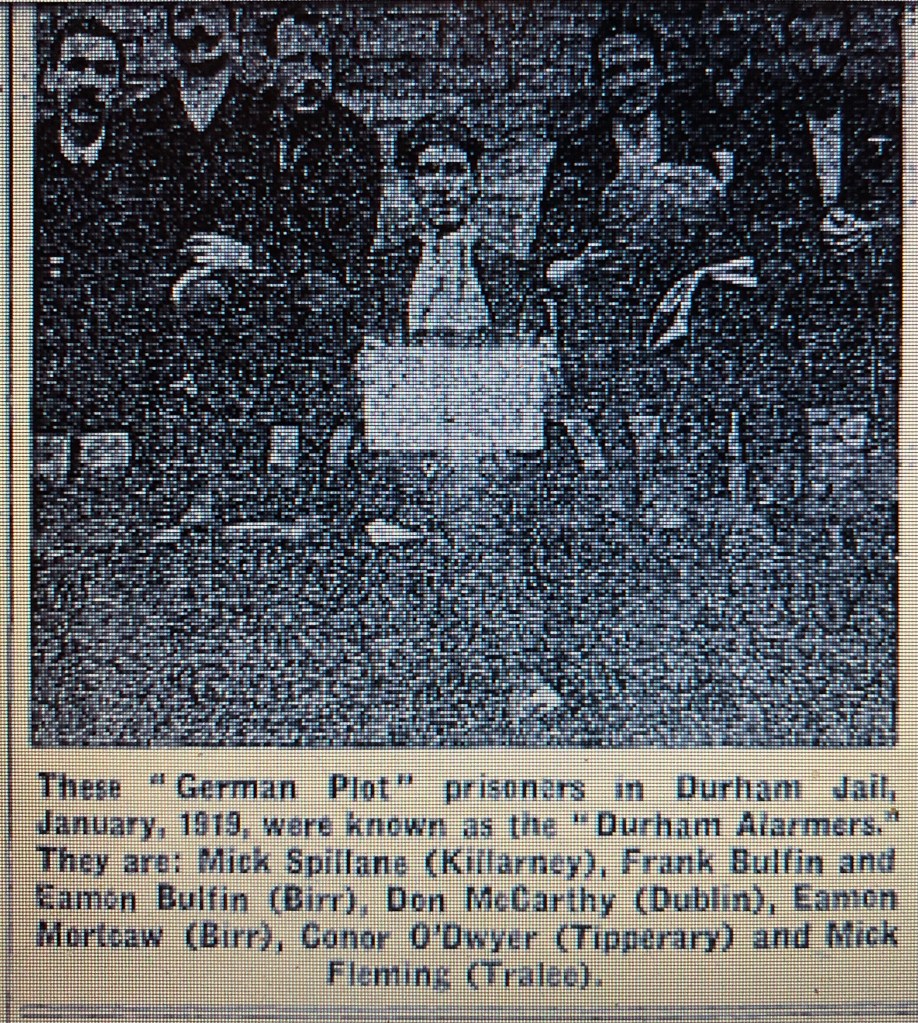
His uncle Patrick Bulfin acted as Lord Mayor of Dublin and a cousin General Edward. S. Bulfin served with distinction in the British Army during the Boer and Great Wars. In 1900 it was reported that Frank’s brother, J.V. Bulfin had died while serving with the Rimington Guides in the Boer War. Frank and his brother Joe (who was later associated with Clonony and Edenderry) were keen agriculturists. During the Ranch War both men were vocal advocates for small farmers and imprisoned for their involvement in cattle driving.
Frank’s uncle Fr. Vincent Grogan served as provincial of the Passionist order in Argentina. The South American connection was to have important ramifications for the family, as Frank’s older brother William emigrated to Argentina where he enjoyed considerable success and eventually became owner of the Southern Cross newspaper. On his return to Ireland, William Bulfin helped to stabilise the Derrinlough farms finances, wrote a popular nationalist travel book Rambles in Erin, promoted the Gaelic League and political movements of his friend Arthur Griffith. William died aged 45 in 1910.
William’s son Eamon attended St Enda’s school and fought under his former teacher Patrick Pearse in 1916 Rising.
Following the release of republican prisoners from internment in late 1916, Eamon and Frank were involved in establishing the republican movement in south Offaly. They were arrested as part of the German Plot in the Summer of 1918 and imprisoned in Durham Gaol. Eamon was later deported to Argentina where he acted as an emissary for the republic during the War of Independence.
On his release from prison Frank Bulfin returned to Derrinlough, where he was involved in sheltering Sean Treacy, Seamus Robinson, Sean Hogan and Dan Breen during the summer of 1920. The so called ‘Big Four’ were on the run following shootings at Soloheadbeg and Knocklong.
Nominated as one of four Sinn Féin candidates, Bulfin was elected unopposed in the Laois-Offaly constituency at the 1921 general election. Arrested and interned at the Curragh, he was released with other TDs in August following the arrangement of the Truce.
Bulfin did not take a high-profile stance during the Treaty Debates but voted to accept the agreement. He was re-elected in the pact election. His nephew Eamon opposed the treaty but took no part in the Civil War following his return from South America and Frank’s niece, Catalina ‘Kid’ Bulfin a member of Cumman na mBan went on to marry well known anti-treaty republican Sean MacBride.
In August of 1922, Frank Bulfin was one of the pall bearers who carried Arthur Griffith’s coffin.
Although he rarely spoke in the Dáil, Bulfin continued to vote with the Cosgrave Government throughout the Civil War. In a statement to the Bureau of Military History Ernest Blythe suggested that because of republican intimidation, Bulfin attempted to resign his seat, but after the intercession of armed Free State Intelligence officers was convinced…
‘It might be more dangerous to resign from the dail than stay in it’. (1)
The veracity of Blythe’s story is difficult to authenticate.
Addressing an election meeting in July 1923 Bulfin commented…
‘Many unpleasant things we have had to do —many very distasteful decisions had to be made, but we never sought popularity at the expense of the real interests of the nation’. (2)
After his re-election, rifts appeared in Cumann na nGaedheal. Bulfin did not support the Army Munity of 1924. Nevertheless, he was understanding of those who left the party at that time to establish the National Group and critical of some in the cabinet whom he felt were self-important and drifting too far from the party’s roots in Sinn Féin commenting …
‘Let these people not get their heads swelled. Greater men than they, Griffith and Collins, had to be done without.’ (3)
At local level his electoral machine was considered ineffective, and he lost his seat in 1927.
In the 1930’s Bulfin moved to Barrysbrook, Croghan close to his mother’s birthplace and farmed there until his death in 1951. He was buried at Rhode cemetery.
Sir Robert Henry Woods
Robert Henry Woods was born at Tullamore in 1865. His father Christopher and mother Dorothea (Lowe) operated a shop and held property in the town.

Sir Robert Woods Educated at Wesley College and Trinity, he qualified as a doctor. An expert on the ear, nose and throat; Woods was considered a world leading physician. President of the Royal College of Surgeons he was knighted for his services to medicine in 1913.
His son Thornley died in 1916 while serving with British Army in Flanders.
In 1918 general election Woods was elected to Westminster for the National University constituency, a seat held until 1917 by Edward Carson.
Elected as an Independent Unionist, Woods was a moderate in personality and politics. He did not take up his seat at the first meeting of the Dail in January 1919. However, unlike other unionist MPs he did send a formal reply to decline his invitation to attend.
In July 1921 he was part of a delegation of southern Unionists who met with Eamon de Valera in the Mansion House Conference which facilitated the announcement of the Truce.
A rare contributor at Westminster, he made his last speech there in the aftermath of the signing of the Treaty when he told the House of Commons…
‘I hope the Prime Minister will permit me to offer him my congratulations on having brought this Conference to so successful a conclusion. If I may say so without offence, he has done a big thing, and he has done it in a big way. The Unionists in the South of Ireland have received the news of this agreement with feelings of satisfaction that can only be appreciated by those who have lived there in recent years, and perhaps by those who have got imagination to visualise what would have happened had these negotiations fallen through. I think I am correct in saying that the majority of Southern Unionists have for a long time seen that there was no other possibility of settlement of the age-long struggle, and the healing of this Irish sore, except through a Conference… I believe that the end of this Agreement will be an accession of strength, not only to Ireland herself, but to the peace and the prosperity of the world at large, and particularly of that great community of nations of which Ireland will, in the future, herself form an integral part.’ (4)
His last political intervention was an unsuccessful run for the Senate in 1925.
A collector of antique furniture, he was also musical enthusiast, president of the Dublin Zoological Society he donated several animals to the Zoo following trips to Asia.
Robert Woods died at his home in Marino in September 1938 and was buried at Deansgrange Cemetery. At his own request the funeral service was private and attended only by his immediate family and household staff.
On his death the Irish Independent commented…
‘Although a Unionist, his liberal and free-minded attitude on all Irish questions was very marked. Rather abrupt and unconventional in manner, the late Sir Robert was a man with a big heart. He was charming in private conversation and his humour was never hurtful, while his wit was always kind. He was extremely popular with his professional colleagues and was ever helpful to the young men attending’ his school. Physically a splendid type of Irishman, he was a familiar figure in Dublin, his broad shoulders, well-shaped head and rugged- features arresting attention.’ (5)
Further biographies online at https://revolutioninprofilesoffaly.com/
Online launch 8pm Thursday December 14th at https://www.facebook.com/profile.php?id=61553625544577
Sources:
(1) Bureau of Military History. Ernest Blythe (Witness 939)
(2) Offaly Independent 7 July 1923.
(3) Cork Examiner 20 January 1925.
(4) Hansard online at https://api.parliament.uk/historic-hansard/commons/1921/dec/15/irish-free-state
(5) Irish Independent. 9 September 1938.
1901 and 1911 Census. Search online at http://www.census.nationalarchives.ie/search/
Bureau of Military History Statements: Ernest Blythe (Witness 939) Patrick Colgan (850)
Hansard online at https://api.parliament.uk/historic-hansard/commons/1921/dec/15/irish-free-state
Patrica M. Byrne & Cathy Hayes. ‘Sir Robert Woods’ Dictionary of Irish Biography online at https://www.dib.ie/biography/woods-sir-robert-henry-a9118
Michael Gallagher. ‘Politics in Laois Offaly 1922-1992’ in Laois History and Society edited by Padraig G Lane and William Nolan online at https://www.tcd.ie/Political_Science/people/michael_gallagher/LaoisOffalyPolitics99.pdf
John Gibney RIA Dictionary of Irish Biography profile of Eamonn Bulfin online athttps://www.dib.ie/biography/bulfin-eamonn-edmond-a10114
C.J. Woods RIA Dictionary of Irish Biography profile of William Bulfin online at https://www.dib.ie/biography/bulfin-william-a1109
Belfast Telegraph. 6 March 1925.
British Medical Journal. 17 September 1938.
Butte Independent. 26 February 1910.
Freeman’s Journal. 5 August 1921.
Irish Independent. 15 June 1907. 22 July 1918. 9 September 1938.
Irish Press. 12 September 1938
Irish Times. 29 June 1907.
Leinster Leader. 31 March 1951.
Leinster Reporter. 20 January 1900.
Nationalist and Leinster Times. 19 Aug1922.
Offaly Independent. 26 March 1966.
Sunday Press. 1 April 1979.
Index of those profiled
George Adam 1894-1922. Great War Veteran, RIC Constable.
Patrick Adams 1881-1939. Politician.
George Adamson 1897-1922. Great War Veteran, IRA Leader, National Army Officer.
Phillip Ahern. 1862-1918. RIC Sergeant.
Thomas Allen 1892-1919. British Army Sergeant.
Andrew Harvey Armstrong 1866-1922. British Army Officer.
Sean Barry 1897-1931. IRA Officer, National Army Officer.
Alan Bell 1858-1919. Magistrate, retired RIC Officer, Intelligence Advisor, Financial Investigator
John Bergin 1889-1922. IRA Officer.
Harry Biggs 1897/ 1899-1920. Great War Veteran, RIC Constable.
Sean Blaney 1898-1922. IRA volunteer. National Army Solider.
Patrick Boland 1890-1962. IRA Police Officer, County Councillor Neutral IRA Association Official.
Joseph Boyle 1889-1944. Teacher, IRA Officer.
Peter/Peader Bracken 1887-1961. Easter Week participant.
Caitlin Brugha/Kathleen Kingston 1874-1951. Sinn Féin TD, Republican Activist.
Eamon Bulfin 1892-1968. Easter Week participant.
Frank/Francis Bulfin 1874-1954. Sinn Féin and Pro- Treaty TD.
Emily Weddall-Burke 1867-1952. Irish Irelander, Cumann na mBan Activist.
James Burke 1892-1920. RIC Constable.
Fr. Thomas Hilary Burbage 1879-1966. Republican Priest.
Thomas Francis Burke/ Bourke 1898-1955. IRA Officer.
James Carroll 1879-1938. Easter Week participant.
Alice Cashel 1878-1898. Cumann na mBan Officer, Republican Judge.
Charles/Charlie Chidley 1903-1975. British Solider, Anti Treaty IRA man.
Cherio/Count Louis William Warren Hammon of Normandy. 1866-1936. Occultist, Entrepreneur.
Christopher/ Christy/ Chris Clarke. 1891-1923. RIC Segreant.
Joseph Connolly 1896-1979. IRA leader, National Army Officer.
Michael Cordial 1898-1972. IRA leader, National Army Officer, Hurler.
John Cooke 1863-1916. Ex-Serviceman,Civilian.
James Corrigan 1891-1918. Irish-Irelander, Republican Activist, Hurler and GAA official.
Felix Cronin 1890-1961. IRA leader, National Army Officer, Hurler, Golfing Official.
Henry Cronin 1873-1920. RIC Sergeant.
Matthew Cullen 1901-1922. IRA Volunteer, National Army Officer.
Thomas Cunningham1871/1876-1921. Ex-Serviceman
David Daly 1895-1970. IRA Officer.
Dr Patrick Gabriel/ Paddy Daly 1898-1983. Republican Gunrunner.
Liam/ William jr/ Willie Dignam 1898-1921. IRA Officer.
William Dolan 1896-1918. Civilian.
John Francis Doody 1899-1963. IRA Volunteer, National Army Solider, Anti Treaty IRA Man.
Edward/Eddie Donoghue/O’Donoghue 1910-1922. 12 year old Civilian.
John Joseph/ JJ Donnelly B. 1897. US Army Veteran, National Army Officer. Garda.
Joseph Doolan 1883-1974. Easter Week participant.
Edward Doran 1897-1921. RIC Constable.
Frank/Francis Dolan 1896-1922. IRA Volunteer.
Dr. Patrick Joseph/P.J. Doyle 1892-1964. Easter Week participant.
John/Jack Drumm 1900- 1990. IRA Volunteer, National Army Officer.
James Duffy 1896-1922. Great War Veteran, National Army Solider.
John Dunne 1899-1921. RIC Constable.
Peter Fahey 1893-1916. Civilian
Thomas Feery 1860-1920. Civilian.
Jack/Sean/John Finlay 1897-1923. IRA Volunteer, Gaelic Footballer, Drayman.
Denis Fitzgerald 1895-1961. IRA Officer.
Michael Patrick Foley 1893-1960. Easter Week participant.
George Frend 1850-1921. Land Agent, Farmer, Magistrate.
William Frith 1878-1916. Dublin Metropolitan Police officer.
Patrick Geraghty 1890-1923. IRA Officer.
John Greene/ Green 1870-1921. RIC Sergeant, Republican intelligence source.
Thomas Gibson 1897-1923. Great War Veteran, National Army Solider, Anti Treaty IRA man.
Patrick Gilligan 1882-1916. Instructor Irish Volunteers, British Solider.
John Gunning 1891-1923. Great War Veteran, National Army Solider.
John Hannon. D 1920. Retired RIC policeman reengaged as a Special Constable
Daniel/ Dan Hoey 1888-1919. Detective, G Division, Dublin Metropolitan Police.
Alfred/ James Albert/ John Alfred Hayes 1902-22. National Army Solider.
James Hayes 1888-1974. IRA Officer.
Rev. Francis Ryan Hitchcock 1867-1951. Church of Ireland minister.
John Joly 1857-1933. Polymath, Inventor, Academic.
Matthew Kane 1881-1921. IRA Volunteer.
Colum/Columb/Columba Kelly 1901-23.
James/ Jimmy/ Seamus Kelly 1895-1986. Easter Week participant
Michael Kennedy 1902-1920. IRA Volunteer.
Kieran Kenny 1887-1922.Easter Week participant
Seamus/James Kenny 1884-1953. Easter Week participant.
Sylvester Rait Kerr 1849-1922. Agriculturist.
Joseph Lawlor 1895-1922. Great War Veteran, National Army Solider.
Gabriel/Gabe Lee 1904 -1937. National Army Solider.
Patrick Joseph Lopeman 1893-1971. Great War Veteran, Connaught Ranger Mutineer.
Denis Patrick Maguire/ McGuire 1875-1920. RIC Sergeant.
Catherine Mahon 1869-1948. Teacher, Trade Unionist, Cumann na mBan leader.
Patrick McDonald/ McDonnell 1895-1921. RIC Constable.
Patrick McDonnell 1894-1949. Easter Week participant
Annie McGrath- Fleming 1897-1972. Cumann na mBan Officer.
Mary Anne Meleady-Treacy 1892-1978. Cumann na mBan Officer.
James Moran 1889-1987. All Ireland Football medalist, IRA leader.
Edward George Morley 1899-1920. Great War Veteran.
Aine ni Rian 1887-1955. Easter Week participant, Cumann na mBan leader.
Patrick Reardon/ Riordan 1892-1976. IRA Officer.
Seamus O’Brennan/ James Michael O’Brennan 1886-1968. Easter Week participant.
Thomas/Tomas/Tommy O’Connell 1900-1924. IRA Officer.
George Charles Payne 1903-1921. British Solider.
Richard (Dick) Pearson 1897-1921 & Abraham (Abe) Pearson 1902-1921.
Mike/ Michael Reilly D.1921. Ex-Serviceman.
Patrick O’Reilly 1892-1920. RIC Constable.
Sean/ John/ Johnny Robbins 1892-1960. IRA Officer, County GAA player and official.
Patrick/Paddy Seery 1889-1920. IRA Officer.
Eric Steadman D 1921. Great War Veteran.
Patrick/Paddy Tiquin/Tyquin 1896-1922. Great War Veteran, National Army Solider.
Constance/Connie Tynan 1901-1922. Civilian.
Leo White B 1887. Great War Veteran.
Patrick Columba/ P.C./Patsy White 1898-1923. IRA Volunteer, National Army Solider.
William Harding Wilson 1864-1920. RIC District Inspector.
Sir Robert Henry Woods 1865-1938. Surgeon, Independent Unionist MP.
-
The Founding of the Presentation Brothers’ Schools at Birr in 1877. Recollections of 1927 from J. Deering. Blog No 549, 30th Nov 2023
[Birr Historical Society meets again on Monday 4 December 2023 after a break of three years. To mark the occasion we reproduce an article by J. Deering first published in the Midland Tribune in 1927 in the context of the golden jubilee of the coming of the Presentation Brothers to Birr. J. Deering makes reference to Chesterfield School and its first headmaster a Mr Biggs. The latter late went on to Portora as headmaster. We intend to publish articles on both Chesterfield and Mr Biggs next year. Then there is Banagher Royal School and the efforts to have its funding diverted to a new school in Birr. Deering makes no reference to the Birr Model School, but he has a few interesting comments on the smaller schools in Birr. Both the Mercy and Presentation schools have published histories as does Banagher (Quane North Munster journal article, 1967), but there is much more to uncover back to the 1820s and earlier.
Birr Historical Society is very strong in attendance at lectures and we have no doubt that Paul Barber’s lecture on Monday 4 December will have a capacity audience. In 2026 Thomas Cooke’s Picture of Parsonstown will reach the 200th anniversary of its first publication and that will be a case for celebration and emulation. The proposed lecture in Tullamore on 4 December was deferred in view of the two book launches at Offaly History Center, Bury Quay on 1 December (Irish Mist) and 11 December (Faithful Images) MB]
(more…)
-
He just walked…. Ireland’s lost people 1850-1950: reflections on the Protestant experience. By Sylvia Turner. Blog No 544, 15th Nov 2023
Ireland has been associated with the loss of its people through migration for centuries. The analyses by the Central Statistics Office identifies that the famine of 1845 – 52 led to a peak in migration and changed the country’s demographic, political, and cultural landscape. Related themes of endemic poverty and religious intolerance were reasons why others left Ireland’s shores trying to find a better life. Literacy rates in 1841 were 47% but by 1911 had risen to 88%. Limited literacy hindered emigrants maintaining contact. Migration could mean that when someone left, they were gone for good and it was unlikely they would ever again speak to or see friends or family back home. Apart from emigration, Irish demographic anomalies, such as late marriage and large families led to people being dislocated from their families. The age gap between parents, particularly fathers, and children was frequently such that being orphaned in childhood was common. Often, there was also a large age gap between older and younger siblings, with the latter hardly knowing brothers or sisters who had left home or emigrated while they were still in infancy. [i]
This context helps me to understand a phrase my mother used when she reminisced about her family life with three sisters and parents, growing up in the Midlands as workers at the ‘big houses’. They would join friends and listen to fiddle playing in the evening occasionally. When I asked her about someone she had described and what happened to them, she would sometimes say ‘Oh, he just walked’ often adding ‘it was very common then’.
(more…)
 offalyhistoryblog