The growth of the soccer club and the rugby club from the mid-1960s led to increased pressure on the grounds such that from time-to-time fixture lists had to be substantially revised so that a pitch would be available. The soccer club enjoyed a tremendous burst of success right through the 1960s while the rugby club was fielding a 2nd XV from the mid-1960s. It was this pressure on the resources at Spollanstown that, more than anything else, led to the dissolution of the Sports Club in 1971. But a secondary factor was the collapse of the carnivals and marquee dancing as a profitable venture from 1966. Thereafter for some five years substantial revenue was earned from Saturday night dancing. These Saturday night hops were largely the responsibility of the rugby club and the profits generated made the argument for independence irresistible. In January 1968 the rugby committee noted that the Sports Club had had a disastrous year financially and would be down £300 but for the profit of £540 from the Saturday night dances. The view of the meeting was that the rugby club wanted a home of its own even if this meant leaving Spollanstown. Soon after the Sports Club met and agreed to dispose of the bungalow built for the caretaker adjacent to the grounds for the sum of £2,650 to pay off the liabilities of the trustees.
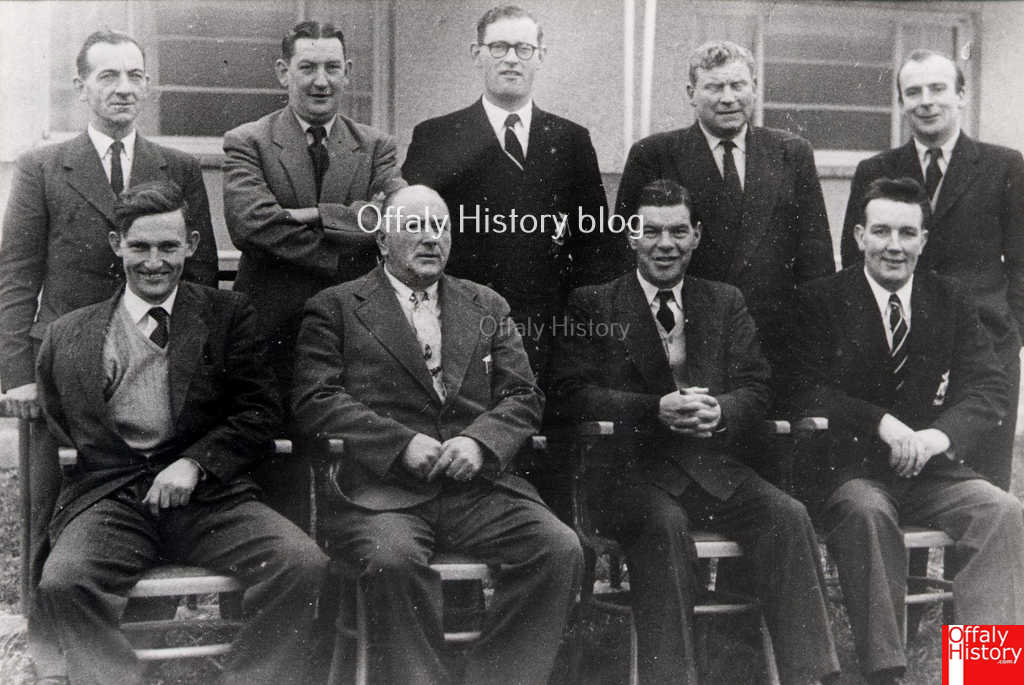
First trustees of the Tullamore Rugby and Soccer Club, 1956. Back row: T. Kelly, G. Smyth, H.L. Egan, W. Champ, D. Kilroy; front row: Terry Adams, W. Stephens, J. Kilroy, O. McGlinchey.(more…)
The rugby grounds at Spollanstown have been used for sporting activity in Tullamore for over 140 years. The establishing of the Spollanstown sports field is rooted in the difficult situation in the 1880s when the land war was at its height, the home rule movement was advancing steadily and, increasingly, sporting activities reflected the deep political and religious divide in the country.
Kilbeggan team in 1927-28. Birr was able to affiliate to IRFU in 1887 and Tullamore in 1937(more…)
But while Amy Biddulph’s life was happy, these were troubled times. From the age of nine Amy began to hear of the Land League. Francis read the newspapers out loud every day for the benefit of Annabella. Just after the shooting of the Chief Secretary Lord Frederick Cavendish in the Phoenix Park, her brothers were walking along one of the roads in the town near their house with two policemen walking in front of them. They saw a flash out of one of the houses and one poor young policeman fell dead almost at their feet. There was constant anxiety about Francis. As a J.P., a landlord and an army man he was a marked man. One day he received a letter containing a picture of a coffin with his name on it. In spite of this, for the three girls growing up in Birr, there was a lively social scene.
Francis Edward Biddulph was born in Congor, County Tipperary, the son of Nicholas Biddulph and Catherine Lucas. His mother died shortly after his birth. Francis was cared for by his aunt, and later by his stepmother Isabella Digges la Touche. He was to have nine half-siblings, many of whom would later live in Birr.
In 1861 he married Annabella Kennedy in Southsea. He was then a lieutenant in the 19th Regiment. They had fourteen children, six of whom survived to adulthood. The family moved from England to Burma and India, and back to England.
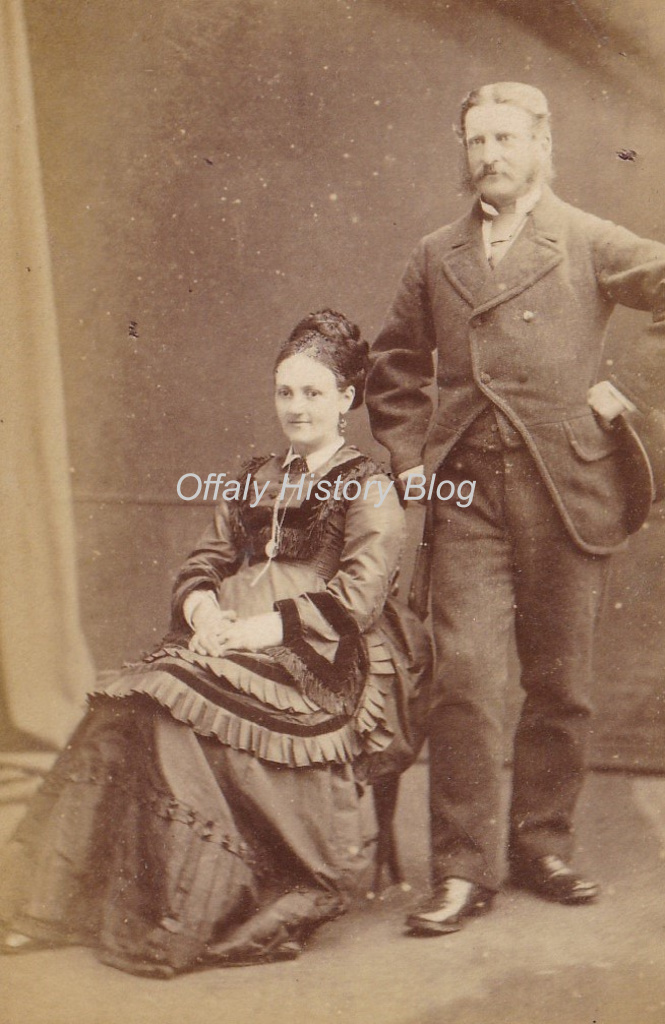
Francis and Annabella, Pembroke Dock, 1873. (Private Collection)
Their eldest daughter, Catherine Mary (Kate), had died in Bangalore, India aged 8. On their return to England they lost four more children. They are buried together in Llanion Cemetery, Pembroke Dock, Wales.
On his retirement from the army, Francis and Annabella returned to Ireland with their sons Nicholas, Charles, Hugh and Arthur, and their daughter Amy who had been born in Aldershot in 1875. Another daughter, Alice, died in Kilmainham, in 1877 and is buried in Grangegorman Military Cemetery. They took up residence, first in John’s Mall, and then in a house called St. Kilda’s, in Birr, then known as Parsonstown after the Parsons family who lived in Birr Castle. The two youngest daughters, Beatrice and May, were born in Birr. Arthur was later to die in Congor aged ten.
Francis became a Justice of the Peace. Later he became chairman, when Lord Rosse was away, of the Board of Guardians, and was on the Board. Then, in the church, he was the Rector’s Churchwarden, also teaching in Sunday school. For eleven years he belonged to the Unionist Association, and for the same length of time he was secretary of the tennis club.
Amy, the eldest surviving daughter, described living on John’s Mall as a child, and being taken for walks on Sunday afternoons with Francis and Annabella in the demesne of Birr Castle‘a glorious park, with miles of walks and rivers and a huge lake where water lilies abounded in summer, which I am ashamed to say often came home hidden under our coats as we were not supposed to pick them.’ Here she would play with her friend Emma McSheehy, daughter of the stipendiary magistrate, climbing the big trees, watching the fish in the river and scampering around what was at that time the biggest telescope in the world. Francis and Annabella would be asked to dinner parties and Lord Rosse would take the guests out to look at the stars and moon on a clear night, which they told Amy was a very wonderful sight.
She also gave an account of a terrible accident on the lake at Birr Castle:
In winter the lake froze and when the noble earl considered it safe for skating it was thrown open and there at seven I learned to skate. How I loved it – one part of the lake was not as safe as it was supposed to be and a bad accident happened – two sisters who were skating together happened on the thin part and one went through. The other tried her best to save her but alas, by the time others had come with ropes she had gone under altogether and I don’t think her body was recovered ‘til the ice melted. After that much greater care was taken and next year parts of the lake were roped off. We also used to skate when it wasn’t thought to be safe on some flooded fields near the barracks and that always ended in tea and lovely hot toast swimming butter in the depot mess, before a huge fire.’
In 1883 the family moved from John’s Mall to St. Kilda’s. The house was close to Crinkill barracks where there was always a regiment. The Leinster Regiment had their depot in Crinkill Barracks. Amy went to sleep every night to the sound of the Bugler’s Last Post, and woke to the Morning Reveille.
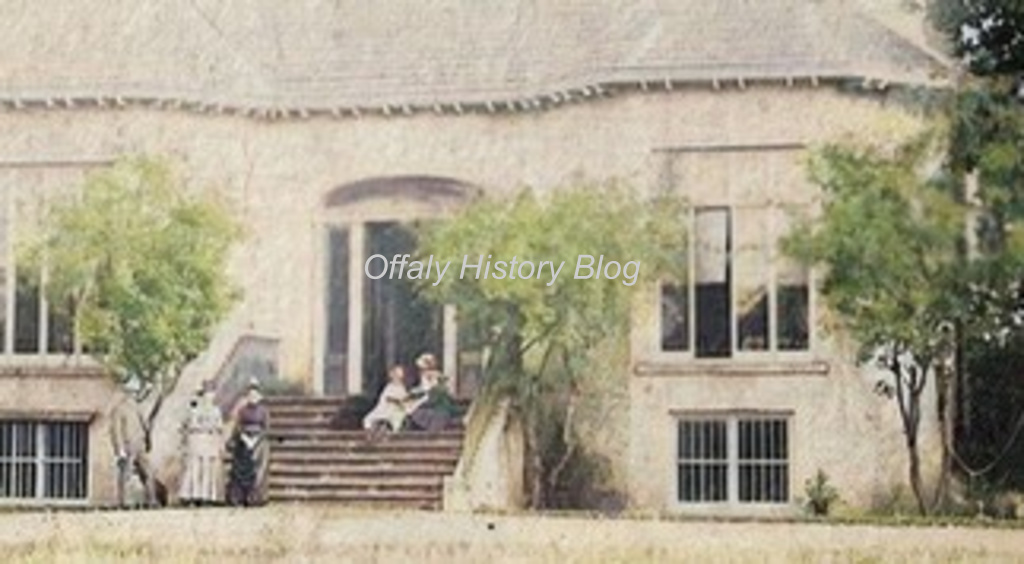
St Kilda’s, Birr, Co. Offaly (Private collection)
While the older Biddulph boys were away, Nicholas in Egypt with the army in Egypt, Hugh and Charles at boarding school in Aravon House, Bray, County Wicklow, the girls remained at home. Amy and the younger girls received an education from a governess. In Amy’s own words:
‘A governess came daily for a couple of hours to give me and my two sisters lessons. Education wasn’t much thought of for girls. As long as we could read, write a good hand and add up a few sums and have a smattering of history and geography. With me they went a bit further and I had painting lessons in the town and a master for music. The others didn’t get that far except what our governess could teach them.’
All three sisters attended Sunday school in Birr.
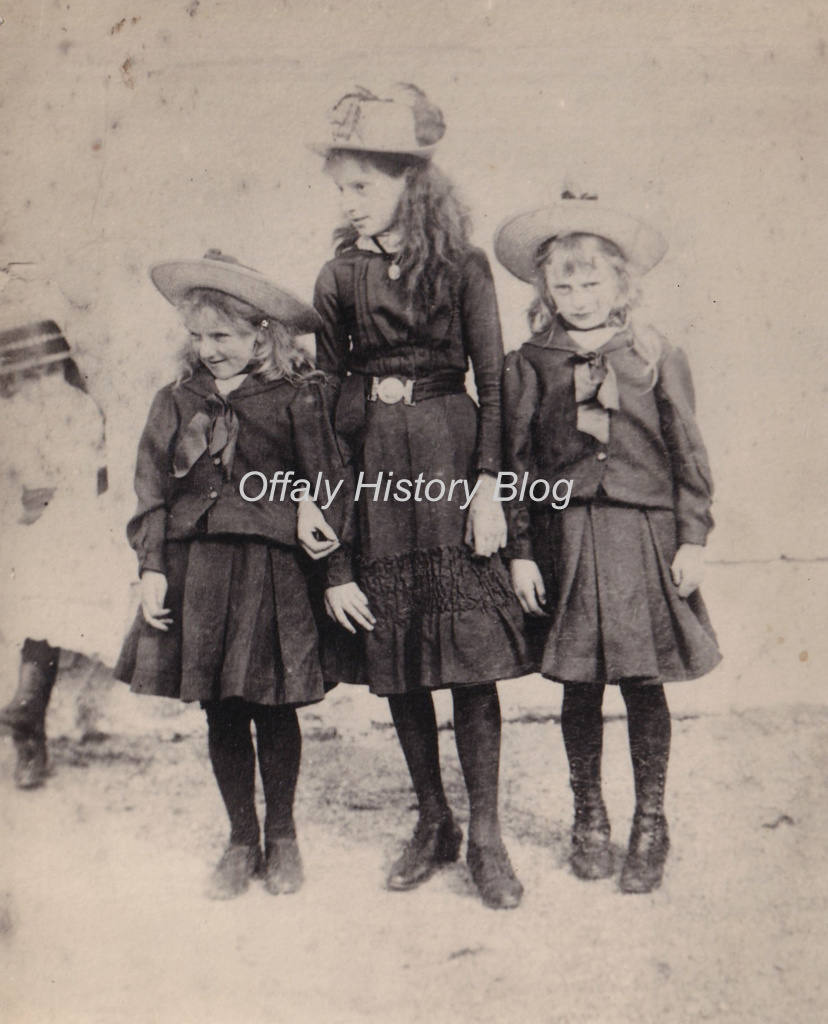
Beatrice, Amy and May Biddulph (Private collection)
Amy had dancing lessons in Birr Castle, with the children of Lord Rosse. They also frequently visited nearby Kinnity where their relatives, Assheton Biddulph and his wife Florence, together with their daughters Kathleen, Ierne, Norah and Ethne, and their son Robert, lived in Moneyguyneen, close to Kinnity Castle. Born between 1881 and 1891, the children were close enough in age to be playmates for the two younger Biddulph daughters, May and Bea. Assheton’s brother Middleton Biddulph lived and farmed at the Biddulph family home of Rathrobin with his wife Vera. They had no children.
Francis Biddulph’s younger half siblings Annie, Mary, James and William were all living in Parsonstown at this time. Annie lived at Birr View. There is a memorial window to Annie in Ardcroney church but the church itself is now located in Bunratty Folk Park. Mary and James lived at Bunrevan, Parsonstown.
James Digges La Touche Biddulph was the second son of Nicholas Biddulph, and the first son of his second wife Isabella Digges La Touche. His sister Mary was born the same year of 1842. It seems likely that they were twins but there are no surviving baptismal records. The church records for Ardcroney were destroyed in 1922.
James Biddulph died in Parsonstown in 1895 from general debility according to his death record. He was fifty years old. His sister Mary Biddulph was present at the death.
BIDDULPH – October 14, at Bunraven, Parsonstown, J. Digges la Touche Biddulph, son of the late Nicholas Biddulph, Congor, Borrisokane. Funeral at 9 o’c. tomorrow (Thursday) morning for Congor.
William was a Church of Ireland clergyman and married to Rebecca Clarke.
Amy described St. Kilda’s as her very happy home – ‘there was a large garden at the back of the house and at the end of it large apple and pear trees – one of these which I claimed as my own had very good branches for climbing and many a day when my two young sisters would be off playing their own games I would sit up for hours partly reading and partly watching the lambs which adjoined our place. How they skipped and jumped – she wrote – especially on old roots of trees which abounded – and then suddenly rushed off like mad things when their mothers called them. They were my delight, and also the rabbits, especially the tiny ones when they first came out of their burrows of which there was a lot in our fields.’ Her brothers, however, caught them in traps and shot them. They were a most useful addition to the menu.
‘The avenue which was more than half a mile long, opened off the Barrack Road.
There was a very high hill covered with big trees on one side and a pretty little lake on the other. When my brothers were home for the holidays they made a rustic bridge and a boat – and the island was always a sort of misty place inhabited by fairies and gnomes.’
Among Amy’s childhood memories were some involving her donkey Yankee. She described him as being almost human. ‘When some of the officers would come over from the barracks one of us would jump up on Yankee with just a stick in our hands to guide him, no saddle or bridle, and canter him round and then we would invite one of them to get on which they would do while we stood at its head. Then we’d say ‘Gee-up, Yankee’ and round he would go, kicking and jumping and arching his back ‘til the unlucky victim would fly off. How we trained him to do that trick I don’t know, but it was an unfailing one.’
But while Amy’s life was happy, these were troubled times. From the age of nine Amy began to hear of the Land League. Francis read the newspapers out loud every day for the benefit of Annabella. Just after the shooting of the Chief Secretary Lord Frederick Cavendish in the Phoenix Park, her brothers were walking along one of the roads in the town near their house with two policemen walking in front of them. They saw a flash out of one of the houses and one poor young policeman fell dead almost at their feet. There was constant anxiety about Francis. As a J.P., a landlord and an army man he was a marked man. One day he received a letter containing a picture of a coffin with his name on it.
In spite of this, for the three girls growing up in Birr, there was a lively social scene.
On the 1st January 1890, according to an item in the Irish Society (Dublin) of the 11th January 1890, the Countess of Rosse and Lady Muriel Parsons held a children’s fancy dress ball in Birr Castle.
‘Dancing commenced soon after 8 o’clock in the beautiful drawing room of Birr Castle, and was continued throughout the evening with the greatest possible spirit and enjoyment. Supper was served at 11 o’clock in the dining room, which was brilliantly illuminated with electric light.’ Miss Amy Biddulph attended as a Russian Tambourine Girl, Miss May Biddulph, as a Watteau Shepherdess, Miss Beatrice Biddulph, an Ice Queen. Miss Kathleen Biddulph, aged 9, daughter of Assheton Biddulph, was Little Bo-Peep.
As the three sisters grew older they played an active part in the life of the town..
May was a keen cyclist. Her name appears in an account of the Bog of Allen Club Bicycle Gymkhana which took place in July 1897. She was clearly an enthusiast of the bicycling craze which swept America and Europe at this time and promised greater freedom for women.
The Annual Gymkhana, promoted by the Bog of Allen Club, came off successfully at Oldtown, Naas, in tropical weather, and in the presence of a large and fashionable concourse of spectators. The Band of the 5th Battalion Royal Dublin Fusiliers played a fine selection of music during the afternoon, under the baton of Mr. Colvet.
She took part in the Hallow Eve Race (for Pairs) with Rev. L. Fletcher, and also in the Bending Race (for Ladies). Her sister Bea also took part in the Bending Race. The final race of the day was a One-legged Race (Ladies and Gentlemen). It’s not known if either May or Bea took part.
Amy Biddulph and her aunt, Miss Biddulph of Bunrevan, took part in a Birr Barracks Entertainment, an account of which appeared in the Midland Counties Advertiser of the 27th October 1892. Amy was seventeen years old.
‘Miss Biddulph, of Bunrevan House, next contributed a pleasing number ‘Saved from the Wreck’ which was very favourably received…Miss Amy Biddulph, St. Kilda, the eldest of the pretty daughters of Colonel Biddulph was, in the absence of Mrs Frend, requested to furnish a song, and greatly pleased her audience by giving a charming rendering of ‘The old home beyond the hill.’ The youthful vocalist fully sustained the musical reputation of her respected family, and she made a most favourable impression. Possessing a voice of singular power and sweetness and under perfect control, this young lady gives every promise of becoming a valued addition to local musical circles.’
Amy played tennis, sometimes mixed doubles with her brother Charlie, sometimes with Emma McSheehy. One year the annual tennis ball was held in St. Kilda’s. ‘It was a lovely moonlight night high in midsummer and the hay had just been cut and put up in heaps to dry and next day we had a great time discovering hankies and fans etc., at a great distance from the house – even on the island which told a tale! Also we weren’t very pleased to find the haycocks had been flattened.’
However this life couldn’t last. Francis had commuted his pension to fund the purchase of the 50-acre farm. When the farm failed through a combination of the agent’s deliberate mismanagement, Francis’ lack of competency, and the difficulties arising from the agrarian unrest, together with the refusal on the part of one of his half sisters to help him financially, the original entail inheritance having been broken to support his half sisters. He had borrowed money at an exorbitant rate from Joyce the moneylender in Dublin, and he was bankrupt. The family was forced to leave St. Kilda’s. All their horses were rounded up to be taken away and sold, though the donkey Yankee and the old pony Countess were later saved. Amy ran until she came to the wishing well and lay on her face on the mossy bank and cried her heart out. Amy’s brother Charlie helped to save some silver and jewellery by packing them into his uniform cases. Bea and May carried out pictures and hid them in an old derelict lavatory in the bushes. Next day they left St. Kilda’s forever and stayed in lodgings in Birr.
Francis and Annabella moved first to Dalkey in County Dublin. Their youngest daughter Bea, went with them and trained to become a nurse. There was worse to come when Charlie died of typhoid on the 26th of June 1900 in Queenstown, South Africa.
May married Charles Francis Pease in Belfast in 1904. He was ‘a well known Irish cyclist’ and the son of Charles Clifford Pease of Hesslewood, Yorkshire.
Amy travelled to Belfast to become a companion to an elderly relative. She married Surgeon-Captain James Walker in Belfast in 1906. By a strange twist of fate he had served in Crinkill Barracks, in Birr. They had seen each other but had never met. He died of pneumonia 18 months later in Jacobabad, India.
Bea would later marry Archibald Mateer, stepson of John Parnell, whose brother Charles Stewart Parnell had founded the Land League.
It was 2003 when the first issue of Offaly Heritage was published. Just twenty years later the twelfth book of essays will be issued by Offaly History on 6 October 2023 at the Offaly History Centre at 6 p.m. and launched by a son of Tullamore, Terry Clavin. Terry is a distinguished historian who works with the Royal Irish Academy and has contributed over 400 biographies to the Academy’s Dictionary of Irish Biography. This is now available online and is a tremendous resource with about 11,000 biographies and eleven published volumes in the main series with a significant number of ancillary publications.
Offaly Heritage 12 is another bumper issue with over 500 pages and very much on a par in quality with the issues since no. 9 was published in 2016. It is a tremendous achievement and, no doubt, benefits from the support of the programme for the Decade of Centenaries and Offaly County Council.
For this issue there was a team of editors – Michael Byrne, Dr Mary Jane Fox, Dr Ciarán McCabe, Dr Ciarán Reilly, Lisa Shortall. Obituaries Editor: Kevin Corrigan.
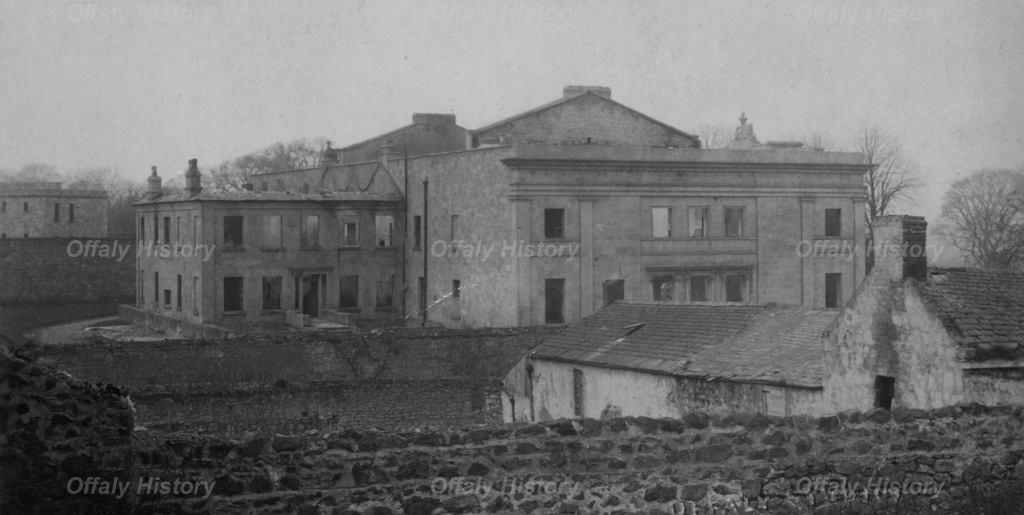
The shell of the county courthouse, July 1922
The essays in section one reflect the ongoing research in Offaly into aspect of life in Ireland 100 years ago as we come to the end of the Decade of Commemoration (1912–1923). The essays reflect the changing nature of society in Offaly at that time, particularly during the years 1920 to 1923 and readers will enjoy contributions as varied as the end of the Wakely family of Rhode; the final years of the Leinster Regiment at Birr; the Protestant minority in Offaly during the revolutionary period; the courts of assize in King’s County in the years 1914–21; the burning of Tullamore courthouse, jail and barracks in 1922; the story of Belgian refugees in Portarlington, and Offaly claimants in 1916.
A series of short lives are presented in this volume, as they were in Offaly 11 and includes entries on individuals as diverse as J.L. Stirling, Averil Deverell, Middleton Biddulph, Robert Goodbody and volunteer Sean Barry.
Brother Pat Guidera S.J. (born 1900, died 1992) was a familiar figure in Tullamore over a period of forty-two years from his transfer to Tullabeg College in 1948 up to its closure in 1990. Today the old college is falling to ruin. Many will recall its very good order up to the 1990s and thereafter it was used in part as a nursing home. Brother Guidera wrote a short ‘Story of my life’ in 1991 and this is an extract from that now very scarce memoir – of which there is a copy in Offaly Archives (courtesy of the Irish Jesuit Archives). The college was opened in 1818 and several volumes have been published on its history but few as intimate as that of Bro. Guidera. His memoir is interesting also for the marked distinctions in the religious orders between those fully ordained and those who were effectively providing support services in the college or convent. Brother Guidera was a carpenter cum painter and many will remember him shopping in Tullamore and carrying the large carton of cigarettes in the town for his colleagues in the college
Pat Guidera was born in Mountrath in 1900 and died in 1992. The family saw lean times in his early years in the town. Here he talks about his time with the IRA from 1919 and with the Republicans in the Civil War, 1922–23. Some Tullabeg Jesuits provided support services to the old IRA in the War of Independence, especially after the attack on Clara barracks. That was long before Bro. Guidera arrived.
As evidence of the climate crisis increases across the world, the need to find alternative forms of energy to fossil fuels has intensified. According to the Sustainable Energy Authority, Ireland imports a little over 70% of the energy used with the EU average, being 58%. Ireland’s. Transport accounts for the most demand, with over 95% of transport energy coming from fossil fuels. Other than environmental factors, being dependent on importation of fossil fuels has led to concern about energy security due to the geo-political climate, specifically today, the Russian Ukraine War.
As a country without its own oil and a limited supply of gas and coal, peat has historically been an important fossil fuel for Ireland, providing it with some energy self-sufficiency.(Geological Survey Ireland) In recent decades, however, there is growing recognition that burning peat for fuel is not sustainable as not only is it a highly carbon inefficient fuel, intact peatlands are an efficient carbon sink, whereas damaged peatlands are a major source of greenhouse gas emissions. “. . . Ireland has more than half the European Union’s remaining area of a type of peatland known as raised bog, one of the world’s rarest habitats and, scientists say, the most effective land form on earth for sequestering carbon . . (New York Times 4 October 2022)
Early in the summer of the year 697, probably in May, a great assembly of kings, bishops and abbots, along with their followers and servants, took place in Birr. It was a joint meeting of kings (rígdál) and of church leaders (synod). They came together to proclaim a law for the protection of women, children, clerics and other people who did not bear arms, in times of conflict. The law was called Cáin Adomnáin or the ‘Law of the Innocents’ (Lex Innocentium) and later referred to in a poem as the ‘Great Law of Bir
In the last blog we noted that the August 1923 General Election in Laois-Offaly was remarkably peaceful given that the civil war had only ended in May. Offaly was still strong in support for the Republicans as was clear from the fact they gained two seats, but, of course, were committed to not entering the Dáil. Labour’s William Davin continued to have a strong vote but not nearly so much as in June 1922. Tullamore’ Patrick Egan gained a seat on Labour transfers. Egan polled only 9 per cent of the first preferences.[1] In Laois-Offaly the Republicans outpolled Cumann na nGaedheal, but the latter won the by-election of 1926 created by the disqualification of Republican John or Séan McGuinness.[2] Overall Cumann na nGaedheal secured 38.9 per cent of the 1923 vote as to anti-Treaty Sinn Féin’s 27.4 per cent.[3] The Sinn Féin vote was secured in difficult circumstances with many still in prison or in hiding. As Joe Lee recorded the outcome was a resounding success for anti-Treaty Sinn Féin and a loss for Labour. Cumann na nGaedheal secured 63 seats, but that was a gain of only five in a Dáil enlarged from 128 to 153 seats. This was the election in which the franchise was extended to all women over the age of 21, thereby expanding the electorate from 1.37 million in 1918 to 1.72 million in 1923.
There was an extraordinary Synod held in Birr in 697AD. This synod was called by Adomnán, abbot of Iona, who arrived in Birr with the princes of church and state and who produced an edict that fundamentally challenged the way warfare was carried out in Ireland and beyond.


 offalyhistoryblog