Oliver Mulpeter was heard to say he ‘would not miss it for the world’ and carrying the national flag which he proudly bore as the nephew of one of the wounded soldiers, he was among the first to arrive.
The commemoration was to honour soldiers of the National Army who were wounded in a Civil War ambush, two of whom died some weeks later. Relatives of all four casualties gathered for a roadside ceremony on a bitterly cold January day with traffic thundering past inches away on that busy road between Raheen and Geashill in North Offaly.
An honour guard of soldiers of The Irish Defence Forces Veterans group was present led by Declan Sheridan. They came to attention and gave the salute as the ceremony progressed – a poignant mark of respect to their comrades-in-arms of a century ago, their presence there an important and vital element of the event.
It was one hundred years to the day that the ambush took place at that spot, within sight of old Raheen chapel, on a bend of the road overlooked by rising ground. The ambush party opened fire with rifles and a Lewis gun from both sides of the road on a platoon of fourteen soldiers marching from their Geashill garrison to Sunday mass. Luckily the Lewis gun jammed, otherwise casualties would have been much higher.
My story starts as a small boy growing up in Dillon Street, Tullamore in the 1940s. I remember seeing a cutting from a newspaper which I presumed was from a Tipperary weekly paper. The article covered a report of a feis and sports held in a field at the Golden Vale Hotel in Dundrum Co. Tipperary. It mentioned about the Misses Crummy from Ballydine taking part in the Irish dancing. A small report on the opposite side of the cutting was headed
Shooting near Birr. Charged at Birr with conspiring in 1923 to kill and killing John Finlay, Tullamore. Chas and Peter Molloy and Michael Coyne were sent for trial.
What is so unusual about this paper cutting from 1923?
My mother, one of the Misses Crummy mentioned in the article, was now working in Tullamore for T. English & Co. She met and married my father Thomas, brother of John Finlay some ten years later.
In Midnight Oil (London, 1971) V.S. Pritchett (1900-97) describes how The Christian Science Monitor sent him to Ireland early in 1923 to write about the Irish Civil War. The Anglo-Irish treaty had been signed, the Irish politicians split, and the two parties were killing each other. When Pritchett arrived the siege of the Four Courts in Dublin was well over and the fighting was drifting away to the south and west. In fact there was not much more than three months left before the Republicans decided to dump arms
On a misleadingly sunny day on the first of February 1923, I took the train from London to Holyhead. In a heavy leather suitcase I carried a volume of Yeats’s poems, an anthology of Irish poetry, Boyd’s Irish Literary Renaissance, Synge’s Plays, and a fanatical book called Priests and People in Ireland by McCabe [McCarthy, 1864–1926, published in 1902], lent to me by a malign Irish stationer in Streatham who told me I would get on all right in Ireland so long as I did not talk religion or politics to anyone and kept the book out of sight. Unknown to myself I was headed for the seventeenth century.
The Irish Sea was calm—thank God—and I saw at last that unearthly sight of the Dublin mountains rising with beautiful false innocence in their violets, greens, and golden rust of grasses and bracken from the sea, with heavy rain clouds leaning like a huge umbrella over the northern end of them. My breath went thin: I was feeling again the first symptoms of my liability to spells. I remember wondering, as young men do, whether somewhere in this city was walking a girl with whom I would fall in love: the harbours of Denmark gave way to Dublin Bay and the Wicklow Hills. The French had planted a little of their sense of limits and reason in me, but already I could feel these vanishing.
Growing up on Clontarf Road, Tullamore, on the banks of the Grand Canal in the 1950s and 1960s I spent many childhood hours playing beside the canal. This was where my father’s family had lived for generations in East View Terrace before he and several of his siblings had acquired houses in Frank Gibney’s new state-of-the-art housing on Clontarf Road. In early teenage years I took to walking the canal line and ventured to Kilgortin Mill and Rahan, where my mother’s people, my grandfather and uncles and a multiplicity of cousins, lived. Not surprisingly the canal got under my skin if not indeed into my bloodstream.
Hiking west from Tullamore the ‘canal line’ took us to exotic locations: The Metal Railway Bridge and slow-moving trains, the inaccessible Srah Castle, Molloy’s Bridge for in-season snowdrops and horse chestnuts and the hugely impressive six-chimneyed Ballycowan Castle, overlooking the imperious and impervious Huband Aqueduct. Rambling east towards Cappancur we soon explored in detail the small aqueduct which seemingly miraculously ushered the Barony River under the canal and were further allured by the rotundity of Boland’s lockhouse and a lock manned by a team of sisters. Graduating to the bicycle we set out along the towpath for far-flung towns and villages: Ballycommon and the Wood-of-O, the Kilbeggan Branch, historic Daingean and the outré but warm and welcoming church at Pollagh.
Grand canal from the 27th lock at Cox’s Bridge, Tullamore about 1910(more…)
Fr Colm Gaynor was a Catholic curate in Birr in the years 1922–37. Originally from Tyone, Nenagh his valuable memoir was published in 2003 and included with that of Sean Gaynor and Eamonn Gaynor. The book was published by Geography Publications as Memoirs of a Tipperary family: the Gaynors of Tyone, 1887–2000. It is available from Offaly History Centre to buy or to read at Bury Quay, Tullamore.
The three young Tullamore men were William Conroy (20), Patrick Cunningham (22) and Colm Kelly (18) and they were executed by the Free State military in the grounds of Birr Castle on 26 January 1923. They were from poor families in the town and had no one of influence to speak for them. It is said that a fourth young man was allowed to go free.
Writing later to the Military Service Pensions Board about the execution of three men, Sean McGuinness, brigade O/C and on the Republican side said :
The three had been expelled from their IRA active service unit for some minor misdemeanours. McGuinness wrote that the men returned to Tullamore, where they “remained unemployed and I presume penniless and without a smoke”. He claimed they were executed by the Free State for a “few minor robberies”, though the court records show they were summarily executed for armed robbery. McGuinness suggested that “their crime was nothing compared with that of the great betrayal of the Republic by the authority responsible for the killing of these three youths”.
Such was the legacy of bitterness understandably arising from the Civil War.[1]
On the 29th March 1919, 20 IRA Volunteers escaped from Mountjoy jail in broad day light. This escape was planned by Michael Collins on the outside and Piaras Béaslaí on the inside. A prison strike had been taking place in the jail in support of four prisoners who were not being afforded political status. In the lead up to the escape this strike was halted because the escape plan had a better chance of success with a quieter atmosphere in the prison.
The plan was to get Piaras Béaslaí and JJ Murphy both MPs and Padraig Fleming a volunteer from the Swan, Co. Laois out, followed by the four prisoners not being afforded political status. A list of men with long sentences was created and it was decided that men serving short sentences or who had sentences close to completion would not escape. Padraig Fleming had conducted an extraordinary fight for treatment as a political prisoner in Maryborough (Portlaoise) jail, enduring hunger strike, torture and physical mistreatment for months. In Mountjoy he was the Officer Commanding the political prisoners.
The escape was planned for 3 p.m. on Saturday March 29th. On the previous Monday the four prisoners being denied political status broke away from the warders in charge of them and led them on a big chase around the field before being recaptured. As a result, they were kept in a metal cage for exercise and guarded by no less than eleven warders. If these precautions were continued their chances of escape were slight, while the presence of so many warders also presented a serious obstacle to the escape plan. On Fleming’s orders the four prisoners caused no more problems for the warders and the prison authorities were lulled into a false sense of security.
@offalyarchives @offalyheritage @courthouses @offalycountycouncil. See our blog of 6 January in regard to a vacancy at Offaly Archives for an archivist.
Reports vary as to how much destruction of the Offaly County Council’s papers took place. A report of 22 July 1922 was upbeat as to how much material was saved. This optimism appeared to be ill-founded:
It is feared that valuable books and papers have been burned. Later, it appears one of the staff of the Co Council was knocked up at his lodgings a short time before the burning of the courthouse, and when he visited the place saw it filled with armed men and the smell of petrol everywhere. They gave him a few minutes to remove some books, documents, etc, to a place of safety. Most of the books, including the rate books, and documents were found undamaged in the strong rooms after the fire. A good deal of documents, including correspondence, was, of course, burned, but at the time of writing it is impossible to make any accurate estimate of missing property. It is stated that the records of the Clerk of the Crown and Peace Office escaped burning in the strong room. . . Thursday Evening, Mr Costello, Co Surveyor’s clerk, Mr Barney Coughlan, Co Council staff, were called before the fire started and with the help of the courthouse caretaker’s daughters (Misses Mooney) and some others, removed before the fire started, large numbers of books and papers. The work had to be done speedily as very little time was allowed for it, but as a result of the efforts made, and the fact that the strong rooms saved most other documents, very little is missing belonging to the Co Council. Cart loads of stuff are being taken to the Urban Council and Technical building, [offices in what is now Banon’s yard in O’Moore Street]
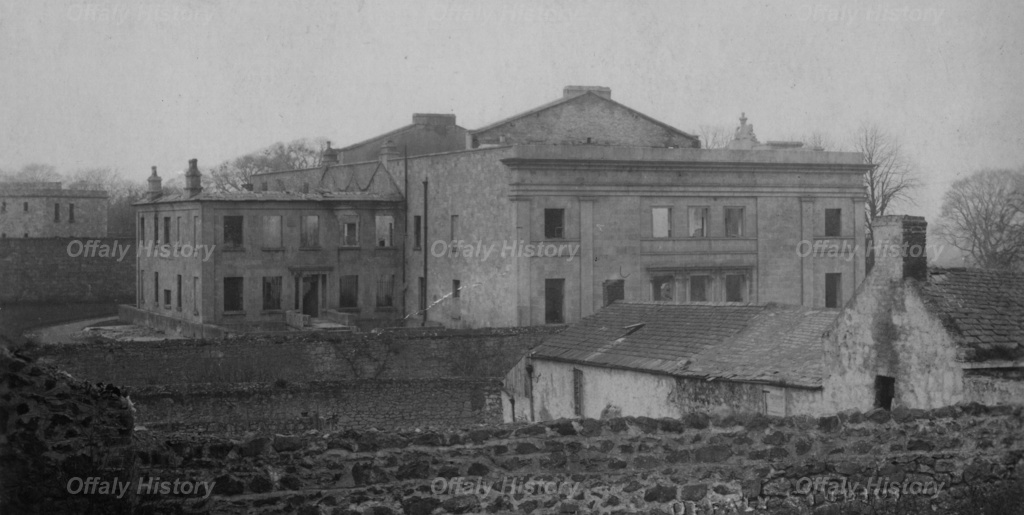
part of the Tullamore jail in the mid-1930s. After the burning there was general plunder of the fittings
where it is intended to re-establish the Co. Council offices. The Co. Council staff are returning to the same offices as they occupied while the British military were in possession of the Courthouse [Jan. 1921–Jan. 1922] Large crowds spent the day viewing the burning remains of the buildings and visiting the interior of the prison. Very few heard anything unusual last night and it was only about 6 or 7 a.m. this Thursday morning the destructive ravages of the fire became generally known.[1]
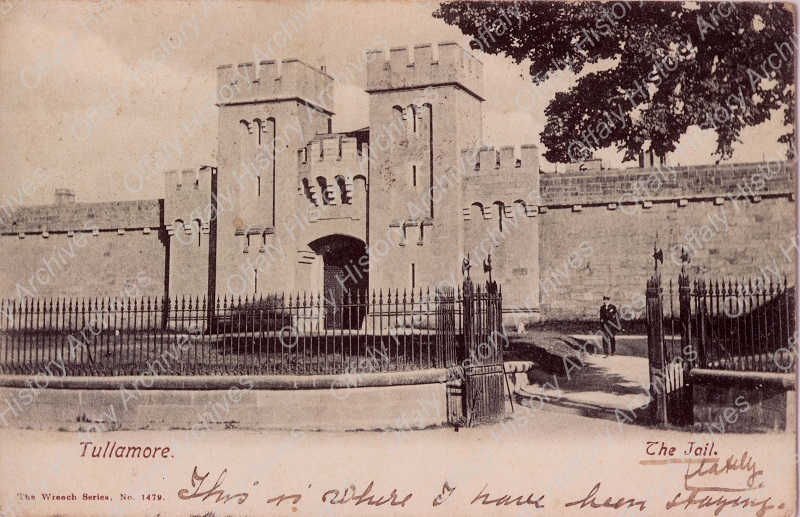
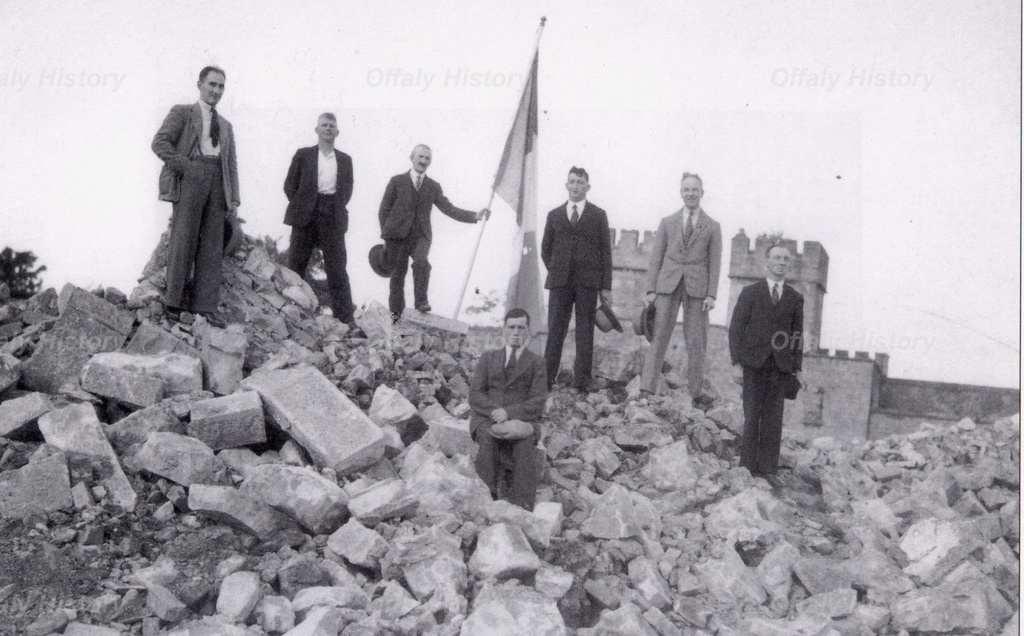
The original Tullamore courthouse of 1835 was destroyed by the Republican IRA on 19-20 July 1922 with the barracks and the jail. It was rebuilt in 1927 for £10,000, and again in 2007 for €10 million.
Things must have been appallingly chaotic for the council staff trying to sort the mess and later having to move back to very confined office, not being much more than ‘a stuffy little office in High Street’.[2] The council staff was now headed by John Mahon who had been the county accountant and was now also acting county secretary following the dismissal/forced retirement in January 1921 of Charles P. Kingston by the new Sinn Féin dominated council on the alleged grounds of neglect of duty.[3] Kingston had been the council’s chief administrative officer since 1900 and would have worked with the old parliamentary party councillors who dominated the scene until the local elections in June 1920. When the results were coming in that June Kingston commented that the ‘election was remarkable and even more revolutionary than the elections of 1898 when only three members of the old grand jury were returned’. Probably Kingston had anticipated the change, did not like it, and was preparing for his departure. He had clashed with the Sinn Féin county organiser and ideologue, T. M. Russell, who had been on the council since early in 1917 and was much too clever for Kingston’s liking. Kingston was enterprising and had erected ‘two fine blocks of double villas’ at Clonminch Road, Tullamore in 1909.[4] He had sold his own house in this development to John Williams (son of D. E. Williams) in late 1918 and perhaps moved to Dublin at this time as he was involved in the Kingston Drapery business from the 1920s. In any case the Kingston removal put considerable pressure on the remaining officials in the councils. All this emerged with the investigation into the council’s affairs and its dissolution in 1924.
The Tullamore jail was partially destroyed on 19-20 July 1922. ‘This is where I have been staying lately.’
The council’s own Finance Committee minute book recorded on 3 August 1922 that:
A meeting of the finance Committee was held in the Urban Council Hall, Tullamore, on the 3rd day of August 1922.
Mr John O’Meara presiding.
The other Members present were: – Messrs Luke Scally and James O’Connor
Payments to the amount of £1,377. 11s.3d. on foot of Works in charge of the County Surveyor, salaries, & c. were made.
The secretary reported, for the purpose of the record on the Minutes, that the County Courthouse and all the contents of same were burned and totally destroyed on the 19th July, and that the Safe, which was in the County Council Office, and which contained Ledgers and Abstracts, Vouchers, Paying Orders, Cheques, Bonds, Bank Pass Books, &c., had fallen to the bottom of the Courthouse, and when it was opened, all the contents were found to have been totally destroyed, being burned into ashes. Certain other books, such as the Minute Books, Rate Collectors’ Books, &c., were stored in the Strong Room in the Crown and Peace Office, by the courtesy of the Assistant Clerk of the Peace, [Mr Holohan] and were found to be safe.
The Secretary also reported that Messrs Healy, Coghlan and Costello had saved all the Rate Books, Expenditure Books, some documents, &c., and County Surveyor’s Books that they possibly could from the fire, and that they had worked hard at great personal risk, and he (Secretary) recommended them to the consideration of the Committee. The County Surveyor also supported this recommendation, and the Committee granted the three persons concerned a sum of £7 each, subject to the approval of the Local Government Department.[5]
Thomas Holohan is obliged to sue the council for the balance of £2 due
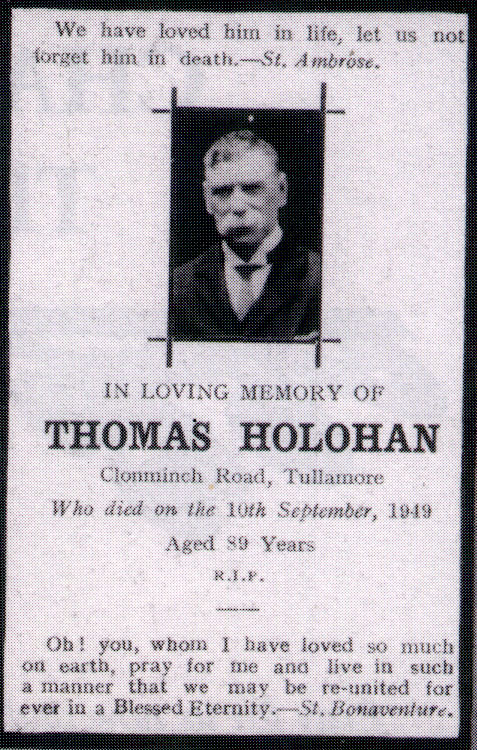
In October 1922 the council agreed to pay Mrs Mooney, the former caretaker of the courthouse a sum of £7 for her work in saving a considerable amount of furniture from the fire in the courthouse.[6] The council was less liberal with Thomas Holohan, the deputy clerk of the peace working in what would later be the county registrar’s office.[7] He had requested the council to pay him the balance of £2 due to him of the total sum of £5 he had paid to a carter to assist in moving the court documents and some ratepayer material from the brick-lined safe. This included some 5,000 items relating to land registration. It took three days to remove the material at the expense of £5 paid by Mr Holohan, who also had had the assistance of his own family in the removal for which he had not charged anything. The council had let the matter go to quarter sessions rather than refund Holohan the balance of €2 of his out-of-pocket expenses for the transport of the documents. Judge Fleming awarded the amount claimed. Ironically, some of the documents saved may well have been included in the planned destruction about 2010 of old land folios in all the county registrars’ offices across the country showing previous transactions on the title. This was done as part of the moving online of the land registry folios but at the loss of much useful historical material.
Thomas Holohan (1860-1949) was a member of the rising middle classes of Tullamore. He became Assistant Clerk of the Peace in 1892 and retired as Senior Clerk in the Circuit Court Office in 1942. In 1909 he moved his family from their rented house in Store Street into ‘Innisfree’ (now ‘Loughmore Lodge’) one of the four substantial semi-detached villas on Clonminch Road built as a speculative development by the County Secretary, Charlie Kingston.
The county council was dissolved on 4 September 1924 and a commissioner appointed. This followed on from a report in May 1924 by the Ministry of Local Government’s chief engineering inspector on the state of the county’s roads and that the results of expenditure on road maintenance were about as bad as could obtain.[8] The situation was aggravated by the difficulty in collecting rates since June of 1920 and the repudiation of the Local Government Board. Furthermore, the accounts books had been seized by both the IRA and the RIC from June 1920. The council staff had been evicted from their courthouse offices in January 1921 and only allowed return in March 1922. Their stay only lasted four months. These reasons and the lack of a trained accountant following on from the promotion of John Mahon to county secretaryship were advanced by Mahon as the reasons for the shortcomings in the council’s management of local affairs. Mahon resigned from the county secretaryship in April 1925 due to chronic illness.[9]
Republican IRA marking the destruction of the jail during the building works for Salts factory in 1937. Included in the picture are Messrs Digan, Clarke and Brennan.
The records of the council’s predecessor – the King’s County Grand Jury
In the several references in the press to the surviving records of the council and the clerk of the crown and peace nothing at all was said as to the fate of the grand jury records (see previous blogs). These would have included the presentment books and perhaps an old county map of the 1750s or perhaps that of 1809. John Wright had drawn on what appears to be a surviving series of presentment books from 1817 for his guide to Offaly published in 1890.[10] These were probably printed in Birr by Thomas Legge who was the only printer in Birr from that time until his death in 1826.[11] Wright did have access to what may have been a list of the sheriffs from 1787 and a summary of the judicial business, but not until 1817 the presentments or ‘Jobs’ books. He was able to list the full list of grand jurors from 1803 and presentment business (as was of interest to him) from 1820.[12] The fact that so much was destroyed in 1922 makes Wright’s book valuable today. The Offaly Archives catalogue provides listings of what survived. In the case of the council from 1912 and for the grand jury generally from 1830. But there may be more out there from 1817 because a collection was sold at Purcell’s for the very high price of £4,000. The rumour was that the National Library bought them but that may not be the case. A buyer from Offaly History went to £1500 but dropped out at that point to great disappointment.
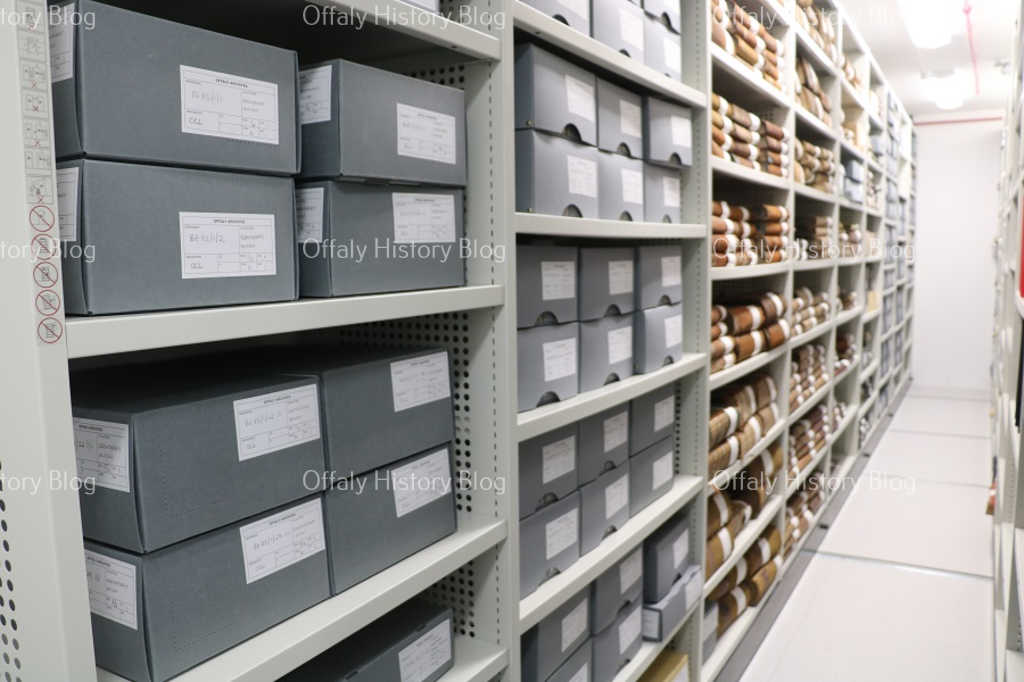
The good news is that our county records are now housed in Offaly Archives.
[1]Midland Tribune, 22 July 1922; Offaly Chronicle, 27 July 1922.
[2] Ibid., 29 July 1922; Tullamore and King’s County Independent, 4 Sept. 1915.
[3] This saga can be followed in Michael Murphy, Anne Coughlan and Grainne Doran, Grainne, Grand jury rooms to Aras an Chontae: local government in Offaly (Tullamore, 2003) pp 143–5.
[7] Holohan (1860-1949) was a member of the rising middle classes of Tullamore. He became Assistant Clerk of the Peace in 1892 and retired as Senior Clerk in the Circuit Court Office in 1942. In 1909 he moved his family from their rented house in Store Street into ‘Innisfree’ (now ‘Loughmore Lodge’) one of the four substantial semi-detached villas on Clonminch Road built as a speculative development by the County Secretary, Charlie Kingston. A noted figure on the Offaly legal scene, to the end of his days, Holohan still dressed in the senior civil servant’s uniform of sponge bag trousers, winged collar, a short ‘Parliamentary’ jacket and a bowler hat. He was dismayed by the actions in the Civil War of the Anti-Treaty forces, whom he always referred to in later life as ‘The Irregulars’. Information from Fergal MacCabe.
[8] Offaly Archives: minute book of Offaly County Council.
[9] Murphy, Michael, Coughlan, Anne and Doran, Grainne, Grand jury rooms to Aras an Chontae: local government in Offaly (Tullamore, 2003), pp 145-6.
[10] [John Wright (ed.).] The King’s County directory, 1890, including a short history together with coloured map, almanac and calendar. Parsonstown: King’s County Chronicle, 1890. Reprinted as Offaly one Hundred years ago with a new introduction by Michael Byrne (Naas, 1989).
[11] Michael Byrne, Printing and bookselling in Offaly in the nineteenth century (Tullamore, 2020), pp 52–3.
[12] John Wright (ed.). The King’s County directory, 1890, pp 253–62.
The commencement of the new District Court in Offaly in January 1923 was an inauspicious time to start. The county was caught up in the civil war that it seemed neither side could win. The Free State (National Army) had taken all the cities by August 1922, but the fight was still going on in the hills, especially in the south. Neither Tullamore nor Birr was free of anxiety with shots fired on New Year’s Eve to remind people that the Republicans had not gone away. How could they forget? In January 1923 two men from Kilkenny were executed for possession of arms and robbery. Soon after five National soldiers captured with a body of anti-Government forces were executed – a courtmartial having found them guilty of treachery. Five from County Offaly were executed in January and early February. In the same month there had been an attack at Raheen in north Offaly – an ambush while soldiers were going to mass with at least one dead. Some of the neutral IRA were talking about ending the conflict and the press reported that Peadar Bracken ex Brigade officer, Thomas Ua Quinn ex Vice Commdt, and Martin Fleming, ex Brigade staff officer, had called a meeting of pre-truce ex officers of nos 1 and 2 Offaly Brigades IRA at the old Sinn Féin hall regarding the peace movement. Peadar Bracken would know the place well as he was involved in the ‘affray’ in 1916 where ‘the first shot was fired’ in that very hall in William/Columcille street, Tullamore.
One hundred and thirty five years ago on Christmas eve 1887, one of the two ‘Heroes of Tullamore’, John Mandeville was released from Tullamore Gaol in wretched physical condition. Mandeville who farmed two hundred acres and was chairman of Mitchelstown Board of Guardians and his fellow Irish National Land League member William O’Brien, born in Mallow, and MP for northeast Cork were imprisoned first at Cork gaol on 31 October and two days later were transferred by train and incarcerated at Tullamore gaol. Earlier on 9 September, after an 8,000-strong demonstration led by John Dillon MP, three estate tenants were shot dead (John Shinnick, Michael Lonergan and John Casey) by police at the town’s courthouse where O’Brien had been brought for trial with Mandeville on charges of incitement at the Kingston Estate under a new Coercion Act. This event became known as the Mitchelstown Massacre. Mandeville, a tall burly man was singled out on instruction for particularly callous and brutal treatment at Tullamore gaol. He died six months after his release and an inquest held to establish the cause of his death concluded it was as a result of his maltreatments at Tullamore gaol. Before he died, he described the gaol conditions in letters to his wife and friend Sydney Halifax.
I write in the hope that you may find space to record my memories of the town of Birr fifty or sixty years ago. The following recollections are all from memory only – no notes – and I am sure a lot of boys and girls I knew will get a thrill.
Birr, as you know, is situated in the South-West of Offaly, known then as King’s County, near the borders of Leix County – known then as Queen’s and Tipperary County. It is about one mile and a half in length and one mile in width.
It was a military town. The Military Barracks were in the village of Crinkle, which is about one-half mile outside the town. The main thoroughfare was from the high path of Drumbawn to the New Line. You passed Moorpark Street, Bridge, Market Square, Main Street, Duke Square, Cumberland, Melsop and Townsend Street, – that is the length. Now the breadth was from Clonoghill Cemetery through Newbridge or Crinkle and the Military Road, John’s Mall, John’s Place, The Green and some of the Lusmagh Road to the back of the Castle.
[On Friday and Saturday 18 and 19 Nov. 2022 the annual heritage seminar will be held in Birr. The programme started on Friday at Birr Library at 5 p.m. with the launch of the collected poems of J De Jean Frazer and will be followed on Saturday with walks in the morning and talks in Oxmantown Hall (1889) in the afternoon. The exile here was Charles Kelly who wrote to the Offaly Chronicle from New York in 1952. It appears that his children moved to the United States. These memoirs give an insight into life that is so valuable. Well done to the Birr Annual Review who have published many such memoirs since 2001. Back issues of the Birr Annual Review have been uploaded to http://www.offalyhistory.com Ed]



 offalyhistoryblog