
First established under the 1881 Land Act, the Irish Land Commission began as a regulator of fair rents, but soon evolved into the great facilitator of land transfer. However, over emphasis on these aspects of its work can sometimes camouflage its equal significance as the main instigator and architect of rural reform. There is no doubt that for most of its existence from 1881 to 1992 the Land Commission was the most important state body operating out of rural Ireland where its long tentacles spread into every nook and cranny. [Come to Professor Dooley’s lecture on Monday in Tullamore – see details below.
(more…)Category: Decade of Centenaries
-
Serious fires at Birr Castle in 1832 and 1919. Serious Tourism now. Specially contributed to mark the decade of centenaries in County Offaly. Blog No 437, 9th Nov 2022
Two serious fires took place at Birr Castle within the hundred years from 1832 to 1919. Thankfully there has been nothing like it since and the castle was fortunate to survive the burnings of country houses in the county in the period from June 1922 to April 1923. Birr Castle is the only large house in the county to have survived in the same family since the 1620s. Its Gothic exemplar Charleville Castle, Tullamore also survived the destruction of the Civil War period. Both houses were occupied by the Free State Army from late July 1922.
The fire of 1832, ninety years earlier, was perhaps the most destructive and in its aftermath Laurence Parsons, the second earl of Rosse took the opportunity to add a third storey to the great house that had been substantially rebuilt in 1801–03. Its comrade in Tullamore is dated 1800 to 1812, or 1809 the grand opening – if not quite finished.
(more…)
-
Clara’s contribution to the birth of radio. By Michael Goodbody. Blog No 436, 5th Nov 2022
#DecadeofCentenaries @DeptCultureIRL @DepartmentofCultureIRL Tourism-Culture-Gaeltacht @offalyheritage @offalylibraries
The B.B.C.’s centenary celebrations and John Bowman’s recent feature on RTÉ’s Sunday morning broadcast which included a recording of my late father, Llewellyn Marcus Goodbody, bring to mind the important part that Clara played in the development of radio, the scientific discovery which transformed communications and is now part of everyday life. Without the backing of Irish capital it is possible that Guglielmo Marconi’s invention would never have got off the ground.
(more…)
-
Huge Crowd Gather in Bracknagh Community Hall for viewing of Film on Ballynowlart Martyrs and Turf Cooperative 101. By Mary Delaney. Blog No 433, 26th Oct 2022
Huge Crowd Gather in Bracknagh Community Hall for viewing of Film
Bracknagh Community Hall was full to capacity on Thursday last for the viewing of a film on the Ballynowlart Martyrs and the Turf Co Operative 101. The event was organised and hosted by the newly formed Bracknagh Heritage Group (A sub group of the Bracknagh Community Association). The guest speaker was Larry Fullam, local historian and researcher from Rathangan. Tony Donnelly extended a warm welcome to the large gathering. Mary Delaney, on behalf of the heritage group introduced and welcomed both Larry Fullam and Amanda Pedlow (Offaly Heritage Officer). Amanda addressed the audience on the supports provided by the Heritage Council for viable local projects.
Larry spoke on how in 1917 a local priest Fr Kennedy with the help of Fr O’ Leary from Portarlington had the remains of the victims of a fire at Ballynowlart church in 1643 exhumed and reburied in the grounds of the St. Broughan’s church. The story of Ballynowlart attributes the setting alight of the church on Christmas Day in 1643 to Cromwell’s forces. A congregation of 108 people, who were attending Christmas Mass all died, with the exception of two, who were said to have escaped. The film produced by Pathe showed Fr Kennedy handling the exhumed skulls of the victims and preparing them for reinternment in Bracknagh in 1917.
The second part of the film centered on how in 1921 (one hundred and one years ago), as part of the Government’s selling of bonds and fundraising, the Bracknagh Turf Co Operative exported sacks of turf to New York to raise money to fund the then, newly formed, Dail Eireann.
Larry donated a number of photographs of the stills from the film to the Bracknagh Heritage Group.The last time a film on Ballynowlart was shown was in 1964 in the cinema in Portarlington. This event was organised by the late Harry Milner of Walsh Island and was attended by a huge crowd from the Bracknagh area, many of whom are still part of the community of Bracknagh today.
The Bracknagh Heritage group are very grateful to Larry for his in-depth research and knowledge and for providing us with a great insight into Bracknagh’s past.The members also expressed their appreciation to all those who attended Thursday evening’s event and are delighted to see the interest and enthusiasm for local history in the area.
The group intend to pursue the following projects in the near future.
The real story of the Ballynowlart Martyrs.
The monastic site of Saint Broughan at Clonsast.
The Impact of Bord na Mona in the area.
The Story of John Joly and the extended Joly family.Lord Ashtown and his role in evicting tenants from the Bracknagh area in the mid 19th century, and how some Bracknagh emigrants were banished to places like Oneido in New York..
The RIC Barracks in Ballynowlart and
The Mill at Millgrove.
It was highlighted at the conclusion of the meeting how the Catholic Church, built at the peak of the Irish Famine celebrates 175 years this year.
The group extend;’/ thanks to Lisa Quinn, Chairperson of the BCA for facilitating the event.
Mary Delaney(on behalf of the
Bracknagh Heritage Group, which include.
Francis Cunningham,
Mary Crotty, Mary Briody, Barry Cunningham, Tony Donnelly & Aidan Briody).
People from Bracknagh gather outside Portarlington Cinema 1964 after watching a film on the Ballynowlart Martyrs (Photo courtesy of Larry Fullam) 
Bag of Turf from the Bracknagh Turf Co-Operative destined for New York 1921 (Photo courtesy of Larry Fullam)
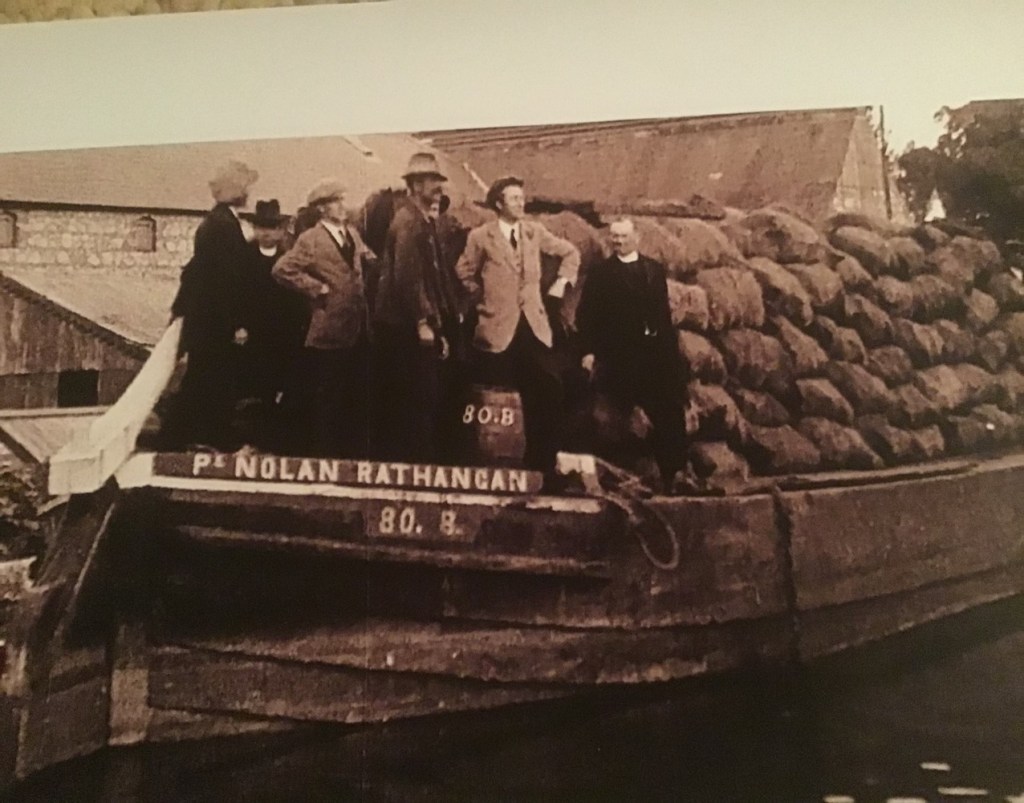
Turf from Bracknagh Co Operative being transported from Rathangan 1921 (Photo courtesy of Larry Fullam)
-
Tullamore ‘in the good old coaching Days’. Tullamore 175 years ago. Blog No 423, 21st Sept 2022
Historical Notes by a contributor writing in 1912, edited by Offaly History
This contribution to local studies was made in 1912 and was based on the writer’s access to a copy of the Tullamore entry in Slater’s Trade Directory published in 1846. At the time there was no public library in Offaly and private reading rooms were few. Neither was there photocopying or digitized copies. Books were expensive and access confined to only a few. There is unlikely to have been any bookshop in Offaly in 1912. By that time Sheppard’s in Birr, the only decent bookshop in Offaly in the mid nineteenth-century, was concentrating on stationery.
The only original comment from our contributor of the 1912 article was in reference to the coming Home Rule and the appointment of Catholics to public office. The War of 1914–18, 1916, The War of Independence and the Civil War were yet to come. The writer remarked:
Judging by the names of those filling public positions in Tullamore sixty odd years ago [in 1846], Catholics and Nationalists had very little influence in the administration of public funds. But times are changed, and even in the comparatively brief period which has elapsed since the above described state of things existed, one cannot but marvel at the immense strides made in science, mechanical engineering, and the arts generally, while the rapid development of National political ideas and aim points to the rapid approach of a golden era for our country.
What a pity the writer did not say more about 1912. That is the gap we have been trying to fill with our blogs on the Decade of Centenaries and our new Decade platform on www.offalyhistory.com. We are now working on a book to bring all these article and photographs together and to be published in late 2023. In the meantime we share this article on Tullamore in 1846. In 1912 the article was probably written out by hand from the rare book and then typeset with hot metal type for publication in the local press. To think that in those days people depended entirely on the printed newspaper for news of things past and pressing matters then current. The new telephone was first tested in Clara in 1898 and the motor car locally in the same year. It was only ten years later in 1908 that telephone services began to develop in the county and likewise with the motor vehicle. To quote the article of 1912:
Slater’s Directory compiled so far back as the year 1846 – [over 175 years ago] – contains some interesting particulars at this distance of times regarding the towns, villages and parishes with which it deals. One frequently hears this period in our history referred to as “the good old coaching days,” though famine and pestilence wasted our land, and the exodus of our kith and kin may be said, as a consequence, to have been inaugurated amid the distressful scenes of “Black Forty – Six and Forty – Seven.” Railways had not then intersected the country, nor had the electric telegraph spreads its message-bearing network round the world. “Wireless” was unknown, and the telephone lay hatching in the cradle of its inception. Business moved in a slow and happy manner, with neither rush nor worry, such as crush the life out of our present-day business men, Heavily-laden carriers carts moving lazily along with their burdens of merchandise from town to town, were a frequent and picturesque sight along the high roads, while the sounding horn of the “Royal Mail” coach awoke the echoes in vale and mountain, as does the shrill steam-blast of its successor at the present time. Carriers’ inns were a feature of our towns, and around the fires in winter, or about the doors in the summer’s eve, many jokes were cracked, and stories told of “life on the road”
Of deeds of valour done ‘gainst robber bold.
Or encounter with a ghostly visitant.

A Bianconi coach in Clonmel, probably 1830s by John Harris, after Michael Angelo Hayes. In 1836, Hayes produced what was to prove one of his most popular pieces of work. It was a series of four illustrations entitled “Car Driving in the South of Ireland” and featured the famous Bianconi coaches, one of the main forms of public transport in Ireland at the time. They were engraved by John Harris and published by Ackermann in 1836. Concerning them, Crookshank and Glin remarked: “They were extremely popular, were often reprinted and clearly made his name.” The hotel from which the Royal mail coach took its departure upon its daily or nightly journey was regarded as a place of importance in the community, and was generally the scene of much animation as the coach was being prepared for the road. Ostlers bustled around their well-groomed horses, getting them into position, with loud-voiced orders to their dumb friends as to good behaviour, while the scrutinising eye of the driver beamed upon them, sometimes in anger, but more often with a look of happy approval. In a by no means softly modulated voice he gave his directions as to traces, bits, reins, swing bars etc., while porters buzzed about like a flock of bees, getting passengers’ luggage into the “boot” of the coach under the driver’s seat, paying scant need to its owner’s inquiries as to possible safety. Highwaymen were not unknown in those days. Passengers took leave of their friends and become seated inside or scrambled to the top of the coach by means of steps conveniently ‘placed for the purpose, and the “Guard, “splendidly robed in brightest of scarlet, bearing the Royal insignia on each shoulder, strutted, peacock-like, up and down the pavement, frequently consulting his watch as the hour for departure approached. At least he become seated, and a huge blunderbuss on each side of him, warned all and sundry that something unpleasant awaited those who, ventured to exhibit an impertinent curiosity as to the content of Her Majesty’s mails. A loud blast of the guard’s horn, and the driver whipped up his horses – they were off.—
Off on their journey for good or for ill,
Down thro’ the valley, up over the hill;
Some to return – some future to roam—
While fond hearts are grieving behind them at home.
TULLAMORE
The authority from which we quote says, that according to the Census of 1841 the parish of Tullamore contained 9,608 inhabitants, and the town 6,343 of that number. The post office was situated in William Street; and the post-master was John Alexander Bradley. There was a delivery of letters daily; those from Dublin and the North arriving every morning at half-past five o’clock, and those from Parsonstown, Mountmellick, and the South and West every evening at seven. Letters from Dublin and the North were dispatched every evening at half-past seven, those from Parsonstown , etc., at six o’clock every morning. A one-day delivery of letters would hardly meet present-day business requirements.

The entry for Tullamore from Slater 1846. Note the number of bakers In the historical sketch the “Directory” says: – “Tullamore, or Tullamoore, the latter appellation said to be derived from the moor on which it stands [in fact the surname of the Moore family] is the county and Assize town of the King’s County, and a parish, in the barony of Ballycowan, 57 miles W. by S. from Dublin, 25 S.E by E from Athlone,12½ N.E. from Ballyboy, 10 west from Philipstown, and six south from Kilbeggan The Grand Canal passes the end of the town, affording water communication with Dublin and Shannon Harbour ; and the small river Clodagh (a branch of the Brosna) runs through, and is crossed by a neat bridge. The town is arranged in the form of cross and the houses being white, and the streets wide, it is in appearance airy and cleanly. The surrounding country is level, and the bogs are numerous, causing turf to be cheap and giving employment to great numbers of persons in producing and bringing it to market. The public structures, besides the places of worship and schools are a noble and admirably constructed gaol, with a graceful courthouse, market house, barracks, and a convent. The Assizes, having been removed from Philipstown, are now held here, and petty sessions every Saturday. The municipal government is vested in a Seneschal, and the local magistrates. The headquarters of the constabulary force is in this town, which is the residence of the county inspector. The principal business establishments are two breweries, the same number of tanneries, a distillery, a branch of the Bank of Ireland, and four hotels.
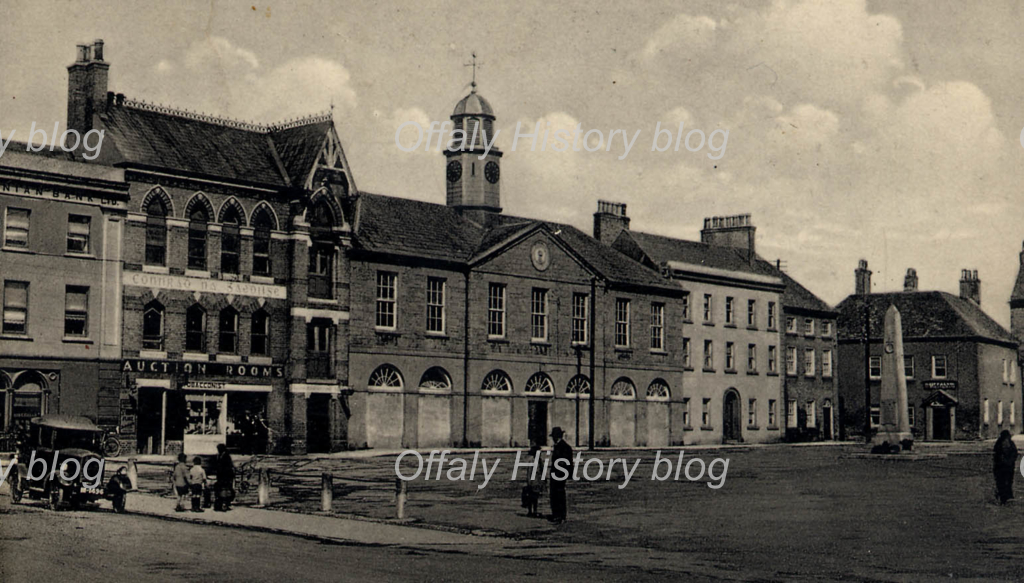
The savings bank was located in the former market house (centre) as was the Tullamore Charitable Loan Fund The parish church of St. Catherine, which stands about a quarter of mile from the town, upon a lofty, sandy hill, is a new building, with a handsome pinnacled tower, conspicuous for a considerable distance round; and several finely sculptured memorials of the Charleville family adorn the interior. The Catholic chapel is a handsome building in the modern style of architecture, with two pinnacled towers at the east end: and the Methodist chapels, of which there are two, are neat structures. To the latter places of worship Sunday school are attached, and there is a valuable school, founded by the Earl of Charleville, for the education of an unlimited number of children of both sexes: a National School, the female branch of which is under the tuition of the Sisters of Mercy, and a free School, supported by their Baptist Irish Society of London, wherein public worship is held every fortnight are the other public educational establishments. A Savings Bank and a Loan Found dispenses their respective benefits here. About quarter of a mile distance, on the banks of the Canal, and near the old road leading from Dublin to Galway, art the ruins of Shragh Castle, built in 1588 by John [Bris]scoe, Esq., of Crofton Hall, in Cumberland, an officer of high rank in Queen Elizabeth’s army, and by his wife, Eleanor Kerny, and their son, Andrew Briscoe, Esq., as recorded on a tablet in the church. Within a mile of the town is the beautiful demesne of the Earl of Charleville, to whom the town is greatly indebted for its improvement. The delightfully-wooded park, with its grottos, rustic bridges, artificial caverns, cascades and lakes, constitute the demesne a terrestrial paradise. The market days are on Tuesday and Saturday. Fairs, March 19th, May 10th, July 10th, October 21st, and December 13th.
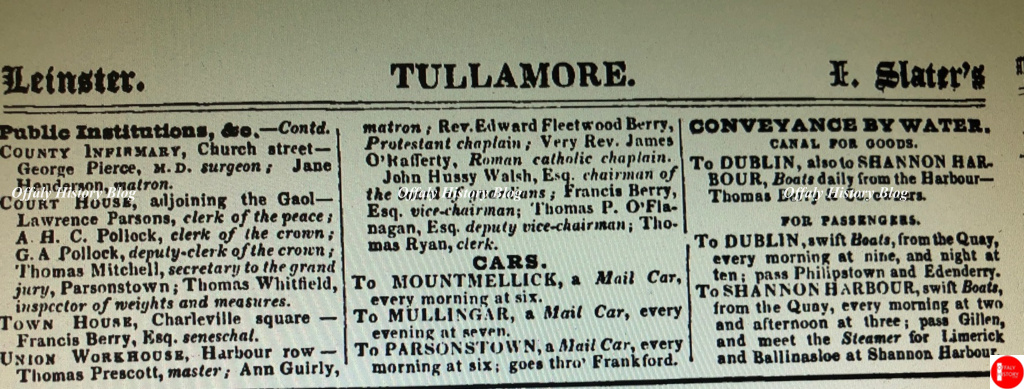
Slater 1846 on transport from Tullamore A mail car ran to Mountmellick every morning at six; to Mullingar every evening at seven, and to Parsonstwon every morning at six, passing through Frankford. Conveyance by water canal for goods to Dublin and Shannon Harbour was available by boats running daily-. Thomas Berry and Co., owners; and for passengers by same route, “swift boats,” started from the Quay [near Bury or Whitehall Bridge] for Dublin every morning at nine, and night at ten, passing Philipstown and Edenderry. To Shannon Harbour, swift boats left the Quay every morning at two, and afternoon at three, passing Gillen, and meeting the steamer for Limerick and Ballinasloe to Shannon Harbour. The Very Rev. James O’Rafferty, V G, was P. P. of Tullamore at this time, the curates were Rev Terence Devine, Rev Philip Callary, and Rev James Keegan. The Protestant congregation of St. Catharine’s were ministered to by Rev Edward Fleetwood Berry (Vicar), and Rev Peter Wilson, curate. Mrs Purcell was superiors of the Convent of Mercy, Bury Quay. The other religious denominations do not seem to have had any fixed pastor attached to their congregations.
The public institutions were officered as follows: ____
Constabulary Barrack, Charleville Square ____ William Henry Pearce, County Inspector ; John S. Stuart, Sub-Inspector ; James Hay, Head-Constable.
Miliary Barrack, Barrack street – Lieut. Henry Jepson, Barrack Master.
Charitable Loan Fund – Francis Berry Esq., Treasurer; John A Bradley, secretary.
County Gaol – Robert Harding, Governor; Very Rev James O’Rafferty, Catholic chaplain; Rev Edward F. Berry, Protestant chaplain; Thomas Whitfield Inspector.
County Infirmary, Church street – George Pierce, M.D., Surgeon ; Jane Henderson, Matron.
Courthouse adjoining the Goal – Laurence Parsons, Clerk of the Peace ; A.H.C. Pollock, Clerk of the Crown; Thomas Mitchell, Secretary to the Grand Jury, Parsonstown ; Thomas Whitfield, Inspector of Weights and Measure.
Town House, Charleville Square – Francis Berry, Esq., Seneschal.
Union Workhouse Harbour Row – Thomas Prescott, Master; Ann Guirly, matron. Very Rev. James O’Rafferty, Catholic chaplain; Rev. C. F. Berry, Protestant chaplain; John Hussy Walsh, Esq., Chairman of the Board of Guardians; Francis Berry, Esq., Vice-Chairman ; Thomas P. O’Flanagan, Esq., Deputy Vice –Chairman.
There were four hotels – The Charleville Arms, Hannah Ridley, Bridge street; Garland’s Hotel, Mary Garland, Church street ; Grand Canal Hotel, Joshua Gill, Harbour; and the Shannon Hotel, John Shannon.
The medical practitioners comprised – Michael Joseph Moorhead, High Street; George Pierce, Charleville Square; John Ridley, Bridge street; and amongst the hardware and ironmongers the firm of Messrs T. P. and R. Goodbody is mentioned. Agent for the Bank of Ireland Branch, Mr. Bartholomew Maziere.
Savings Bank, Town House (open on Mondays) – Mr Anthony Molloy, treasurer; Mr. John Alexander Bradley, actuary.
Apothecaries – Philip Belton, William Street; John Quirk, Bridge street.
Attorneys – George Duigenan, John William Briscoe, Charleville Terrace; William Ridley, Bridge Street.
In addition to the four hotels mentioned above , the names of nine publicans and two spirit dealers, four pawnbrokers, three saddlers, two tallow chandlers, four tailors, two tanners, three millers, two dyers, two brewers, one distiller, while eating and lodging house keepers musters a total of nineteen. Grocers and provision dealers number thirty- one; blacksmiths, six; boot and shoe- makers, five, etc.
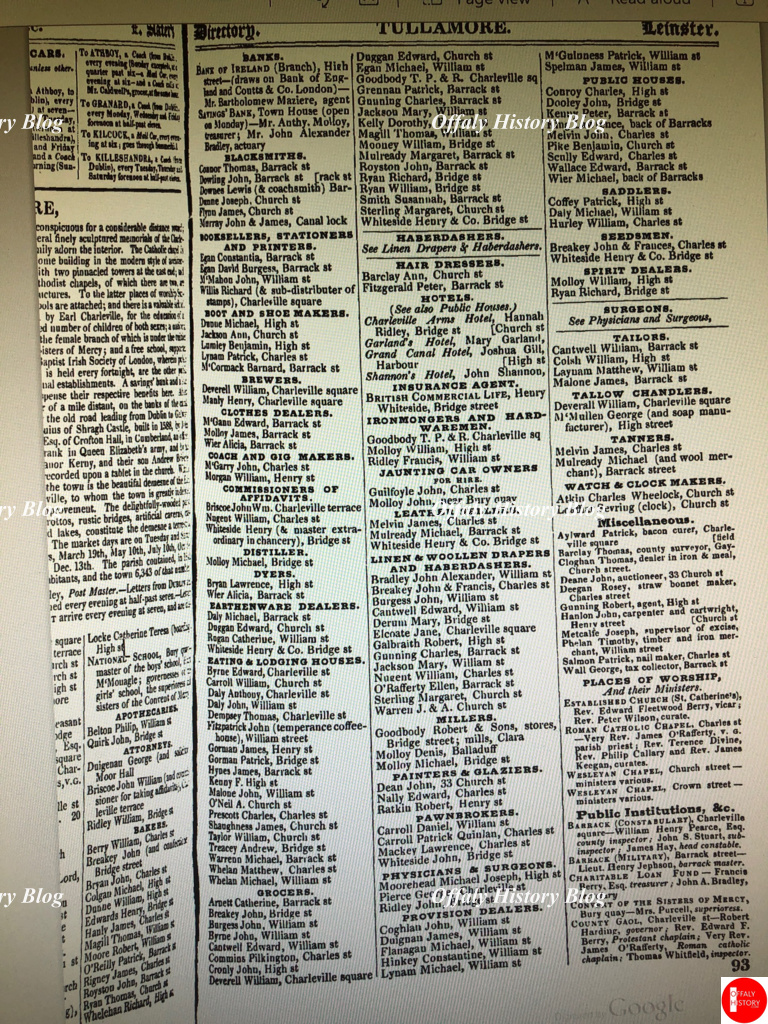
Note the number of hotels and eating and lodging houses
-
Building Improvements in Birr town since the 1850s. By Michael Byrne. Blog 422, 17th Sept 2022
Despite the low level of industrial activity in Birr in the latter half of the nineteenth century building contractors did well with a surprising amount of progress made in this area. This was in contrast to Tullamore where few new structures were erected until after the 1900s. The extent of the building activity tends to confirm the view that Birr owed its lack of industrial activity to want of entrepreneurs rather than want of capital. Among the public buildings and monuments to be erected or improved upon was St. Brendan’s Catholic Church which was completed in 1824-5. It was now remodelled and enlarged. Improvements were carried out at St. Brendan’s Church of Ireland church in 1879 under the supervision of Mr (later Sir Thomas) Drew, architect. The church was enlarged by extending the eastern gable. The organ was removed as also were the horse-box pews. In 1885 the stone was laid for a new Presbyterian church at John’s Place, beside the house of the parish priest, Dr. Bugler. The new church here was part of the redevelopment of the southern side of John’s Place. The old Crotty meeting house in Castle Street was sold for secular use in 1885.
(more…)
-
A length of material and other memories of Clara in 1919–23 and its aftermath: some recent changes for the better By Sylvia Turner. Blog No 421, 14th Sept 2022
Michael Byrne’s recent blog article ‘The Gill Drapery Store in High Street Tullamore, 1900–22’ reminded me of the significance of drapery stores in the early 20th century and the Clara of my mother’s time. Amongst the correspondence between members of her family, frequent mention is made of the buying of material. The most common form of correspondence would seem to have been the postcard. Below, on the reverse of a postcard that depicted the ruins of Geashill Castle is an example sent on 27th of May? 1924. It was to my grandmother from her sister living in Clara and concerned the buying of material for ‘M’, May, her eldest niece.
(more…)
-
Decline and resurgence in Birr, 1850-1922. Michael Byrne. Blog No 420, 10th Sept 2022
All the south midland towns declined during the fifty-year period after the Famine with the exception of Clara where the Goodbody jute factory provided employment for 700 workers in the 1880s. The towns of Birr and Banagher were most severely hit. The decline of Birr was exacerbated by the final closure of the large military barracks in Birr in 1922. The previous year the Birr workhouse was closed and amalgamated with Tullamore. At a time of depression and scarce employment opportunities it was not surprising that the county capital, Tullamore, should seek to draw to itself whatever job opportunities existed in the public service sector, but it was to cause a good deal of resentment in Birr up to the 1950s.
-
The growth of middle class-owner occupied housing in Tullamore, 1900-1960. By Fergal MacCabe. A contribution to the Decade of Centenaries. Blog No 419, 7th Sept 2022
The growth of middle-class housing after 1900 may be said to have begun with the building of four ‘villas’ at Clonminch in 1909 by Charles P. Kingston, the then county secretary to King’s County Council. It was preceded earlier by the substantial house of Daniel E. Williams completed at Dew Park in 1900. Were it not for the war and the scarcity of materials we might have seen more housing in the 1916–23 period. However, there was a further scarcity of building materials and high prices in the early 1920s and it was not until about 1930 that middle-class housing began to grow again and almost entirely on Charleville Road and Clonminch the period prior to the Second World War. After a slow start in the late 1920s council housing was constructed in earnest from 1933–4 and up to 1940, resuming again in the late 1940s (see my earlier blog).
(more…)
 offalyhistoryblog