
Growing up in our house in Clonminch outside of Tullamore, I came to detest
that mawkish dirge about the Lake Isle of Innisfree. My grandfather, who had
once visited the island, was obsessed by the poem and insisted that I recite it
at every party. He even named our house after it.
Later, as a young town planner, I blamed the wretched verse for the rash of
holiday homes that were beginning to appear in every beauty spot in Ireland
and cursed Yeats who had provided the moral justification for this desecration.
If a well known poet could simply arise and go and build in whatever idyllic
place he chose, why shouldn’t everybody else?
But – would Yeats get planning permission? I would put that to the test.
Category: General
-
‘The Lake Isle of Innisfree’ How my hatred of the poem changed utterly. By Fergal MacCabe. Blog No 771, 27th Dec 2025
-
QuinnEdwards/ by Neasa MacErlean. The Clara-born historian David B. Quinn 25.6 2025. A contribution to the Commemorations Series 2025. Blog No 725, 25th June 2025
David Beers Quinn’s collaboration and lifelong friendship with Robert Dudley Edwards is described in Telling the Truth is Dangerous, one of the first biographies of a modern Irish historian. Author Neasa MacErlean, Edwards’s granddaughter, looks at a relationship that helped modernise the study of Irish history.
(more…)
-
“Voices of Offaly” Launch of New Offaly History Resource available from Offaly History. By Aidan Barry. Blog No 721, 14th June 2025
Introduction
(more…)
In June Offaly History launched “Voices of Offaly” – a website which serves as a digital archive dedicated to preserving and sharing the personal histories of individuals from County Offaly, Ireland. By collecting and presenting oral histories, the platform offers a window into the lives, experiences, and memories of the county’s residents. Blog no 7 in the Offaly History Series
This new resource is accessible from the main Offaly History home page.
http://www.offalyhistory.com
-
New books on Offaly History in 2024: another good crop. Blog No 681, 15th Dec 2024
The year 2024 was another good year for publications on Offaly history with overviews of County Offaly towns, books on Tullamore, Birr and a musician from Killeigh who acquired fame in the United States. We also had Cloneygowan, canals, peat, a Feehan bibliography and natural history.
(more…)
-
Renewing your subscription to Offaly History (Offaly Historical and Archaeological Society) for 2024: a gentle reminder to Canon Stubbs, the Regius Professor of Modern History at Oxford, in regard to his membership subscription due to the Hellenic Society, in 1882. Joining OHAS in 2024. Blog No 603, 21st April 2024
A recent purchase by a ,member of Offaly History of the Letters of William Stubbs (1825-1901), edited by W.H. Hutton included an original letter from the Hon. Secretary of the London-based Society for the Promotion of Hellenic Studies sending a gentle reminder to the learned and revered historian that his subscription was outstanding for four years. i.e. from when that society was formed in 1879. This sometimes happens in Offaly History too, when perhaps a distinguished member will forget to renew and one would not have the temerity to send a reminder. Not so the Hellenic Society.
(more…)
-
Babies, Beggars and Belligerents: A Case Study of Unidentified Death Records in Co. Donegal, 1870-1950. By Megan McAuley, the Offaly History/P. and H. Egan scholarship winner for 2021-2023 at Maynooth University. Blog No 289, 22nd May 2021
William Dudley Wordsworth accurately noted in his 1876 study of the Dublin Foundling Hospital that: ‘dead children, like drowned sailors, tell no tales’. The same can be said in the context of this analysis of Civil Death Records in County Donegal where unidentified (those registered as deceased without a known forename or surname) infant deaths occurred in their hundreds. This study was inspired by an article in Irish Historical Studies called ‘Registered ‘Unknown’ Infant Fatalities in Ireland, 1916-32: Gender and Power’ by O’Halpin and Breathnach, where the evidence suggests that many unidentified infant fatalities were homicides that occurred as a result of deliberate action, or inaction, i.e., infanticide. This is also true in the case of Donegal from 1870-1950, as the vast majority of unidentified death records belonged to infants, many of whom unfortunately died in suspicious circumstances. Wordsworth’s ‘drowned sailors’ too make an appearance in this set of records and can illuminate local communities’ experiences of Irish neutrality during the Emergency. Unidentified death records also shed light on another marginal group of society: mendicants. This cohort would have been familiar faces to many on the streets of Donegal, but utterly nameless to most, especially when they died. Similar studies could, and should, be undertaken in other counties, such as County Offaly, to further illuminate the ‘unknown’, marginalised or the forgotten in Irish society.
In January 1864 it became obligatory to register all births, marriages, and deaths with the local authorities. Not all deaths, natural and unnatural, however, came to official notice, as popular understanding of the law pertaining to Civil Registration was poor. It can be assumed that the deaths of many people of all ages remained unregistered, particularly in rural areas, for some time after the law was passed. Registrations were collated according to Superintendent Registrar’s Districts. 350 unidentified deaths were recorded in total in the districts of Ballyshannon, Donegal, Dunfanaghy, Glenties, Inishowen, Letterkenny, Londonderry, Milford, Strabane, Stranorlar and Castlederg. Of the death records, 196 were infants and 104 were adults. The remaining 84 death records could not be identified by age. Of the 196 infants, 162 were regarded as suspicious, such that an inquest was held by the local Coroner.
The illegitimate status of a child was a common motivation for infanticide in nineteenth and twentieth Ireland, due to the societal stigma associated with pregnancy and childbirth out of wedlock (for further reading, see Rattigan and Farrell). Pursual of this crime through the courts could only occur, however, if the infant was identified and a suspect detained through police enquiry. This leads the historian to probe a number of questions regarding the Donegal case: How many infant bodies were never recovered, particularly due to quick decomposition, from the rural landscape? Of those that were, how many new-borns were never identified and thus the perpetrator escaped a court trial? It is important, however, not to lay all of the blame on women who committed infant murder. They too were victims of a patriarchal society which valued familial landholding over the life of an apparently illegitimate child.
(more…)
-
Mother and Child Report: a personal reflection – knowing, not acknowledging. By Sylvia Turner. Blog No 258, 27th Jan 2021
The Final Report of the Commission of Investigation into Mother and Baby Homes (2021) catalogues the institutional abuse and cruelty meted out to pregnant, vulnerable women and their children between 1922 and 1998. The Mother and Baby homes are commonly associated with The Magdalene Asylums and Laundries which were run by Catholic orders. What is less well-known is that the original Magdalene Asylum had a Protestant foundation. The philanthropist, Lady Arabella Denny (1707–1792) worked closely with the Dublin Foundling Hospital to improve practice. As it became clear that unmarried mothers had little option but to place their children there, she decided to establish an institution to care for the mothers and it became known as the Dublin Magdalen Asylum. It was originally opened in 1765 in Lower Leeson Street and closed in Eglinton Road in 1994.
(more…)
-
Fr Michael Kelly, of O’Connor Square, Tullamore and a citizen of Zambia. From the Sources of Offaly History Series, No. 9, oral history from the Diaspora, or the scattered Offalians around the world. Blog No 228, 30th Sept 2020
How many Offaly people have emigrated? They have stories we would like to hear and to archive for Offaly History Centre. This is some of Michael Kelly’s story. You have one too, whether living at home or abroad. So sit down and start writing. The words will flow. Thanks to Michael Kelly SJ for this report. He appears on a postage stamp and is an honorary citizen of Zambia and of Tullamore. We will add this latest report to the almost 250 stories we hold from Offaly people who wrote it down or talked to us. Like our offalyhistoryblog to receive it free every week and sometimes twice a week. Almost 70,000 views so far this year

ON MONDAY, August 22, 1955, a young Irish Jesuit stepped off a plane at the City Airport (which is now a Zambia Airforce base in Longacres). It was his first visit to Africa, and he fell in love with it. He talks about the cheerfulness, generosity and openness of the Zambian people, as well as their suffering. A mathematics genius, he dedicated his life to educating young Zambians, and later to the fight against HIV and AIDS. Sixty-five years later, Father Michael Kelly says he is now looking forward to going home. And by “home”, he is not referring to his native country – Ireland – but to Heaven.
(more…)
-
6 Sources for Offaly History and Society. ‘Offaly one hundred Years Ago’: A compendium by John Wright and published in 1890 as ‘The King’s County Directory’ was reprinted in 1989 as ‘Offaly one hundred years ago’. Blog No 220, 26th August 2020
Written and compiled by John Wright- owner/editor of the King’s County Chronicle, Birr, from 1872 until his death in 1915 – the book was published early in 1890 as ‘The King’s County Directory’. His son Archie succeeded and died in 1954. Increasingly, over the intervening years, it has been treasured as an invaluable source of reference for local historians but it has long been out of print and only a few copies remain extant. It was reprinted in 1989 now in hard back form, in a facsimile edition which reproduces its 368 pages – including 24 pages of advertisements and a number of drawings of noteworthy buildings. Since then it has also been made available on CD.
(more…)
-
BALLOONATICS AND THE GREAT FIRE OF TULLAMORE ON 10 MAY 1785. Michael Byrne. Blog No 195, 9th May 2020
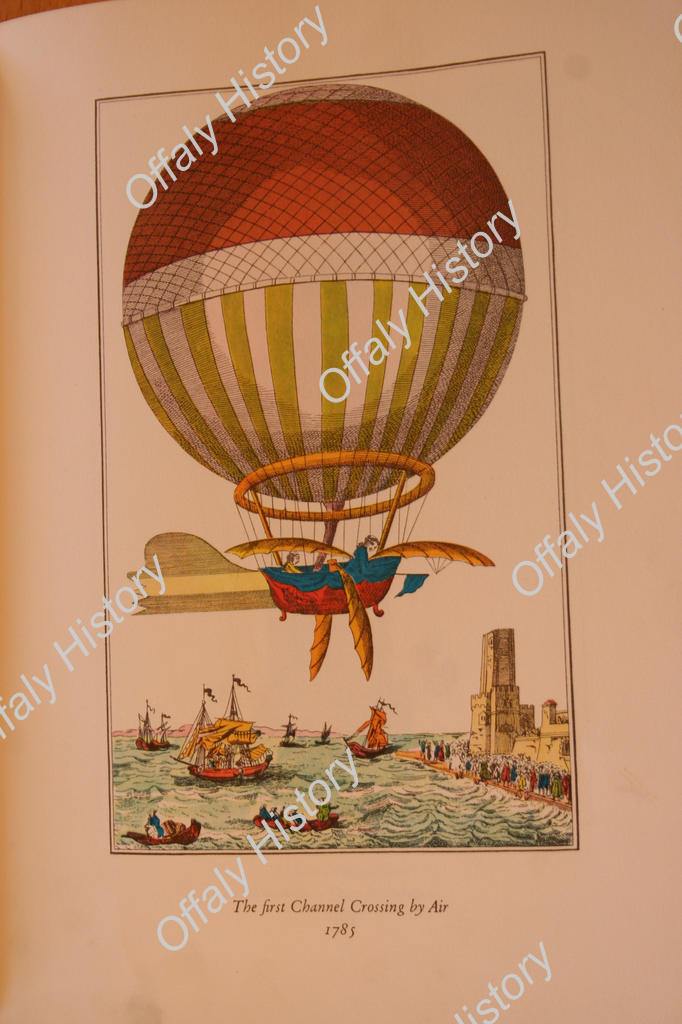
The balloon fire of 10 May 1785 (235 years ago tomorrow) is perhaps the best known event in the history of Tullamore. Today we are reminded of it every time we see the town crest and in the past with the annual celebration – the Tullamore Phoenix Festival. The first premium whiskey from the new Tullamore DEW (Phoenix, 2013) was in honour of that tradition. It is hardly surprising that it should be so. The event caught the imagination at the time and was widely reported in the national newspapers and by visitors in their publications thereafter. Unfortunately, many turned to the Wikipedia of those days – the previous fellow’s account – and did not seek to get all the facts and record them. What we are left with then are the few contemporary accounts from national newspapers, the comments of a succession of visitors who seemed to rely on the diary entry of John Wesley in 1787, and the notes of Charles Coote in his published survey of King’s County (Offaly) in 1801. Wesley, the great preacher and founder of Methodism, unlike Coote, would have known the town well as he visited the place some twenty times from the late 1740s to the 1780s. Why are there so few accounts?
 offalyhistoryblog