The Commission of Enquiry into the Poorer Classes in Ireland was the result of the United Kingdom government’s investigation of rapid increases in population living in extreme poverty. From their official reports in the post-Napoleonic period Ireland’s growth-rate had remained high. In the 1831 census Ireland returned a population of 7.8 million up from 6.8 million in 1821. In the year 1831 the population baronies of the Upper and Lower Philipstown was 17,311. The town of Daingean had a population of 1,454.[i] For King’s County in general please see our previous blog.[ii]
In the baronies of Philipstown Upper and Lower two commissioners were appointed: Jonathan Binns and James O’Hea. It should be noted, previous to the dissolution of the Parliament of Ireland in 1800, Philipstown returned two members to that legislature.[iii] In 1835 Tullamore became the county town and with that the assizes were moved there from Philipstown.[iv] As the Poor Law Commissioner Jonathan Binns reflected:
‘Its trade has disappeared – many of its houses are in ruins – its shops are falling into decay – and its population, as these signs sufficiently indicate, are poor and wretched.’[v]
5 July, Saturday morning from 11 to 12 30 p.m. Walking tour of Tullamore town: Patrick Street and Church Street with Michael Byrne. Explore the history of these old streets dating back to the 1700s, from the military barracks of 1716 to the church of 1726, county hospital of 1788, the Methodist chapels (4) and the families and shops over 250 years. Find out what is left of the old barracks; where was Swaddling Lane and Pike’s Lane, the linen factory. Who was the Henry in Henry Street – and so much more.
We can meet outside Offaly History Centre, Bury Quay (beside Old Bonded Warehouse restaurant) for ease of parking from 10 45 a.m. All are welcome and the tour is free. Teas/Coffee and bathrooms available from Offaly History Centre from 10. 30 a.m. A big welcome to Birr IGS members who are planning to join the tour.
12 July Saturday morning from 11 to 12 30 p.m.Walk around Harbour Street, Store Street, St Brigid’s Place, the Harbour and O’Carroll Street with Michael Byrne. We can meet outside Offaly History Centre for ease of parking from 10 45 a.m. All are welcome and the tour is free. Coffee and bathrooms available from Offaly History Centre from 10. 30 a.m. Tea and scones available.
This blog post will trace the decline of the canal as a means of transport and critical element in the economic development of Edenderry and the surrounding area. The transition of the canal and harbour as a tourist and leisure amenity will be discussed further on. The introduction of the railways in the mid-nineteenth century weakened the canals importance to the economy. Both the canal and railway had to compete for the limited inland trade. A struggle the canal was also going to lose.[i]
In the summer of 1846 it was reported that the people of Edenderry had averted an accidental breach in the branch canal to the town harbour.[ii] Another serious breach occurred between Ticknevin lock (20th) and the Blundell aqueduct in February 1849. The breach occurred in the bog embankment.[iii] The repairs were carried out under the Grand Canal Company’s (G.C.C.) new engineer, Christopher Mulvany. While repairs occurred Mulvany constructed dams and laid a tramway along the canals north bank allowing trade to continue. If the first half of the nineteenth century saw the rise of the canal as a revolutionary mode of transport, so too can the railway be seen to replace the canal.
‘Map of the canal and railway lines’, Ruth Delany, The Grand Canal, figure 23.
In 1835 Thomas Murray derided the idea of the possibility of a rail link to Edenderry:
‘There is nothing to be sent from this but a few passengers which only fill about three or four coaches every day and which will not pay almost anything.’[iv]
Although the Midland Great Western Railway (M.G.W.R.) and Great Southern and Western Railway (G.S.W.R.) both showed an interest in buying the G.C.C. in the 1850s, nothing came of it, and the Company remained independent.[v]
In 1871 before the beginning of the Land War, the Downshires still owned 14,000 acres of Edenderry as they had done at the beginning of the century, now with an annual rental of £6,800. The M. G. W. R. established a train station in Edenderry in 1877. It had reached Enfield twenty-seven years earlier. By the 1880s traffic on the canal had begun to decrease, although the G.C.C. was still running at a profit. In 1888 the Alesbury brothers moved their premises to the Grand Canal and built a factory there. The Alesburys used their own canal boat to transport timber for use in making furniture.[vi] In 1911 the G.C.C.’s engineer, Henry Wayte, was allowed by the Board to become the Irish agent for Bolinder engines and four of these were fitted. By 1911 the G.C.C. was converting its horse-drawn fleet to the Bolinder diesel engine. By 1914 twenty-eight canal boats had been converted to Bolinder engines.[vii]
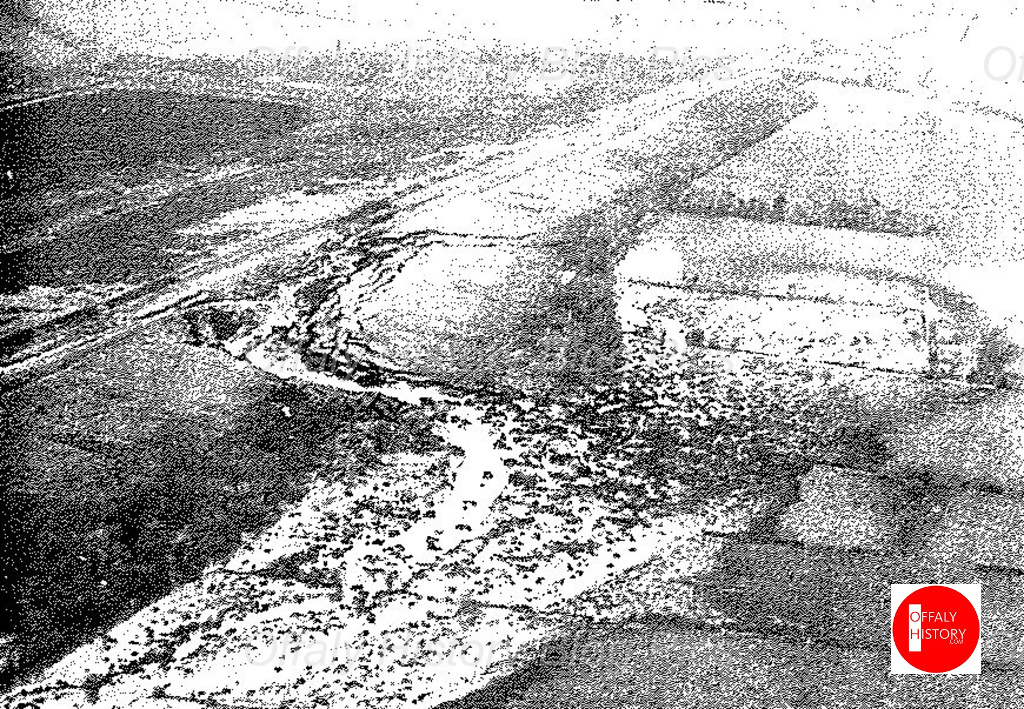
‘Breach at Edenderry, 1989’, Safe harbour, p. 17.
In 1916, again, there was a breach in the canal at Edenderry in the north bank of the canal near Blundell Aqueduct. On 11 January 1916, 300 yards of bank were carried away. Wayte had dams erected to try and keep trade moving and to help in bringing clay to the sit. The Leinster Leader vividly depicted the aftermath of the breach:
‘…no description, however graphic, could have prepared them for what they saw-the havoc wrought by the muddy rushing water, the enormous force that must have pressed it outwards, the utter impotence of the protecting line to resist the pressure and the great cataclysm that resulted….Again the breach took place on exactly the same spot as the great breach of 60 years ago.’[viii]
The cause of the breach was attributed by Gordon Thomas, engineer to the Grand Junction and Regent’s Canals, to ‘boisterous weather’ and ‘heavy rainfall.’[ix] Soon after Wayte decided to use three rows of new piles, backed and filled in with clay and bog material. Work in February was hampered by gales and snow with the workers exhausted. In March snows and blizzards continued to slow down progress. In early April, Wayte was able to report in his weekly report to the G.C.C. Board that the repair work had been completed.[x]
From 1917 to 1920 the government subsidised maintenance costs of the canal and paid war bonuses to the G.C.C. employees.[xi] During the Civil War conflict erupted on the canal when stores were burned and boats were attacked. By 1922, with the end of the revolutionary period, the Downshire estate consisted of 6,780 acres, most of it being unleased bog land. And in 1923 with the passage of the Irish Free State’s Land Act, the process of land purchase was completed. In 1950 the Grand Canal was nationalised under Córas Iompair Éireann at a cost of 1.25 million.[xii]
With the development of the River Shannon as a tourist amenity it was shown the Grand Canal still had a post-nineteenth century role for the Irish economy. The final barge to leave Edenderry Harbour was the 48M Canal Barge in May 1960, ending over 150 years of service.[xiii] The Edenderry branch had become impassable with weeds and was cleared and reopened for the opportunity tourism brought with it. An advertisement for the sale of the warehouse at the harbour, as part of the winding up of the financial use of the canal, was placed in the Offaly Independent in October 1960.[xiv]
‘Last barge, 1960’, Safe harbour, p. 26.
The canal breach of January 15th 1989 was the worst seen since 1916. 400 meters of the north embankment broke away at the midway point between Blundell Aqueduct and the Edenderry line.[xv] £1 million worth of damages was caused by the breach.[xvi] It would not be until March 1990 that the Office of Public Works would complete the repairs of the Edenderry canal.[xvii]
Stephen Rynne summed up the canal’s history as:
Fifty years in the thinking-out and arguing; fifty years in the making; almost fifty years flourishing; over a hundred years staggering along and not knowing from year to year when the final blow would fall.[xviii]
Since the 1990s festivals have become a recurrent sight during the summer season in Edenderry harbour. Canoeing too is popular today on the canal along with fishing. Among the fish inhabitants of the canal are roach, bream, perch and pike.[xix] The local inhabitants of Edenderry and the surrounding townlands and villages use the canal year-round as a walking route. The successful transition of Edenderry harbour and canal into a leisure and tourist amenity has given it a new lease of life into the twenty-first century.
‘Map of the canal and railway lines’, Ruth Delany, The Grand Canal, figure 23.
[i] Ruth Delany, A celebration of 250 years of Ireland’s Inland Waterways (Belfast, 1992), p. 5.
[ii] Delany, The Grand Canal (Newton Abbot, 1973), p. 165.
[iii] Delany, The Grand Canal of Ireland (Dublin, 1995), p. 175.
[iv] W. A. Maguire, ‘Missing persons: Edenderry under the Blundells and the Downshires, 1707-1922’ in William Nolan and Timothy P. O’Neill (eds), Offaly: history & society (Dublin, 1998), pp 515-42 at p. 537.
It was a big day for Offaly at the Heritage Week Awards held in the wonderful Royal Hospital Kilmainham on Friday 15 November 2024. As Amanda Pedlow, the Offaly Council Heritage Officer noted:
It was Offaly’s day at The Heritage CouncilHeritage Week Awards in Kilmainham today. James Scully is the well-deserved winner of the national Heritage Hero Award.
Lemanaghan Bog Heritage and Conservation Group were runners up in the Intangible Cultural Heritage Award (The Mícheál Ó Muircheartaigh Award) for their project recording traditions and folklore of Lemanaghan.
The changing face of Offaly towns in the early 1900s: An illustrated history edited by Michael Byrne with contributions from Paul Barber, Stephen Callaghan, Grace Clendennen, Kevin Corrigan, Michael Goodbody, Ger Murphy, John Powell, Laura Price, Ciarán Reilly and Brendan Ryan (Offaly History, Tullamore, 2024, 368 pp). Available from Offaly History Centre and Midland Books Tullamore and online at www.offalyhistory.com. ISBN 978-1-909822-38-2 (hard back), €27.99. The book will be launched at Offaly History Centre, Bury Quay, Tullamore – beside the new Aldi and Old Warehouse. It is already available at the Centre, online at http://www.offalyhistory.com and at Midland Books, Tullamore. If you cannot attend in Tullamore we have a launch at Giltrap’s of Kinnitty on Thursday 21 Nov. at 7. 30 p.m. We will have copies in Bridge Centre for the Christmas Sale 14 to 24 December.
Memories of Offaly can best be described as opening a diary into life in Co Offaly, over the last 50 or 60 years. The author of the book is Aidan Grennan, from Killina, Rahan. Aidan is to be congratulated on his second book. Both books are available from Offaly History Centre and online at http://www.offalyhistory.com
‘It is a nostalgic glimpse into the people and events in the county within my own life-time’ said Aidan. He commented: ‘I think it’s important now and then, to take a look-back over the years. I love nostalgia’, though we have to live in the present.
The Grand Canal was completed to the River Shannon in 1804, 220 years ago. By 1864 passenger traffic was finished and commercial by 1960. Cruise traffic was only in its infancy and when this article was written 45 years ago things were bleak. In looking at the building of the Grand Canal from Tullamore to Shannon Harbour, we need to look at a piece written in the Irish Times by Sean Olson with photographs by Pat Langan, which was published on Thursday, 7 June 1979 in the Irish Times. The newspaper had been a good supporter of keeping the canal open in the 1960s when it was under threat from Dublin Corporation.
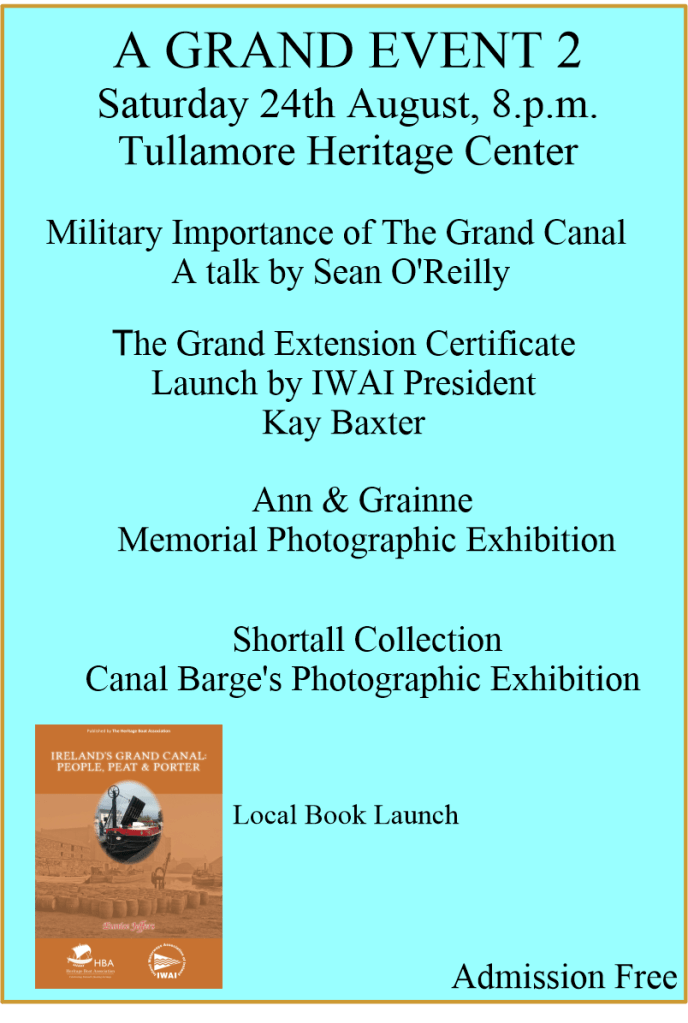
Things have improved so much in recent years with the towpaths now the focus of attention to promote walking and cycling. Today 23 August see the launch of an excellent study of the canal system as illustrated. Then on Saturday evening and Sunday there are two events from Waterways Ireland to be held in the Offaly History Centre Exhibition Hall beside the canal at Bury Quay (neighbour to Old Warehouse Bar and Restaurant), as illustrated.
Olson is worth reproducing to remind us that we do not want to go back there and was an excellent record of its time. Also worth mentioning is our over 60 blog articles on the Grand Canal available as blogs at http://www.offalyhistory.com. All free to read and download.
‘If the steps of the ruined canalside hotel at Shannon Harbour, Co. Offaly could talk they would have a tale to tell. It would be a story of bustled Victorian ladies and their potb-bellied merchant husbands, of trade, of business deals finalised in airy rooms overlooking the still waters of the canal.
For once the pulse of commerce beat hard at Shannon Harbour. It was an inland port – a staging post leading to the mighty Shannon river. It was built by the commerce of a different age, a monument to an era when the first hesitant puff of the steam engine sounded the death knell for trade on inland waterways. It was a slow lingering death. When it finally came in 1960, there were few obsequies for Shannon Harbour. Those there were hardly took the place into account at all. It all but died with the departure of the last barge.
Now the once fine hotel, later home of several families who made their living from the barges, stands staring roofed, inside gutted, steps broken and lifted. The warehouses once full of goods and porter, are roofless sentries before the lock gates that lead down to the Shannon.
Ted Barrett, one of the pioneers of cruising on the canal, was well aware of its environmental and leisure value. By the late 1960s he was advocating linking the canals with the lakes that might be made from the disused bogs to form a type of Norfolk Broads in Ireland.[1] In this letter of October 1964 he was to show his diplomatic and marketing skills in the course of advocating canal cruising. Barrett was the author of a guide to cruising on the canals.[2] At about the same time as Barrett Harry Egan and Frank Egan of Tullamore had developed a cruiser hire business based at Tullamore Harbour under the name Gay Line Cruisers. Later this was followed by Celtic Canal Cruisers (Mike and Heather Thomas). In fact by mid-1964 things were looking up for the Grand Canal after several years of uncertainty due to the Dublin Corporation proposal to cover over parts of the canal line in Dublin to facilitate sewerage disposal. The IWAI had been formed in 1954 to promote all the waterways but by the 1960s was in the van in protecting the Grand Canal waterway. A branch had been formed in Tullamore with the support of Frank Egan and PV Egan. These men went on to establish Gay Line Cruisers, based in Tullamore, and got involved in boat building. 1964 was also the year in which Brendan Smyth (d. 2021) of Banagher started his Silver Line Cruisers business – now one of the most successful on the Shannon and led by his children Barbara and Morgan. By 1991 up to nine hire cruise firms were offering almost 400 cruisers for self-drive, mostly on the River Shannon.
Banagher, County Offaly has associations with two well-known writers of the nineteenth century – Anthony Trollope and Charlotte Bronte. Up to recent years nothing by way of notice of this was to be found in Banagher, but that has all changed as Banagher, now hard pressed along its main street, looks again to embrace tourism in a way that it did so well in the late nineteenth century and in the 1960s. The plans for the former hotel at Banagher will do much for the promotion of the architectural heritage of the town as did the voluntary work by the co-operative at Crank House. Pope Hennessey’s description in 1971 of Banagher in September would be music to Failte Ireland anxious as they are to extend the holiday season. He wrote:
‘The month of September in Banagher, and all along the Shannon banks, is visually a glorious one, with golden autumn mornings, the low sun making long shadows of the houses in the street. At dusk the whole river reflects the varied sunsets as the days draw in – effects of palest pink, for instance, striped by cloudy lines of green, or an horizon aflame with scarlet and orange light.’ And
The bridge at Banagher affords a splendid view over the level reaches of the river, which here flows glassily between a countryside as flat as that in some Dutch picture. In winter-time the flooded river spreads across these meadows to create an inland sea. In spring and early summer kingcups bloom amongst the sedge and reeds along the Shannon’s bank, wild yellow irises abound and cowslips also. In early summer, too, plumes of mauve and purple lilacs hang over the white walls of the yards of Banagher, and the whole countryside beyond the town displays brilliant variations of the “forty shades of green”.
Many have tackled Trollope’s life, but none immersed himself so much in Banagher as the late James Pope Hennessy.
John McCourt in his 2015 study of Trollope Writing the Frontier: Anthony Trollope between Britain and Ireland ‘offers an in-depth exploration of Trollope’s time in Ireland as a rising Post Office official, contextualising his considerable output of Irish novels and short stories and his ongoing interest in the country, its people, and its always complicated relationship with Britain’.
Last week we looked at the history of steamers on the Shannon. Today we take the account of Henry D. Inglis published in 1835. Inglis was a professional travel writer and author of Spain in 1830, A Journey through Norway etc, published his A Journey throughout Ireland during the Spring, Summer and Autumn of 1834 in London in 1835. His account is well thought of and in his concluding remarks he says why jest or narrate the curious and witty eccentricities of Irish character when ‘God knows there is little real cause for jocularity, in treating of the condition of a starving people.’ So there was a degree of sympathy rather than of superiority.
Inglis was born in Edinburgh and was the only son of a Scottish lawyer. His Irish travels volume was published the year of his death, (first edition, 1835, fourth edition 1836). While considered a ‘fairly benevolent interpreter’ he could find no explanation for the Irish situation other than defects of character.
Inglis spent a week there and also visited Killaloe, Portumna and Banagher. He went from Banagher to Athlone by road and thought the latter was a remarkably ugly town – but not withstanding an interesting and excellent business town. He spent a week in Athlone and used it as a base for touring in the county of Longford to see Goldsmith’s Country.






 offalyhistoryblog