Down the Decades was launched in Rahan Hall in November 2023 with a large audience and since then the new book by Tom Minnock has proved to be extremely popular with more copies printed to meet the demand. We asked Tom Minnock to tell us in this blog article about how the book came about.Born in 1922, the life of George Griffith tracked the life of the new Irish State, down through the decades. George never left his native Clonshanny giving him a local perspective on community life in the area during a fascinating period in the history of Ireland and the world.George Griffith died in March 2022.
Tom’s book is a collection of George’s reflections on that century up to 2022. Tom has set the context both locally and globally for each decade.
Tom Minnock writes:
The book is out there now and it is a peculiar feeling that is hard to put into words as something that you have spent countless hours living with takes wings. A few random words sketched out on a large note book and transferred on to a computer screen had grown and grown over time. How did this come about and why do I think it was important to publish it and expose myself to my community to be judged? I would like to share the journey and in doing so challenge you all reading this to consider writing or sharing your stories with somebody who will set them down for a future generation to ponder and continue the process.
We need wind energy, but are we to give up on saving the bogs and destroying natural and community amenity in the process? This article looks at the works at Clongawney bog and the real threat to Lemanaghan and the natural heritage of County Offaly. More transparency is needed and more care about what outcomes we intend to have in Offaly in regards to our landscape. Will the area of Lemanaghan be now destroyed? We in Offaly need to revisit this and ensure care is taken and proposed works assessed by independent experts . The works proposed for Lemanaghan need to be scrapped or scaled back to protect what should be a special conservation area. Communities need to know what is happening to their local landscape. What has happened so far at Clongawney?
Clongawney works
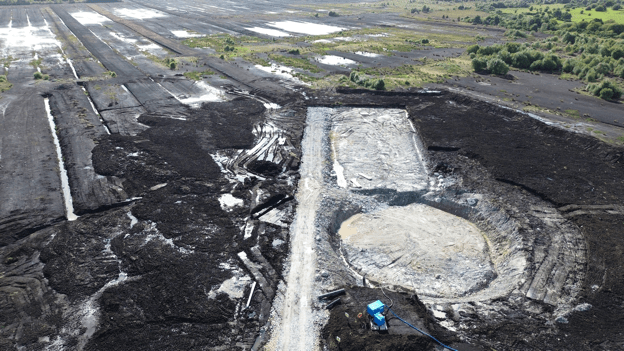
It is difficult not to be disturbed and distressed by the images below which shows excavation in progress for a wind turbine base in Clongawney bog. There is an enormous amount of destruction and disruption for a relatively small base. And what makes the situation much worse and even more disturbing is that the turbine is clearly located in bog wetlands. In a few years this area will be covered in vegetation and will be home to a variety of wildlife. And right in the middle will stand a massive turbine with massive blades. The bogs are special places. They have suffered so much over the last 70 years. Ignorance and necessity may be the explanation for what happened. However there is no excuse now. This is permanent destruction of our bogs. How can this be allowed to happen ?
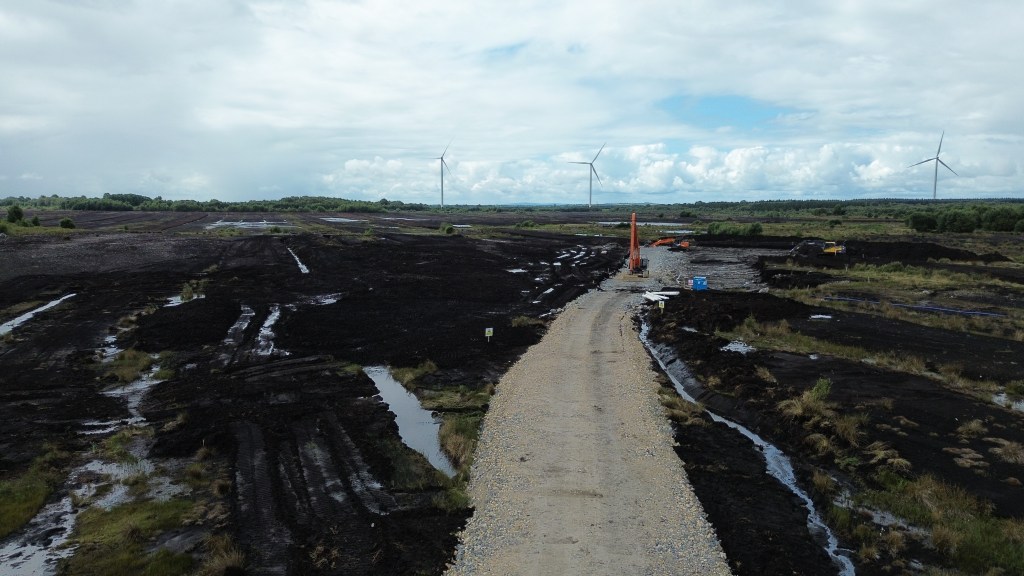
Below are photographs of the works at Clongawney Bog near Banagher and the works which must conflict will all our plans to protect the natural environment.
CLONGAWNEY IS LOST. DERRINLOUGH IS LOST. LEMANAGHAN IS NEXT.
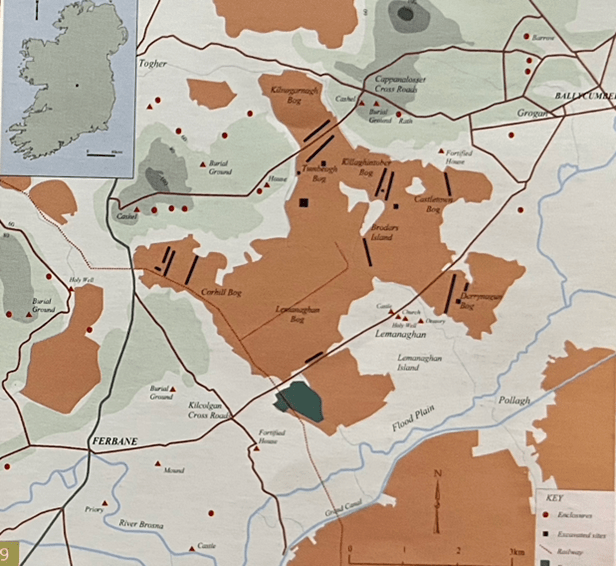
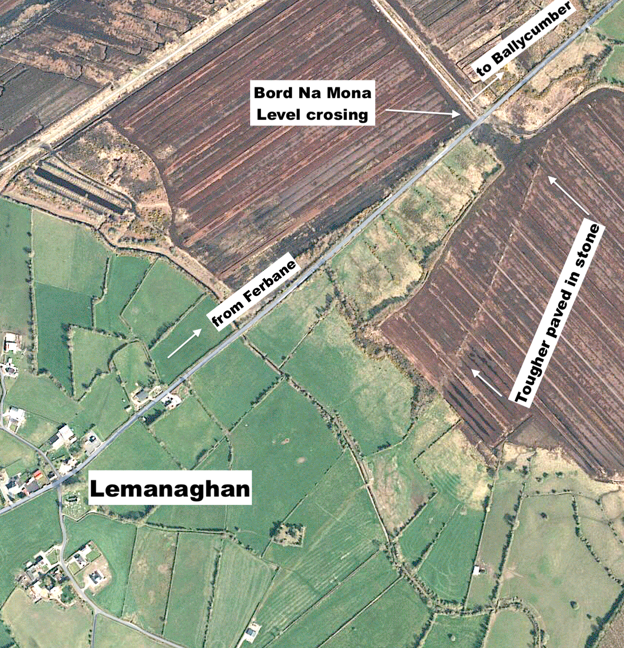
There can be few places in Ireland of more historic importance than Lemanaghan. The image above shows the location of several toghers which have been found on Lemanaghan Bog. Amazingly the largest togher on Lemanaghan can be seen clearly from space! Click on the Google Earth link and be astonished.As can be clearly seen from the map above the bog is criss-crossed with ancient toghers and holds an array of archaeological sites. It would be unthinkable to put wind turbines on the callows or the eskers or the bogs that surround
Links in higher resolution to some of the pictures below.
This is a dramatic way to show this fabulous togher Lemanaghan Togher
The massive dumper which can be seen on this image helps size this extraordinary motorway type junction on Clongawny Bog. This motorway/roadway will only be used once to transport the components for a turbine and then….? To comprehend the scale of what is happening you need to visit to Clongawny.This find took place a few weeks ago on Clongawny Bog, just a mile or so from Banagher. Note wind turbine construction activity in the background. It is piece of timber with at least two square holes worked by human hand, possibly two thousand years ago. The piece is located on the side of a drain about half metre below the bog surface. No doubt there are many more precious archaeological artefacts and sites awaiting discovery in Clongawny and Lemanaghan and in other bogs.This image shows an extensive deposit of bog iron ore also on Clongawny Bog. In the background are tens of thousands of stone are being poured onto the bog surface.
Bord Na Mona Bogs in 2023 A Brief Summary
Peat harvesting ended in 2020 but finished on many bogs more than 20 years earlier. There is at least 1 metre of bog remaining on all bogs and more than 2 metres in most places.
Return to nature
A wide variety of vegetation has become established on many bogs with little interference from anyone with the possible exception of the blocking main drains. Drinagh is now a beautiful area of perhaps 1000 acres with wide expanses of vegetation interspersed with water and inhabited by a variety of wild life.
Rewetting
Extensive ‘rewetting’ has been carried out on a few bogs. This mainly involves the construction of ‘berms’ about 3/4 metres high and up to 7 metres wide thereby dividing the bog into fields a few acres in size. The berms prevent water runoff and hopefully in time will lead to growth of sphagnum moss. This system is totally dependent on rainfall and long dry spells will be a significant test as well as fire risk when berms dry out. Derrinboy bog is a good example and is easily accessed from the Kilcormac- Kinnitty road.
Wind turbines
Wind turbines were erected on Mount Lucas bog a few years ago and are now in progress on Clongawney and Derrinlough bogs. Because of the heavy and sizeable components a grid of motorway type roads have to be constructed on the bogs. These are supported on mats of very heavy duty plastic as bogs are not capable of taking weight. On completion access is secured and controlled by BNM. If Mount Lucas is taken as an example wind turbine farms will not be an attractive place to visit unless cycling or walking on 7 metre wide ‘straights’ can be considered exciting. There is a real fear that at some point in the not too distant future BNM wind farms will be packaged and sold off to international investor funds.
Tracks and Trails
Substantial state funding is now available to help make the 10s of 1000s of acres of post peat harvesting bogs interesting and attractive places to visit for locals and visitors. The management of this fund seems to rest entirely with BNM. There are hundreds of kilometres of bog rail track which can be easily made into walking and cycle ways. All of the bogs have raised headlands where no harvesting took place and these are ideal and save places for cycling or walking. It is important that those playing a role in the design of this project have a familiarity with and sensitivity to the bogs and to the locality.
Please see an invitation from the community in Lemanaghan about two events this Saturday 12 August as part of Heritage Week. We are publishing early this week as part of our Heritage Week Specials from 12 to 20 August. So keep in touch with us on Social Media and do call to Offaly History Centre and Offaly Archives as part of next week’s 2023 programme.
The community of Lemanagahan extend a special invitation to you for a truly remarkable event – the book launch of “The Annals of Clonmacnoise” where the links with Lemanaghan will be discussed by the author Nollaig Ó Muraíle. Event Details: Date: Saturday, August 12th, 2023 Time: 2:30 PM Venue: The Granary, Boher, Ballycumber, Offaly, N35NX30 [beside St. Manchans Church]
“The Annals of Clonmacnoise” is a meticulously compiled chronicle that offers a panoramic view of Ireland’s past. Through its pages, you’ll be transported to a world of ancient tales, historical intrigue, and cultural treasures that have shaped the very essence of our heritage.
My story starts as a small boy growing up in Dillon Street, Tullamore in the 1940s. I remember seeing a cutting from a newspaper which I presumed was from a Tipperary weekly paper. The article covered a report of a feis and sports held in a field at the Golden Vale Hotel in Dundrum Co. Tipperary. It mentioned about the Misses Crummy from Ballydine taking part in the Irish dancing. A small report on the opposite side of the cutting was headed
Shooting near Birr. Charged at Birr with conspiring in 1923 to kill and killing John Finlay, Tullamore. Chas and Peter Molloy and Michael Coyne were sent for trial.
What is so unusual about this paper cutting from 1923?
My mother, one of the Misses Crummy mentioned in the article, was now working in Tullamore for T. English & Co. She met and married my father Thomas, brother of John Finlay some ten years later.
Brother Pat Guidera S.J. (born 1900, died 1992) was a familiar figure in Tullamore over a period of forty-two years from his transfer to Tullabeg College in 1948 up to its closure in 1990. Today the old college is falling to ruin. Many will recall its very good order up to the 1990s and thereafter it was used in part as a nursing home. Brother Guidera wrote a short ‘Story of my life’ in 1991 and this is an extract from that now very scarce memoir – of which there is a copy in Offaly Archives (courtesy of the Irish Jesuit Archives). The college was opened in 1818 and several volumes have been published on its history but few as intimate as that of Bro. Guidera. His memoir is interesting also for the marked distinctions in the religious orders between those fully ordained and those who were effectively providing support services in the college or convent. Brother Guidera was a carpenter cum painter and many will remember him carrying the usual large carton of cigarettes in the town for his colleagues in the college. His recollections of life in the Rahan area show the value of personal histories so why not give it a go.
Kitchen, parlour and bedroom – transforming a house into a home
Traditional Architecture in Offaly: History, Materials and Furniture by Rachel McKenna (Offaly County Council, 2022) is a wonderful new addition to the growing collection of quality publications on the county of Offaly and its place in Irish heritage. For long neglected by the travel writers who took the coastal route the county has made up for that oversight since the late 1970s with a whole series of publications. The writer is the county architect and well placed to observe the changing scene and to appreciate what was distinctive about the habitations of the ordinary people (the third and fourth class housing of the 1841-61 censuses) and what has survived to the present day. As the CE of Offaly County Council has written in the Preface
It has been a good year for new publications contributing to the history of County Offaly and helping us to get to know ourselves and our place better. When the annual report of the Tullamore Credit Union is dropped in the door you know Christmas is close. Seeing the cover and that the credit union is now sixty years old set us thinking of phases in our history. The year 1923 marked the end of the civil war. After a period of growth from 1891 to 1918 things got difficult. You could write off 1923–63 in terms of the economic engine. It was mostly switched off with exceptions in Tullamore Yarns, the Bacon Factory, Tullamore and the Williams and Egan businesses serving the midlands. The emerging Bord na Mona and ESB were providing jobs in west Offaly from the 1950s and east Offaly later, but it was the 1960s before a general ‘all boats’ lift up occurred. Equally you could say that since September 2001 (and the mobile phone) we have been living with anxiety which seems to grow every year especially since Brexit 2016 and now the war and climate change. Not to mention all the things we have to do online to comply with the requirements of banks and government. These books are all available from Offaly History, Bury Quay (and online http://www.offalyhistory) and our friends in Midland Books, Tullamore.
Specially contributed to mark the Decade of Centenaries in Offaly #DecadeofCentenaries @DeptCultureIRL @DepartmentofCultureIRL Tourism-Culture-Gaeltacht @offalyheritage @offalylibraries
Bellair or Ballyard is in the Parish of Lemanaghan, in the Barony of Garrycastle and has an area of 1,198 acres and borders Hall, Westmeath in the north, Cappanalosset in the west, Moorock to the east and Springpark to the south. The dominant feature is the Hill of Bellair, which is visible from adjoining counties. The most striking feature of the Hill is the wonderful plantation of Beech and Fir trees which were planted on the instructions of Rev. Doctor Mulock. The Mulock or Mullock family were not planters, but were Irish landowners, who originated in the North of Ireland in the lands of Dal Araide.
Contributed by Offaly History to mark the occasion
The new book, St Manchan’s Shrine, by Griffin Murray and Kevin O’Dwyer was launched to great acclaim by the CEO of the Heritage Council Virginia Teehan on Friday 21 October 2022 at Offaly History Centre, Tullamore before a large and distinguished audience. Proceedings began at 5 30 p.m. with Amanda Pedlow ably acting as chair and introducing the four speakers. First was the author of the text Griffin Murray, followed by silversmith and photographer Kevin O’Dwyer. The County Offaly CE Anna Marie Delaney skillfully chartered the progress being made in regard to the county’s heritage while CEO Virginia Teehan paid tribute to the county for its wide-ranging involvement in heritage projects and availing of the funding available. The new Offaly Archives was a leading case but one among many successful projects undertaken. Another is that of the funding received to create the post of a biodiversity officer. Offaly has demonstrated its ability to secure funding for projects and that was a reflection of the work being done in the county. Ms Teehan congratulated the authors, Griffin Murray and Kevin O’Dwyer, on a job well done. Yet another exemplar.







 offalyhistoryblog