
New books about Offaly History and some of its neighbours issued in 2025 are greatly adding to our knowledge potential for this inland county. All available from Offaly History at Bury Quay and Bridge Centre, Tullamore, making for a readable Christmas and 2026.
(more…)Category: Local history
-
COOL POOL: James Scully (Kilbeggan Bridge, Tullamore) recalls happy times at the Tullamore Outdoor Swimming Pool (1938, Church Road) in the course of the launch of the new book of memories. Blog No 767, 13th Dec 2025
ROSE-TINTED: Memories of the Tullamore Swimming Pool inevitably come through rose-tinted glasses. Some can be explained: The glorious weather – you didn’t go to the pool unless the weather was good. But there were heatwaves!! I vividly remember tar bubbling up on red hot road surfaces beyond Hop Hill Church, destroying the soles of our bare feet or God forbid THE NEW SANDALS!! from Owen Marron’s sweet smelling leathery shoe shop [in Patrick Street]
(more…)
-
The making of O’Connor Square, Tullamore: People, Houses and Business will be launched on Wednesday 10 December 5 p.m. at the Brewery Tap, Tullamore and Ferbane 1950-2000 on 12 Dec. in Ferbane Blog No 766, 9th Dec 2025
The making of O’Connor Square, Tullamore: People, Houses and Business will be launched on Wednesday 10 December 5 p.m. at the Brewery Tap, Tullamore. The Brewery Tap is the longest established business in the square dating back to the 1830s as a pub and brewery. The lease of the site was dated to 1713 with the property in possession of the Brennan and Thornburgh families, later Deverell, Egan, Adams, Carragher and now Paul and Cathy Anne Bell.
We look forward to meeting you at the launch where savouries and tea/coffee will be served. Parking will be available at this time and should not cost more than 1 euro for an hour. Walkers and cyclists go free.
The making of O’Connor Square, Tullamore: People, Houses and Business (Offaly History, Tullamore, 2025), pp 440, p/b €23, h/b €29. ISBN978-1-909822-45-0 (hardcover) ISBN978-1-909822-46-7 (softcover). The book contains fifteen essays by Michael Byrne, Fergal MacCabe, Rachel McKenna and Timothy O’Neill. Publication is supported by the Heritage Council.
At the same event we launch Offaly Heritage 13. This the 13th issue of the Offaly History Journal It’s another bumper issue with over 330 pages and well-illustrated, €19 soft and €25 hardback. The issue is dedicated to the late Christy Maye – a great friend to Offaly History.
The two books are now available from Offaly History Centre, Midland Books and at www.offalyhistory.com for online.
(more…)
-
Offaly Heritage 13. The 13th issue of the Offaly History Journal is now available and will be launched on 10 December at the Brewery Tap, Tullamore at 5 p.m. Blog No 765, 6th Dec 2025
Offaly Heritage 13. This the 13th issue of the Offaly History Journal is now available and will be launched on 10 December at the Brewery Tap at 5 p.m. It’s another bumper issue with over 330 pages and well-illustrated, €19 soft and €25 hardback. The issue is dedicated to the late Christy Maye – a great friend to Offaly History. The new book is now available from Offaly History Centre. Midland Books and online at http://www.offalyhistory.com. The new book on The making of O’Connor Square will also be launched at this event. Signed copies will be available on the evening.
Offaly Heritage 13 (2025)
Editors: Michael Byrne, Dr Mary Jane Fox. Obits editor Kevin Corrigan
Introduction by Helen Bracken, President Offaly History
It was 2003 when the first issue of Offaly Heritage was published. Now 22 years on we are publishing our thirteenth volume. With so many other demands it has proved difficult to produce a volume every year. Instead, we prefer to produce a large volume every two years.
Offaly Heritage 13 is another bumper issue and very much on a par in quality with the issues since no. 9 was published in 2016. It is a tremendous achievement and benefits from the pro bono work of the editors and contributors.
(more…)
-
The Silver River of Slieve Bloom. From John Feehan’s address at the launch in Kilcormac on 20.11.2025. Blog No 764, 3rd Dec 2025
It’s almost exactly 50 years since I had the great privilege of studying the geology of Slieve Bloom as a postgraduate student in Trinity College. For over 4 years after that my job was to reach into every corner of the mountains where rock might have poked through to the surface, and then bring together the clues these pieces, of the jigsaw that told the story of the formation and subsequent history of the mountains, to form a more or less coherent picture.
But I soon began to understand two things. First of all, that in looking at the rocks I was seeing less than half of the story; even if I included the flora and fauna they supported. The other half was the human story. Slieve Bloom is what its people have made it down all the centuries, and a parallel investigation is required to assemble all the pieces of this jigsaw together into a coherent story, and then place it over the first jigsaw. And then you begin to see how they are really two sides of the same coin.
And then, at the end of the four years, as some of you will know, I wrote a book about it.
(more…)
-
Change, resilience and imagination at Lough Boora: New Sculptural Works by Kevin O’Dwyer unveiled at Lough Boora Discovery Park. Blog No 763, 29th Nov 2025
Two new sculptural works by artist Kevin O’Dwyer have been officially launched at Lough Boora Discovery Park, marking the first major additions to the park’s sculpture collection in over a decade. The works, titled Regeneration and Light as a Feather, reflect the park’s evolving story of transformation from industrial peatlands to a landscape of ecological restoration, culture and public enjoyment.
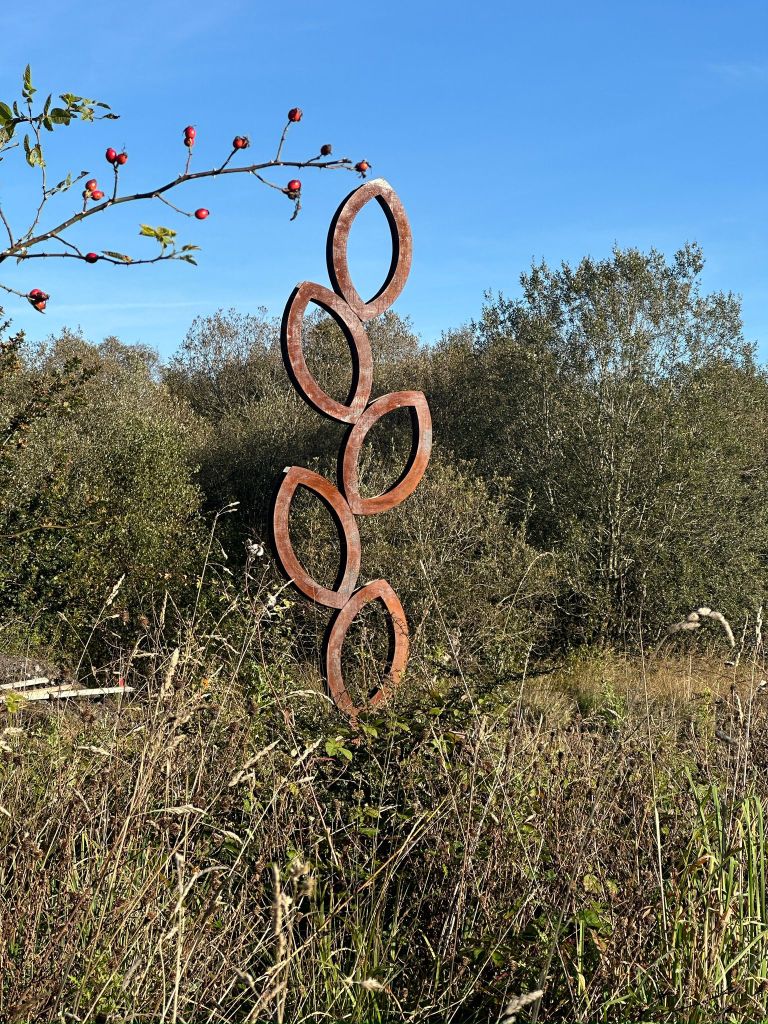
Regeneration draws inspiration from the seed as a symbol of renewal, growth, and cyclical change. Rising vertically from the ground, the work acknowledges the industrial history of the site while pointing toward its continued regeneration.
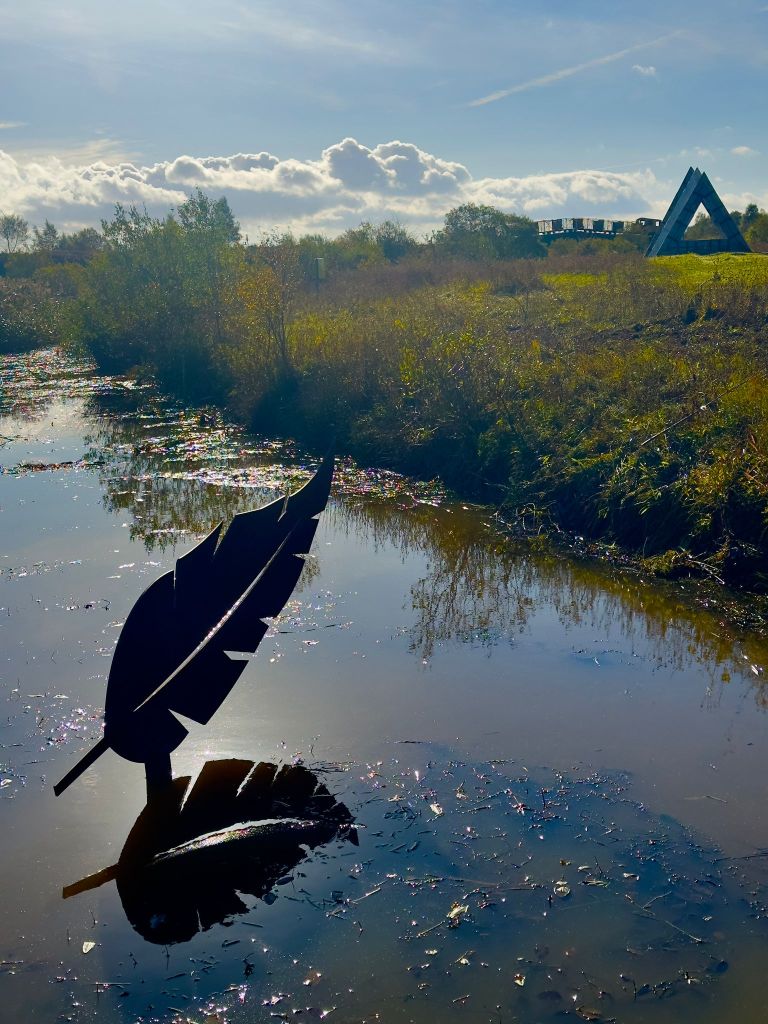
Light as a Feather offers a contrasting visual language — a suspended, airy form that engages with space, balance, stillness and the quiet expansiveness of Boora’s open horizon.
“Lough Boora is a place shaped by change, resilience and imagination,” said Kevin O’Dwyer. “These works are rooted in the landscape’s capacity to hold memory while continually becoming something new. O’Dwyer says it has been an honour to contribute to this next chapter in the park’s cultural and environmental renewal.”
(more…)
-
Tullamore Jail moves the muse in T.D. Sullivan. The new annotated edition of Prison Poems; or Lays of Tullamore (1888, new edition 2025). By Terry Moylan and Pádraig Turley. Blog No 762, 26th Nov. 2025
Timothy Daniel Sullivan MP published Prison Poems; or Lays of Tullamore in 1888, printed by The Nation at 90 Middle Abbey Street, Dublin. What are these about? What made Sullivan write them?
[Before moving to that we wish to congratulate the authors on the issue of the new annotated edition of Prison Poems; or Lays of Tullamore from Terry Moylan and Pádraig Turley and published by Offaly History with the support of the Decade of Commemorations funding. The book is now on sale and is available from Offaly History Bury Quay and online at www.offalyhistory.com. Ed.]
These were written during a most tempestuous, unsettled, tumultuous decade in Irish history, the 1880s. The Land War was at its height under the leadership of Charles S. Parnell. The campaign for Home Rule had turned to dust. William Ewart Gladstone the British Prime Minister had brought forward a Home Rule Bill in 1886, which by today`s criteria might appear modest, but for its time was seen as revolutionary. This set off alarm bells which would do irreparable damage to the ruling Liberal Party.
(more…)
-
Shannon Bases and Viking Raids in Offaly. By John Dolan. Blog No 761, 21 Nov. 2025
There are a number of references in the Annals to Viking bases been set up on the Shannon, particularly in the larger lakes of Lough Derg and Lough Ree. There were two distinct periods of Viking activity on Lough Ree starting In the ninth century when the Vikings had a fleet on the lough. The Annals of Ulster for 845AD say ‘There was an encampment of the foreigners i.e. under Tuirgéis on Loch Rí, and they plundered Connacht and Mide, and burned Cluain Moccu Nóis (Clonmacnoise) with its oratories, and Cluain Ferta Brénainn (Clonfert), and Tír dá Glas (Terryglass) and Lothra (Lorrha) and other monasteries’. Later another base was built between Dromineer and Castlelough in the lands of the O’Sextons. It was from the Shannon that the majority of raids into County Offaly were carried out. A very early and unusual entry in the Annals of Ulster for 749 says ‘ships with their crews were seen in the air above Cluain Moccu Nóis’.
The following year Tuirgéis was captured by Maelsechlainn and drowned by him in Lough Owel outside Mullingar. The Annals of Ulster for 922AD say ‘The fleet of Limerick, that is of Ailche’s son went on Loch Rí, plundered Clonmacnoise and all the islands on Loch Rí and took great booty in gold, silver and much treasure’. In 924AD the entry reads ‘Kolli son of Bárðr ‘Lord of Luimnech’ raids Lough Ree’.
(more…)
-
Vikings on the Shannon. By John Dolan. Blog No 760, 14 Nov. 2025
There is little doubt that contact by sailors from Norway had occurred over many years in the 8th and 9th centuries between the islands of northern Scotland, the east coast of England and with Ireland. Most of these sailors would have been fishermen or traders and would have acquired details of the Irish coastline, location of rivers and awareness of monastic sites. This intelligence was readily available when the Viking raiders came calling.
Tony Lucas in his paper on the plundering of Irish churches makes the point that of the 309 ecclesiastical sites that were plundered between 600 and 1163AD, the Irish themselves were responsible for 139 of these. Only 140 of these can be directly attributed to the Vikings and 19 raids are attributed to the Irish and Norse together. An entry in the Annals of Ulster for 755 records ‘The burning of Cluain Moccu Nóis on the twelfth of the Kalends of April’ by the Irish long before the arrival of any Viking.
(more…)
-
An Old Charmer: Meeting Eamon de Valera, Uachtarán na hÉireann, in theÁras. By Fergal MacCabe. No. 22 in the 2025 Offaly History anniversaries series. Blog No 759, 7th Nov 2025
As this year is the fiftieth anniversary of the death of Eamon de Valera it is probably a good time to recount meeting this towering (literally) but often controversial figure.
It would now appear to have been discontinued, but in those days the newspapers regularly printed a sort of Court Circular announcing the official engagements of Uachtarán na hÉireann. Dev’s visitors seemed to be drawn almost exclusively from visiting American priests and nuns, so in 1970 I wrote him a rather provocative letter accusing him of being out of touch with ordinary Irish people – especially go ahead modern youngsters such as myself and my wife Brid. How could he possibly know what was happening in the real world!
(more…)
 offalyhistoryblog