Bracknagh a small village in east corner of Co. Offaly, formerly, in the Barony of Coolestown. While originally part of the parish of Clonsast, today it forms part of the parish of Clonbullogue. It borders Co Kildare to the east, lying approximately six kilometres from Rathangan, and borders Co Laois to the west, situated seven kilometres from Portarlington. Geographically it is located on the Figile River and fringes the Bog of Allen.
While Bracknagh village is the focal point of the settlement, the area of Bracknagh includes the hinterlands of Ardra, Clonsast, Clonshannon, Ballinrahan, Ballinowlart, Ballyshane, Nahana, among others.
We are used to hearing of the formal gardens at Birr Castle Demesne and the famous box hedges. The landscape of the demesne has been manicured since the time of Mary, the third Countess of Rosse in the 1840s and 1850s. Later the fifth, sixth and the present seventh earl have devoted much time to demesne improvements. The Illustrated London News in an issue of 1843 was the first periodical with an international circulation to devote space to the demesne (see our earlier blog). In the mid-1960s it was Country Life with the distinguished architectural historian , Mark Girouard, who wrote up three articles on the castle and one on the town of Birr.
A contribution to Tullamore 400 and the Living in Towns initiative of the Heritage Council. Sit down and have a cup of tea with this blog!
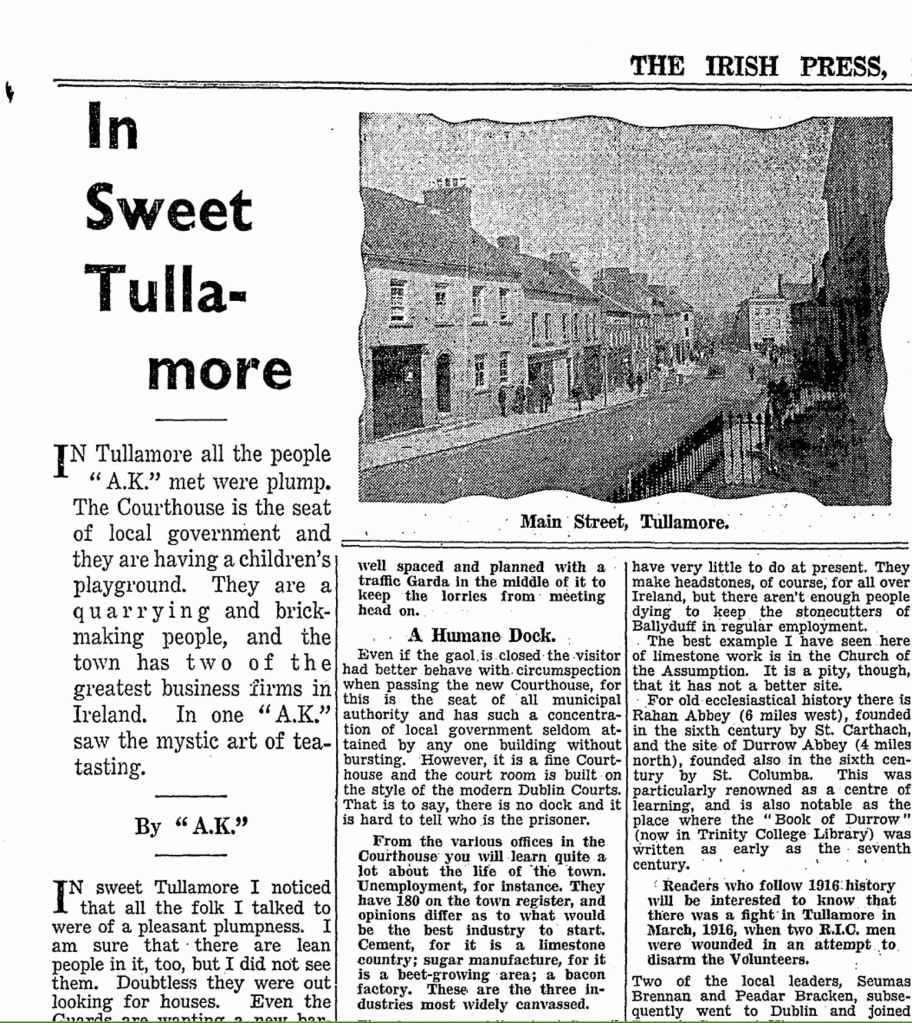
A visit by an Irish Press journalist to Tullamore in 1933 provided a nice puff for the Williams tea business and its brand Red Cup Tea. At the time Williams provided regular advertising in the Irish Press for its tea and Edmund Williams (d. 1948) was a founder director of Irish Press. D.E. Williams’ interest in tea can be traced back to 1895. In the Chronicle and the rest of the local press for February 1895 advertisements appeared in connection with the opening of a wholesale tea business by Daniel E. Williams. In a comment the Chronicle stated that most of the blending was done in London where D.E.W. had larger stores than hitherto. The draft 1917 accounts for DEW Ltd show sales at £8,324. This had risen to £13,807 by 1923. The business was much expanded in the 1930s led by the blender, a Mr O’Shea.
From the Irish Press, 5 May 1933. The picture is from an old postcard rather than sending a photographer.(more…)
Dr William Moran, a distinguished man of letters and former parish priest of Tullamore (1949–65), published the article below in 1962 and in the same year as his pamphlet on the history of Tullamore. In many ways it was a seminal overview that has not as yet been superseded.[1] Material has of course been published by the late Sister Dolores Walsh on the history of the Mercy schools in Tullamore while others have written of the Presentation schools in Rahan and Birr, Mercy Birr, Mount St Joseph, Tullabeg College, vocational schools in county Offaly including Tullamore, and primary schools in Durrow (See Irishhistoryonline and the OH Library catalogue online for guidance). Dr Moran’s strongly held and trenchantly expressed views come across in this piece.
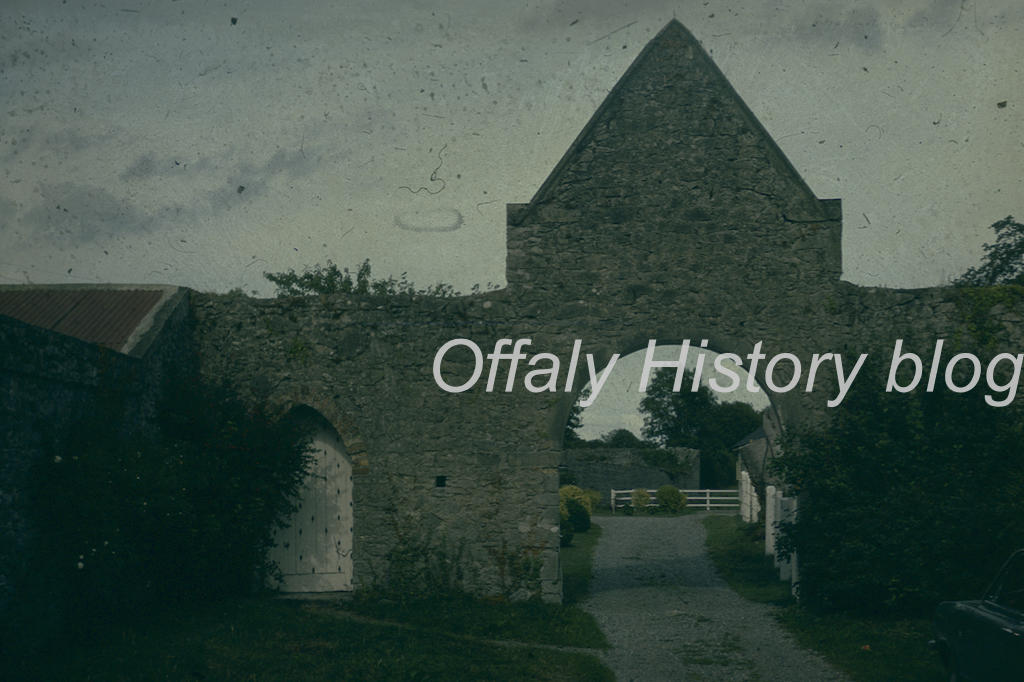
The site on which Hollow House can be found on is one that has changed and adapted throughout its time starting in the 17th century. The first sign of life in the area is the bawn wall for the residence that was said to be “built by de Renzi” it can be assumed that there was a castle on the site because of an ordnance survey stating ‘Castle in ruins’. It is certain that they were living incredibly comfortably for the time because of their previous home in Clonony castle for eight years from 1612 to1620 before leaving and eventually buying the land where Hollow House stands today. The bawn and circular towers found in the area were originally built with defence in mind, as time passed their use became more domestic. The towers were repurposed as pigeon towers.
Remaining part of the bawn wall from the outside
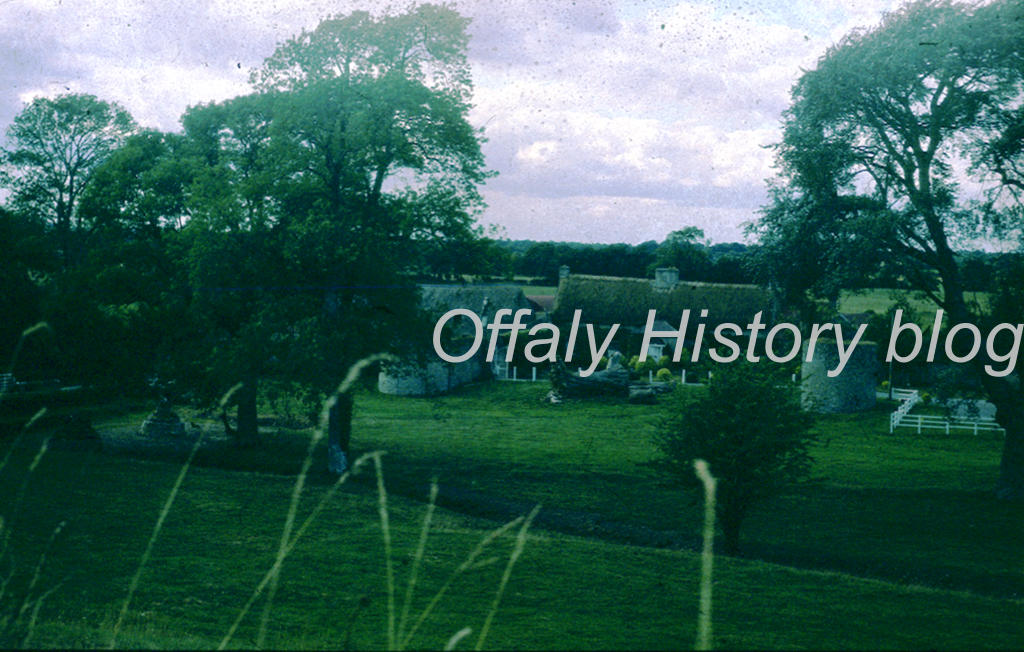
The gardens at Hollow House have been described as early-eighteenth century by Maurice Craig and William Garner but the 1838 ordnance survey of Tinnycross seems to confirm no such gardens are depicted. However, the same survey also left out a large lake near Birr castle so it is still possible that the features were simply left out for some reason or another. This same issue presents itself with putting a date on the creation of the decorative pond in the garden as it first appears in a 1910 ordnance survey of Tinnycross, but since the 1838 survey may be unreliable, it is uncertain when the pond was actually built. The farmyard beside the house shows signs of being built in the mid-late 1800s, the largest building has a corner slab with the year 1863 seen on the wall. The pond in the garden includes two stone structures built in three tiers of oddly shaped limestone rocks, the gaps in these stones were more than likely used by water fowl as a shelter. These structures were decorative pieces more than anything, it is unfortunate to note that one of these structures was destroyed by a falling tree in recent years, the stones from the structure remain in the place where it once stood.
Long shot of the gardens, house, pond and turrets at Hollow House,
Sir Matthew De Renzy (1577-1634) was born in Cologne, Germany. It must be noted that the surname de Renzy has been spelt de Renzi or de Renci and these spellings were used interchangeably on different documents. He became a cloth merchant in Antwerp, one of many merchants who held control over the trade in the city, this fell apart due to a decline in trade in the area which was caused by a conflict between the Dutch United Provinces and the ruling Spanish Hapsburgs which led him to move to London in 1604, he found himself in financial difficulty in early 1606 and when he was unable to recover enough money from merchants who owed him, he was then declared bankrupt. With his creditors were pursuing him so he fled rapidly to Ireland via Scotland arriving in Dublin in August, without a penny to his name.
His main ambition upon arrival was to obtain land and he understood that to achieve this successfully he would need friends in high places. He made many good contacts in Dublin and further afield including Sir Arthur Chichester, then Lord Deputy of Ireland. As a polyglot he was fluent in Latin, Italian, English, German, French and Spanish and set about learning Irish he learned both spoken and colloquial Irish from Conchubhar and Tadhg Mac Daire MacBruaideadh he also learned classical Irish in Sligo from Tadhg Ó hUiginn so that he could read Irish manuscripts and write in the language this new skill aided him in communicating with the Gaelic Lords at the time and gaining the trust and more importantly, their land. He acquired 100 acres in Clonony where he lived in the castle that remains standing to this day. His 100 acres expanded to over 1000 acres in the following years.
Hollow House c. late 1970s. Courtesy Offaly History
In around 1620 he sold his land in Clonony and became a government administrator in Dublin, he was knighted in 1627. Not much is known about his marriage but he was first married in 1608 to Mary Adams and his second marriage was to Anne Maypowder. His interest in the Irish language was purely from the perspective of a planter attempting to gain land in a functioning Gaelic Lordship that still remained in Offaly at the time. Despite his affinity in their language the local farmers and families often disrespected his claim to the land he lived on often ploughing on his land and de Renzy had to fight hard to keep his claim on any land in the area both legally and literally, this conflict may have been the reason for the defensive style found at Hollow House. He also had a son Matthew de Renzy, his heir. In 1630 he purchased land near Tinnycross Co. Offaly, in the name of his eldest son. De Renzy died in 1634, his son Matthew Jr. commissioned a memorial for his father in St. Mary’s Church Athlone where it can be seen today.
Matthew Jr. was listed as the owner of the land in Tinnycross in the Down Survey of 1654-6, during his ownership of the land he let it to Francis De Renzy who lived there with his wife Elizabeth Keane. Francis died in 1665 and is commemorated in Durrow church with a carved grave slab. This stone was moved outside to the north face in about 2004. His wife remarried and eventually died in 1686. The land came into the hands of the Cox family of Ferns through another Matthew De Renzy in 1704. Sir William Cox was cited as the owner in Griffith’s Valuation of 1854. He leased it to Edward Kelly who has been noted to live in Tinnycross in a list of landholders in King’s Co. 1824 and Griffith’s valuation 1854. It is also noted in Griffith’s valuation that Edward Kelly was also leasing small amounts of land to several people in the area, Michael Seery, William Freyn, Christopher and Elizabeth Hackett and James Lynham. It can be assumed that the land remained to be leased to different families for residence and farming for the next 50 or so years until eventually coming into the hands of the Walsh family where they would continue to live in the area for most of the 20th century and beyond.
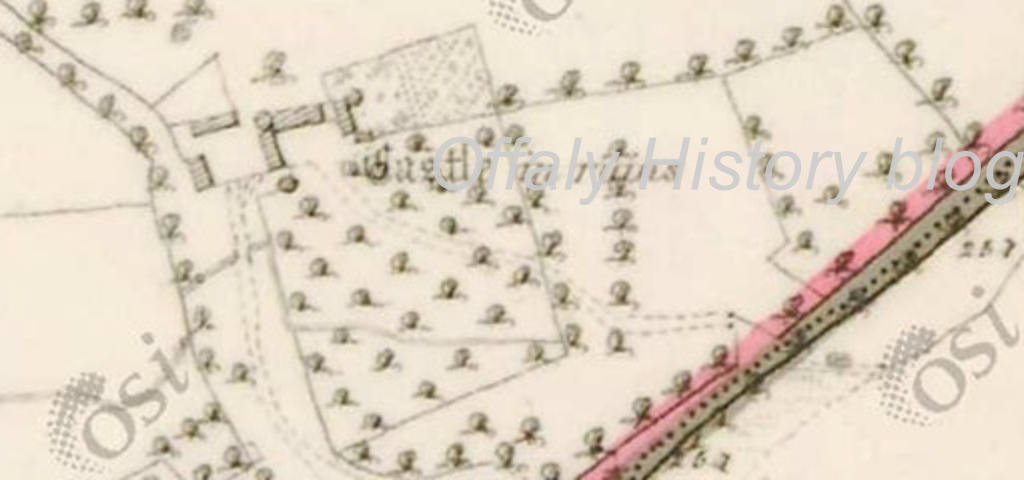
Map of 1838 showing Hollow House with the inscription “Castle in ruins”
The beginning of the 20th century sees Hollow House being inhabited by two young men Patrick Walsh, 18 listed as the Head of the Family and his younger brother Andrew, 17. Looking at the House and Building Return from the 1901 census the landlord listed for their dwelling was Michael Walsh who appears to be their father from his own census record with many children and of perfect age to have had both of the brothers. Another link between them is that Michael is listed as a farmer under his own occupation while the young men put themselves down as farmer’s sons. The evidence suggests that the brothers had started to farm on their own just north of where their father lived and worked with the rest of the rather large family having eight other children at home and a servant to help either on the farm or around the house. By 1911 we can see that Andrew has started a family with his wife, Elizabeth and two young children Michael and Patrick.
Archaeology.ie provides the following:
Townland: BALLYNASRAH OR TINNYCROSS
Description: An early Georgian farmhouse is situated on the site of castle of which nothing remains. The four round corner towers along with bawn wall and round arched gateway with triangular pediment and spiral finials all belong to the late 18th or early 19th-century and were built after the castle was destroyed probably by the occupiers of the now ruinous Georgian farmhouse. An early Georgian farmhouse is situated on the site of a castle of which only the bawn survives. The four circular angle towers along with part of the bawn wall (OF009-023001-) appear to date from the seventeenth century. The round arched gateway with triangular pediment and spiral finials appear to belong to the late eighteenth or early nineteenth-century and were built after the castle was destroyed probably by the occupants of the ruinous farmhouse. The back wall of this cottage is part of the earlier bawn wall of 17th century date. Probable plantation castle of 17th century date with large rectangular bawn wall with four corner flanking towers. The wall and angle towers are defended with gun loops that provided flanking fire along the outer face of all four walls of the bawn.
The above description is derived from the published ‘Archaeological Inventory of County Offaly’ (Dublin: Stationery Office, 1997). In certain instances the entries have been revised and updated in the light of recent research.
Offaly History members and friends at Hollow House, late 1970s. The picture includes Fr Conor McGreevy, Baron von Ow, Ger Coughlan, Cecil Lumley, Danny Robbins, Joan McGill, John Devereaux, Frank Meehan, Tom Galvin, Owen Wyer, Mrs J. Doyle. Younger members Terese and Noel Scully, Brendan Doyle.
Scheduled for inclusion in the next revision of the RMP: Yes
Description: An early Georgian farmhouse is situated on the site of a castle of which only the bawn survives. The four circular angle towers along with part of the bawn wall appear to date from the seventeenth century. The round arched gateway with triangular pediment and spiral finials appear to belong to the late eighteenth or early nineteenth-century and were built after the castle was destroyed probably by the occupants of the ruinous farmhouse. The back wall of this cottage is part of the earlier bawn wall of 17th century date. Probable plantation castle (OF009-023—-) of 17th century date with large rectangular bawn wall with four corner flanking towers. The wall and angle towers are defended with gun loops that provided flanking fire along the outer face of all four walls of the bawn.
When Christians arrived in Ireland and started to write about the country they found an island of Gaelic kingdoms, perhaps up to 150, that was dynastic and the political organisation was based on the tuath. The tuath was the bedrock of the Gaelic political system and is described as a small kingdom. Most of what we know now has been gleaned from the Irish Law Tracts, commonly known as the Brehon Laws. Other written sources include the Hero and Saga Tales.
I am always intrigued, and fascinated to learn of a person, who in their time was famous, but somehow or other has faded into the mists of time. Such a person is our subject Joseph Stirling Coyne. He was during his lifetime a very famous dramatist, writing upwards of 100 plays, a theatre reviewer and one of the first editors of Punch magazine. His story is worth telling and hopefully this blog may restore him to public conscientiousness, especially in his native town.
He was born in 1803 in Birr, then known as Parsonstown. The year 1803 was a pretty good year to be born, for he shares it with Gerald Griffin, John Henry Newman and James Clarence Mangan no less, and of course with his fellow Birr man the poet John De Jean Frazer.
About two kilometres from Shannonbridge on the Clonmacnoise road (R444), in the townland of Clerhane, a narrow laneway leads to the site of all that now remains of a once thriving industry in limestone quarrying. While the origins of the quarries are lost in the mists of time it can be assumed that the stone for all the major building projects in the area was sourced locally. The heyday of the operations can be regarded as being from the early nineteenth to the mid twentieth century. While their many monuments and buildings in stone will stand for centuries, the memories of the quarries that produced them, their owners, the workforce and methods of operation are in danger of being totally forgotten.
Terence Dooley in his Burning the Big House: the story of the Irish country house in a time of War and Revolution (Yale, 2022) devoted fourteen pages to a case study of the burning of Tubberdaly, Rhode. He concluded that the house was burned as a result of labour disputes, local agrarian issues and the demand to have the demesne and untenanted lands distributed to local people as the main reasons.[1]
Beaumont Nesbitt had inherited an 8,000-acre estate from his cousin Catherine Downing Nesbitt of Leixlip House in Kildare in 1886. Most of this estate was at Rhode in King’s County. Nesbitt sold all of this land (save 1200 acres) under the Wyndham Land Acts. The First World War has been said to mark the last phase of unionism in ‘Southern Ireland’ and to that can be added personal tragedies with the death of one of Nesbitt’s son in the war and Nesbitt’s wife in 1918. The same was to happen with the Digbys of Geashill Castle and the Rait Kerrs of Rathmoyle. Prices rose substantially in the latter years of the war and with that came the agrarian disturbances among the labourers who had not benefited in the way that farmers had from high prices. The labour dispute at Tubberdaly in 1919 went on for four months and when resolved saw three of the ringleaders dismissed. That would prove to be a running sore, just as with Thomas Dunne and the Geashill Cattle Drive of 1914. Land disputes, personal animosities and IRA membership all provided the ingredients in the ongoing struggle, which in the case of some of those concerned was not resolved until de Valera and Fianna Fáil came to power in 1932.
Do you want to know more about your townland? In this article you will discover the origin name, meaning and history of some of the townlands in the parish of Kilbride, Tullamore. The civil parishes of Kilbride and Durrow are closely aligned with the boundaries of the Catholic parish of Tullamore
The description of the parish of Durrow and Kilbride from Petty’s Down Survey of c. 1654.The soil is fertile and watered by the Silver River and the Brasnagh – with great store of fish. The forfeited lands were those of the Briscoes of Srah Castle and the Herberts of Ballycowan Castle. Tullamore lands were owned by the settler Moores from the 1600s-20s period and as such Protestant and not for planting with new owners.(more…)





 offalyhistoryblog