
John O’Donovan was in Birr in early 1838 and having obtained a copy of The Picture (1826) by Thomas Lalor Cooke thought better of him as a scholar, but one subject to some foolish ideas after the school of Charles Vallancey. O’Donovan identified Cooke as ‘B’ in the Penny Journal articles he wrote and one of these was on the monastery of Seir Kieran at Clareen. It is interesting to compare the article in the 1834 issue of the DublinPenny Journal with that in the 1875 publication. Also of interest is to take into account the manuscript annotations to the Picture of 1826, now in Birr Castle Archives. And if that was not enough Cooke has letters and other MS sources in the RIA, NLI and the National Archives. In his letters of 1850 to the Cork antiquarian, John Windle (now in RIA) he tells Windle that he was the author under the pseudonym ‘B’ of articles in the Penny Journal and under his own initials of articles in the Dublin Evening Post. Despite the published work of George Petrie on the Round Towers (1833 and 1845) Cooke continued to put forward the Vallancey-style notion that the origin of the round towers lay in early times and were temples of fire.
Read more: Thomas Lalor Cooke the Mr ‘B’ of Birr with his Dublin Penny Journal article of 1834 on Seir Kieran. No. 16 in the 2025 Offaly History Anniversaries Series. Blog No 715, 28th may 2025 (more…)Category: Local history
-
Anne Jellicoe (1823-80) of Mountmellick, Clara and Dublin: ‘a quiet but determined revolutionary’ who let the credit roll. No. 14 in the 2025 Anniversaries Series from Offaly History. Blog No 713, 14th May 2025
Hopefully Clara will soon honour Anne Jellicoe with a street name. Susan M. Parkes, the author of a history of Alexandra College, Dublin contributed a valuable short life of Anne Jellicoe to the Dictionary of Irish Jellicoe (now online) was a pioneer in establishing a craft industry in Clara during her ten years there in 1848–58. The early 1850s was a time when many craft industries were established by boards of guardians and convents. Some such as that connected with the Mercy convent schools, Tullamore lasted less than five years. That at Clara was also to have a short life. Michael Goodbody in his The Goodbodys (Dublin, 2011) noted that John Jellicoe, a quaker miller from Monasterevan leased the Erry, Clara mill from John Dugdale in 1848. The mill was destroyed by fire in 1849 and rebuilt, and after Jellicoe’s time was worked by the Perrys. It was in 1850 Goodbody states that John Jellicoe’s wife Anne started a lace making school in Clara to provide work for local girls. She also began to teach embroidery, an idea taken from Mountmellick. By 1854 the craft school was in trouble because ‘the new priest beat the work girls from Anne Jellicoe’s school to make them attend his own’. The source of the row may have been religious instruction (Goodbody, 2011, 216). By 1856 the contents of the lace school were auctioned off. Clara would have more trouble with its parish priest and bishop in the 1890s. The Jellicoes left Clara in 1858. There are further references to the Jellicoes in the diary of Lydia Goodbody published in 2021 under the title 100 years of Clara history: a Goodbody family perspective. Anne Jellicoe would be a fitting inspiration in the event of new housing state in Clara needing a name. Dead over 100 years now there could hardly been an objection from Offaly County Council.
(more…)
-
Sharavogue Shinrone, County Offaly and the King’s County Polo Club. By Aidan Doyle. Blog No 710, 23rd April 2025
Polo traces its origins to the game of Chovgan, an equestrian team sport played by the aristocracy of the Persian Empire. It spread across Asia evolving along the way. By the 1400s it had arrived in India, supposedly introduced during the Muslim conquests of the subcontinent. During the Mughal period polo was dubbed the ‘Sport of Kings’ and the emperor Jalal ud-din Akbar introduced a set of rules governing the sport in the 1560s. In 1859, British soldiers and tea planters serving in India established the Calcutta Polo Club and the game was quickly introduced to Britain. When Carlow hosted Ireland’s first polo match in 1872, the local press referred to it as ‘Hurling on Horseback’. A year later the All-Ireland Polo Club was founded, with its grounds at the Nine Acres in the Phoenix Park. In 1875 the Hurlingham Polo Committee in London drew up a set of rules which would shape the polo in the century which followed. In the same year polo had migrated once again and in time the scions of Argentina’s richest families would establish that countries position as the global powerhouse of the game.
(more…)
-
George Petrie (1790–1866), a key landscape painter for Offaly’s ‘heritage of ruins on the landscape’. No 3 in a series on the paintings and drawings of County Offaly, 1750-2000, explored through the works of artists from or associated with County Offaly. Blog No 709, 15th April 2025
George Petrie was born in Dublin in 1790 and has a strong King’s/ County Offaly connection through his work at Clonmacnoise, Birr, Banagher, Clonony, Lemanaghan and Rahan. He may have been the most significant topographical artist so far as Offaly is concerned. He was certainly the greatest exponent of the heritage of Clonmacnoise first visiting the site in 1818–22. Dates differ as the visits to Clonmacnoise as was noted in the most attractive publication by Peter Murray and published by the Crawford Gallery in 2004.[1] The other great work on Petrie is that of William Stokes, The life and labours in art and archaeology of George Petrie (Longmans, London, 1868). Also important is Crookshank and Knight of Glin, Irish painters, 1600–1940 (Yale, 2002).
The Dictionary of Irish Biography (DIB) entry by David Cooper records that Petrie, was an artist, antiquary and collector of Irish traditional music, and was born on 1 January 1790 in Dame Street, Dublin, the only child of James Petrie, portrait painter, of Dublin, and Elizabeth Petrie (née Simpson) of Edinburgh, Scotland. James Petrie (d. 1819) was born in Dublin of Scottish parents and studied at the drawing school of the Dublin Society. Afterwards he practised as a miniature painter and a dealer in jewellery, coins, and antique objects at 83 Dame Street. The collecting instinct would stand Irish heritage in good stead with James Petrie’s son George performing an outstanding archival and museum service.
(more…)
-
Bernard Delaney (1854-1923): Offaly piper conquers America. ‘He put the music right under their feet’ – Francis O’Neill (1913). By Frank Kelly. 2025 Anniversaries Series. Blog No 707, 9th April 2025
Do come to the lecture and musical event on 12 April, 3 p.m. Saturday at Offaly History Centre, Bury Quay, Tullamore (beside New Aldi and Old Warehouse)
Bernard Delaney (1854-1923) – Offaly piper conquers America
Bernard Delaney was an extraordinary man, a superb musician and above all a survivor. Birr Historical Society presented the story of piper Bernard (Barney) Delaney in January and we are glad to confirm a further lecture and musical afternoon to recall his life and contribution to Irish traditional music. This time in his home town of Tullamore. Delaney suffered the loss of three of his four children and his wife in the late 1870s and was forced to leave his country in search of hope and a better life in the New World. Delaney was a master of the Uileann Pipes. The Talk will focus on his life, the story behind his enrolment into the elite Irish Music Club of the Chicago Police Department and his legacy.
Short presentations will be given by both Frank Kelly and Seamus Kelly.
Delaney’s musical heritage will be played at the event by Frank Kelly and musical friends.
Frank Kelly is from Lusmagh and has written articles about Delaney for the Fleadh Cheoil Clár and the Comhaltas magazine Treoir.
Seamus Kelly is from Kildare with Birr connections. He has researched Barney’s life and written the book Bernard ‘Barney’ Delaney (1854-1923) Offaly and Chicago Piper. Copies available from Offaly History Centre.
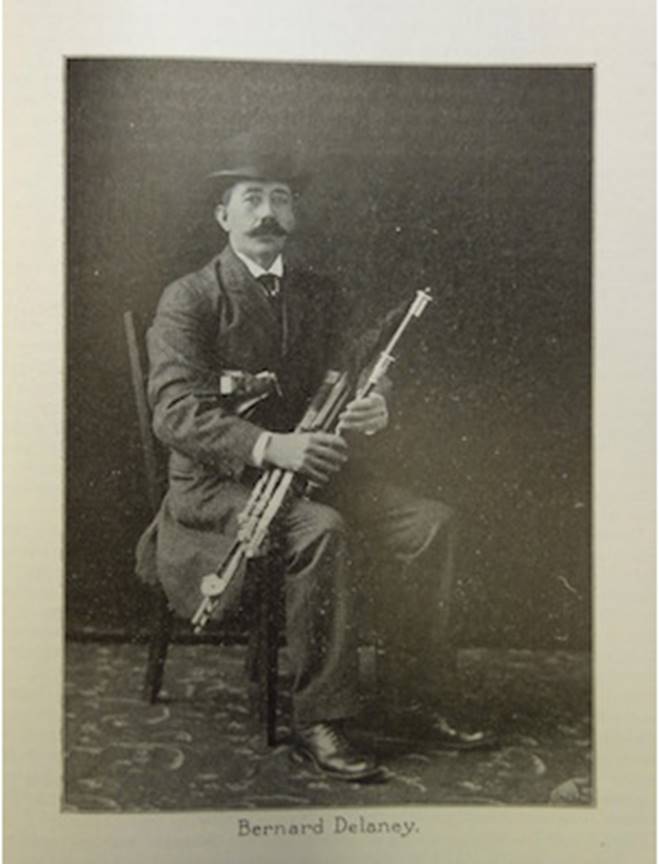
Bernard Delaney, Source: Francis O’Neill, Irish Minstrels and Musicians (1913)
‘We are more or less indebted to Bernard Delaney for the introduction of many fine tunes to our community. His well-deserved reputation as an Irish piper did much to spread the local knowledge of his music among local musicians, as well as to promote the popularity of Irish music in general.’ Source: Francis O’ Neill, Irish Folk Music (1910)
Ahead of Fleadh Cheoil ns h-Éireann 2009, I researched the life of Bernard (Barney) Delaney of Killeigh so as to publish a piece on him in the Fleadh brochure. Offaly has a rich Traditional-Music Heritage and a multitude of All-Ireland champions since modern competitions began in Fleadhanna in the 1950s. However, our folklore is filled with records in the oral and written traditions of musicians dating back to the courts of our Gaelic Chieftains, our famed monastic settlements and music even has filtered through to us from the Celtic mists of ancient Ireland.
Due to the devastating famines of the 1840s and the following poverty in the 1860s and 70s when the people’s main motivation was pure survival, our musical heritage fell away among the general population. It fell to the immigrant classes to carry their music and song with them to the far-flung places where they could find work and sustenance.
Bernard Delaney of Killeigh was typical of these survivors. Unlike many of his fellow immigrants, he had a “magic wand” in his pocket in the form of a penny whistle and all the melodies that instrument could conjure up. Melodies that would provide his sorry Irish comrades with hope, joy, and the happier memories they may have associated with these tunes.
Following my meagre scraping of the surface in 2009, a hero emerged in the form of Seamus Kelly of County Kildare who dug deeper Delaney’s life. Then, with the backing of Attracta Brady; the soon-to-be Uachtarán of Comhaltas Ceoltóirí Éireann, local researcher, Brendan Berry and Seamus’ own team of sleuths, the life of Bernard or Barney Delaney was uncovered. Before the launch of this delightful publication, few in Offaly or Killeigh would have known much of the life of the once-celebrated uilleann piper of Chicago and American fame. Now, it’s about time Barney was given the recognition he truly deserves. The following are a few snippets of background from Seamus Kelly.
Frank Kelly
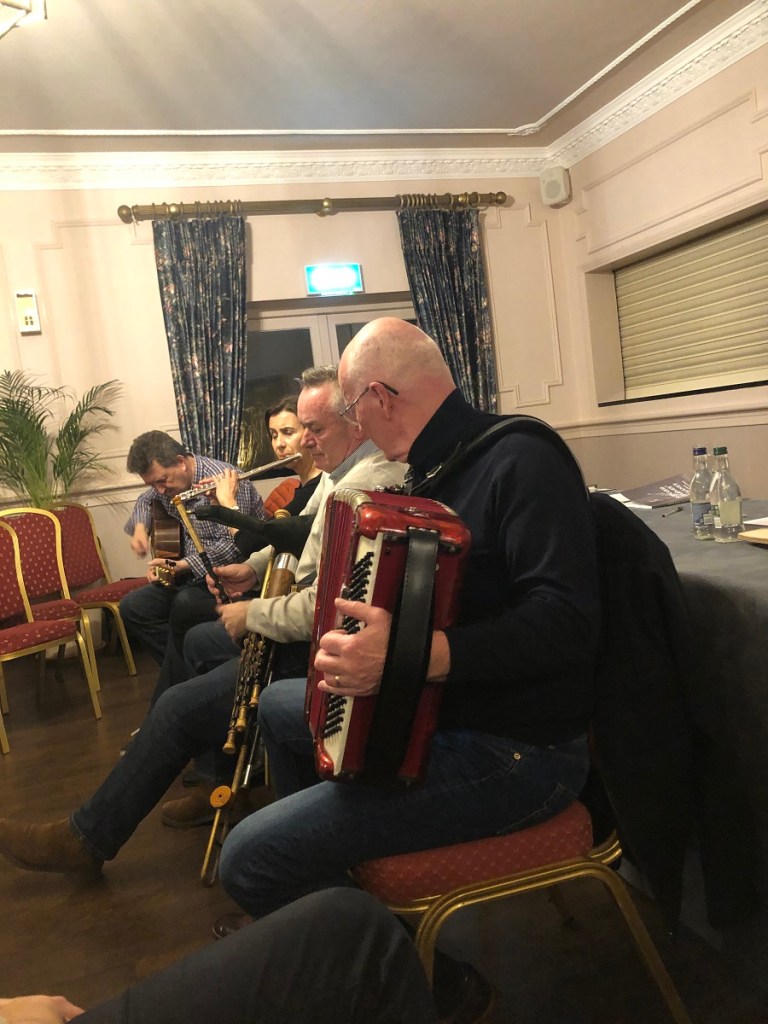
The musicians at the Birr Historical Society event in January 2025. 
Courtesy Bantry Historical Society Seamus:
Frank Kelly’s article in Treoir outlined some of Barney’s background and early life in Ireland. Without Frank Kelly, and his many Offaly contacts, my publication would not have seen the light of day. The support of Attracta Brady, now President of Comhaltas Ceoltóirí Eireann (CCE), was also crucial.
The Offaly Independent (18 September 1992 stated that Offaly has a tradition of excellence in music and added that ‘Offaly can also boast one of the great Irish pipers in Barney Delaney who was born in the Tullamore area about 1860…’. He was, in fact, born there in 1854.
The book was brought to fruition by three Kellys – Seamus, Frank and Michael. Michael Kelly and Brendan Berry’s pioneering work in following up on Delaney’s family in Ireland has made a real difference to our knowledge of the ‘Offaly piper’. An article by John Ennis in The Gael magazine (February 1902) also provided us with a wonderful photo of Delaney.
Francis O’Neill wrote in 1910 that he was delighted that Bernard Delaney brought himself and his tunes from Offaly ‘Here, indeed was a prize and what a repertory of unfamiliar tunes he had from Tullamore, his native place! Chief O’Neill, mentioned that Barney was from around Tullamore. Well, could we be more specific? Yes, we can.
Finding out that his father’s name was Patrick (from Bernard’s passport application in 1919) was a start. Frank Kelly’s article entitled ‘The Offaly-Chicago connection from Scrubb, Killeigh, to Ocean Springs, Mississippi’ (Treoir, 2009, 2020) tried to identify Barney Delaney’s birthplace. Brendan Berry was able to pinpoint Patrick Delaney’s plot to Meelaghans instead of Scrubb.
The Killeigh Co. Offaly Delaney connection was further confirmed by the excellent research of Michael Kelly. Aileen Saunders accessed the transcript of Bernard Delaney’s baptismal record. It informs us that Bernard was from the Parish of Killeigh, just south of Tullamore. The name was misspelt ‘Delay’ on this electronic record which was unhelpful. It gives us Bernard’s mother’s name as Eliza Dinn (possibly Elizabeth Dunne). It also gives the date of his baptism, in Killeigh, as the 25 May 1854.That date is reliable although it conflicts with other records. For example, in the 1900 US Census Barney gave his birth date as August 1852. His police record says he was born on 24 March 1854.
Bernard had a family of his own, in Offaly, before he emigrated to America in the early 1880s. Aileen Saunders noted from US Census records that Bernard Delaney had a daughter Elizabeth. Barney was around 20 years old when he married Mary Farrell on the 23rd October 1874. Bernard’s age was given as 20 while Mary was 24. They were married in Tullamore. Mary Farrell, from Tullamore, worked as a servant and was the daughter of Charles Farrell who was a carpenter. Bernard’s father Patrick had died before the wedding. Throughout this period (1876–1882) Bernard Delaney is described as a labourer. The children of Mary and Barney Delaney:
Thanks to Michael Kelly’s research we know when the Delaney children were born and when they died. Bernard and Mary lived in Charleville Road, Tullamore but mostly after that they were in Distillery Lane until at least May 1882. Their first child Patrick was born on 25 March 1875 at Charleville Road in Tullamore. Soon after they moved to Distillery Lane in Tullamore where most of the children were born. Second son John was born there on 6 September 1876. Their first daughter Mary arrived in April 1879 followed by Elizabeth on 2 July 1880. Their last child, Ellen was born in February 1880. Five children in five years!
Note: ‘The Tullamore Piper’ title is still accurate in the sense that he lived as a young married man in Tullamore though he was a native of and was baptised in Killeigh; RC parish. A tune in O’Neill’s Music of Ireland (1903) (Number 1773) is called The Tullamore piper. The title can only refer to one man!
Tragically, all of the Delaney children, except Elizabeth, died young between 1879 and 1882. Patrick died from typhoid fever on 1 March 1877, aged 2. Mary died (aged 1 year), John died (aged 6) and Ellen (aged 3 months). Barney’s wife Mary Farrell died from measles, pneumonia and heart disease in Tullamore Union Workhouse or the infirmary attached to it, on 21 May 1882, aged 30.
Their youngest child Ellen had died the day before. Mary died 8 days after her son John died from measles.
The family struggles must have been traumatic. Mary Delaney must have suffered terribly. The losses of his wife and four of his children must have taken its toll on Bernard. These very harsh family circumstances probably influenced his very rapid decision to emigrate, and may have impacted on him later in life.
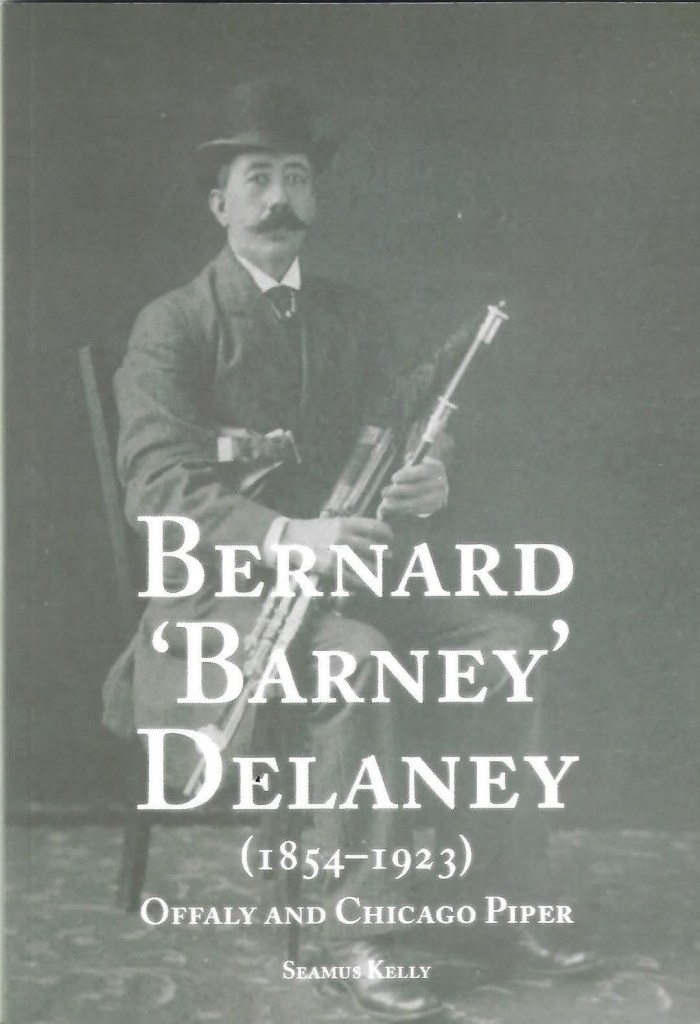
The full publication is available in the Offaly Historical Society book shop on Bury Quay.
Frank Kelly

Venue for the Saturday lecture and music session, Bury Quay (beside New Aldi and Old Warehouse restaurant).
Published as part of the County Offaly 2025 Commemorative Programme with the support of Department of Tourism, Culture, Arts, Gaeltacht, Sport and Media

-
Michael Scott: his Midland Connections and Networks. By Fergal MacCabe. No 2 in a series on the paintings and drawings heritage of County Offaly, 1750-2000, explored through the works of artists from or associated with County Offaly. Blog No 705, 2nd April 2025
The Murals Bar Cultural life in 1950s Tullamore centred around ‘The Murals’ bar. This was where us local artists, actors, historians and writers drank, clutching our copies of ‘Ulysses’ in its concealing brown paper cover while engaging in fevered and sparkling debates on cubism, existentialism, atonality and Marxism.
I may be exaggerating somewhat, but ‘The Murals’ really was our Deux Magots, our Cafe de Flore. The bar was the meeting place of what passed for an intelligentsia in Tullamore at a time, which, though it is now regarded as restrictive and obscurantist, I remember as stimulating and progressive. Maybe I was lucky.
The attraction of ‘The Murals’ was its design which was quite unlike any of the more traditional pubs of the town which were usually small, dark and poky. With its high ceiling, stripped down design, timber veneering, bright red stools, it was cool and elegant and above all- modern.
(more…)
-
Parsonstown/Birr Minor Model School.By Joseph Doyle. No 10 in the 2025 Anniversaries Series. Blog No 701, 15th March 2025
Between 1849 and 1867 a nationwide network of almost thirty Model Schools was established by the Board of National Education. These schools were under the exclusive control of the Board and it was expected that attendance would be drawn from the various denominations to be found in the area of each school’s location. The primary aim of these institutions was to provide a regulated system of training for candidate teachers. Due to a growing reluctance on the part of the Roman Catholic hierarchy and clergy to be associated with these institutions where they had no input into management, the establishments were decidedly skewed towards Ulster. This became even more pronounced when a scheme for the establishment of those schools termed Minor Model Schools – as opposed to the more prestigious District Model Schools – was put in train. Of the seven such schools, only one – Parsonstown Minor Model School – was located outside of Ulster. As such it was an exotic.
(more…)
-
Vice Admiral Arthur Craig Waller of Tullamore and the Royal Navy (1872–1943). By Michael Byrne. No. 6 in the Offaly Anniversaries Series 2025. Blog No 695, 22nd Feb 2025
The recently announced sale on 11 March 2025 by Noonans of Mayfair of the Jutland medals of Tullamore man Arthur Craig (assumed Waller in 1920 on inheritance) is a reminder of the fact that despite being an inland county Offaly (King’s County up to 1920) has a significant association with the Royal Navy through the celebrated achievements of Birr-born Charles Parsons (1854–1951), of Dreadnought fame; Birr-born Sir Frederick Charles Dreyer (1878–1956), the expert in naval gunnery; and Tullamore-born Alexander Percival McMullen (1885–1916) who was killed at the Battle of Jutland in 1916. The Birr men could have lost the war in an afternoon! Both McMullen and Craig were associated with St Catherine’s, Tullamore – the first of an old Tullamore family who emigrated to Canada in 1910, and Craig as a son of the rector of the parish from 1869 to 1902. His brother succeeded in 1902 and was parish rector up to his death in 1929.
(more…)
-
Holy Wells in County Offaly: the search is on ‘Do you know about your local holy well, do you visit it, can you share your knowledge and experiences’. Under the current Offaly Heritage Plan we are carrying out research and keen to hear from you – email heritage@offalycoco.ie . Blog No 694, 19th Feb 2025
There are more than sixty Holy Wells in County Offaly along with springs, mineral spas and local wells. Their setting varies from directly on the roadside such as St Finan’s at Cumber East, to the middle of a field (St Molua’s Well, Roscomroe).
They can be associated with a neighbouring church (St Lugna’s Well, Letter), or remain isolated from a religious setting in some cases located in the middle of agricultural land (St Brigid’s Well or Toberneera, Castlearmstrong).
Many of the wells have an associated patron saint, the spelling of which may have changed many times across verbal, mapping and literary references, while in some cases the name changed entirely to a different saint.
While difficult to date, most are recorded monuments, an early reference is noted by Thomas Lalor Cooke (Cooke’s History of Birr), quoting from the Annals of Clonmacnoise that ‘a person named torbaid was comorban of St Patrick previous to the year 758, when his son Gorman died on a pilgrimage at the well of St Fineen at Clonmacnoise’.
(more…)
-
Mapping the Past, Shaping the Future: the Changing Story of Ireland’s Boglands. Blog No 692, 12th Feb 2025
News of a temporary exhibition at NLI Kildare Street, Dublin for February only

A new temporary exhibition at the National Library of Ireland explores the history of the Irish Bogs Commission and how its 19th-century maps are now shaping the future of Ireland’s peatlands.
Peatlands are among the world’s most vital carbon stores and play a crucial role in climate regulation. But when they’re drained, they lose their carbon sink potential and unique biodiversity and contribute to climate change. In Ireland, peatland drainage for agriculture and industry has shaped the landscape for centuries. Now, as part of national efforts to combat climate change, restoration of these ecosystems is a top priority.
(more…)
 offalyhistoryblog