O’Connor Square has been an open space and at times a crowded place over its 300 years in existence. Described as a market place as early as 1713 it was not until 1789 that the market house (now the Rocket restaurant) was built. For over 250 years the square fulfilled the important market function of any provincial town. A place where town met country and where people came to sell their farm produce and livestock. Trading was carried on in the formal setting of the market house for just thirty years. By 1820 that function in the square was modified with the provision of a new Cornmarket (now the Market Square) off Harbour Street and close to the Grand Canal harbour. (more…)
The 2016-17 €3m enhancement plan for Tullamore town contains a broad proposal that the war memorial in O’Connor Square be moved to a widened footpath opposite the Brewery Tap. The reasoning is unclear, but may be to have a broad sweep in the square for a covered market or band stand idea to the front of the library. A Fergal MacCabe drawing of 2013 was able to provide for the retention of the war memorial where it was first placed in 1926. The purpose of this article is to provide a history of this and other memorials in the square with a quick overview of Tullamore’s monuments to recall ‘those who should not be forgotten’. (more…)
There may be no families resident in O’Connor Square in 2017 and the area is now almost entirely a public and commercial space with well-designed buildings, a memorial in memory of the war dead of 1914-18, a public library, the restaurant ‘Bake’ and a market house/’town hall’ to which the public have access for the most part due to its being a restaurant at ground level. The great footfall recipient today is the Post Office, fulfilling in the square what the credit union does in Patrick Street. (more…)
Some of the options around the €3m Enhancement Plans for Tullamore town envisage O’Connor Square as a tree-lined open space with perhaps a band stand and from time to time one assumes the holding of local markets including a Christmas market. The market function goes back over 300 years and survived intact for the first 100 years up to the 1820s. By that time the town had expanded and a new market function, near the commercial harbour (an inland port) was developed in a rectangular area perhaps twice the size of O’Connor Square. Even so the main square continued to be used for the sale of light goods on the big trading days or Fair Days. That custom pertained until the 1980s when it came under fire from a pincer movement (more…)
Agreeing on what will make Tullamore better is not a simple task
O’Connor Square, Tullamore is in the news because of the proposed enhancement works for Tullamore based on a budget of €3m which will see Main Street connected to the Bridge Centre, the laying underground of cables in some of the streets and the re-ordering of O’Connor Square to remove the motor car, in so far as politically possible. What are proposed now are enhancement works to have more pedestrianisation (more…)
December 2016 sees the publication of two new books on the subject of the 1916 Rising in Offaly. The first is the latest edition of the journal of Offaly Historical and Archaeological Society, Offaly Heritage 9, a collection of essays to mark the 100th anniversary of the 1916 Rising, edited by Dr. Ciarán Reilly. A sister publication from the Society, a new book by Michael Byrne, Tullamore in 1916 – the making of the Tullamore incident, looks at Tullamore town as a place to live during this tumultuous period of Irish history (more…)
Following the online launch in August 2016 of the annual reports of W. S and T. W. Trench, land agents to the 9th Lord Digby, Offaly History Archives in conjunction with Offaly County Council’s Heritage Office and with support from the Heritage Council, have now released the next two series of records from the Digby Irish Estates Papers. These comprise the annual reports from (more…)
James Dillon Esq of Clara, King’s County was born in 1788 to Simon and Catherine Dillon. His father was involved in property and his mother had a general provisions shop with extensive property at New St., Clara. James was politically active in the 1820s and 1830s opposing tithes and supporting Daniel O’Connell’s Emancipation cause. He married Alice Kelly in the mid 1820s and had 10 children between 1827 and 1847, six daughters and four sons.
Apart from being a postmaster and a grocer, he was elected coroner for the county in July 1836 at the age of 48, having beaten his opponent Benjamin Toy Midgley by 341 votes. He was the latest in a long list of county coroners dating back to 16th century when the office of coroner was provided for in the 1557 statute establishing the King’s County. In 1847, the county was divided into northern and southern districts and Dillon was assigned the northern Tullamore district, while his former opponent, Midgely was assigned the Parsonstown district. We are very fortunate in Offaly to have a set of Dillon’s diaries which contain the verdicts of the various inquests he held in the county from the time he was elected until his own sudden death in 1859. Coroners’ diaries are extremely rare as most were destroyed in the Four Courts fire of 1922. These particular diaries are of great significance as they record sudden death in Offaly immediately before, during and after the Great Famine. (more…)
As a follow on to a previous post outlining the concept and development of the online catalogue, this post from Ed Doyle explores the technical development of the catalogue which may be of interest to other archivists and repositories who are thinking of using AtoM software.
Beginnings
Our first version of AtoM started off on a single local office computer previously scavenged from various spare parts in the back of an office. The archivist had to create all the data that would appear on the AtoM site from scratch as there were no legacy finding aids to import, all while learning the ins and outs of the new software and communicating her experience with myself.
Our installation used Ubuntu 14.04 LTS as the operating system and AtoM 2.2 and all of its dependencies. If you are starting from scratch I would advise using whatever version that is stable (currently 2.3).
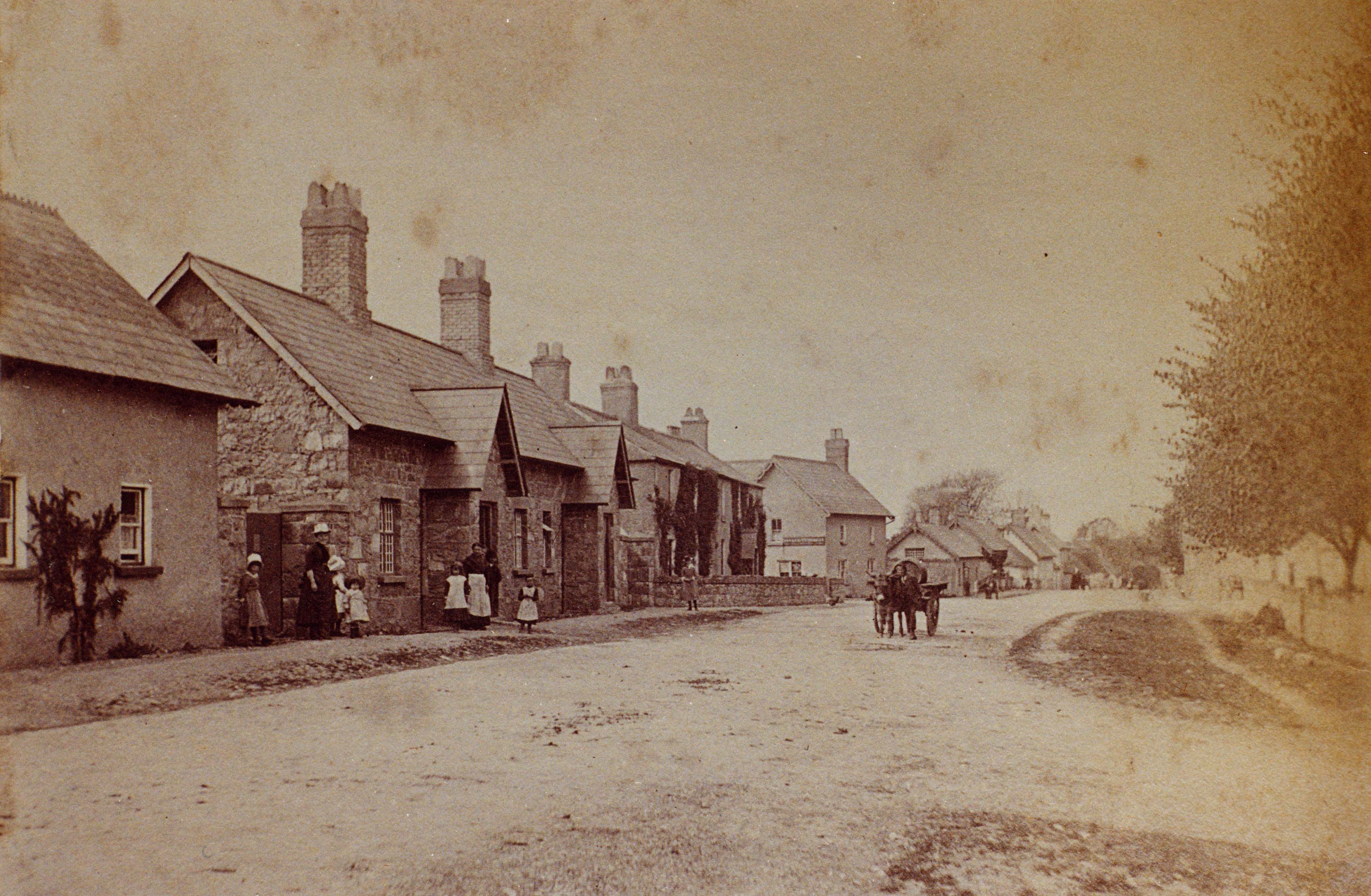
Geashill Village, courtesy Offaly History Archives
In June of 1857, William Steuart Trench and his son, Thomas Weldon Trench, set off in a horse and cart from Tullamore, King’s County and spent three weeks surveying the near 31,000 acre estate of Edward St Vincent Digby, 9th Baron Digby. Lord Digby, resident in Dorset, had appointed W.S. Trench as land agent on his Geashill estate with a view to improving its financial viability. Trench had a great reputation as an ‘improving’ land agent and also worked for the Shirley and Bath estates in Monaghan and the Lansdowne estate in Kerry. To ease his workload, and much the same as employing his other son, John Townsend Trench as agent in Kenmare, W.S. appointed Thomas as resident agent in Geashill, living as all Lord Digby’s agents before and after had lived, in Geashill Castle.
Between 1857 and 1872, the Trenchs transformed Digby’s landholding from a large, boggy and uncultivated midlands estate into a well-ordered and agriculturally productive estate with tidy and well-kept villages, the design of the latter winning numerous awards from the Royal Agricultural Society of Ireland. This was a huge achievement and certainly an improvement on housing conditions for the tenantry but the methods employed by the Trenchs to achieve their aims were controversial to say the least and the folk-memory of the Trenchs as tyrants persists to the present day. Large clearances of squatters from their ‘mud-hovels’ took place, leases were cancelled and rearranged, small holdings were merged into larger, more productive holdings, less productive tenants were encouraged to emigrate where possible and agitators were forcefully ejected.


 offalyhistoryblog