It’s almost exactly 50 years since I had the great privilege of studying the geology of Slieve Bloom as a postgraduate student in Trinity College. For over 4 years after that my job was to reach into every corner of the mountains where rock might have poked through to the surface, and then bring together the clues these pieces, of the jigsaw that told the story of the formation and subsequent history of the mountains, to form a more or less coherent picture.
But I soon began to understand two things. First of all, that in looking at the rocks I was seeing less than half of the story; even if I included the flora and fauna they supported. The other half was the human story. Slieve Bloom is what its people have made it down all the centuries, and a parallel investigation is required to assemble all the pieces of this jigsaw together into a coherent story, and then place it over the first jigsaw. And then you begin to see how they are really two sides of the same coin.
And then, at the end of the four years, as some of you will know, I wrote a book about it.
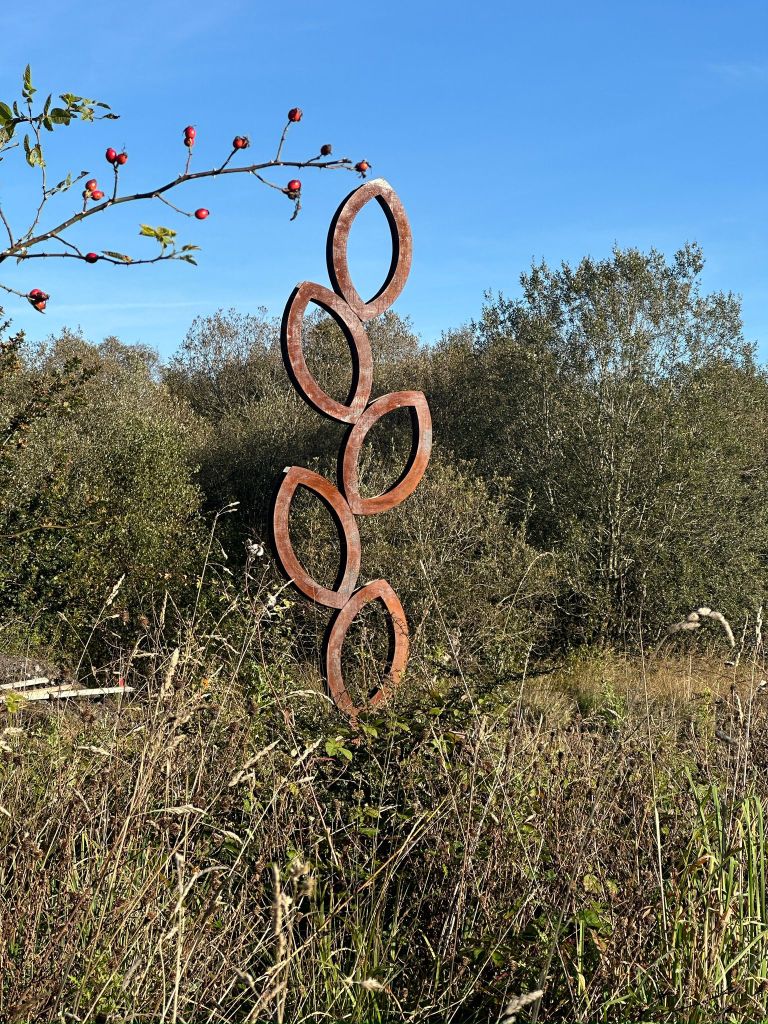
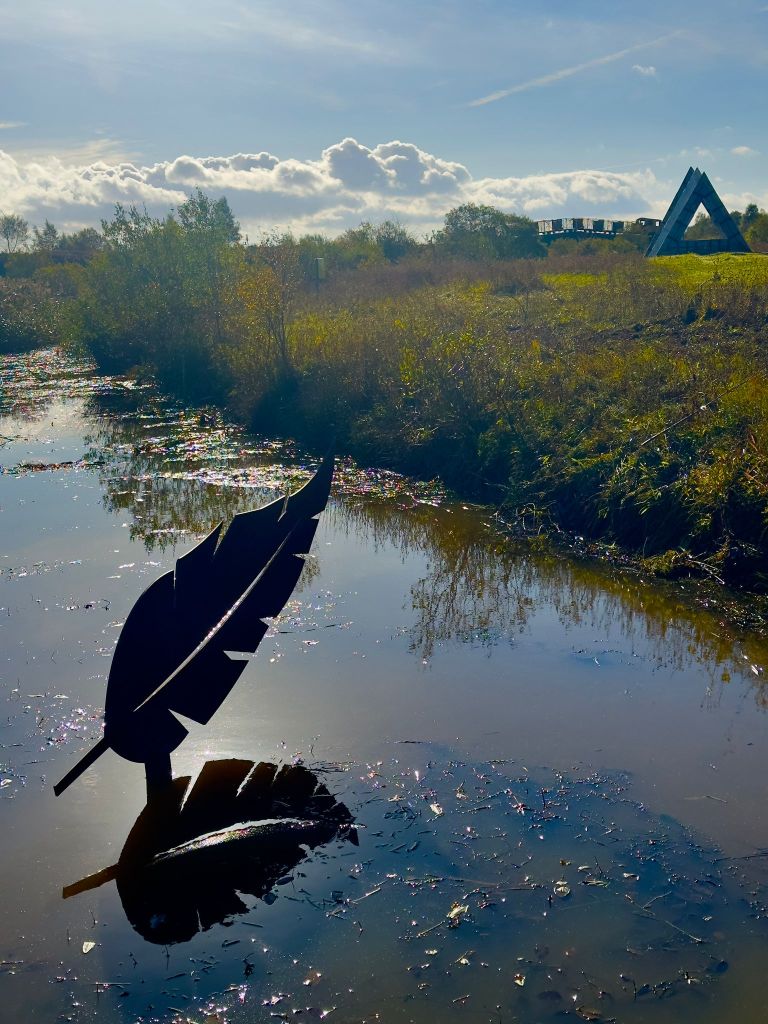
Two new sculptural works by artist Kevin O’Dwyer have been officially launched at Lough Boora Discovery Park, marking the first major additions to the park’s sculpture collection in over a decade. The works, titled Regeneration and Light as a Feather, reflect the park’s evolving story of transformation from industrial peatlands to a landscape of ecological restoration, culture and public enjoyment.
Regeneration draws inspiration from the seed as a symbol of renewal, growth, and cyclical change. Rising vertically from the ground, the work acknowledges the industrial history of the site while pointing toward its continued regeneration.
Light as a Feather offers a contrasting visual language — a suspended, airy form that engages with space, balance, stillness and the quiet expansiveness of Boora’s open horizon.
“Lough Boora is a place shaped by change, resilience and imagination,” said Kevin O’Dwyer. “These works are rooted in the landscape’s capacity to hold memory while continually becoming something new. O’Dwyer says it has been an honour to contribute to this next chapter in the park’s cultural and environmental renewal.”
News of a temporary exhibition at NLI Kildare Street, Dublin for February only
A new temporary exhibition at the National Library of Ireland explores the history of the Irish Bogs Commission and how its 19th-century maps are now shaping the future of Ireland’s peatlands.
Peatlands are among the world’s most vital carbon stores and play a crucial role in climate regulation. But when they’re drained, they lose their carbon sink potential and unique biodiversity and contribute to climate change. In Ireland, peatland drainage for agriculture and industry has shaped the landscape for centuries. Now, as part of national efforts to combat climate change, restoration of these ecosystems is a top priority.
Friday 9am to 5pm – Discover Birr Castle Demesne by taking on the engineering trail through the gardens and science centre.
Friday 7pm – Welcome reception with tea and sandwiches followed by opening lecture(1) – 8pm. Note: All lectures in Birr Theatre and Arts Centre
8.00pm Lady Alicia Clements – Introduction to the Engineering Weekend Festival
8.15pm John Burgess – The Parsons Families of the 19th Century
Saturday – 10.00am Lecture (2) – Power on Land
Brian Leddin TD – Chair of the Joint Oireachtas Committee on Climate Action – Welcome and Opening Remarks
Geoff Horseman (Formerly Head of Turbine-Generator Engineering at Parsons and Chief Turbine Engineer at Siemens Newcastle-Upon-Tyne) – Evolution of the Parsons Land Steam Turbine
Saturday – 11.30am guided discovery tour in Birr Castle Gardens to visit (Please note to wear non-slip footwear and outdoor gear for walking on garden trails):
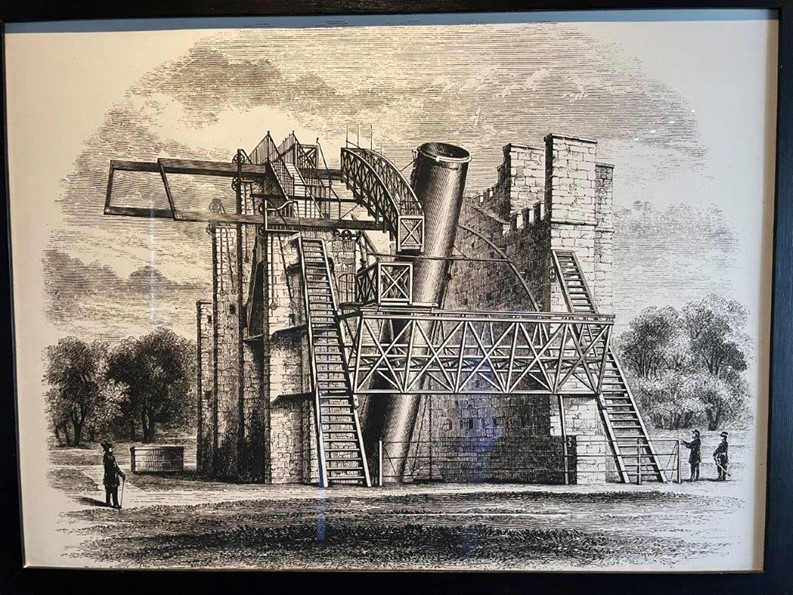
The Leviathan and LOFAR Telescopes – Peter Gallagher or Joe McCauley
The refurbished suspension bridge,
Rejuvenated hydro-electric turbine, and
The secret of the lake’s ingenious water level management system.
Saturday – 1.15pm Lunch at the Kellys Bar
Saturday – 2.30pm Lecture (3) – Power at Sea
2.30pm Ian Whitehead – Turbinia – a daring venture in marine propulsion
3.00pm Geoff Horseman – Engines of the First Giant Turbine Passenger Liners
4.00pm Jody Power – Marine Propulsion Steam Turbines – A Personal Journey
A recess of 2 hours from 4.30pm to regroup at 6.30pm in John’s Hall
Saturday – 6.30 pm Exhibition in John’s Hall, Birr.
8.00 pm Dinner in Doolys Hotel
Sunday – 10am – Lecture (4) – Power to Change
10.00am – Benita Stoney – The Stoney family collaboration and achievements
10.45am – Una O’Grady – Renewable Energy in the Midlands – Wind, Water and Stars
11.30am – Stephen Grant – Engineering at a time of change – 21st to 19th Centuries parallels to inform a paradigm shift in addressing climate change
Banagher, County Offaly has associations with two well-known writers of the nineteenth century – Anthony Trollope and Charlotte Bronte. Up to recent years nothing by way of notice of this was to be found in Banagher, but that has all changed as Banagher, now hard pressed along its main street, looks again to embrace tourism in a way that it did so well in the late nineteenth century and in the 1960s. The plans for the former hotel at Banagher will do much for the promotion of the architectural heritage of the town as did the voluntary work by the co-operative at Crank House. Pope Hennessey’s description in 1971 of Banagher in September would be music to Failte Ireland anxious as they are to extend the holiday season. He wrote:
‘The month of September in Banagher, and all along the Shannon banks, is visually a glorious one, with golden autumn mornings, the low sun making long shadows of the houses in the street. At dusk the whole river reflects the varied sunsets as the days draw in – effects of palest pink, for instance, striped by cloudy lines of green, or an horizon aflame with scarlet and orange light.’ And
The bridge at Banagher affords a splendid view over the level reaches of the river, which here flows glassily between a countryside as flat as that in some Dutch picture. In winter-time the flooded river spreads across these meadows to create an inland sea. In spring and early summer kingcups bloom amongst the sedge and reeds along the Shannon’s bank, wild yellow irises abound and cowslips also. In early summer, too, plumes of mauve and purple lilacs hang over the white walls of the yards of Banagher, and the whole countryside beyond the town displays brilliant variations of the “forty shades of green”.
Many have tackled Trollope’s life, but none immersed himself so much in Banagher as the late James Pope Hennessy.
John McCourt in his 2015 study of Trollope Writing the Frontier: Anthony Trollope between Britain and Ireland ‘offers an in-depth exploration of Trollope’s time in Ireland as a rising Post Office official, contextualising his considerable output of Irish novels and short stories and his ongoing interest in the country, its people, and its always complicated relationship with Britain’.
Last week we looked at the history of steamers on the Shannon. Today we take the account of Henry D. Inglis published in 1835. Inglis was a professional travel writer and author of Spain in 1830, A Journey through Norway etc, published his A Journey throughout Ireland during the Spring, Summer and Autumn of 1834 in London in 1835. His account is well thought of and in his concluding remarks he says why jest or narrate the curious and witty eccentricities of Irish character when ‘God knows there is little real cause for jocularity, in treating of the condition of a starving people.’ So there was a degree of sympathy rather than of superiority.
Inglis was born in Edinburgh and was the only son of a Scottish lawyer. His Irish travels volume was published the year of his death, (first edition, 1835, fourth edition 1836). While considered a ‘fairly benevolent interpreter’ he could find no explanation for the Irish situation other than defects of character.
Inglis spent a week there and also visited Killaloe, Portumna and Banagher. He went from Banagher to Athlone by road and thought the latter was a remarkably ugly town – but not withstanding an interesting and excellent business town. He spent a week in Athlone and used it as a base for touring in the county of Longford to see Goldsmith’s Country.
With the construction of the Grand Canal from the late 1750s, brought with it the expansion of Trade. goods could be carried from East to West along the line, this helped boost the development of the local economy from the late 18th century. The Offaly section of the canal runs approximately 42 miles and is home to a number of species and wild plants, due to the cross over through wet bog land during the development of the canal way[1].
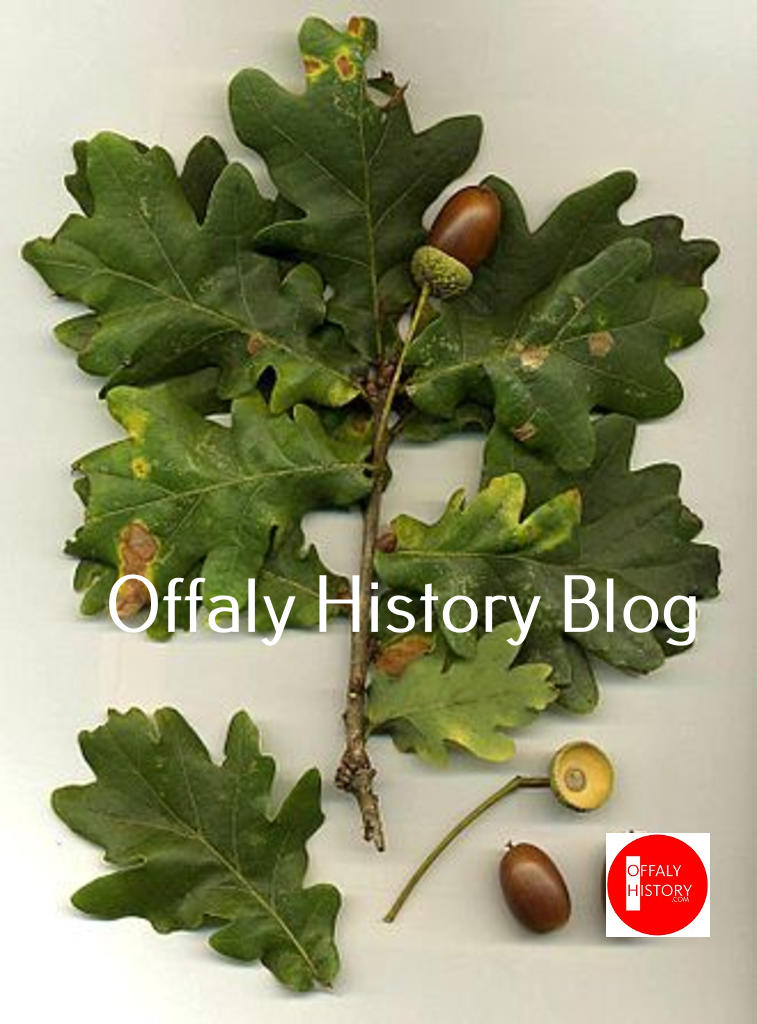
The first townland we come to along this way is Derries. It is situated in the Electoral Division of Ferbane, in the Civil Parish of Wheery or Killagally, in the Barony of Garrycastle, in the County of Offaly. The Irish name for Derries is Na Doirí meaning The Oak Woods.
Derries townland map. Image Source: Townlands.ie / Illustrations Nature on Irish Canals by Paul Francis
Wheery or Killagally is a large civil parish and it extends about 7 miles from Pollagh Village.
Rahan, Civil Parish is situated in the ancient O’Molloy territory of Fear Ceall meaning Men of the Woods or Men of the Churches. It is bounded on its north west side by the Brosna River. Its bedrock is Limestone and it has deposits of brick and clay along the Grand Canal.
The townlands from Ballydrohid, Tullamore to CornalaurBallindrinan Townland/ Image Source Townlands.ie
Its best know archaeological site is the Rahan Monastic Centre which was an area of great importance in the early Christian Period.
Townland: Ballindrinan is in the Electoral Division of Rahan, in Civil Parish of Rahan, in the Barony of Ballycowan, in the County of Offaly.
The Irish name for Ballindrinan is Baile an Draighneáin meaning land of the blackthorns.
Frank Mitchell (1912–97) was a distinguished but unassuming academic, environmental historian, archaeologist and geologist. While he had many academic writings his best known book was The Irish Landscape (1976) about which he was typically modest. In 1990 Mitchell published ‘a semi-autobiography’ The way that I followed. The title was a play on Robert Lloyd Praeger’s, The way that I went (Dublin, 1937). Praeger in his peregrinations was less kind to Laois and Offaly than Mitchell with Praeger’s observation that neither county need detain us long (p. 235) and ‘there is not much of special interest’ (p. 237). Westmeath he found to be more hospitable than Offaly having less than half of the amount of bog in Offaly and more pasture. We may look at the Praeger account in another blog
Kilgortin is in the Electoral Division of Rahan, in Civil Parish of Rahan, this parish is situated in the ancient O’Molloy territory of Fear Ceall meaning the mem of the woods or men of the churches. If you look closely along the line in this area you will see deposits of brick clays along the Grand Canal between Ballycowan and Rahan, this was the source of an energetic brick industry in the past. In this part of Rahan you will find the site of Rahan Monastic Centre, this is the most famous archaeological site in this location. It was a very important aspect of Early Christian period.