This week we look at the background to the Vallancey report on the Offaly towns carried out in 1771 to facilitate the construction of the new Grand Canal line from Dublin to the Shannon. Vallancey was then a young engineer, employed to report to the Commissioners of Inland Navigation and his findings were published in a little known and very scarce pamphlet, AReport on the Grand Canal or Southern Line (Dublin 1771).[2] This report is useful as a window on some of the north King’s County (hereafter generally referred to as Offaly) towns and villages and all the more so because of the scarcity of published accounts of the midland towns prior to 1800.[3] The report was published in the same year as that of John Trail who was at the time employed by Dublin Corporation.[4] Vallancey was writing with a mission. He was being paid to spin the story of the benefits that would come from inland navigation and to highlight the difficulties with road transport and its adverse impact on competition and pricing of commodities so as to bolster the arguments in favour of canal construction and satisfy those who were paying his consultancy fees.
Why not contribute to our series of blog articles on the Grand Canal in Offaly – info@offalyhistory.com.
There is a popular saying in politics sometimes attributed to Ronald Reagan ‘When you’re explaining, you’re losing
History often involves explaining, but in recent times I’ve regularly watched people’s eyes glaze over as I described my latest research project.
Q: What’s it called.
A: ‘A Revolution in Profiles’.
Q: What’s it about.
A: Its about Offaly in the Revolutionary Decade.
Q: Okay. How many words in it?
A: Over 60,000, but it’s divided into profiles, each about 600 words long
Q: Is it a book?
A: No, it’s a website with over 100 different profiles of people from the period.
Q: So, it’s a blog?
A: Not really, it’s modelled on the RIA’s Dictionary of Biography.
Q: How much are you charging for It?
A: No, there’s no charge. Access is completely free. The RIA provided a bursary to build the website as part of the Decade of Centenaries programme, but anyone can view the profiles and there’s no fee.
At this stage the questioner runs the entire gamut of emotions from confusion, disbelief, pity and finally suspicion. ‘If its free there must be a catch’.
If we’re lucky the conversation shifts to the height of the Shannon or which senior clubs are still looking for a hurling manager, if not it peters out into a prolonged awkward silence.
‘I’ll tell what it’s not’
The site is not a definitive history of Offaly in the revolutionary period. That will come later, written by others more qualified to do so. It is a reference tool designed to educate on and simulate interest in Offaly’s revolutionary story. In time perhaps it may provide other researchers with a foundation from which a deeper understanding of the era might be developed. One of the ways it aims to do so is providing readers with the opportunity to compare and contrast different people from the period.
Don’t tell, show me!
Mark Twain reportedly once said ‘Don’t just say the old lady screamed. Bring her on and let her scream!’ Having struggled to explain the site, I usually take a leaf out of Twains book an give an example. Offaly History have been kind enough to host two profiles from the site dealing two elected officials.
The People’s Choice
Between 1918 until 1923 the constituencies of Kings County and Laois-Offaly were represented by Dr. Patrick McCartan. A leading member of the Irish Republican Brotherhood from Tyrone; McCartan spent most of those years on diplomatic missions to the United States and the Soviet Union.
Meanwhile Hugh Mahon from Killurn outside Tullamore sat as a Labor representative in the Australian Parliament until his expulsion in 1920. His ejection was carried out in response to Mahon’s public condemnation of the British Empire in the aftermath of the death of Terence MacSwiney on hunger strike in Brixton prison.
Mahon and McCartan’s biographies are among 30 extra profiles which will be added to the site over the next year, but for now the focus centres on two other parliamentary representatives from Offaly, representing two different traditions. Frank Bulfin and Sir Robert Woods.
Frank Bulfin
Frank Bulfin was born in 1874 at Derrinlough, where his parents William and Ellen Bulfin (nee Grogan) owned a large farm.
His uncle Patrick Bulfin acted as Lord Mayor of Dublin and a cousin General Edward. S. Bulfin served with distinction in the British Army during the Boer and Great Wars. In 1900 it was reported that Frank’s brother, J.V. Bulfin had died while serving with the Rimington Guides in the Boer War. Frank and his brother Joe (who was later associated with Clonony and Edenderry) were keen agriculturists. During the Ranch War both men were vocal advocates for small farmers and imprisoned for their involvement in cattle driving.
Frank’s uncle Fr. Vincent Grogan served as provincial of the Passionist order in Argentina. The South American connection was to have important ramifications for the family, as Frank’s older brother William emigrated to Argentina where he enjoyed considerable success and eventually became owner of the Southern Cross newspaper. On his return to Ireland, William Bulfin helped to stabilise the Derrinlough farms finances, wrote a popular nationalist travel book Rambles in Erin, promoted the Gaelic League and political movements of his friend Arthur Griffith. William died aged 45 in 1910.
William’s son Eamon attended St Enda’s school and fought under his former teacher Patrick Pearse in 1916 Rising.
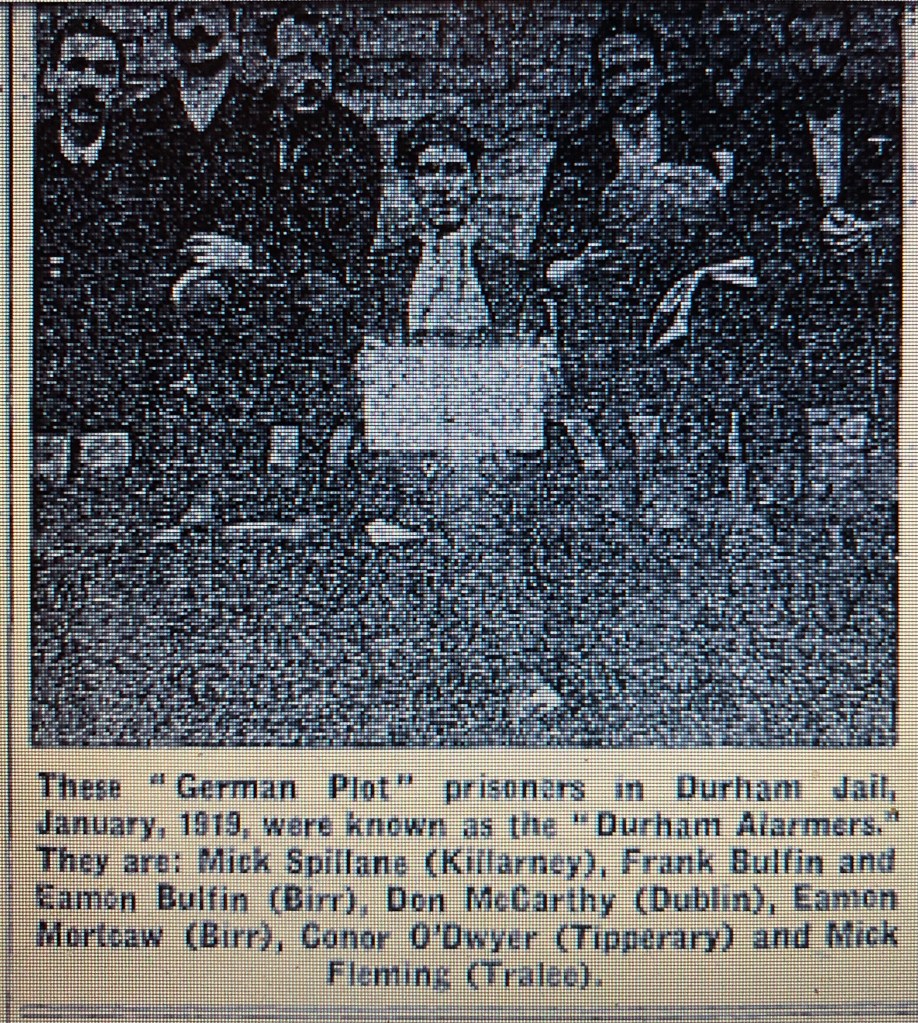
Following the release of republican prisoners from internment in late 1916, Eamon and Frank were involved in establishing the republican movement in south Offaly. They were arrested as part of the German Plot in the Summer of 1918 and imprisoned in Durham Gaol. Eamon was later deported to Argentina where he acted as an emissary for the republic during the War of Independence.
On his release from prison Frank Bulfin returned to Derrinlough, where he was involved in sheltering Sean Treacy, Seamus Robinson, Sean Hogan and Dan Breen during the summer of 1920. The so called ‘Big Four’ were on the run following shootings at Soloheadbeg and Knocklong.
Nominated as one of four Sinn Féin candidates, Bulfin was elected unopposed in the Laois-Offaly constituency at the 1921 general election. Arrested and interned at the Curragh, he was released with other TDs in August following the arrangement of the Truce.
Bulfin did not take a high-profile stance during the Treaty Debates but voted to accept the agreement. He was re-elected in the pact election. His nephew Eamon opposed the treaty but took no part in the Civil War following his return from South America and Frank’s niece, Catalina ‘Kid’ Bulfin a member of Cumman na mBan went on to marry well known anti-treaty republican Sean MacBride.
In August of 1922, Frank Bulfin was one of the pall bearers who carried Arthur Griffith’s coffin.
Although he rarely spoke in the Dáil, Bulfin continued to vote with the Cosgrave Government throughout the Civil War. In a statement to the Bureau of Military History Ernest Blythe suggested that because of republican intimidation, Bulfin attempted to resign his seat, but after the intercession of armed Free State Intelligence officers was convinced…
‘It might be more dangerous to resign from the dail than stay in it’. (1)
The veracity of Blythe’s story is difficult to authenticate.
Addressing an election meeting in July 1923 Bulfin commented…
‘Many unpleasant things we have had to do —many very distasteful decisions had to bemade, but we never sought popularity at the expense of the real interests of the nation’. (2)
After his re-election, rifts appeared in Cumann na nGaedheal. Bulfin did not support the Army Munity of 1924. Nevertheless, he was understanding of those who left the party at that time to establish the National Group and critical of some in the cabinet whom he felt were self-important and drifting too far from the party’s roots in Sinn Féin commenting …
‘Let these people not get their heads swelled. Greater men than they, Griffith and Collins, had to be done without.’ (3)
At local level his electoral machine was considered ineffective, and he lost his seat in 1927.
In the 1930’s Bulfin moved to Barrysbrook, Croghan close to his mother’s birthplace and farmed there until his death in 1951. He was buried at Rhode cemetery.
Sir Robert Henry Woods
Robert Henry Woods was born at Tullamore in 1865. His father Christopher and mother Dorothea (Lowe) operated a shop and held property in the town.
Sir Robert Woods
Educated at Wesley College and Trinity, he qualified as a doctor. An expert on the ear, nose and throat; Woods was considered a world leading physician. President of the Royal College of Surgeons he was knighted for his services to medicine in 1913.
His son Thornley died in 1916 while serving with British Army in Flanders.
In 1918 general election Woods was elected to Westminster for the National University constituency, a seat held until 1917 by Edward Carson.
Elected as an Independent Unionist, Woods was a moderate in personality and politics. He did not take up his seat at the first meeting of the Dail in January 1919. However, unlike other unionist MPs he did send a formal reply to decline his invitation to attend.
In July 1921 he was part of a delegation of southern Unionists who met with Eamon de Valera in the Mansion House Conference which facilitated the announcement of the Truce.
A rare contributor at Westminster, he made his last speech there in the aftermath of the signing of the Treaty when he told the House of Commons…
‘I hope the Prime Minister will permit me to offer him my congratulations on having brought this Conference to so successful a conclusion. If I may say so without offence, he has done a big thing, and he has done it in a big way. The Unionists in the South of Ireland have received the news of this agreement with feelings of satisfaction that can only be appreciated by those who have lived there in recent years, and perhaps by those who have got imagination to visualise what would have happened had these negotiations fallen through. I think I am correct in saying that the majority of Southern Unionists have for a long time seen that there was no other possibility of settlement of the age-long struggle, and the healing of this Irish sore, except through a Conference… I believe that the end of this Agreement will be an accession of strength, not only to Ireland herself, but to the peace and the prosperity of the world at large, and particularly of that great community of nations of which Ireland will, in the future, herself form an integral part.’ (4)
His last political intervention was an unsuccessful run for the Senate in 1925.
A collector of antique furniture, he was also musical enthusiast, president of the Dublin Zoological Society he donated several animals to the Zoo following trips to Asia.
Robert Woods died at his home in Marino in September 1938 and was buried at Deansgrange Cemetery. At his own request the funeral service was private and attended only by his immediate family and household staff.
On his death the Irish Independent commented…
‘Although a Unionist, his liberal and free-minded attitude on all Irish questions was very marked. Rather abrupt and unconventional in manner, the late Sir Robert was a man with a big heart. He was charming in private conversation and his humour was never hurtful, while his wit was always kind. He was extremely popular with his professional colleagues and was ever helpful to the young men attending’ his school. Physically a splendid type of Irishman, he was a familiar figure in Dublin, his broad shoulders, well-shaped head and rugged- features arresting attention.’ (5)
The square proper never had a public house until that in GV 5 in recent times, while the Brewery Tap on the western side at GV 3 High Street has served the public for well over 100 years. It was only in 2018 that a new public house and night club was opened at GV 5, now known as The Phoenix. The great garage of G.N. Walshe (GV 1 High Street) replaced the Goodbody hardware store which was in business from the 1840s to 1930 and with a tobacco factory at the rear until 1886.
In 1961 I joined B. Daly & Co Ltd and two years later SI was transferred to Irish Mist (another wholly owned Williams company) to supervise the production line in the Bond Store. I joined up with Joe Scally, and I was still with him until I finished in 1985 over 22 years later. Joe and I were always involved in Production. We overcame many difficulties in the area over the years due to expansion and increased demand for output, with changes in packaging and design etc. I started on the middle floor of the Bond Store. We shared the building with Tullamore Dew. We had a staff of about 12 at the time, with no machinery as the output was small. Within a short time later, in 1966 due to increased demand, we had to move to the top floor. We became much more mechanised and we saw a dramatic increase in output, and also a big increase in staff numbers. We also saw the introduction of the Figurine, Blue decanter, the pocket Flask, the Waterford Glass decanter, and many more display packs, introduced onto the market. In 1966 a new office block was built, along with a new laboratory and a compounding unit.
Commerce, community, and creativity are all part of the weave.
Golden, sophisticated, with a dash of mystery Irish Mist occupies a special place in the history of Irish distilling.
Ireland’s legendary liqueur might well be described as the accidental offspring of Tullamore Dew.
First produced in 1947 in response to the urgent need to make economic use of excess stock of whiskey it proved to be an inspired idea by Desmond Williams, grandson of the founder of the Tullamore Dew whiskey company.
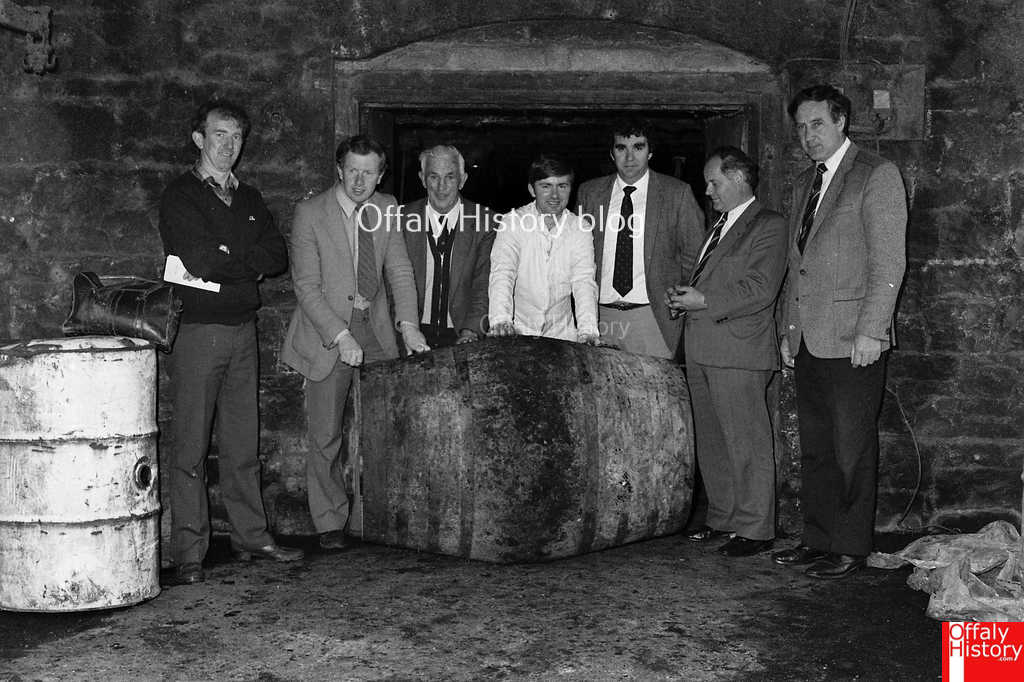
Rolling out the barrell – the last whiskey is the famous Sally Grove warehouse in Water Lane – now called Main Street with Irish Mist staff and the officers of the Excise in 1983.
The history of Irish Mist involves a secret receipt from a mysterious Austrian distiller, celebrated through the famed ceramic figure made by Coronetti, Cunardo, Italy.
Now a collector’s item the splendid figurine is a replica of an Irish officer in the Austrian army from the 1750s.
In the first half of the nineteenth century all of the original buildings in O’Connor Square were three-storey with the exception of the market house and the house where PTSB is now located (GV 8). The finest house was that of Pim/Wilson (GV 7) of c. 1740–48 (demolished 1936) and not unlike the fine houses in the square of the Quaker settlement of Mountmellick where the Pims and Wilsons would have had connections.
So far we have looked at the 1821 and 1901 censuses for Castle Street, Birr together with traders in the street in the nineteenth century (see previous articles by going to the blog section on http://www.offalyhistory.com.) There were a lot of new families in Castle Street in 1911 when compared with 1901 based on the surname of the occupiers – not always a reliable guide. Families where there was continuity included that of John Wall, James Sammon, Patrick Connors, Laurence Kennedy, Owen Gaffney and Elizabeth Watterson.
On several walking tours of High Street, Tullamore in 2023 what stuck one was how good the architecture is, the plan of the street, how much has survived, and the extent of reforms and repairs needed to houses that have become dilapidated. This article is about no. 29 High Street, the former Motor Works, and a dwelling or manse for the Presbyterian minister for over thirty years from the early 1900s. The number 29 is derived from that in the first printed Griffith Valuation of 1854.
The former Motor Works, 29 High Street, Tullamore. The signage has now been removed. If the shop fronts were removed, walled area restored and sash windows inserted etc etc.Lived in and looking well will be a good compromise in these times when so many fine town houses are strugglingfor life.The garden once ran to Moore Hall and behind it. The two houses to the left were also built on this generous leasehold. But then what would you not do for your doctor?
No 29 is the first house on the upper east side of High Street and occupies an important visual position when seen from Cormac Street and in the distance from the old road as one walks out of Charleville Demesne. The house is of five bays and three storeys, and has ‘gable-ends with rough cast battered walls and a high pitched, sprocketed roof. The windows are small and have a good rhythm which slows towards the centre. However, they have lost their original glazing-bars. The house has a simple round-headed, architraved doorcase which is probably later in date. (Garner, 1980).
The 1901 census noted twenty-seven buildings in Castle Street, Birr (five less than in 1821, see our recent blog) of which six were unoccupied commercial properties, eight were shops including two public houses, four were boarding and lodging houses, and ten were private dwellings. Women were ‘head’ of house in six of the twenty-one dwellings. There was only one ‘dwelling’ where there was no more than one occupant and the largest household was thirteen. Only one house was divided between two families. Almost all those with stated occupations in the head of house category were in shops and craft industries with the exception of a bank porter, a retired teacher, and an Ordnance Survey employee. The latter family was Anglican as was Mrs Ellen Morahan and all other residents on the street were Roman Catholic. In 1821 perhaps up to one-third of the residents were other than Roman Catholic. The other significant change was the almost entire absence of domestic servants in 1901 and in 1911. This is a longish blog to accommodate the 1901 census. Next week we look at the street in 1911. If you have material to pass on email us info@offalyhistory.com.
In 2022, Barry Wrafter, sculptor and architectural stone carver, was interviewed about his work on Clare FM local radio. Among other things, he talked about the value of using traditional methods and skills in working with stone. Barry is the latest in a long line of Wrafters who have made their living by working with stone. The Wrafter involvement in quarrying and stonecutting in Ballyduff and Tullamore goes back almost certainly to the 18th century which means that the Wrafter name and its association with stonecutting has spanned four centuries.
I have identified three distinct branches of the Wrafter family that were involved in quarrying, stonecutting, and stone carving. In this article, I look more closely at one of these families. The other two branches will be dealt with in a separate article.
In earlier blogs for Offaly History (March 19 and April 20, 2022) I mentioned my great-great-grandfather John Wrafter (b 1794) and his role as sculptor in the building of the county gaol in Tullamore, in 1826. I mentioned his involvement in the making of the windows of the Catholic church in Birr in 1842, and the windows of St Laurance O’Toole church in the centre of Dublin in 1848. John was also contracted to build the workhouse in Tullamore in 1841. I also touched on his son John (b 1828) who, among other things, provided chiselled stone from Ballyduff qurries for a Presbyterian church in Mountmellick. Below I take a closer look at their involvement in stonecutting and the Ballyduff quarries.




 offalyhistoryblog