
If walls could talk and archives survived, what would we learn about GV no. 48 High Street, Tullamore. A lot over its 275-year history so far. The number in the first printed valuation map of 1854 was no. 48. It is convenient to use this as the street was built by 1820, except for the Presbyterian church of 1865.
O’Connor Square and High Street were the principal streets in Tullamore from the 1740s to the 1960s. Charles Moore, the second Lord Tullamore, and from 1757 to his death in 1764 earl of Charleville, gave leases for substantial houses in High Street and these included the former Motor Works, the Round House, Mr Price building and Colonel Crow’s (no GV 48).
Most of the surviving houses in High Street date from the 1740s to the first fifteen years of the 1800s. Yet there is evidence of the commencement of a street here from 1713 with the building of houses GV 1, 2 and 3, followed in the 1740s and 1750s by GV 4, (O’Connor Square west for our purposes, from Bridge Centre entrance to the G.N. Walshe shop) and GV 5 and 6 High Street (Conway and Kearney and Guy Clothing). Both the northern and southern ends of High Street face important open spaces: the northern end forms the west side of O’Connor Square, and the southern end broadens out to form a triangular open space at the junction of O’Moore Street and Cormac Street.
High Street has been known by its present name since the early 1700s. However, until the early-nineteenth century High Street also included what is now Bridge Street. The street is uniformly wide throughout even allowing for the fact that some of the houses had railed-in areas to the front. Most of these, but not all, were destroyed by the 1970s.
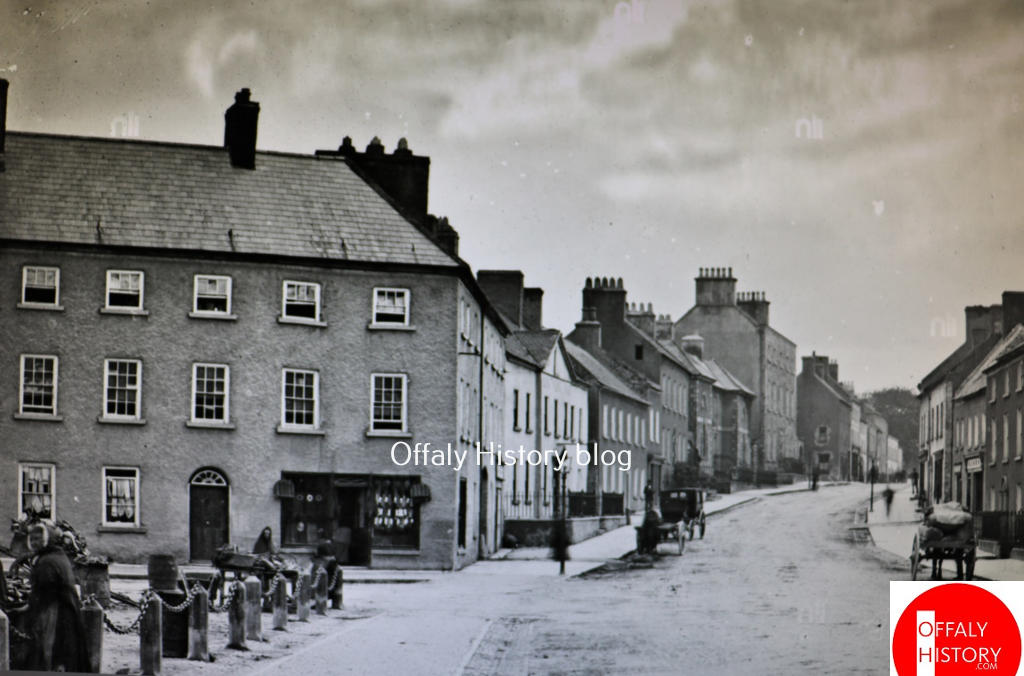
Col. Crow’s is a fine three-storey, seven-bay house with a Gibbsian door-case and open-bed pediment. The building, for many years known as Colton’s Hotel, has now two shopfronts and the original railings and low wall fronting the basement were removed in the mid-1970s.The building has lost its original glazing bars. From the early Lawrence photograph of c. 1900 we can see that a third storey was added soon after the existing hotel was purchased by Abraham Colton. It was then that a pediment to the roofline was removed and the third floor added. It was not so unusual to add a floor and there are examples of it in Columcille Street with Galvin’s and Dolan’s.
This house was built in 1750 for Colonel Thomas Crowe and survived intact until about 1974. Part of the large garden was used in the building of the Rose Lawn housing scheme in the late 1980s. The house to the south was demolished in 1940 to make way for the new Ritz Cinema, opened in 1946 and demolished in 1980. Roselawn of 21 houses was completed about 1990.
(more…)

 offalyhistoryblog