To conclude our Heritage Week series of talks online we want to tell you the illustrated talk New light on Irish county map-making in the early 19th century – tracings from William Larkin’s map of King’s County/ Offaly, c. 1808 has now been uploaded. You get a 30-minute introduction from the leading expert on the early maps of Offaly. This is followed by minute comparisons of the Larkin tracings for west Offaly with the published Larkin atlas of 1809. Dr Arnold Horner has prepared an in-depth lecture on map-making in King’s County in the early nineteenth century where he analyses the significance of the new map tracings attributed to William Larkin which were donated to Offaly Archives last year, and conserved by Liz D’arcy through Heritage Council funding. He particularly looks at features in the landscape around Birr, Banagher, and Ferbane.
With thanks to Offaly Archives last Tueday’s lecture (16 Aug. 2022) by Dr Arnold Horner is now online as are the maps which are recently conserved.
This is a new 20-minute video recording on the history of the Society, now better known as Offaly History with lots of interesting photos especially recorded for Heritage Week. We want to thank all who have contributed to making it so successful so far with activities across the county, and continuing until Sunday. The lecture on Larkin’s maps and their predecessors we shall post next week, also a video on the Durrow Pattern. Our next lecture is on 5 September on Michael Collins and is important. More information next week.
A PowerPoint presentation narrated by Michael Byrne explores the identities of Castle Street in Birr as part of a project to know and appreciate our distinctive town centres. This Streetscape project is in partnership with Offaly County Council and part funded by the Heritage Council.
An initiative promoted by the Heritage Council as part of its Streetscapes Project
Castle Street about 1857. Courtesy of Birr Castle Archives
The focus of this study is Castle Street in the town of Birr. The street comprises a mix of about thirty commercial and residential properties close to the Camcor river to the south, Main Street and the old parish church to the north, and to the west Birr Castle. On the east at the Market Place or Market Square it opened into Main Street, Bridge Street and from the 1880s into the new Brendan Street.
Castle Street about 1920.
The market house stood from the 1620s where the memorial to the Manchester Martyrs was placed in 1894. Surprisingly, when the market house was taken down in the late 1700s it was not replaced with a new building. Castle Street varied greatly in character from the strong residential houses of two and three-storeys to the robust commercial warehouses close to the boundary of the castle, attracted by the availability of water-power and facilitating in the 1800s the development of distilling, brewing and malting houses. Castle Street was also the principal marketplace in Birr with markets held each week and large fairs three or four times per year. There was a strong base in agri-business in the street and this in turn created businesses such as draperies and boots and shoemaking to cater for the farming clients from the prosperous hinterland. That Castle Street was intimately bound up with the rural economy is clear from the surviving early photographs of the 1900s and one of 1856–7. The early photograph is by Mary Rosse and is of a market day in Castle Street.[1] This would make it the earliest surviving photograph of a busy street in Offaly, as most others are not before 1890 or 1900.
Castle Street about 1970, courtesy Birr Castle Archives
[1] David Davison, Impressions of an Irish Countess: the photographs of Mary countess of Rosse, 1813-1888 (Birr, 1989).
Crotty’s Church, Castle Street
Click on the blue Offaly History Blog to open the video from an email
Exploring Castle Street, Birr: the buildings, business and people.
J. de Jean’ was the nom-de-plume of John Frazer (c. 1804–1852), a Presbyterian of Huguenot extraction, cabinet-maker and a native of Birr. As a young man he started writing poetry, and his first work – a lengthy poem entitled ‘Eva O’Connor’ was published in 1826 (Richard Milliken, Grafton Street, Dublin). During the 1840s individual poems, increasingly expressing radicalised politics, appeared in the newspapers and periodicals of the day, many of which were featured in his collected works `Poems For The People` 1845 and `Poems` 1851.
This online presentation is to promote the first complete edition of his poems, edited by Terry Moylan, Pádraig Turley and Laurel Grube, which will be published in October of this year. The society would like to thank Offaly County Council and Creative Ireland for support for this important publication.
A presentation of the Birr poet John Frazer (J. de Jean)
This weekend sees the start of Heritage Week 2022 and a very welcome return to exploring the county in person with some great material coming on-line too from Offaly History. We are launching six new videos via Offaly History YouTube and Heritage Week 2022. Our thanks to Amanda Pedlow, county heritage officer for all who work in coordinating the programme. She writes:
With over 30 events here is a reminder for Saturday’s events as a starter’…@offalyheritage @HeritageHubIRE Our thanks to Fergal MacCabe for the use of three of his wonderful watercolours of Srah Castle (1588), Ballycowan (1626) and Bury Bridge (1801).
Arthur Griffith died of a heart attack, or stroke, in Dublin on 12 August 1922. He was only 51 and had given a lifetime of service to his country at huge personal cost. To mark the centenary of his death we recall an important contribution from Richard Barry (1880–1978) in 1970 where he set out some of the cultural history of Tullamore in the period before the Rising and the War of Independence. Barry was greatly influenced by the writings of Arthur Griffith in the United Irishman and also by the earlier contributions of William Rooney (1873–1901). Rooney met Griffith probably in 1888 and both were members of the Parnellite Leinster Literary Society, and after 1892 of the Celtic Literary Society. When the United Irishman was launched in 1899, with Griffith as editor, William Rooney was the main contributor and, working together, developed Sinn Féin policy. Rooney’s early death at the age of 27 was a devasting blow to Griffith. William Murphy in the short life of Rooney in DIB cites Michael Collins as describing Rooney in terms normally associated with John the Baptist: ‘Rooney spoke as a prophet. He prepared the way and foresaw the victory’ (Path to freedom, 150).
This year’s That Beats Banagher Festival will take place over next weekend Friday to Sunday, 22 to 24 July with a multiplicity of literary, heritage, cultural and sporting events including a food and craft fair in the Bridge Barracks Yard at the West End on Saturday, 12 noon to 4.30 p.m. craft workshops, children’s events, water events, children’s outdoor cinema and other surprise events. We are a day early with the blog to help promote this interesting festival.
Book Launches
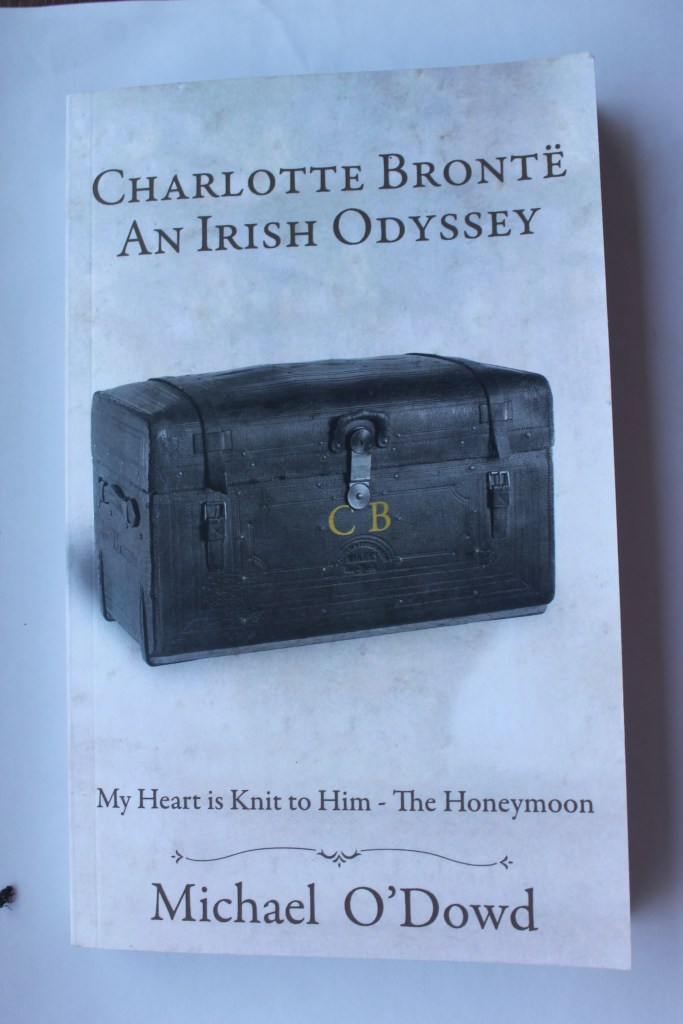
The programme is particularly strong on literary events with the launch of two books on Charlotte Brontë’s honeymoon in Ireland, the first called Arthur & Charlotte, by Pauline Clooney (published by Merdog) and the second, Charlotte Brontë: An Irish Odyssey by Michael O’ Dowd (published by Pardus Media). Pauline & Michael recently spoke with much acclaim at the prestigious Bradford Literary Festival under the title No Net Ensnares Me: Charlotte Brontë Abroad. The event will be held at 6.30 p.m. on Friday 22nd July in the Long Room in The Crank House.
Contributed by Offaly History to mark the Decade of Centenaries
We saw in previous articles in this series the lead up to the civil war notwithstanding the outcome of the general election in June in which the vote was substantially in favour of supporting the acceptance of the Anglo-Irish Treaty of December 1921. In Laois-Offaly all four pro-Treaty candidates were elected with Labour, who preferred to look at the social rather than the Treaty question securing almost fifty percent of the vote. But among the soldiers of the IRA, particularly in Offaly, there was a reluctance to accept the Treaty outcome. Some were of the view that the people would follow where the military led.
The burning of Tullamore courthouse, jail and the former military barracks (in Barrack Street, now Patrick Street) on 20 July 1922 was one of those momentous historic occasions the impact of which had an almost a numbing effect on the people of Tullamore and the county. The completion of these buildings in 1716, 1830 and 1835 were all major steps in the progress of Tullamore. Now all were destroyed in one night for no tangible military benefit by the departing Republican IRA.
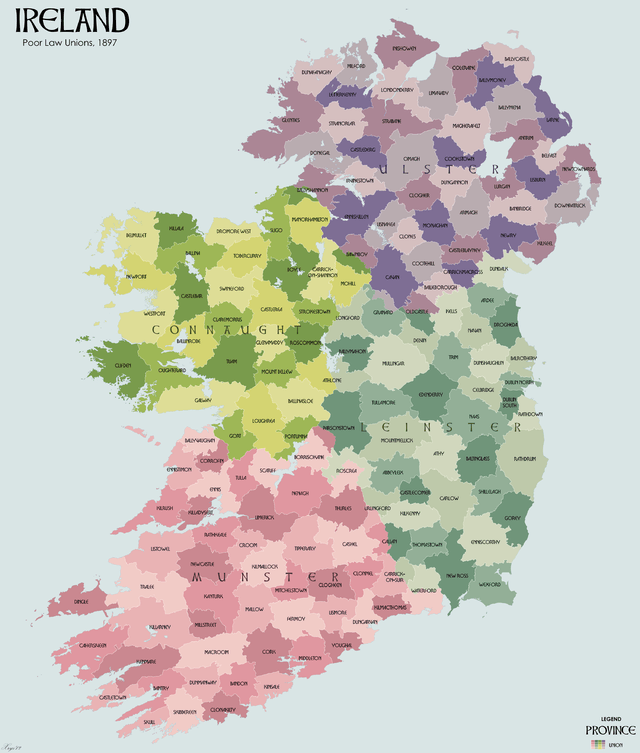
Since the early 18th century public healthcare in Ireland had been funded by voluntary donations. The first hospitals in Ireland were founded in the 1720s. The dispensary doctor was formally established by legislation in 1805 under an Act of Parliament. The amount from voluntary donations was matched by county grand juries from local taxation. The Poor Law Act of 1838 improved the distribution of dispensaries and divided Ireland into 130 administrative units known as Poor Law Unions, with their own workhouse, governed by the Poor Law Guardians, who were elected by the local rate payers.
The Poor law unions at the end of the nineteenth century. Courtesy Wiki Commons
The dispensary doctor became the mainstay of healthcare in rural Ireland as many people lived too far from medical help in workhouses. The position of the dispensaries was clarified in the 1851 Medical Charities Act, which introduced a state-funded dispensary system to provide free medical aid to the poor. These were to be funded from local taxation and were subsidised by the Poor Law Commission. To attend the dispensary, a person needed to have a colour-coded ticket, dispensed by the committee. The Poor Law Commission was replaced by the Local Government Board in 1872.
Today 14 July 2022 marks one of the most significant centenaries of the year in County Offaly, the burning of Birr Barracks in Crinkill. While the barracks started to go into decline towards the start of the twentieth century, it was still a vital provider of local trade. When the town council requested Lord Roberts station an infantry regiment in the barracks in 1897, local trade from the barracks was valued at £40,000 or around €3.5 million today. While not totally abandoned, troops were stationed in the barracks during the Second Boer War and during the WW1.
On duty at Birr Barracks about 1910
With the signing of the Anglo-Irish Treaty and the evacuation the barracks was handed over to the National Army, Commandant General Michael McCormack taking command of the barracks. The last of the British Army to leave had been a detachment of the Northamptonshire Regiment, which stayed to oversee an auction of government property, which ultimately never took place. The deport staff of the Leinster Regiment, had left several days before, bound for Colchester, which would act as the depot until the regiment was disbanded in June 1922.
Now in the hands of the National Army, the barracks was to act as the headquarters for the 3rd Southern Division. As the rift in the army occurred those in favour of the Anglo-Irish Treaty left the barracks leaving behind the anti-treaty forces, which sealed the faith of the barracks.




 offalyhistoryblog