
Diaries offer a fascinating glimpse into history through the personal accounts of people who lived through war, famine, disease, revolution and other events of huge social disruption. Along with contemporary correspondence, personal diaries help to flesh out the bare facts of history with human experience, where otherwise official records are the only historical source. Find out how you can help us to record the history of the 2020 Covid-19 pandemic in Offaly and join a long line of Offaly diarists who have shaped our understanding of the past. (more…)
Category: Archival collections
-
DRAYTON VILLA, CLARA: ‘a handsome residence, a good home neatly furnished’. By Michael Goodbody. Blog No 185, 4th April 2020
It was lately announced that Drayton Villa, Clara and some lands adjoining are to be acquired by Offaly County Council for public purposes. Offaly History asked Michael Goodbody to contribute this piece on the story of this important house. He is currently working on ‘One Hundred years of Clara History’ to be published later this year and from a preview we can say that it will represent an important contribution to the story of Clara from the 1840s to the 1940s. Thanks to Michael Goodbody for the article and the pictures. We have added the subheadings.

Drayton Villa (courtesy Stephen Williamson) Drayton Villa, built by Lewis Frederick Goodbody in the mid-nineteenth century, is largely untouched by more recent additions and alterations, so that many of its original features are intact. The main block of three bays, with a basement underneath, dates from 1849. There can be no disputing this date for it is recorded by Lydia Goodbody – future sister-in-law of Lewis – in her diary entries for that year.
-
From a hedge school in Cappincur to adventures in the American Civil War: the story of Peter Cavanagh. By Michael MacNamara. Blog No 180, 18th March 2020
Offaly Archives received a very interesting donation of manuscripts in recent times. Michael MacNamara, a native of Colehill and long-time resident of County Limerick, donated archives relating to his great grand-father, Peter Cavanagh, who was born in Cappincur in 1824 and ended up as a solider in the US army during the American Civil War. Before all those adventures, Peter undertook high level tuition from a Mr Patrick Glowry in a hedge-school arrangement through the famine years of 1844-1848. His copybook survived and is among the items donated to Offaly Archives. Michael MacNamara has spent many years researching Peter Cavanagh and summarised his unusual life and times for an interview in the Midland Tribune in 2005: (more…)
-
Workhouse orphan emigration, particularly those from Parsonstown (Birr). By Perry McIntyre. Blog No 172, 25 Jan 2020
Perry McIntyre is the Chair of the Great Irish Famine Commemoration Committee (Email: contact@irishfaminememorial.org. Website: www.irishfaminememorial.org).
On 4 May 2017 Offaly Historical and Archaeological Society archivist, Lisa Shortall, brought up the Parsonstown Union Letter Book [Reference OHS 71] for me to consult at Bury Quay. (This item is now available to consult at Offaly Archives). My interest was to see what clues may have been recorded about any of the 136 young women who left King’s County for Australia during 1848-1850 as part of the Famine emigration to Australia, now often referred to as ‘Earl Grey’s workhouse orphan scheme’. During these three years 4114 young women aged between 13 and 18 were selected as healthy, suitable domestic servants and potential marriage partners and they were given a free passage from Ireland to one of three Australian colonies: two in New South Wales (Sydney and Port Phillip) and Adelaide in South Australia. (more…)
-
Shackleton’s photographs of Tullamore and west Offaly in the 1890s. Michael Byrne. Blog No 162, 16th Nov 2019
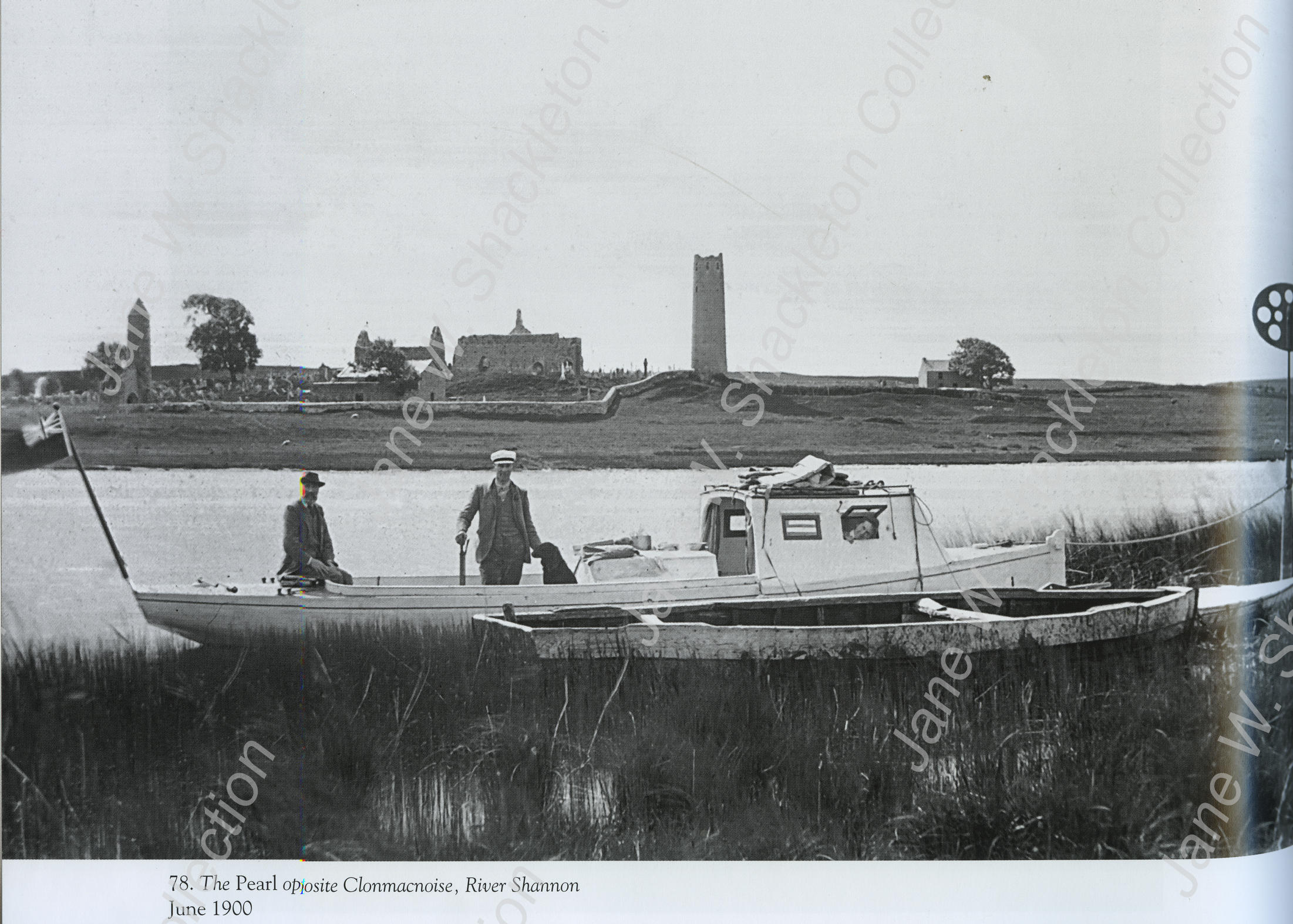
Jane W. Shackleton’s Ireland compiled by Christiaan Corlett (Cork, 2012) is an attractive large format publication from the growing stable of books issued by Collins Press and consists of 180 well produced photographs by Jane Shackleton. Jane Shackleton (nee Edmundson) was born in 1843 and in 1866 married Joseph Fisher Shackleton of the famous Ballitore, County Kildare family of Quakers. Thirteen Shackletons are included in Richard S. Harrison’s, Dictionary of Irish Quakers (second edition, Dublin, 2008) including Jane’s husband, Joseph Fisher Shackleton. Like his father he was a miller and in 1860 took over the Anna Liffey Mills in Lucan.
-
The Papers of St Stanislaus College, Tullabeg. By Damien Burke and Lisa Shortall. Blog No 126, 23rd March 2019
Offaly Archives is pleased to announce the publication of the catalogue of the Papers of St Stanislaus College, Tullabeg, the result of a collaboration with the Irish Jesuit Archives, Leeson St, Dublin, where the papers are permanently housed. This blog outlines the history of the college at Tullabeg, the scope of what is contained in the archives and how to access the online catalogue.
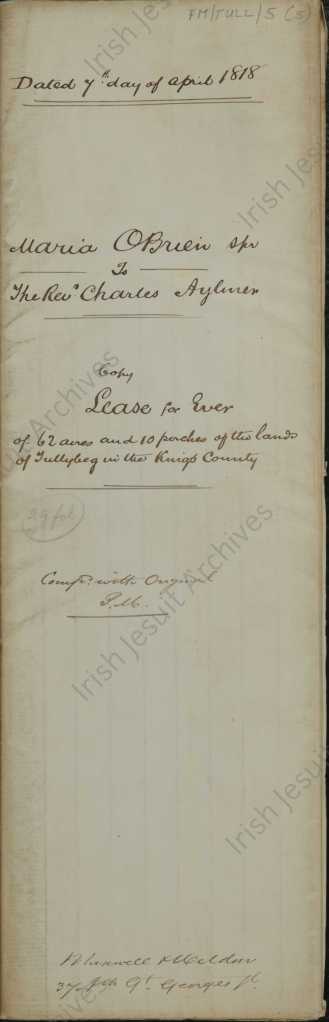
The Jesuit community at Tullabeg (St Stanislaus College), Offaly was established in 1818, four years after they were restored as an order. Tullabeg was initially intended to function as a novitiate (training centre for Irish Jesuits) and a suitable site was offered in 1815 by Ms Marie O’Brien (1765-1827), of Rahan Lodge. She had also helped the Presentation Sisters establish a convent nearby at Killina. When the Tullabeg building was complete, the idea of novitiate was abandoned and the new foundation served as a feeder school for Clongowes Wood College, Kildare. Tullabeg rarely counted more than forty pupils, all of them below early teens and the pace of life was unhurried. Drama, debates and sport (gravel football and cricket) were encouraged, and facilities followed. The appointment of Fr William Delany SJ (1835-1924) as rector, transformed the College educationally. Pupils were matriculated and examined successfully for BA degrees at the University of London, and later at the Jesuit-run University College, Dublin.
(more…)
-
John’s Place, Birr and Foley’s Memorial to the 3rd Earl of Rosse, by Michael Byrne. Blog No 49, 01 October 2017
Birr has been referred to as Umbilicus Hiberniae, the navel or centre of Ireland. For many years it was also known as Parsonstown taking that name from its then proprietors, the Parsons family, earls of Rosse. That it is the centre of Ireland is often disputed but few will deny the accuracy of yet another appellation that of the ‘model town’. The late and much loved Jim Dooly, who was chairman of the town council in the mid-1960s, appeared on a Frank Hall programme in 1971 to defend Birr’s claim. He was no lover of television as can be seen in his performance, now viewable on the Frank Hall Archive of RTE on Youtube (‘Dead Centre of Ireland’). (more…)
-
Rahan Looks Forward – a Creative Ireland collaboration. Blog No 48, 20 Sept 2017
Do you have interesting photographs relating to Rahan parish – place or people? Would you like to contribute to a growing archive of images from this area? Read on and see how you can help to visually document this important parish in Offaly.
(more…)
-
The Rosse Papers in Birr Castle Archives. Blog No 18, 25 February 2017.
The Muniments Room
The Muniments Room in Birr Castle is a special space. Based in the eastern flanker of the castle, it was once a smoking room and contained a much painted-over and practically hidden Jacobean plaster frieze, the oldest complete example of its kind in Ireland. In 1980, on inheriting the castle, the present Earl of Rosse, set about restoring the frieze to its former glory and applied for an Irish Georgian Society grant which allowed master stuccadore Séamus Ó hEocha to undertake the painstaking restoration work soon after. It was the first act of modern restoration work in the castle and its results were startling. (more…)
 offalyhistoryblog