
Church Street is unusual in Tullamore in that it does not have a common width throughout and its lower half, closest to the town centre, is clearly earlier than the upper half from the Methodist church to the Pound Bridge over Tullamore River. While the building pattern is now post 1786 in date it did have at least two earlier buildings in the Protestant church built by Mrs Ellen Moore in 1726. She was the mother of the first Lord Tullamore who died in 1725. Charles the second Lord Tullamore succeeded while still a minor, having been born in 1712.[1] In an earlier article we reproduced maps from the 1770s depicting the church and noted that the building was shown on the on the 1730 Mountrath (Coote) estate map. The church stood in what was post 1820 the yard shown as The Shambles and was not aligned to the later street.[2]
(more…)Category: Archival collections
-
William Bulfin: Birr’s Fenian Travel Writer. By Luke Condron. No. 19 in the Offaly History Anniversaries Series. Blog No 749, 20th Sept 2025
On the 1st of February, 1910, a Gaelic League nationalist died quietly in his home in Derrinlough House, Birr, County Offaly. Four days later, in An Claidheamh Soluis, he was briefly memorialised in print by Seán Ó Ceallaigh:
On Tuesday, Lá Fhéile Brighde, the first day of spring, Señor Bulfin was carried off by a sudden attack of pneumonia, before even his friends knew he was ill. The Gaelic League loses in him a great champion of its ideals, and the Irish of Argentina their leader… He was known and admired wherever an Irish class existed.
The name William Bulfin, in our time, does not live up to the description offered above, though it may well arouse some curiosity at the mention of an Irish Argentine. However, Bulfin, though his credentials remain firmly intact — An Irish nationalist, a Gaelic Leaguer who was present at the opening of the Argentine Gaelic League branch in 1899 and at many important league summits in Ireland — has largely fallen by the wayside in the discussion of Irish nationalist figures of the late nineteenth and early twentieth centuries. When reading the musings and sophisticated theses of Rambles in Éirinn, his seminal work, one realises that obscurity ought not to be the final resting place of this man of two countries, who loved both so well.
(more…)
-
Local Heritage and Family History Course: Sources and Methods, 24 September to 26 November 2025 (ten sessions of two hours each) at Offaly History Centre, Bury Quay, Tullamore. Blog No 747, 13th Sept 2025
What? The course will give an overview of the sources and methods for the study of the archaeology, community and family history of County Offaly, and how to do research on areas that may interest you in local and family history. Thematic sessions will be delivered by experienced local scholars, who will introduce participants both to physical sources and to online resources. Offaly is taken as the example, but most of the records will have application for the entire country.
When? All talks will be held on Wednesday nights, from 7.30 to 9.30 pm.
Where? Offaly History Centre, Bury Quay, Tullamore, Co. Offaly, R35 Y5V0

Fees? The course fee for all ten sessions is €50, payable to the Offaly Heritage Centre at the time of booking. Please provide your credit or debit card details when booking, or visit the shop Monday–Friday, 9:30 am–4:30 pm.
Alternatively, payment can be made by bank transfer: Best contact us first as only a few places are left.
This course is supported by the Heritage Council and Offaly County Council.
Places are limited to 25 participants, so early booking is strongly advised.Please call or email us to check availability and make your booking
(more…)
-
Banagher Ancient Cross is now on exhibit in the National Museum. By Kieran Keenaghan. Blog No 746, 12th Sept 2025
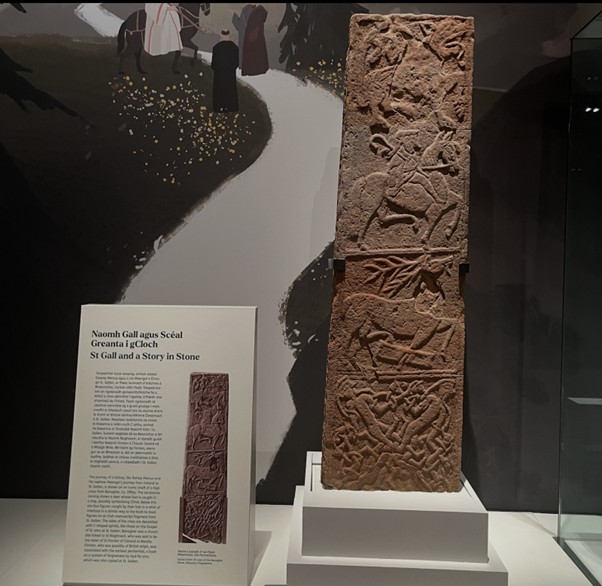
MUSEUM CAPTION :‘In preparation for our major temporary exhibition Words on the Wave: Ireland and St. Gallen in Early Medieval Europe, opening in late May this year, we reveal the ongoing conservation and scanning work on the famous high cross shaft from Banagher, Co. Offaly (1929:1497). The cross helps tell the story of the connections between art, belief and society in the world which produced the manuscripts.
‘The journey of a bishop, like Bishop Marcus and his nephew Moéngal’s journey from Ireland to St. Gallen, is shown on an iconic shaft of a high cross from Banagher, Co. Offaly. The sandstone carving shows a deer whose foot is caught in a trap, possibly symbolising Christ. Below this are four figures caught by their hair in a whirl of interlace in a similar way to the back-to-back figures on an Irish manuscript fragment from St. Gallen. The sides of the cross are decorated with C-shaped spirals, like those on the Gospel of St. John at St. Gallen. Banagher was a church site linked to St. Ríoghnach, who was said to be the sister of St. Finnian of Clonard or Movilla. Finnian, who was possibly of British origin, was associated with the earliest penitential, a book on a system of forgiveness by God for sins, which was also copied at St. Gallen.’
(more…)
-
The firefighting Foley family of Ferbane and the supreme sacrifice at 9/11 New York. By Aidan Doyle. A contribution to the Commemorations Series 2025. Blog No 744, 6th Sept 2025
The 1920’s saw high levels emigration to the United States from Ireland. Among those crossing the Atlantic Ocean was James Foley from Endrim near Ferbane. James was 21 when he boarded the RMS Cedric at Cobh enroute to New York in March 1927.
His brother Peter had arrived in the Big Apple a year earlier. In 1929 the Wall Street Crash heralded the end of the Roaring Twenties and the beginning of the Great Depression. Offalians in the city found mutual support in the Offalyman’s Association, an organisation in which the Foley family were closely associated.
James was living on Milton Street in the Greenpoint district of Brooklyn when he applied for US citizenship in 1933. After his marriage to Mary Egan, the daughter of Mr & Mrs Lawerence Egan from Kilcormac, the couple lived at Inwood on Manhathan and later in the Bronx.
(more…)
-
Memories of Church St. Tullamore in the 1960s and 70s: living in flatland. By Imelda Higgins. From the Offaly History series on Church Street, Tullamore: houses, businesses and families, over 300 years. No 6 in the 2025 Living in towns series prepared with the support of the Heritage Council. Blog No. 742, 29th August 2025
I left Tullamore years ago but I enjoy reading the Offaly History blogs and delighted with the articles on Church Street. A friend of mine died there a few years ago and it brought back many memories of my time sharing in a flat in Church St, Tullamore. I was there in the late 1960s and 70s and it had certainly changed when I saw it lately. I came to work in the hospital from a small farm near the Mayo Sligo border and found the midlands a bit strange at first. I came to love Tullamore. I lived in hospital accommodation at first but eventually a friend and I branched out into a flat. There were lots of flats in Church St in those days. Nobody called them apartments! We were down near Merrigan’s furniture store in the terrace below the Methodist church. There were two of us. We had one bedroom and a living room. Our kitchen was actually little more than the passage between the two rooms with a two-ring cooker and oven, a sink and a little press. Ikea eat your heart out! We shared a bathroom and toilet with the girls across the corridor and it was fine .We took turns to clean it and we never fought! We also took turns to answer the phone in the hall and answer the front door. We all certainly knew each other’s business! There were lots of people living in similar flats right along Church St and we knew each other well to see. You could set you watch by one lad who used to drive his car around from Church St to Harbour St every morning to collect his paper from Francie Gorry ! I think he was one of the teachers from near the Manor.
(more…)
-
The five Methodist Churches in Tullamore town, 1760–1889. In the Offaly History series on Church Street, Tullamore: houses, businesses and families, over 300 years. By Michael Byrne and Offaly History. No 5 in the 2025 Living in towns series prepared with the support of the Heritage Council. Blog No 741, 23rd August 2025
John Wesley, the founder with his brother Charles, of the religious movement, Methodism, visited Ireland on twenty-one separate occasions between 1747 and 1789 and has left eight volumes of journals (the Curnock edition) to tell the tale. The journals are mainly spiritual in character but nevertheless contain much that is useful about Irish life, the towns, estates and even the weather. The late T. W. Freeman, in his ‘John Wesley in Ireland’ used the Everyman edition The Journals of the Rev. John Wesley, A.M., edited by the Rev. F. W. Macdonald.[1]
Freeman noted that Wesley generally visited Ireland in the late spring and stayed for two or three months; making what was in those days, the perilous journey across the Irish Sea. Wesley was born in 1703 and died in 1791 and was the fifteenth child of Samuel Wesley. His ‘conversion’ is dated to this time and following the example of George Whitefield (1714 – 70), the originator of Methodism, he began his open-air preaching of which he did much across his ‘parish’ which was effectively England, Scotland, Wales and Ireland. The ODNB noted that his journal of missionary travel would serve as a guidebook to Britain and Ireland.[2] To the last he continued to travel and is said to have preached 40,000 sermons and travelled 250,000 miles.
(more…)
-
James Lyle Stirling Mineral and Medicinal Water Manufacturing, Importer of Wines and Brandies, Athy and Church St., Tullamore. By Noel Guerin. Part of the Offaly History series on Church Street, Tullamore: houses, businesses and families, over 300 years. No 4 in the 2025 Living in towns series prepared with the support of the Heritage Council. Blog No 740, 20th August 2025
James Lyle Stirling was born 16 May 1858 to Thomas Lyle and Anne Stirling of Tullamore. He was a business man who ran several businesses in Tullamore, between the years of 1880 and 1888, and is best remembered for his mineral water manufacturing company.
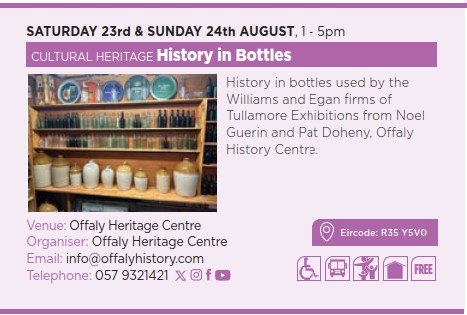
You can find out more about Stirlings by visiting the exhibition on Saturday and Sunday at Offaly History Centre.
His father, Thomas Lyle Stirling, was a brewer and merchant in Kings County, who ran most of his business in Church St., Tullamore. He was also an active Tullamore town Commissioner and sometime acted as an agent for Mary Anne Locke of Locke’s Distillery Kilbeggan. Thomas Lyle Stirling married Anne Jane, daughter of William and Catherine Commins of Cappincur, Tullamore, they had six children, all born in Tullamore except the youngest, Thomas who was born in Dublin. The children were Margaret (born 1857), James Lyle (1858), William (1860), Catherine (1862), Isabella Elizabeth (1863) and Thomas (1866).
(more…)
-
The first Protestant church in Tullamore town, Church Street, 1726–1815. In the new Offaly History series on Church Street, Tullamore: houses, businesses and families, over 300 years. By Michael Byrne and Offaly History. No 3 in the 2025 Living in towns series prepared with the support of the Heritage Council. Blog No 739, 16th August 2025
The young Arthur Fisher from Annagharvey was at the age of twelve in 1880 apprenticed to Archibald Warrren, the Church Street draper (where Salter’s shop was later located) and could recall many years later (c. 1949) coming into Tullamore that day with his mother to begin his five-year term. At the end of the fifth year he would receive £5 and in the meantime live over the shop with bed and board. The town he recalled was built on the river and Grand Canal. He went on to describe the entry to the town from the Geashill Road-Portarlington via Cloncollog.
(more…)
-
Church Street, Tullamore: houses, businesses and families, over 300 years: the well-known Hayes’ Hotel (Phoenix Arms), now Boots Pharmacy. By Michael Byrne and Offaly History. No 2 in the 2025 Living in Towns series prepared with the support of the Heritage Council. Blog No 738, 9th August 2025
It is strange that we should start with the most modern of buildings in Tullamore completed in 2001 and since 2015 Boots Pharmacy. Prior to that it was Menarys fashion and homeware and opened in 2001 as #1 Bar and Restaurant. It is the newest of the new buildings in the town and replaced one of the oldest – Hayes’ Hotel. The hotel was built in 1785 as a new hotel for Tullamore but was perhaps a refurbishment and not a new build.
The building is in a strategic location with four streets intersecting and was known for many years as Hayes’ Cross. The original building was L-plan in shape not unlike no 3 in O’Connor Square (the insurance brokers) and its neighbour south of the river Flynn’s bakery, also L-plan until street widening in 1938 removed the two front rooms to Bridge Street. The hotel was on the south-west corner of the narrow part of Church Street – the oldest part dating back to at least 1726 when the first Protestant church was built in what was later the Shambles and market south of the Foresters Hall, now as to the ground floor a Thai restaurant.
(more…)

 offalyhistoryblog