This month we begin a series of articles on the history and heritage of the Grand Canal in County Offaly that will run to upwards of 50 blog articles in 2024 and have its own platform on our website, http://www.offalyhistory.com. Our aim is to document the story of the course of the canal from the county boundary east of Edenderry to Shannon Harbour in the west. Today the Grand Canal is one of the greatest amenities that County Offaly possesses and we want to tell the story, and for readers to contribute by way of information and pictures. All the material will be open to be used on our website and the format will allow for editing to improve and to receive additional information from you the reader, which will be acknowledged. So Buen Camino as we make our journey through a quiet and well-watered land. The year 2024 marks the 120th anniversary of the completion of the Shannon Line at Shannon Harbour and may also see the completion of the canal greenway in this county.
During the twentieth century a tradition arose of a Christmas bird, usually a turkey, being sent from Ireland to extended members of the family who had emigrated to the Britain. They arrived in a canvas bag packed in straw. The Second World War disrupted the tradition. It did not resume immediately after the War as the British Government thought that birds would be traded on the black market in contravention of food rationing as explained by the New Ross Standard 22nd October 22nd 1948.
There is a popular saying in politics sometimes attributed to Ronald Reagan ‘When you’re explaining, you’re losing
History often involves explaining, but in recent times I’ve regularly watched people’s eyes glaze over as I described my latest research project.
Q: What’s it called.
A: ‘A Revolution in Profiles’.
Q: What’s it about.
A: Its about Offaly in the Revolutionary Decade.
Q: Okay. How many words in it?
A: Over 60,000, but it’s divided into profiles, each about 600 words long
Q: Is it a book?
A: No, it’s a website with over 100 different profiles of people from the period.
Q: So, it’s a blog?
A: Not really, it’s modelled on the RIA’s Dictionary of Biography.
Q: How much are you charging for It?
A: No, there’s no charge. Access is completely free. The RIA provided a bursary to build the website as part of the Decade of Centenaries programme, but anyone can view the profiles and there’s no fee.
At this stage the questioner runs the entire gamut of emotions from confusion, disbelief, pity and finally suspicion. ‘If its free there must be a catch’.
If we’re lucky the conversation shifts to the height of the Shannon or which senior clubs are still looking for a hurling manager, if not it peters out into a prolonged awkward silence.
‘I’ll tell what it’s not’
The site is not a definitive history of Offaly in the revolutionary period. That will come later, written by others more qualified to do so. It is a reference tool designed to educate on and simulate interest in Offaly’s revolutionary story. In time perhaps it may provide other researchers with a foundation from which a deeper understanding of the era might be developed. One of the ways it aims to do so is providing readers with the opportunity to compare and contrast different people from the period.
Don’t tell, show me!
Mark Twain reportedly once said ‘Don’t just say the old lady screamed. Bring her on and let her scream!’ Having struggled to explain the site, I usually take a leaf out of Twains book an give an example. Offaly History have been kind enough to host two profiles from the site dealing two elected officials.
The People’s Choice
Between 1918 until 1923 the constituencies of Kings County and Laois-Offaly were represented by Dr. Patrick McCartan. A leading member of the Irish Republican Brotherhood from Tyrone; McCartan spent most of those years on diplomatic missions to the United States and the Soviet Union.
Meanwhile Hugh Mahon from Killurn outside Tullamore sat as a Labor representative in the Australian Parliament until his expulsion in 1920. His ejection was carried out in response to Mahon’s public condemnation of the British Empire in the aftermath of the death of Terence MacSwiney on hunger strike in Brixton prison.
Mahon and McCartan’s biographies are among 30 extra profiles which will be added to the site over the next year, but for now the focus centres on two other parliamentary representatives from Offaly, representing two different traditions. Frank Bulfin and Sir Robert Woods.
Frank Bulfin
Frank Bulfin was born in 1874 at Derrinlough, where his parents William and Ellen Bulfin (nee Grogan) owned a large farm.
His uncle Patrick Bulfin acted as Lord Mayor of Dublin and a cousin General Edward. S. Bulfin served with distinction in the British Army during the Boer and Great Wars. In 1900 it was reported that Frank’s brother, J.V. Bulfin had died while serving with the Rimington Guides in the Boer War. Frank and his brother Joe (who was later associated with Clonony and Edenderry) were keen agriculturists. During the Ranch War both men were vocal advocates for small farmers and imprisoned for their involvement in cattle driving.
Frank’s uncle Fr. Vincent Grogan served as provincial of the Passionist order in Argentina. The South American connection was to have important ramifications for the family, as Frank’s older brother William emigrated to Argentina where he enjoyed considerable success and eventually became owner of the Southern Cross newspaper. On his return to Ireland, William Bulfin helped to stabilise the Derrinlough farms finances, wrote a popular nationalist travel book Rambles in Erin, promoted the Gaelic League and political movements of his friend Arthur Griffith. William died aged 45 in 1910.
William’s son Eamon attended St Enda’s school and fought under his former teacher Patrick Pearse in 1916 Rising.
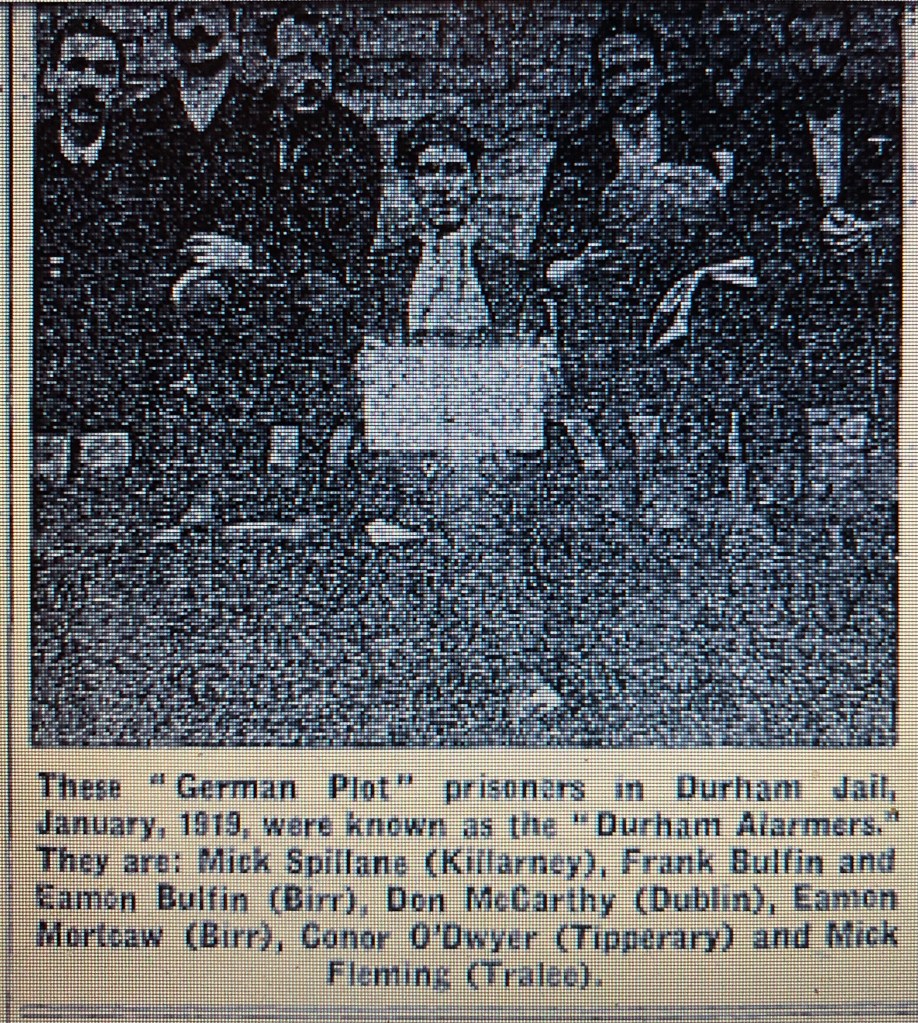
Following the release of republican prisoners from internment in late 1916, Eamon and Frank were involved in establishing the republican movement in south Offaly. They were arrested as part of the German Plot in the Summer of 1918 and imprisoned in Durham Gaol. Eamon was later deported to Argentina where he acted as an emissary for the republic during the War of Independence.
On his release from prison Frank Bulfin returned to Derrinlough, where he was involved in sheltering Sean Treacy, Seamus Robinson, Sean Hogan and Dan Breen during the summer of 1920. The so called ‘Big Four’ were on the run following shootings at Soloheadbeg and Knocklong.
Nominated as one of four Sinn Féin candidates, Bulfin was elected unopposed in the Laois-Offaly constituency at the 1921 general election. Arrested and interned at the Curragh, he was released with other TDs in August following the arrangement of the Truce.
Bulfin did not take a high-profile stance during the Treaty Debates but voted to accept the agreement. He was re-elected in the pact election. His nephew Eamon opposed the treaty but took no part in the Civil War following his return from South America and Frank’s niece, Catalina ‘Kid’ Bulfin a member of Cumman na mBan went on to marry well known anti-treaty republican Sean MacBride.
In August of 1922, Frank Bulfin was one of the pall bearers who carried Arthur Griffith’s coffin.
Although he rarely spoke in the Dáil, Bulfin continued to vote with the Cosgrave Government throughout the Civil War. In a statement to the Bureau of Military History Ernest Blythe suggested that because of republican intimidation, Bulfin attempted to resign his seat, but after the intercession of armed Free State Intelligence officers was convinced…
‘It might be more dangerous to resign from the dail than stay in it’. (1)
The veracity of Blythe’s story is difficult to authenticate.
Addressing an election meeting in July 1923 Bulfin commented…
‘Many unpleasant things we have had to do —many very distasteful decisions had to bemade, but we never sought popularity at the expense of the real interests of the nation’. (2)
After his re-election, rifts appeared in Cumann na nGaedheal. Bulfin did not support the Army Munity of 1924. Nevertheless, he was understanding of those who left the party at that time to establish the National Group and critical of some in the cabinet whom he felt were self-important and drifting too far from the party’s roots in Sinn Féin commenting …
‘Let these people not get their heads swelled. Greater men than they, Griffith and Collins, had to be done without.’ (3)
At local level his electoral machine was considered ineffective, and he lost his seat in 1927.
In the 1930’s Bulfin moved to Barrysbrook, Croghan close to his mother’s birthplace and farmed there until his death in 1951. He was buried at Rhode cemetery.
Sir Robert Henry Woods
Robert Henry Woods was born at Tullamore in 1865. His father Christopher and mother Dorothea (Lowe) operated a shop and held property in the town.
Sir Robert Woods
Educated at Wesley College and Trinity, he qualified as a doctor. An expert on the ear, nose and throat; Woods was considered a world leading physician. President of the Royal College of Surgeons he was knighted for his services to medicine in 1913.
His son Thornley died in 1916 while serving with British Army in Flanders.
In 1918 general election Woods was elected to Westminster for the National University constituency, a seat held until 1917 by Edward Carson.
Elected as an Independent Unionist, Woods was a moderate in personality and politics. He did not take up his seat at the first meeting of the Dail in January 1919. However, unlike other unionist MPs he did send a formal reply to decline his invitation to attend.
In July 1921 he was part of a delegation of southern Unionists who met with Eamon de Valera in the Mansion House Conference which facilitated the announcement of the Truce.
A rare contributor at Westminster, he made his last speech there in the aftermath of the signing of the Treaty when he told the House of Commons…
‘I hope the Prime Minister will permit me to offer him my congratulations on having brought this Conference to so successful a conclusion. If I may say so without offence, he has done a big thing, and he has done it in a big way. The Unionists in the South of Ireland have received the news of this agreement with feelings of satisfaction that can only be appreciated by those who have lived there in recent years, and perhaps by those who have got imagination to visualise what would have happened had these negotiations fallen through. I think I am correct in saying that the majority of Southern Unionists have for a long time seen that there was no other possibility of settlement of the age-long struggle, and the healing of this Irish sore, except through a Conference… I believe that the end of this Agreement will be an accession of strength, not only to Ireland herself, but to the peace and the prosperity of the world at large, and particularly of that great community of nations of which Ireland will, in the future, herself form an integral part.’ (4)
His last political intervention was an unsuccessful run for the Senate in 1925.
A collector of antique furniture, he was also musical enthusiast, president of the Dublin Zoological Society he donated several animals to the Zoo following trips to Asia.
Robert Woods died at his home in Marino in September 1938 and was buried at Deansgrange Cemetery. At his own request the funeral service was private and attended only by his immediate family and household staff.
On his death the Irish Independent commented…
‘Although a Unionist, his liberal and free-minded attitude on all Irish questions was very marked. Rather abrupt and unconventional in manner, the late Sir Robert was a man with a big heart. He was charming in private conversation and his humour was never hurtful, while his wit was always kind. He was extremely popular with his professional colleagues and was ever helpful to the young men attending’ his school. Physically a splendid type of Irishman, he was a familiar figure in Dublin, his broad shoulders, well-shaped head and rugged- features arresting attention.’ (5)
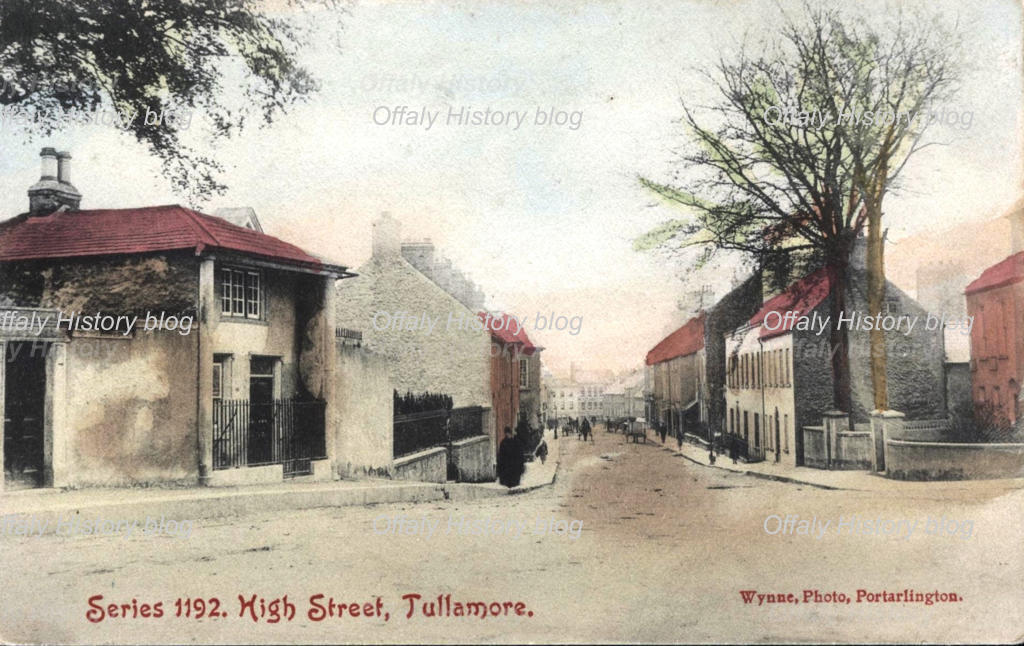
The square proper never had a public house until that in GV 5 in recent times, while the Brewery Tap on the western side at GV 3 High Street has served the public for well over 100 years. It was only in 2018 that a new public house and night club was opened at GV 5, now known as The Phoenix. The great garage of G.N. Walshe (GV 1 High Street) replaced the Goodbody hardware store which was in business from the 1840s to 1930 and with a tobacco factory at the rear until 1886.
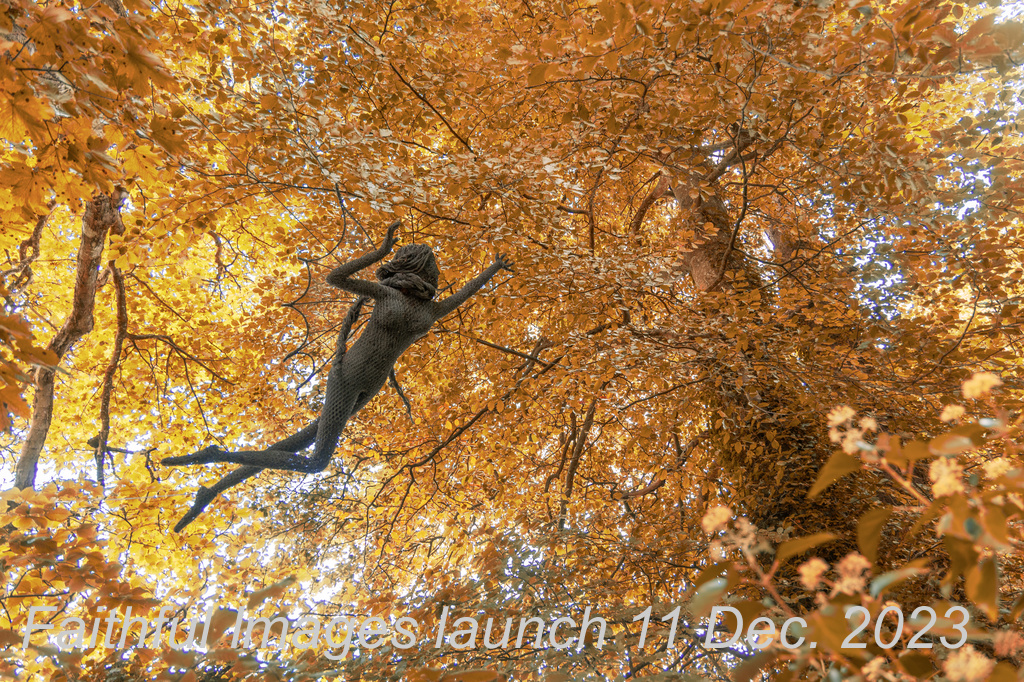
Faithful Images: public art in County Offaly, will be launched on Monday 11 December at 8 p.m. at Offaly History Centre, Tullamore by Eddie Fitzpatrick, cathaoirleach of Offaly County Council. Faithful Images is a welcome addition to the growing library on the cultural patrimony of County Offaly. Thanks to Creative Ireland and Offaly County Council for their support. The new book is in full colour and is €20. It can be purchased at Offaly History Centre, Bury Quay (beside the Grand Canal and the Old Warehouse) and at Midland Books, and online at http://www.offalyhistory.com. You will be welcome to attend the launch and to purchase a signed copy.
The Turf Man – capturing working on the bog for over a century
The combination of Fergal MacCabe as architect/town planner/water colourist with that of Paul Moore as photographer makes for an excellent outcome. Fergal MacCabe has an eye to the broad sweep of architectural history from his having studied and practised the subject over sixty years. He has been looking at buildings with an admirable curiosity since his teenage years. By the 1970s this had blossomed into his being a superb watercolourist especially when it came to places associated with his childhood years in the midlands. Living in Dublin now he can return to his native place bringing with him a fresh perspective. We had the pleasure of working with him on Tullamore: a portrait in 2010, attending several of his exhibitions, and several of his lectures including those on the rediscovered Frank Gibney.
Aisling – the spirit of the trees, Geashill(more…)
The publications below are available from Offaly History’s history shop at Bury Quay, Tullamore beside the Old Warehouse restaurant, online 24/7, and open Mon to Fri 9 to 4. 30. We are also in Bridge Centre from 14th to 24 Dec. as in previous years. We look forward to seeing you. All our work is to promote Offaly History on a selfless basis. All the publications below are from authors pro bono, pro deo, pro condado.
Offaly History is delighted to produce another volume of Offaly Heritage which is the twelfth collections of essays and writings on the history of the Faithful County’. The essays in section one reflect the ongoing research in Offaly into aspects of life in Ireland 100 years ago as we come to the end of the Decade of Commemoration (1912-1923). The essays reflect the changing nature of society in Offaly at that time, particularly during the years 1920 to 1923 and readers will enjoy contributions as varied as they end of the Wakely family of Rhode; the final years of the Leinster Regiment at Birr; the Protestant minority in Offaly during the revolutionary period; the courts of assize in King’s County in the years 1914-21; the burning of Tullamore courthouse, jail and barracks in 1922; the story of Belgian refugees in Portarlington, and Offaly claimants in 1916. A series of short lives are presented in this volume, as they were in Offaly 11 and includes entries on individuals as diverse as J.L. Stirling, Averil Deverell. Middleton Biddulph; Robert Hames Goodbody and volunteer Sean Barry. This volume of Offaly Heritage is also strengthened by a wide array of essays on aspects of Offaly history stretching from Colmcille to early soccer activity in Offaly in the late nineteenth century. The editors are particularly pleased to include essays from a number of contributors for the first time. The compilation of writings on Offaly history topics continues in this volume. The volume concludes with information on the Offaly Historical and Archaeological Society, the county’s heritage office and reviews of recent books of Offaly interest.
In the first half of the nineteenth century all of the original buildings in O’Connor Square were three-storey with the exception of the market house and the house where PTSB is now located (GV 8). The finest house was that of Pim/Wilson (GV 7) of c. 1740–48 (demolished 1936) and not unlike the fine houses in the square of the Quaker settlement of Mountmellick where the Pims and Wilsons would have had connections.
Over a series of articles, it is intended to examine the evolution of the ‘market place’, Tullamore to the fine square it is today. It is intended to look first at the evolution of the square over the period from 1713 to 1820 with additional comments on the building history in the last 300 years in the second article. This will be followed with analysis of the return for the 1901 and 1911 censuses and thereafter case studies of two of the houses in the square. Both are public houses, the Brewery Tap and The Phoenix, and business is conducted in the original houses albeit that both have been extended. Both are well known with the Brewery Tap one of the oldest pubs in Tullamore and The Phoenix the newest. The Brewery Tap house can be dated to 1713 and The Phoenix as a house to 1752.
So far we have looked at the 1821 and 1901 censuses for Castle Street, Birr together with traders in the street in the nineteenth century (see previous articles by going to the blog section on http://www.offalyhistory.com.) There were a lot of new families in Castle Street in 1911 when compared with 1901 based on the surname of the occupiers – not always a reliable guide. Families where there was continuity included that of John Wall, James Sammon, Patrick Connors, Laurence Kennedy, Owen Gaffney and Elizabeth Watterson.
In my previous article (Part 4) on the history of the Ballyduff quarries I looked in more detail at one of the Wrafter families involved in stonecutting at far back as at least 1807. In this article I will relate the story of two other Wrafter families of stonecutters. Members of these families are still active in the cutting, carving and sculpting of stone.
Wrafter family #2
This Wrafter family were also from Ballyduff and were heavily involved in the stonecutting trade at least from the 1850’s onwards. Between 1850 and the 1950’s at least 12 men from three generations of this family were stonecutters and most of them had at one time or another lived in Ballyduff and learned their trade at the nearby quarries. The lack of older records makes it impossible for me at present to say to what extent this family, and indeed even the other Wrafter branches, were involved in stoneworking before 1800.
Belonging to the earliest generation of stonecutters were Thomas (b. 1835, d. before 1882) and Patrick (b. ab. 1842, d. 1889). Five sons of Patrick Wrafter and his wife Katherine (nee Walsh) became stonecutters (John, Patrick, Jim, Joseph and Alec). After learning their trade in Tullamore Jim, Joseph and Alec practised their trade for extended periods in Cork and Dublin.
John worked a quarry of his own in Ballyduff in the late 19th – early 20th century. Patrick worked a quarry together with some employees in the neighbouring townland of Arden until at least 1928. Alec returned to Tullamore and also worked part of the Ballyduff quarries up to the 1950’s.
Stonecutters from this Wrafter family worked on the building of the new Catholic Church in Tullamore circa 1906. In 1908, they carved the stone tracery for a new stained-glass window for St Catherine’s Church (Church of Ireland) in Tullamore. Several of the Celtic cross grave monuments at Clonminch cemetery in Tullamore bear the names of John and Patrick Wrafter, and can arguably be considered works of art.
Clonminch, Tullamore 2
Fig. 1. Celtic cross headstones sculpted by John Wrafter (1866-1941). Erected in or around 1910 in Clonminch cemetery, Tullamore. The monument in the photo on the right (2) was made by John for his own family; three of his children and his wife are named on the headstone.
Four of the Wrafter brothers (John, Jim, Alec and Joseph) were active in the Stonecutters’ Union of Ireland, a trade union for stonecutters. The photo below is of representatives of various branches of the Stonecutters’ Union of Ireland, as well as of the union’s central organisation. The picture was taken about 1905. Two of the brothers feature in the photo:
John Wrafter (b 1864), representative for Tullamore and Alec Wrafter (b 1879), representative for Dublin.
Fig 2. Photo of members of the Stonecutters Union of Ireland (obtained from Barry Wrafter). Alec Wrafter (Dublin) back row, 2nd from the left. John Wrafter (Tullamore) back row, 2nd from the right.
James (Jim) Wrafter (b 1872) was Treasurer of the Union (perhaps the Dublin Branch) about 1909.
Joseph Wrafter (b 1882) was elected Annual Auditor of the Stonecutters’ Union of Ireland in 1907. Joseph was not living in Dublin at the time so involvement in the union would have meant regular trips by train to Dublin to attend meetings in Capel St. Several years later Joseph moved to Dublin and by 1932 he had been elected the General Secretary of the Stonecutters’ Union of Ireland. He died in Dublin in 1936.
Among the members of the Tullamore Company of the Irish Volunteers in 1916 were several stonecutters and masons from the Bracken, Wrafter and Molloy families. Joseph Wrafter was an active member and played a big part in the events of 20 March 1916, which became known as the “Tullamore incident”. In a skirmish, shots were fired and a bullet from the gun of Peader Bracken (another stonecutter) hit police sergeant Ahern. Joseph and his fellow volunteers were tried by a military court and ultimately released without conviction. Joseph was the father of the late Sister Oliver, who was a Presentation nun in Rahan and a keen local historian.
Recurring issues at the Union meetings reported by the press were demands for the use of Irish limestone in construction and the employment of Irish stonecutters in quarrying and dressing stone. Another demand was that available jobs should go to trade union stonecutters.
In 1896 stonecutters of the Stonecutter’s Union at the Ballyduff quarries went on strike over demands for higher wages and a half-day on Saturdays. The strike was short-lived as a settlement was promptly reached. Three decades later in 1922, there was another dispute over wages. This time the settlement resulted in a reduction of wages of stonecutters by 5 shillings to £3-10s, and of quarrymen by 2 shillings to £3. This may have reflected a decrease in the demand for quarried stone. In the early years of the 20th century concrete blocks began to replace stone for construction purposes, a development that was much criticized by the Stonecutter’s Union.
Several of the next generation of the Wrafter family entered the stonecutting trade. I will mention just two of them here. Patrick Joseph, born c. 1899, son of James, emigrated to America. He states his occupation as stone carver on his wedding certificate of 1922 in Albany, New York State.
John born 1891, son of John (b 1864), became a stonecutter/sculptor in Tullamore. By the 1930s he had left the stone trade and became a grocer and publican, with premises on Harbour Street (Wrafter’s Harbour Bar).
The latter half of the 20th century saw the continuing decline of the stonecutting trade. The carving of headstones was one of the few activities that survived for the employment of stonecutters. Among the Wrafters of Tullamore the trade died out. Four or five decades passed without a Wrafter putting his signature to a piece of stonework. Then in the late 1990s the Wrafter name appeared once again in connection with stonework. Barry Wrafter, the great-grandson of stonecutter John Wrafter, born 1864, and grandson of John Wrafter of the Harbour Bar, revived the family tradition, and has made a name for himself as a sculptor and stone carver.
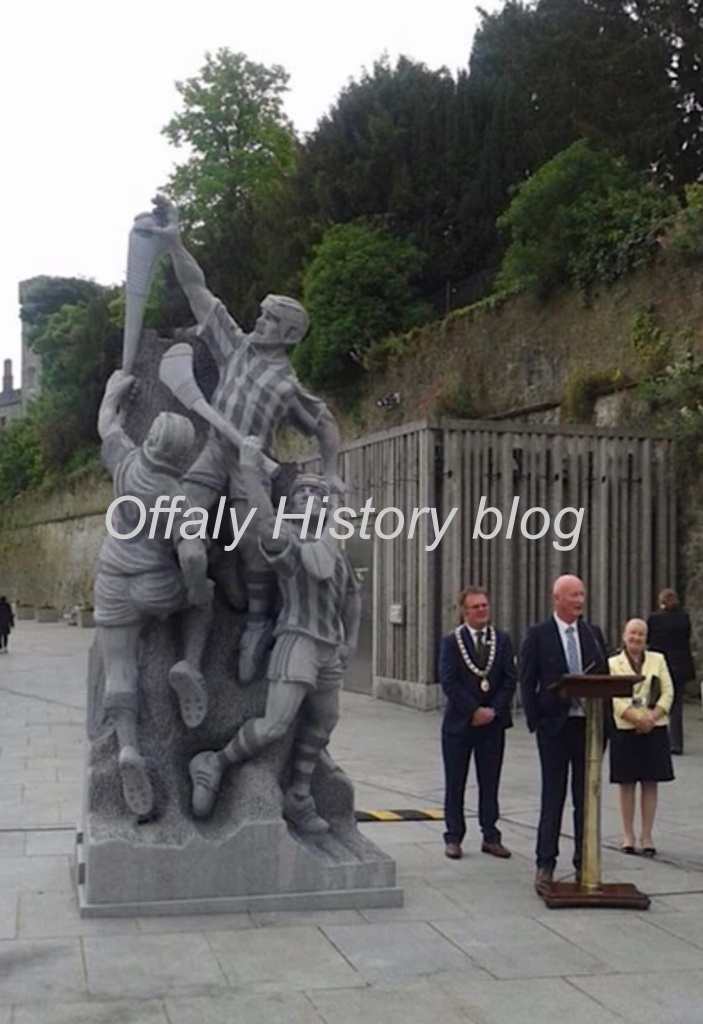
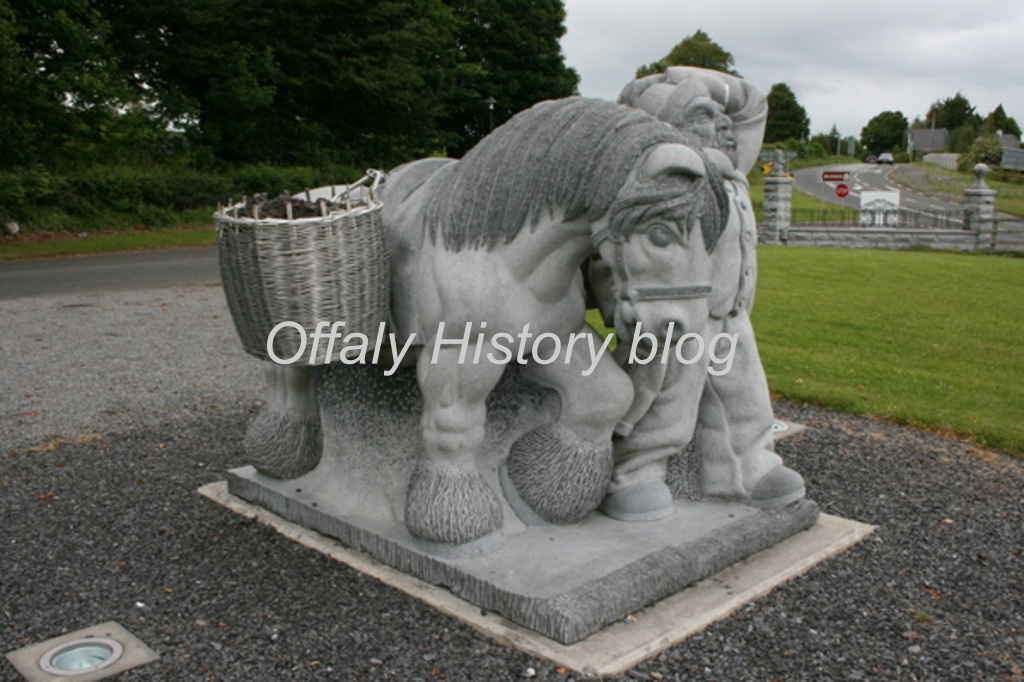
Growing up in Ennis, Co Clare, Barry returned to the trade of his forefathers as an outlet for his creative talent. He became interested in stone carving and sculpting after learning about the history of stonecutting in his family. Barry is one of only a few stone carvers using traditional methods and skills operating at the current time in Ireland. Since 1999 he has been commissioned to produce several public works throughout Ireland. His most ambitious work to date is undoubtedly the hurling sculpture in Kilkenny city (Fig 2), which he worked on in 2016-17. Closer to the home of his ancestors is “The Turf Cutter” from 2007, which is to be seen at the entrance to Belvedere House Garden and Park, near Mullingar (Fig 3).
Fig 3. Barry’s major work, the Kilkenny Hurling sculpture in Irish limestone completed in 2017. (Photo: http://www.barrywrafterart.com)
Fig 4. The Turf cutter sculpture at the entrance to Belvedere House and Gardens. (Photo: http://www.mckeonstone.ie)
More recently (in 2022), Barry was employed in the restoration of the Primark store (also called The Bank Buildings) in Belfast. The building, made of red sandstone from Scotland and completed in 1900, was ravaged by a fire in 2018. Some of his work can be seen in the photos below.
Fig 5. Pieces of carved sandstone ready for mounting into place in the Primark department store in Belfast. (Photo: Barry Wrafter)
Fig 6. Part of the facade of the Primark department store in Belfast during restoration. (Photo: Barry Wrafter)
Wrafter family #3
The third Wrafter branch involved in stonecutting may have started with Timothy Wrafter, born about 1804. Timothy, who lived in Aharney (a townland about 6 km northwest of Tullamore), was a stonecutter and farmer. He married Bridget Houghran in 1839 and had a large family; they had at least 11 children between 1840 and 1861.
At least two of the sons became stonecutters. John, born 1840, had settled in Chicago by 1880. He was married to Mary Molloy. He died in Chicago in 1904, age 65, occupation “Stone cutter”.
Another son, Timothy, born in 1849, married Anne Somers in 1877 and emigrated with his wife and two young children to Australia in 1883. They settled in the Brisbane area, where Tim continued his trade as a stonemason. Before leaving Ireland he probably worked for John Molloy at the Ballyduff quarries.
Timothy’s nephew, also called Tim, was a stonecutter according to the 1911 census. He was living with his parents in Ballykillmurray, close to Tullamore and the quarries, according to the same census. A couple of years later, in 1913, Tim made the same journey as his uncle had done 30 years earlier. He arrived in Brisbane, Queensland on 19 December 1913 on the ship Perthshire. Working with his uncle Timothy, the younger Tim learned the ropes of the trade.
Timothy eventually procured the business from his uncle and together with his two sons, Denis and Joseph, who were apprenticed as stonemasons, they founded the firm, T. Wrafter & Sons in Brisbane. It is still owned and run by the Wrafter family. They are the fifth or sixth generation of this Wrafter family involved in stonecutting. The company produces monuments, memorials, public works, and carries out church work, stone artworks and heritage restorations.
One of their most recent works is a 5-meter-tall Celtic cross standing on the grounds of Nudgee College in Brisbane. The monument, erected in August 2021 to mark 130th anniversary of the college, celebrates the school’s Irish Catholic heritage. Peter Wrafter, Company Director and a qualified stonemason, is a former pupil of the school. The material sought after for the cross was one that would exhibit good weathering properties and would have a colour resembling crosses in Ireland. Australian black granite was chosen and after a sandblast finish resembles the colour of Irish limestone. This beautiful work of art is a testament to the legacy of the Ballyduff stonecutters.
Fig 7. A recently erected Celtic cross on the grounds of Nudgee College in Brisbane made by T Wrafter and Sons, Stonemasons. (Photo: https://twstone.com.au)
Fig 8. An example of one of many public works in stone designed and produced by T Wrafter and Sons, Stonemasons., Brisbane. (Photo: https://twstone.com.au)
Given the prevalence of the name Timothy in this family there may be a link with another Timothy Wrafter who died in 1815 and whose headstone can be found in the graveyard of the old Church of St Carthage in Rahan. The tombstone is ornately carved as can be seen below.
Fig 9. The gravestone of Timothy Rafter who died in 1815, aged 33, in the graveyard of the old Church of St. Cartage in Rahan. (Photo: Paul Stafford. From booklet Offaly Tombstone Inscriptions. 1. Rahan Graveyards)
Thomas Wrafter is another Wrafter stonecutter that emigrated to Australia in the 19th century. Thomas ran a quarrying business on the outskirts of Adelaide in South Australia in 1880. He employed several stonecutters. He may be the same Thomas Wrafter that emigrated from Ireland and arrived in Brisbane in 1866. I have not been able to link him to any specific branch of the Wrafters.
Conclusion
In my research into the quarries and stonecutters of Ballyduff and Tullamore a picture has emerged that shows that the limestone quarries of Ballyduff produced some of the finest building and monument stone in Ireland. Moreover, the stonecutters that originated in Tullamore were widely recognized as some of the best in the country, and those that left Ireland (mainly to Australia) found that their skills were highly valued in their new homelands.
Many thanks to John Wrafter for these articles. Great research and we look forward to a printed publication in due course, Ed.









 offalyhistoryblog