An often-overlooked heritage is that of our townlands, even the few unassuming townlands that surround Ballinagar village are a treasure trove of folklore and history. These places were once full of ‘rambling houses’ where locals gathered to play cards or enjoy music and stories. There were stile-ways through the countryside, used when crossing fields was more common than using roads.
Work by John O’ Donovan in the 1840s and later P.W. Joyce, and more recently Thomas Lee along with a survey in conducted by the English in 1550 give some understanding of the townland names and how they have developed over the years.
On the eve of the Great Famine in 1845 the backwardness of Irish agriculture was seen by many as the reason for much of the country’s economic woes. About Irish farmers, it was stated that they knew nothing of the ‘English’ method of farming or indeed welcomed its arrival. However, there was amongst many Irish landlords, and their agents, a growing understanding of the benefits of the ‘science’ of agriculture and many had willingly adopted such methods in the management of their estates. In particular, many land agents were the leading pioneers of better agricultural practice. The employment of agriculturalists; the establishment of agricultural societies and the trips undertaken to observe foreign models of agriculture all highlight the progression of Irish agriculture by the early 1840s.
The first hotel constructed in Tullamore in 1786 cost £200. The second in 1801 about £4,5,00. Even by multiplying by 200 for the cost of living today, this expenditure was light in the context of the three new hotels in Tullamore in 1997- 2008 which may possibly represent a total expenditure of €25 million for 270 beds. And yet the canal hotel of 1801 was a major investment and may have never made a return to the Grand Canal Company. The need for it disappeared within five years of its construction. By contrast the deprecated Bury Arms (Hayes/Phoenix Arms) in the centre of town was in business for over 200 years.
The Bury Arms (later Hayes Hotel) erected in 1786, demolished 2000. From the Hanly Collection Offaly History. This view in the late 1950s.
The first hotel (that we know of) to be constructed in Tullamore was the Bury Arms Hotel (later the Phoenix Arms, demolished 2000, now Boots Pharmacy), erected in 1786 as an inn for Tullamore at a cost to the landlord, Charles William Bury, of £200. We know that in 1798 it had 13 beds for letting. The hotel was first leased to John Tydd at a yearly rent of £20. John Tydd and his son Benjamin were both dead by 1798 at which point the innkeeper was one Mr Doherty. Captain William Evans, who had been a director of the Grand Canal Company until c.1796, but remained with the Company providing engineering advice until 1805, was critical of the Bury Hotel on his visit there in 1798. His departure from the company in 1805, possibly following soon after the completion of the works to Shannon Harbour in 1804. Notwithstanding Evans’ criticism of the Bury Arms hotel Sir Richard Colt Hore who stayed at the hotel in 1806 wrote: ‘At Tullamore I found a good inn and accommodation at Doherty’s (the Bury, later Charleville Arms) near the Bridge’ (Tour, p. 32). The hotel had changed its name in line with that of the ennobling of the town’s landlord who became Lord Tullamore in 1797, Viscount Charleville in 1800 and earl of Charleville in 1806. It should be mentioned that there was at least one earlier inn in Tullamore, that of Hugh Clough in the 1760s and other smaller hotels post 1800.
This week we have a blog provided by Eduardo García Saenz (member of Champagnat Rugby Club, Economist, Journalist and Sports’ Historian, especially in rugby, soccer and horse Polo. In this article he is presenting about THOMAS St. George ARMSTRONG (1797-1875); born in Garrycastle, near Banagher and who made a fortune in Argentina. His son bought Garrycastle House, Banagher in 1890 and is in Burke’s Landed Gentry 1912 edition with lands in Garrycastle and a residence in Paris. This is our last blog of this year and so far we have achieved 103,000 views for our blogs since 1 Jan. 2020. Thanks contributors and readers for all your help and wishing you all the best in 2021. Like our blog to ensure you get it every week per an email advice. All our blogs can be found at Offalyhistoryblog and our web platform http://www.offalyhistory.com. We post them every week to Facebook and Twitter (Offaly History).
Eduardo García Saenz
Eduardo is the the great-great-grand child (Chozno Grandson) of Thomas Armstrong who died in Buenos Aires in 1875. Eduardo has visited Dublin and Malahide, but has not yet had the opportunity to visit Banagher, Birr and Tullamore. He is aware of our ‘delicious Irish whiskey and also the malt’. In rugby he knows that there are two good rugby clubs in Co, Offaly: Tullamore RFC and Birr RFC.
Eduardo writes that the Armstrong family gave the land in Banagher to build St. Rynagh’s Church in 1826 and donated the bells for the church. Thomas Armstrong was also a donor to the Catholic church in Banagher in 1873 (King’s County Chronicle, 20 Mar. 1873). In 1847 he donated £50 to support famine relief in Banagher and Lusmagh, and later to the Crimean War Fund.
We would welcome blogs from overseas on the contribution of people from the midlands of Ireland in their adopted country (to info@offalyhistory.com). We draw attention to the Dictionary of Argentina Biography and the like for Australia. These are now online. The Irish DIB goes on line free in 2021.
The architect and town planner Frank Gibney (1905-1978) is today recognised as one of the most talented, influential and prolific housing designers of mid-20th c. Ireland.
Responsible for almost six thousand local authority dwellings in every part of the country, his deep concern for human scale and for good living standards delivered homes of a quality which have stood the test of time, while today many of their contemporaries have been altered or demolished.
Principal amongst his many achievements are the six Midland bog villages built in the 1950s for Bord na Mona workers, which were inspired by the aspirations of Patrick Pearse and Eamon de Valera for national self-sufficiency and which have been described by the Yale University Press/Royal Irish Academy volume on Irish architecture as ‘models for rural living’. These beautiful urban set pieces are cherished by their proud present day inhabitants and beg the question as to why contemporary housing policies have not emulated their success.
Gibney designed housing estate at Clarecastle, County Clare
Gibney’s numerous and extraordinarily ambitious town planning schemes founded on Garden City and Beaux Arts principles, were less successful, being proposed at a time of cultural conservatism and financial stringency. His passion for plans based on aesthetic principles which would preserve the best of towns while creating new and beautiful public areas found little local response. Nonetheless, he was engaged by many Irish towns and cities including Waterford and Drogheda to chart their future and elements of his proposals are still capable of fulfilment today.
There is an increasing appreciation of the records of the local press: the Midland Tribune, Leinster Express, Tullamore and King’s County Independent and King’s County Chronicle, without which our knowledge of the county of Offaly since 1831 would be so much the poorer. The press was the only source of news for the public in the pre-‘wireless’ days up to the 1920s and 1930s. This week we mark the burning of the Athlone Printing Works and with it the machinery of the Offaly Independent and Westmeath Independent in early November 1920 and look at the evolution of its editorial viewpoint from pro-war to pro- Sinn Féin and the Irish Republic.
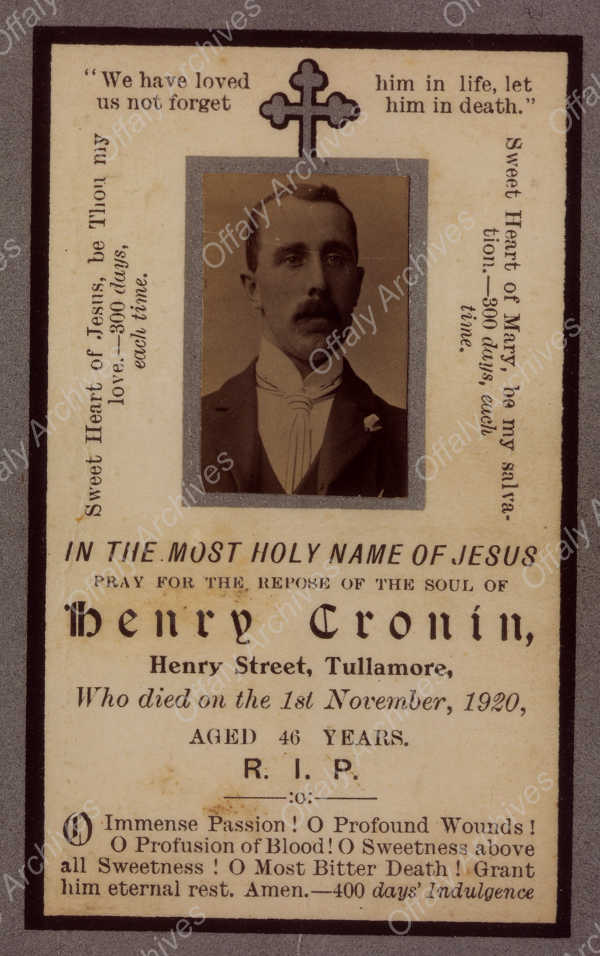
Killings such as that of Sergeant Cronin were rarely spoken of in Tullamore in the years from 1920 to the 1990s. As to who shot Cronin there were so many suggestions – men from out of town, a policeman siding with the I.R.A. and so on. Like the Spanish Civil War there was a pact of forgetfulness (olvidados) for those who were there. When Peadar Bracken made the Offaly I.R.A. Brigade return in 1940 (filed in confidence for over seventy years) in connection with service and pensions for those who had fought in the 1916–21 period he described the Cronin killing outside Cronin’s house in Henry/O’Carroll Street as
‘31st Oct., 1920 – Sergeant Cronin ‘wounded returning to Barracks, at Tullamore. Died subsequently.’
Today we know that the causes, course and consequences of any national struggle are complex and that the results can be not what was anticipated. In Ireland it became a Free State with a Civil War that set back the country for many years. Perhaps until after the emigration of 400,000 in the 1950s.
A new book detailing the history of Birr Military Cemetery has been published by Offaly County Council. Researched, written and designed by Stephen Callaghan the book gives an authoritative history of the cemetery and all those identified as buried there. While the cemetery only contains 52 inscribed memorials, the book gives biographical details of a further 230 people buried there. The memorials which survive are also examined and described in detail, including information about type, symbols and details about the materials used and the stonecutters who made them. The cemetery is one of the few surviving features of Birr Barracks and is an important link to the past. The people buried there are a mix of soldiers, soldiers’ wives and children, the latter make up most of the burials.
Hunston is the name of a townland in the west of Offaly, close to where the Brosna and Shannon rivers meet. It is unlike many place names in Ireland which relate to an anglicised geographical description. It originates from a planter family who came to Ireland from England in the 16th century during the first plantation of Ireland.
Following Henry VIII claimed of kingship over all of Ireland in 1541, the English wished to extend their control further than the area called the Pale around Dublin to the whole of Ireland. One way was to drive the Irish landowners off their land and replace them with English or Scottish settlers, called ‘planters’. The first plantation took place in the region now known as Offaly and Laois in 1556. It was from this area that the O’Connor and O’Moore clans had invaded the Pale. The Government divided the land into Counties. Present day Laois was named Queen’s County, after Queen Mary, daughter of Henry VIII and present-day Offaly was named King’s County after Mary’s husband King Philip of Spain. Forts were built at Maryborough (Portlaoise) and Philipstown (Daingean).
The current issue of Irish Historical Studies (no. 165, May 2020) has a featured review of five issues from the Maynooth Local Studies series published in 2019. That brought the number issued to 144. We attach the list to 144 for your convenience and we bring to your attention the latest batch of four. Raymond Gillespie is the quiet man behind the series and who has acted as general editor since its inception in 1995. The reviewer in IHS, Maura Cronin, reminds of his characterising local history as being ‘primarily about people in places over time’. Place is described as the bedrock of local history, but it must be seen in the context of the actions of people and the pivotal role of historical research is looking for the forces of disruption and of cohesion. What brought people together and what drove them apart.
The four new issues of 2020
Four new volumes have been published in the Maynooth Studies in Local History series (general editor Professor Raymond Gillespie). The volumes by Denis Casey, Emma Lyons, Brendan Scott and Jonathan Wright and can be ordered via Offaly History Centre.



 offalyhistoryblog