In the decades before the Great Famine of the late-1840s numerous parliamentary inquiries were held into the condition of the poorer classes in Ireland. Political and social elites wished to understand the nature of Ireland’s seemingly endemic poverty in the hope of improving the social, economic and moral condition of the peasantry, as well as quelling the country’s tendency for social upheaval and political radicalism. The most significant of these inquiries was the Royal Commission for Inquiring into the Condition of the Poorer Classes in Ireland (aka the Poor Inquiry). Chaired by the Church of Ireland archbishop of Dublin Richard Whately (1787-1863), the commission sat between 1833 and 1836, holding extensive public inquiries (akin to court sittings) in parishes throughout the country, supplemented by extensive correspondence with persons of significance across the island, as to the social condition of the poor in their locality. The printed output of the commission – totalling more than 5,000 pages of detailed information, witness testimonies and statistics – constitutes an unparalleled source for the study of poverty in the pre-Famine period. The Poor Inquiry reports tell us much about County Offaly (King’s County) a decade before the Great Famine. (more…)
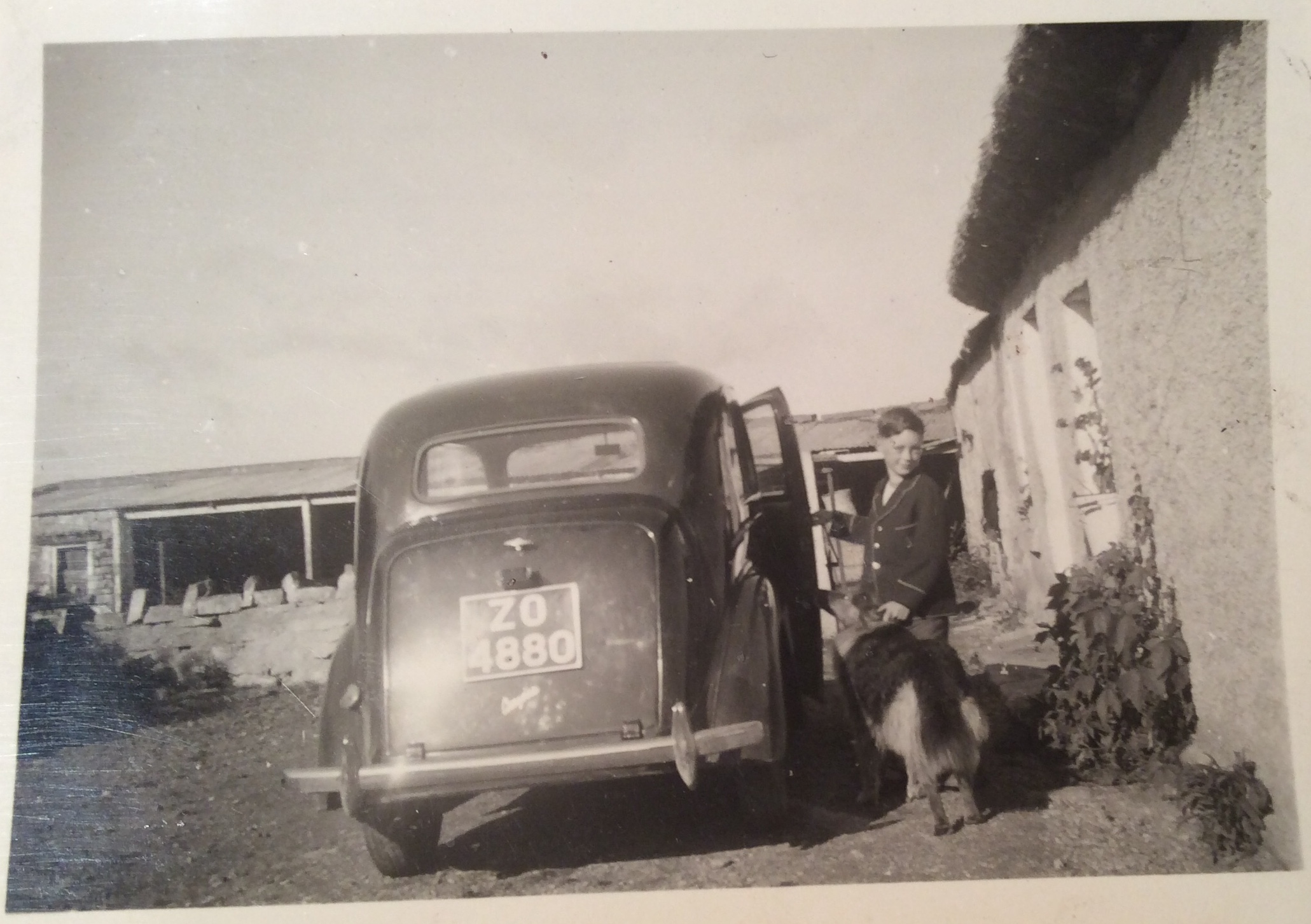
As Patrick Kavanagh might have put it, I was ten Christmasses of age and living in a place called Clerhane, a townland some two miles south of Clonmacnoise.
We were farmers, and there were five of us residing on the farm, my maternal grandparents, my uncle Joe, my mother and I. My father for economic reasons worked in Dublin, and I would only see him three times a year, the Easter break perhaps three days, his summer holidays that took place during the first two weeks in August, and of course for Christmas break which generally lasted two or three days depending, on how Christmas fell. You can imagine the excitement that built up in me as a child with the prospect of the approaching Christmas.
The Christmas I am talking about was 1954, indeed as time would prove, my last Christmas residing in west Offaly, as the following summer my mother and I moved to Dublin to live with my father, who had just purchased a house.
1954 is best remembered for the floods, the river Shannon reaching the highest level since 1925. I remember soldiers from Athlone assisting the farmers that year with the harvest. Folk were really looking forward to the bit of Christmas cheer.
McCartan for offaly. This picture may be in 1921 or 1922 and not 1918. The feature poster is for the April 1918 by-election.
Congratulations to the people of Offaly in having secured as their member Ireland’s Ambassador to America. Their unanimous endorsement of his mission is particularly opportune. Dr McCartan will voice a united Ireland’s demand that the Irish people be given the right of self-determination and will tell the world that Irishmen will not fight as England’s slaves.
De Valera telegram to Dan MacCarthy, Dr Patrick McCartan’s election agent for the North King’s County by-election, April 1918. Irish Independent, 20 April 1918.
This week we publish a day earlier to mark the 100th anniversary of the General Election of 14 December 1918 – a watershed in the history of politics in Ireland. It should be noted that apart from the by-election of 1914 in North King’s County (Banagher-Tullamore-Edenderry district) no opportunity arose for the north King’s County parliamentary voters to go to the ballot box between 1885 and 1922. Notwithstanding all the excitement in 1918 for both the by-election in April and the general election in December Dr McCartan was unopposed. Women who had fought so much for the vote in the pre-war years did not get a chance to exercise the parliamentary franchise in north Offaly until 1922.
The Parker Brothers of Clara and John Martin of Tullamore. One of the Parker boys was killed as was John Martin on 8 October 1918.
There was very little published work relating to Offaly in World War I until recent times. The 1983 essay by Vivienne Clarke was a first and rare examination of the period in Offaly, until Tom Burnell’s Offaly War Dead in 2010, and 2014’s Edenderry in the Great War by Catherine Watson. And so nearly every essay published in Offaly and the Great War which was launched to mark the centenary of the end of the Great War represents new and original historical research and findings, a very exciting prospect in the world of history publishing.The seventeen contributors have submitted essays that cover every aspect of the war and from almost all corners of the county.
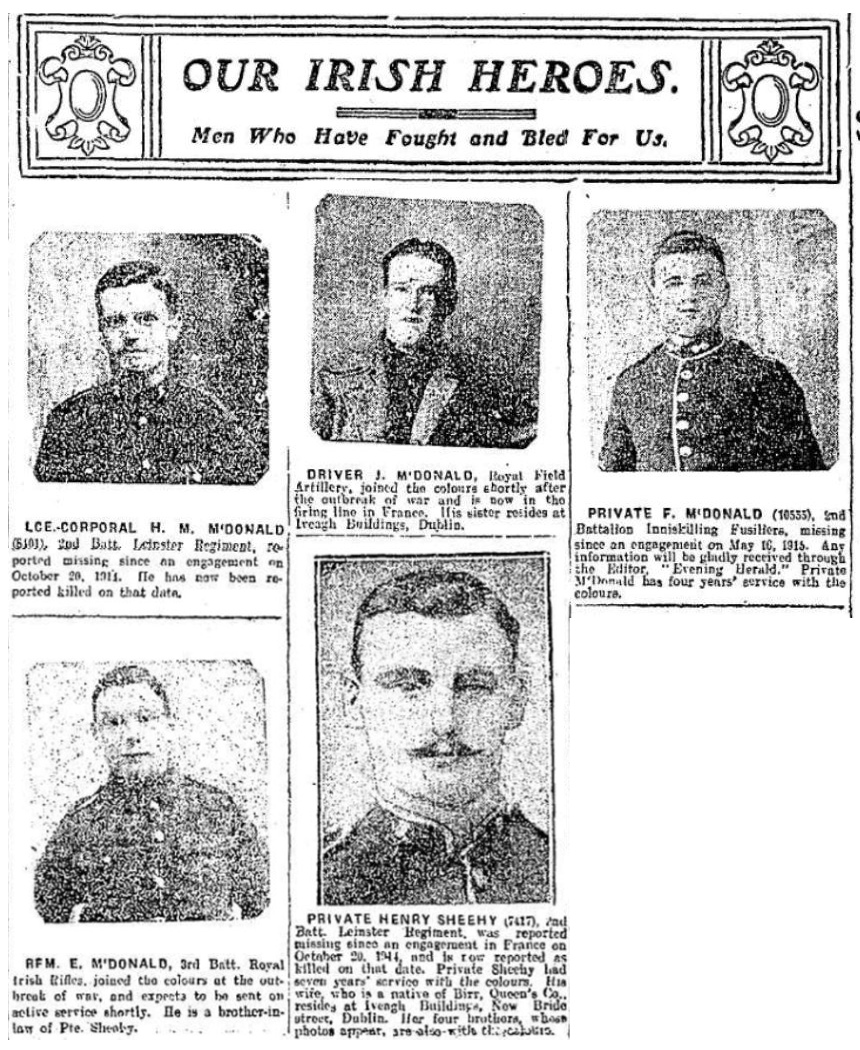
In July 2018 an interesting Great War campaign medal appeared on eBay, a single 1914–15 Star awarded to Private Frederick McDonald of the 2nd Battalion, Royal Inniskilling Fusiliers. The description provided by the seller stated that Frederick was born in Birr, and that he had been killed in action during the war.
Further research unravels a forgotten story, which gives insight into the life of Frederick and his family. It is a story not too dissimilar among the many working class Catholic families in Birr, because serving in the British Army was a source of steady employment and a means to support a family.
To be invited to participate in the Biennale is one of the highest accolades for an architect – to be asked to curate it, set the theme and organise the gigantic assemblage into a coherent whole, is simply stratospheric and lifts the reputation of the organisers into the top most rank.
This year’s show is entitled ‘FREE SPACE’ and runs from May to November. It is curated by Grafton Architects who have established their international reputation with new university buildings in Milan and Lima. Grafton is the creation of two remarkable women, Shelley McNamara and Yvonne Farrell who are recognised as among the most important female architects of our time. Critics have marvelled at the bravura, confidence and muscularity of the architecture of the quietly spoken, almost excessively modest pair
. Views of the Boconi building in Milan (Universita Luigi Bocconi, Milan, Italy).
Yvonne Farrell is, of course, from Tullamore (Clara Road and St. Philomena’s Convent School) and acknowledges the formative experiences of growing up in the town on her subsequent career. She sees architecture as an essentially collaborative process produced by the entire team at Grafton, which includes her fellow director Ger Carty from Walsh Island. The Offaly tinged firm is now engaged in work in London, Toulouse and Paris but in particular have two important projects in Dublin, the redevelopment of the former ESB offices and the new City Library in Parnell Square. Early sketches suggest that these will be exciting additions to the capital city.
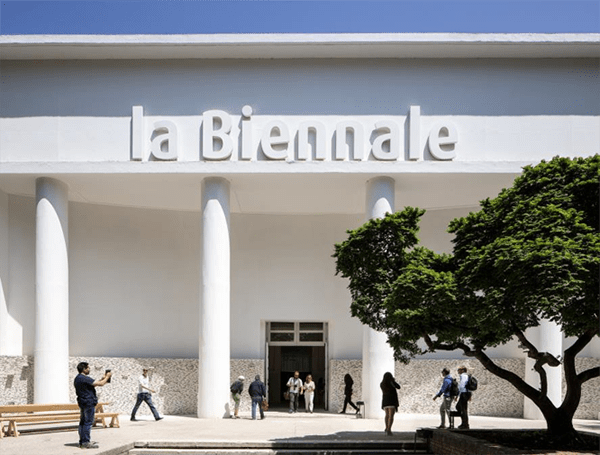
The exhibition hall in Venice
The Biennale exhibition which is spread over three different locations around Venice has fifty five national pavilions and individual projects/presentations by one hundred architects. All are stimulating and I wish I had the space to discuss them in detail, but would single out just one entry that appealed to me. For the first time ever, the Holy See was invited to participate and responded by commissioning seven well known architects to create seven chapels (or contemplative spaces, as the more secular might call them) on the island of St. Giorgio and each is delightful yet profound in its own way.
The scale of the whole exhibition can be overwhelming and I would not be the first to observe that while architects can be fluent in their visual presentations, the impenetrability of the language used to describe their projects can often be daunting. The Irish Pavilion is devoted to an exhibition entitled ‘FREE MARKET’ which is a study of the market square as a place of social, cultural and commercial exchange in smaller Irish towns. Fifty examples are cited including those in Edenderry, Portarlington and Mountmellick. This entry has attracted a lot of attention and has featured in reviews in the international media, attesting to the universality of this seemingly Irish typology. Regrettably, while offering comprehensive surveys and a degree of analysis, no case studies are supplied of successful transformations. Indeed, the only example given is that of Dungarvan in which the sole change would appear to be that of providing a better quality of paving under an otherwise unaltered carpark.
Boconi building, Milan
As the controversial pedestrianisation of both Emmet Square in Birr and O’Connor Square in Tullamore has shown, the role of market squares and the approach necessary to converting them in whole or part to public spaces is a lot more complex than the Irish entry suggests. I believe that such initiatives can only be realised in the context of well laid overall plans which consider, traffic, parking, land uses, retail needs, urban design, architectural conservation and a myriad list of other issues which can justify their future scale and nature. Standalone building projects just don’t work.
These minor quibbles should not diminish our pride in the prestige which Yvonne and Shelley have brought to Irish architecture and to their own roots. In a commentary on the Biennale, the distinguished architectural critic Shane O’Toole has written of how Irish architects of the past ‘would have been amazed to learn that less than half a century after we ‘joined’ Europe, Irish architects have resolutely clambered to the top of the international architecture mountain range, and that Shelley and Yvonne have planted our flag of values at its very summit’.
Department of Finance, 7-9 Merrion Row, Dublin 2: top left.
Right: University of Engineering and Technology in Lima, Peru, won the RIBA’s inaugural International Prize last December
How marvellous it would be if they were commissioned to design an important building here in Offaly! The imminent redevelopment of the Harbour in Tullamore would present an excellent opportunity here in Offaly!
One hundred blogs is a reason to celebrate this September day in 2018. Yes 100 articles, 150,000 words, at least 400 pics – and the 100 stories have received 64,000 views and climbing every week. In 2018 alone we have received over 32,000 views. The list of all that has been published can be viewed on Offalyhistoryblog. We have lots more lined up. We welcome contributors, so if you have a history story you want to share contact us. The other big story is happening on Monday night with the launch of Offaly History 10. (more…)
The 1540s and the 1550s was a turning point in what we now know as the county of Offaly. It was a time of colonising wars when the administrative county, then known as King’s County, was established by force and expropriation of the lands of the native families. It was in the time of Henry VIII of the Tudors and Wolf Hall television series fame that serious inroads began to be made into the area we now call County Offaly. The actual shiring into an administrative county of the territory of the O’Connors, O’Molloys and the other native families went on over sixty years from the 1550s to the 1610s. The O’Connors had been allies of the Kildare family of FitzGeralds, whose leaders were all killed in the 1530s, after the revolt of Lord Offaly, Silken Thomas. From then on the conquest of the midlands was the firm policy of a reinvigorated English administration under Henry V111 and the administrative expertise of Thomas Cromwell. (more…)
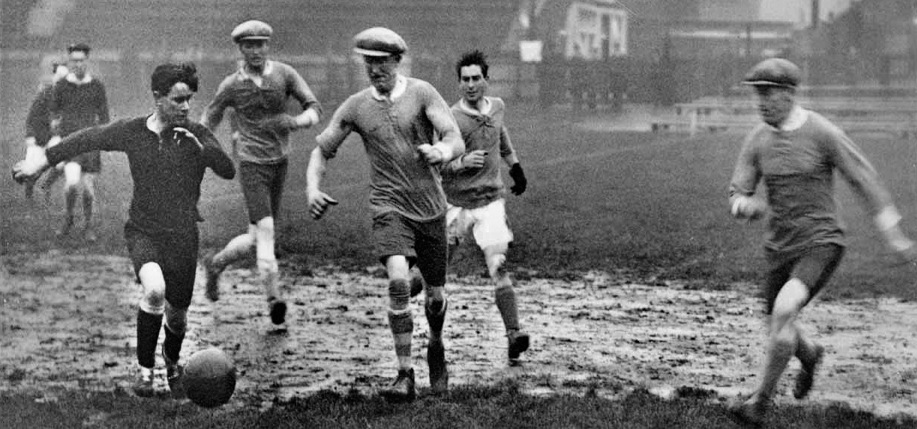
‘From Jones’s Road to the craggy hillsides of the Kingdom the day was fought and won in fields no bigger than backyards, in stony pastures and on rolling plains … wherever posts could be struck and spaces cleared, the descendants of Fionn and the Fianna routed the seal of servitude. In one never to be forgotten tournament we crossed our hurleys with the lion’s claw and emerged victorious’. Tommy Moore of the Dublin club, Faughs.
Congratulations to the people of Offaly in having secured as their member Ireland’s Ambassador to America. Their unanimous endorsement of his mission is particularly opportune. Dr McCartan will voice a united Ireland’s demand that the Irish people be given the right of self-determination and will tell the world that Irishmen will not fight as England’s slaves. De Valera telegram to Dan MacCarthy, McCartan’s election agent for North King’s County by-election, April 1918. Irish Independent, 20 April 1918.
‘Up Offaly’ the Tullamore and King’s County Independent told its readers that ‘Offaly men can proclaim through their votes that they are no sons of a miserable English province’ but descendants of a royal race. They were not to be deceived by the ‘hireling band’ of paid politicians who would descend on the county for the by-election. ‘Poor Ned Graham’, it said, drove them out in 1914 aided only by a few priests and local nationalists. Tullamore and King’s County Independent, 30 Mar. 1918.







 offalyhistoryblog