The weather was bad when Joseph Hutchinson arrived in Tullamore. For 22 years Hutchinson had dedicated himself to the Irish National Foresters and as a result a small mutual aid society founded by 18 men in Dublin, had spread across the globe and recruited over 20,000 members in Ireland. On Sunday 9 April 1899, Hutchinson had come to the midlands to recruit some more members and establish the first INF branch in King’s County. His visit that day would have profound repercussions for Tullamore, but it had its roots in the north of England.
A case can be made for declaring that the Grand Canal in Offaly is the county’s greatest building. No other structure has contributed so much to the economic development of so many of its towns and villages over the last 230 years. In addition, it has supported the recreational wellbeing of local citizens for a hundred years or more and seems set to do so exponentially in the decades ahead. It also preserves a relatively undisturbed wildlife corridor for many of our threatened flora and fauna species. The canal has its own rich cultural identity, much celebrated in literature and music. Its components, listed below, still combine to create an architectural entity that is almost fully operational although in a fashion undreamt of when it was first conceived in 1715, well over 300 years ago.
Combining the Shannon or Main Line (1793–1804) and the Kilbeggan Branch (1830–35), the stretches of the canal in Offaly and Westmeath took just over fifteen years to build. As it flows forty-four miles from Cloncannon, south-east of Edenderry, to Bunbrosna and Minus, downstream of Shannon Harbour, and eight miles along the Kilbeggan Line, its architectural components present a staggering list: it tumbles through sixteen locks; crosses five large aqueducts; supports and reflects forty or so ancient and modern bridges; funnels into its own channel an array of supplies or feeders, kept in control by a strategically placed system of overflows or overspills; conducts scores of unwanted streams, syphoned and otherwise, through scores of tunnels or culverts, under its non-porous bed to nearby rivers and gently glides along between a hundred miles of well-staunched towpaths and embankments to a seamless confluence with the brimming Brosna and the Lordly Shannon.
The pioneering travel book on the Irish canals was Green and Silver (London, 1949) by L.T.C. Rolt (1910–74). Tom Rolt made his voyage of discovery by motor cruiser in 1946 along the course of the Grand Canal, the Royal Canal (fully open from Mullingar to the Shannon, until 1955 and thereafter from 2010), and the Shannon navigation from Boyne to Limerick (happily now navigable up to Lough Erne). The Delanys writing in 1966, considered Rolt’s book to be the most comprehensive dealing with the inland waterways of Ireland.[1]
During the 1940s, and up to the early 1970s the canal candle was flickering but was kept burning by enthusiasts in England and in Ireland. Among these were the late Vincent Delany and Ruth Delany whose book on the Irish Canals in 1966 was a seminal work. As pointed out in the Irish Times in November 1993 Ruth Delany is the most prolific author on the subject of the Irish canals and herself acknowledges that Green and Silver had a profound influence on her. Other writers were Hugh Malet and Colonel Harry Rice – the latter largely founded the Inland Waterways Association. In 1973 Ruth Delany extended the 1966 book with a full-scale study of the Grand Canal which was reissued in 1995 with an update on the previous twenty years.
Tom Rolt was born in Chester in 1910 and after working in engineering and with vintage cars he became a full-time writer in 1939. Some of his many books are shown in the attached illustrations while ‘his biographies of great engineers, such as Isambard Kingdom Brunel (1806-1859), are still highly regarded. As a campaigner, activist and champion of industrial heritage Rolt is best known for his involvement with the Inland Waterways Association, the Talyllyn Railway Preservation Society, the Newcomen Society, and the Association of Industrial Archaeology.’[2] On his marriage in 1939 to Angela Orred, daughter of a retired army major. They went to live on his house boat Cressy and in 1944 published Narrow Boat, a passionate evocation of the British canals and those who worked on them. His wife left him in 1951 to join the Billy Smart circus. Two very focused people.
This week we look at the background to the Vallancey report on the Offaly towns carried out in 1771 to facilitate the construction of the new Grand Canal line from Dublin to the Shannon. Vallancey was then a young engineer, employed to report to the Commissioners of Inland Navigation and his findings were published in a little known and very scarce pamphlet, AReport on the Grand Canal or Southern Line (Dublin 1771).[2] This report is useful as a window on some of the north King’s County (hereafter generally referred to as Offaly) towns and villages and all the more so because of the scarcity of published accounts of the midland towns prior to 1800.[3] The report was published in the same year as that of John Trail who was at the time employed by Dublin Corporation.[4] Vallancey was writing with a mission. He was being paid to spin the story of the benefits that would come from inland navigation and to highlight the difficulties with road transport and its adverse impact on competition and pricing of commodities so as to bolster the arguments in favour of canal construction and satisfy those who were paying his consultancy fees.
Why not contribute to our series of blog articles on the Grand Canal in Offaly – info@offalyhistory.com.
The closure in 2012 of Offaly Express, where I served as a staff reporter from 1988 to 2007, marked the end of an era in local journalism.
When I was a schoolboy, living in Tullamore, the dominant local paper was the Offaly Independent, though the Midland Tribune circulated to a degree from Birr. The growth of Tullamore led to a feeling that a specifically local paper was needed, and in 1978, the Tullamore Tribune was launched, under the editorship of the late Geoff Oakley. He remained in that post until he retired in 1994, when he was succeeded by Ger Scully.
The Offaly Express emerged as a sister paper of the Portlaoise-based Leinster Express, which began to circulate around Tullamore in 1984, though it already had a presence in Edenderry and the eastern half of Offaly. Much of the credit for the Offaly edition must lie with the late Kevin Farrell, who would surely have enjoyed the irony of the fact that his death in July 2012 took place the very day on which the Offaly Express ceased publication and that it had to hold on to report the sad news of his passing.
Collecting books on your favourite topics is an ever present challenge that can give great satisfaction and broaden as well deepen one’s knowledge of a subject. On 8 October 2022 Offaly History Centre is hosting a book fair, such as not seen in the town for three or four years. Many dealers are coming so why not call and talk books from 10 a.m. to 5 p.m., but don’t get caught in the callows! Bring money and enthusiasm.
Book fair day 8 Oct. The Society has over 50,000 books of which 25,000 are for sale comprising about 3,000 titles. The Society’s 13,000 titles in its library can be viewed on http://www.offalyhistory.com as to the titles. Call if you want to read something including many of the latest Irish history publications.(more…)
The 12th of June 2022 marks the 100th anniversary of the disbandment of the historic Southern Irish infantry regiments of the British Army at Windsor Castle. Disbandment was brought about by economic cuts to the British Army after World War One (Army Order No. 78 dated 11 March 1922 “reduction of establishment”) and in part due to the Anglo-Irish Treaty and the establishment of the Irish Free State. The Royal Irish Regiment, Connaught Rangers, Leinster Regiment, Royal Munster Fusiliers, Royal Dublin Fusiliers (and South Irish Horse) were all earmarked for disbandment and would surrender their colours to King George V.
The various detachments of the six regiments made their way to Windsor Castle via the 9:55 am train from Paddington Station, London. The historic ceremony took place at 11:30 am in St. George’s Hall in Windsor Castle with each battalion of the various regiments consisting of a colour party of three officers and three other ranks, with the respective colonel of each regiment also present.
At a time of economic stringency, the architect Michael Scott delivered several elegant retail buildings for a prominent midlands business family. These were executed in a Modernist style and incorporated natural materials in an innovative fashion.
D.E. Williams
In a recent Offaly History blog, Michael Byrne described the expansionary retail strategy of the notable Offaly commercial firm of D. E. Williams in installing high quality shops and pubs in virtually every town and village across the county in the period 1884-1921.
This courageous approach had not deserted the go ahead commercial family when during the Second World War, then modestly referred to as ‘The Emergency’, they ambitiously embarked on the redevelopment of their most prominent retail outlets in Dublin, Athlone and Birr and and most importantly, delivered a flagship shop and public bar in Patrick Street in Tullamore. To implement their progressive strategy they turned to Michael Scott.
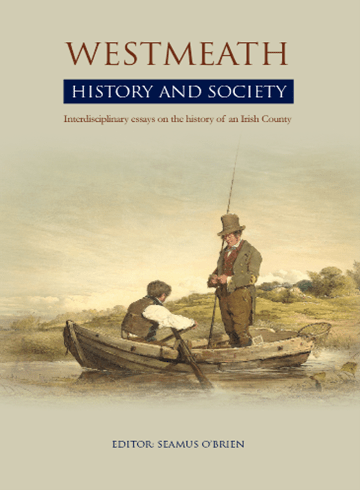
The Mullingar and Athlone launches of Westmeath History and Society have provided two interesting and original addresses on the status of local history in Westmeath, our neighbouring county. The Offaly History and Society volume was published in 1998 and is long out of print. A few copies were secured by Offaly History some years ago and are offered for sales as scarce titles. We thank our friend Dr Harman Murtagh for a copy of his address on 31 3 2022 and we have added some pictures for our readers. Enjoy the address in Athlone and you can get the book at Offaly History Centre and online at www.offalyhistory.com, over 900 pages, hardback, €60.
My friends,
This is the south Westmeath launch of this magnificent volume, Westmeath history and society.
A week ago it was launched in north Westmeath by the archbishop of Dublin, the very Reverend Dr Farrell; south Westmeath must make do with the most irreverent Dr Murtagh.
The book is 900 pages long. As the archbishop observed in Mullingar, it’s about the size of a concrete block: in my view, its only fault is that it’s rather heavy to hold in bed.
Westmeath history and society is one of a series of county books – incredibly it’s the twenty-ninth in the series. The series has been appearing at the rate of a volume a year since 1985.
The series founder, general editor and manager from the start is Dr Willie Nolan, aided and abetted by his wife, Theresa. Their contribution to Irish society and to local studies is without equal. In France they would undoubtedly be awarded the Legion of Honour; in Britain surely Sir Willie and Dame Theresa? In Ireland, and here in Athlone, we can offer at least our enormous admiration for their magnificent achievement – twenty-nine county volumes of this size down, and only three to go! Wow!
In the aftermath of the Anglo-Irish Treaty Birr Barracks in Offaly was one of the first to be evacuated by the British military. It was also the largest in the county. Stephen Callaghan takes up the story.
Wednesday, 2 February 2022 marked the centenary anniversary of the departure of the Leinster Regiment from Birr Barracks. A historically significant event which little is known about. The signing of the Anglo-Irish Treaty in December 1921 effectively saw the withdrawal of the British Army from Ireland which would take place over the coming months, with British military barracks around the country being handed over to the newly created National Army. This mass exodus included the Leinster Regiment depot staff based in Birr Barracks, which it had called home for the past 41 years.



 offalyhistoryblog