The founding of Tullamore Credit Union in April 1963 was one of the best things that ever happened in Tullamore. The same can be said of the credit union movement founded in Ireland in the late 1950s. How did it come about? How was it sustained? Who were the leaders, managers and staff at the front line? The success of a community-based, people-centred and voluntary effort is all the more relevant today when people often have only machines to turn to in the provision of services and some feel disenfranchised both at local and central government level. ‘We ourselves’ was heard a lot in this ‘Decade of Centenaries’. It was also the cry of the credit union founders in the Lemass-led early 1960s when practical steps were taken to stem the flow of emigration and provide employment opportunities at home through the provision of credit where it could be useful.
Growing up on Clontarf Road, Tullamore, on the banks of the Grand Canal in the 1950s and 1960s I spent many childhood hours playing beside the canal. This was where my father’s family had lived for generations in East View Terrace before he and several of his siblings had acquired houses in Frank Gibney’s new state-of-the-art housing on Clontarf Road. In early teenage years I took to walking the canal line and ventured to Kilgortin Mill and Rahan, where my mother’s people, my grandfather and uncles and a multiplicity of cousins, lived. Not surprisingly the canal got under my skin if not indeed into my bloodstream.
Hiking west from Tullamore the ‘canal line’ took us to exotic locations: The Metal Railway Bridge and slow-moving trains, the inaccessible Srah Castle, Molloy’s Bridge for in-season snowdrops and horse chestnuts and the hugely impressive six-chimneyed Ballycowan Castle, overlooking the imperious and impervious Huband Aqueduct. Rambling east towards Cappancur we soon explored in detail the small aqueduct which seemingly miraculously ushered the Barony River under the canal and were further allured by the rotundity of Boland’s lockhouse and a lock manned by a team of sisters. Graduating to the bicycle we set out along the towpath for far-flung towns and villages: Ballycommon and the Wood-of-O, the Kilbeggan Branch, historic Daingean and the outré but warm and welcoming church at Pollagh.
Grand canal from the 27th lock at Cox’s Bridge, Tullamore about 1910(more…)
The finding of the De Burgo-O’Malley Chalice in a house in High Street, Tullamore in 1896 was a significant event and the chalice now features in A History of Ireland in 100 Objects.[1] Other artifacts in the 100 series include the Clonmacnoise Crozier, Old Croghan Man and the Ballinderry Brooch. Surprising omissions from the 100-book were The Shrine of St Manchan, The Book of Durrow and MacRegol’s Gospel. Never mind, these manuscripts were included in the British Library exhibition in 2018–19, and the wonderful new book The Shrine of St Manchan will make the locally held shrine known to a much wider public.[2]
It has been a good year for new publications contributing to the history of County Offaly and helping us to get to know ourselves and our place better. When the annual report of the Tullamore Credit Union is dropped in the door you know Christmas is close. Seeing the cover and that the credit union is now sixty years old set us thinking of phases in our history. The year 1923 marked the end of the civil war. After a period of growth from 1891 to 1918 things got difficult. You could write off 1923–63 in terms of the economic engine. It was mostly switched off with exceptions in Tullamore Yarns, the Bacon Factory, Tullamore and the Williams and Egan businesses serving the midlands. The emerging Bord na Mona and ESB were providing jobs in west Offaly from the 1950s and east Offaly later, but it was the 1960s before a general ‘all boats’ lift up occurred. Equally you could say that since September 2001 (and the mobile phone) we have been living with anxiety which seems to grow every year especially since Brexit 2016 and now the war and climate change. Not to mention all the things we have to do online to comply with the requirements of banks and government. These books are all available from Offaly History, Bury Quay (and online http://www.offalyhistory) and our friends in Midland Books, Tullamore.
A contribution to marking the Decade of Centenaries in Offaly and recalling the past generations and the towns and villages on the eve of the War of Independence
In marking the years from 1912 to 1923 we may think that the years around 1916, the War of Independence and the Civil War were times of unmitigated strife. Not so. Normal life continued, if punctuated by violent acts, such as the shooting of policemen in Kinnitty, Kilbeggan or Tullamore. The finding of bodies of spies, ‘the disappeared’, in Mountbolus or Puttaghaun. The holding of brief gunbattles in Ballycommon or Charleville Road. Worst of all the organised state violence condoned by Churchill and Lloyd George in the form of the Black and Tans racing through towns and villages in the dead of night and taking shots at anything that moved. Yet normal life continued and no better illustrated than by the issue, almost every week, (Offaly Independent excepted as the printing works was destroyed by British forces ) of the three or four local papers in Offaly and from time to time trade supplements or special publications such as trade directories that very much illustrate local business in most of the Offaly towns. Recently Offaly History acquired the 1919 MacDonald’s Trade Directory for Ireland to add to its collection at Bury Quay, Tullamore.
This is a new 20-minute video recording on the history of the Society, now better known as Offaly History with lots of interesting photos especially recorded for Heritage Week. We want to thank all who have contributed to making it so successful so far with activities across the county, and continuing until Sunday. The lecture on Larkin’s maps and their predecessors we shall post next week, also a video on the Durrow Pattern. Our next lecture is on 5 September on Michael Collins and is important. More information next week.
This weekend sees the start of Heritage Week 2022 and a very welcome return to exploring the county in person with some great material coming on-line too from Offaly History. We are launching six new videos via Offaly History YouTube and Heritage Week 2022. Our thanks to Amanda Pedlow, county heritage officer for all who work in coordinating the programme. She writes:
With over 30 events here is a reminder for Saturday’s events as a starter’…@offalyheritage @HeritageHubIRE Our thanks to Fergal MacCabe for the use of three of his wonderful watercolours of Srah Castle (1588), Ballycowan (1626) and Bury Bridge (1801).
The Offaly Heritage Office and Amanda Pedlow have been working with Dr Maebh O’ Regan of National College of Art and Design supporting a project with the Banagher Crafting Group exploring the Banagher and Bronte connections. Some of you may have attended events at the recent That Beats Banagher Festival.
One of the outputs is a short fifteen-minute film about the discovery of the Bronte Family Portrait in Hill House in Banagher in 1914 and an interview with Dr Sarah Mouldon of the National Portrait Gallery London who care for it now. Please see the video link for you tube of a very fine presentation adding greatly to our knowledge of how the portrait was received when first presented to the public in 1914. We attach some background material on the discovery of the painting at Hill House, Banagher and how it came to be there from an earlier Offaly History blog. Our thanks to Amanda Pedlow and all concerned with this fine and informative production.
This is one of the projects supported by Offaly County Council through the Creative Ireland programme.
This year’s That Beats Banagher Festival will take place over next weekend Friday to Sunday, 22 to 24 July with a multiplicity of literary, heritage, cultural and sporting events including a food and craft fair in the Bridge Barracks Yard at the West End on Saturday, 12 noon to 4.30 p.m. craft workshops, children’s events, water events, children’s outdoor cinema and other surprise events. We are a day early with the blog to help promote this interesting festival.
Book Launches
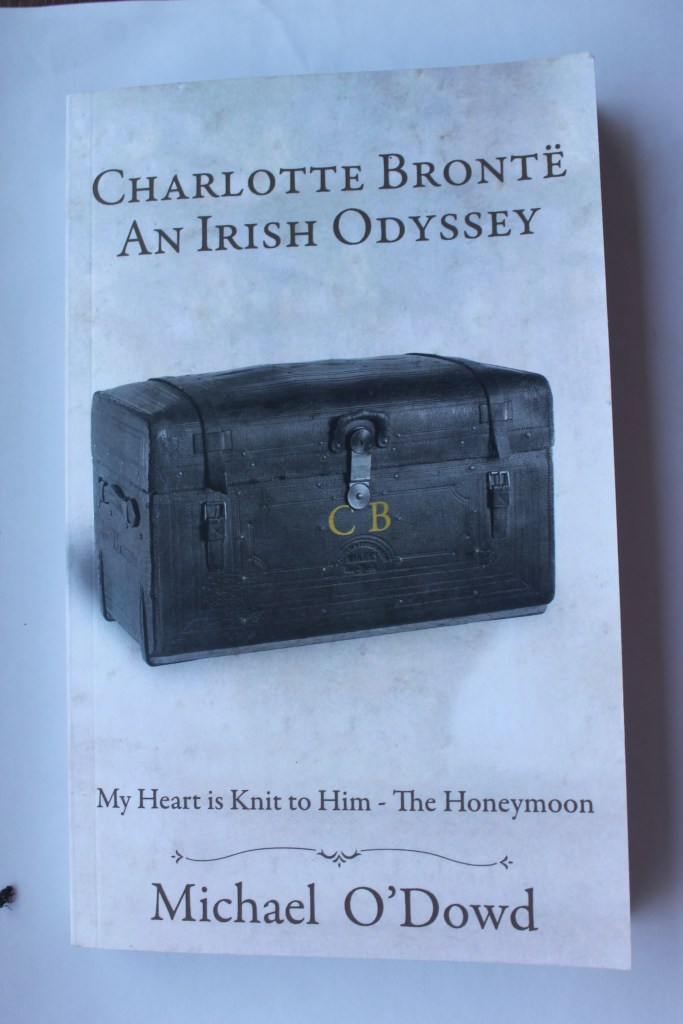
The programme is particularly strong on literary events with the launch of two books on Charlotte Brontë’s honeymoon in Ireland, the first called Arthur & Charlotte, by Pauline Clooney (published by Merdog) and the second, Charlotte Brontë: An Irish Odyssey by Michael O’ Dowd (published by Pardus Media). Pauline & Michael recently spoke with much acclaim at the prestigious Bradford Literary Festival under the title No Net Ensnares Me: Charlotte Brontë Abroad. The event will be held at 6.30 p.m. on Friday 22nd July in the Long Room in The Crank House.
As part of the Tullamore 400th series and also in the context of research as part of a survey of Tullamore’s heritage in O’Connor Square and High Street, Tullamore we are pleased to present this article on one of the most attractive of the buildings of O’Connor Square. This is the building described by Andrew Tierney in Central Leinster in the Buildings of Ireland series (Yale 2019, p. 628) as ‘a ‘flamboyant three-storey Ruskinian Gothic warehouse’. The number 12 is from that in Griffith’s printed valuation of 1854 (GV 12). The number 71 (noted below) was part of the running series for the entire town of Tullamore in the manuscript valuation of 1843. the brick building was the first in Tullamore to be restored as to the facade (but not the interior) and incorporated in the Bank of Ireland Tullamore branch in 1979. It set a high standard for such work and wile not residential at least is well used and contributes to the streetscape, and very much so since one-third of O’Connor Square has now been pedestrianised.
O’Connor Square in 2020
To cite the Heritage Council’s own words on the Historic Towns Initiative:
Many of our city, town and village centres are historic places with their own distinct identities. Sustaining these is a complex process that in many cases involves the conservation and re-use of existing buildings, the care of public spaces and the provision of community facilities. The conservation and interpretation of this heritage makes our towns interesting, unique and attractive to residents and visitors. In support of the Town Centres First policy set out in the Programme for Government: Our Shared Future (2020), the Historic Towns Initiative (HTI) is a joint undertaking by the Department of Housing, Local Government and Heritage and the Heritage Council which aims to promote the heritage-led regeneration of Ireland’s historic towns.




 offalyhistoryblog