Offaly History is pleased to announce the opening of Offaly Archives at unit 1F, Cluster Two, Axis Business Park, on Thursday 18 November 2021, by minister of state at the Department of Housing, Local Government and Heritage, Malcolm Noonan.
Offaly History completed the building of its second premises in 2019 to coincide with its 50th anniversary. The new repository is a state-of-the-art archives building managed by a professional archivist, Lisa Shortall, and houses the collections of Offaly History and Offaly County Library. The mix of the voluntary and the public sectors, under professional management, provides a unique blend of enthusiasm, specialist knowledge and continuity that can only enhance Offaly Archives over time.
Tullamore made the switch from gas lighting to public lamps powered by electricity on 27 September 1921 and Birr about a week earlier. The change in Tullamore was coming for over twenty years and Charleville Castle and D. E. Williams both had electric light from about 1900 and earlier. Lord Rosse had it in Birr Castle in the 1880s. Birr was earlier to have public lighting by gas lighting than Tullamore and had a town supply and town commissioners in 1852.
Tullamore elected its town commissioners and adopted gas lighting in 1860. Before that public lighting was non-existent in Tullamore with just one candle lamp in Charleville/O’Connor Square in 1854. By the beginning of the First World War the number of gas lamps in Tullamore was almost 80 and the lighting system had been greatly improved with ‘the illuminating power of the lamps having been greatly increased by the adoption of inverted incandescent burners’ (1915). The gas was supplied by a private company comprised of local merchants who were the owners and directors. Change was flagged in 1913 but little progress could be made during the war. In 1918 Birr registered a company to take charge of the local public lighting undertaking and Tullamore did likewise in 1920-21. Birr business contributed £9,000 and Tullamore £13,000 to the new undertakings. The lighting was switched on in Birr in 1920 but only for short time and was not finally in place until a week before Tullamore in mid September 1921. Roscrea had electricity at least a year earlier via a tender from Roscrea Bacon Factory. The Tullamore investors included D.E. Williams £5,000, P.J. Egan €1,000, P & H Egan Ltd £1,000, Fr Callary £500, Sisters of Mercy £200 and others. What is striking about the list of promoters of public lighting is that where Quaker and Methodists businessmen led the way in 1860 (Goodbody and Lumley), in 1921 it was Catholic merchants and Catholic institutions (Egan, Williams, the parish priest and the Mercy nuns). The 1921 directors were all Catholics save the Methodist W.C. Graham.
Tullamore’s High Street with Sergeant Ahern talking in what is now the Dew Inn (former Bus Bar), about 1910. Courtesy of NLI.
A Tullamore school boy records the date in his diary
Patrick Wrafter, better known in later life as P. A. Wrafter, kept a short diary relating to national and Tullamore events during the War of Independence and the Civil War. For its simplicity and directness, it is attractive and provides an insight into how crucial events in Ireland’s history impacted on the mind of a thirteen-year-old boy. Most of the diary entries were about the War of Independence and the Civil War. The move to electricity began during the War of Independence and was completed during the Truce period, i.e. when negotiations had started but before the delegation went to London. Wrafter wrote:
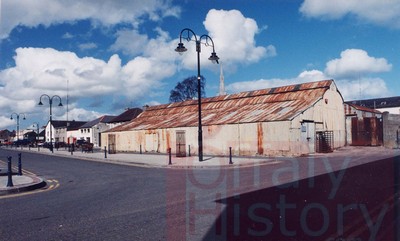
Started to build the Electric Light Shed over in the square on the 3rd January 1921. The same day as we went back to school. [This was the shed used to house the electricity generating equipment in the Market Square. The ESB acquired the Tullamore Electric Light Company in 1930 and the shed was demolished in 1999.]
Alo Brennan, Church St., Tullamore, was arrested on the 18 January 1921. [Later of Cormac Street, he was prominent in the Volunteers.]
Masked and armed men entered the Post-Office in Tullamore on the 20th January 1921 and took away the mails for the R.I.C.
Peace Conference started on July the 3rd 1921, in the Mansion House, Dublin.
Mr D. E. Williams, Tullamore died on the 3rd July 1921 aged 72 years. R.I.P.
Truce declared in Ireland in July 1921. [9th July.]
At least 80 prisoners escaped from the Rath Camp, Curragh by a subterranean tunnel 50 ft. long dug by themselves with pieces of iron etc. Sept. 1921 [LE, 17 Sept. 1921.]
Electric light was lit in the streets and houses on September the 27, 1921.
The electricity generating shed in Market Square, Tullamore, 1921-1999.It was to the rear of the old gas company buildings
Young Patrick Wrafter might have added that the poles to carry the electric cable were in course of erection in the streets of the town from July 1920. These were not the first of many poles to ‘grace’ the streets as those for telephones had been provided from about 1908–11. Of the 80 or so gas lamp standards in Tullamore only one survives at Moore Hall, O’Moore Street. The Truce of 11 July 1921 was holding with a Truce dance in the Foresters new hall over the co-operative bakery in September and a big meeting in Tullamore on 2 October to welcome Dr McCartain. In the same month a young girl of 20 was tied to the railings of Tullamore church with the word ‘Immorality’ written on a card attached to her. Two more girls were chained to the new electric poles near the church with the card attached ‘Beware of I. . . There are others too’. Presumably these were girls who had been overfriendly with the occupying forces, or it may have been the highly moral new republican police acting on possible sentencing in the Dáil courts.
The provision of public utilities in a town is a measure of its civility. Here we are talking of lighting, water, sewerage, roads, footpaths, a market house, and nowadays a public library (see OH blog of May 2021), and a swimming pool. Arts centres, public archives and museums would be down the list, but even here we are well on the way with only the county museum missing from the galaxy of facilities. Hospitals, courthouses and jails were early on the list of institutional facilities with a county hospital of sorts in Tullamore from 1767.
In a blog on 20 October 2020, we wrote that the start-up of the Tullamore Gas Company was in 1859 and the company survived until September 1921. Gas lighting for Tullamore had been mooted as early as 1845 but it took sustained pressure from the local press and the business acumen of the Goodbody brothers of the Tullamore tobacco factory to get it done. Others who helped were Alfred Bury of Charleville (later fifth earl) and the young Tullamore-born barrister Constantine Molloy. Initial opposition had come from the parish priest Fr O’Rafferty (died 1857), and later from the ratepayers led by the Acres family – the principal tenement property owners in Tullamore. Birr had street lighting from 1852 and Mullingar and Newbridge by 1859. The completion of the new railway connection to Tullamore in September 1859 was another boost to forward thinking about the status of Tullamore and its potential. The opening of the streets for lamps meant the adoption of a small measure of local government and the provision of town commissioners – the first town council in Tullamore from 1860. It did not mean that buildings were to be lighted and places such as Tullamore courthouse were still without gas lighting in 1868, as was much of the workhouse in 1897. The latter was using 36 lbs of candles per week in the late 1890s. Gas was later provided but as late as of 1910 the infirmary section of the workhouse was still lit by oil lamps.
The question of lighting Tullamore by electricity surfaced as early as early as 1897. Daniel E. Williams, who was the first to have a motor car in Offaly, introduced electrical generation in his own business in the 1890s. In 1909 the Tullamore town clerk, E.J. Graham, estimated that it would cost £4,000 to bring electricity to Tullamore. At the time the town was serviced by 69 lamps at £2 each per year. This would increase to 78 lamps by 1916. By this time the council had spent large sums on waterworks and housing but less so on sewerage. Economy was a watchword and, as noted, the gas lamps were not activated on moonlit nights. The Tullamore rector, R.S. Craig wrote to the press in early 1914 in the aftermath of the rejection of electric light for Tullamore in 1913 on the grounds of the need for a town sewerage system needed to have a prior call on local expenditure.
The public lighting of Tullamore is not in the hands of the Urban Council as it should be. It is farmed out to the local Gas Company, and one of the conditions – economic conditions – is that there is no occasion to light the lamps on moonlight nights. This is a condition , as the Rev Mr. Craig very aptly says, has nothing to commend it, but ancient precedent. The same bad precedent in the matter of this arrangement is followed in Athlone, and many of the other provincial towns. On the nights when we should have moonlight, but very often have not, there is no public lighting, and pedestrians and visitors or strangers doing business within our gates move about to the imminent danger of breaking their necks. There was the recent case in Tullamore when on the occasion of the great National Demonstration many thousands of people were gathered in the town. Before they could get out of it nightfall overtook them. The business houses were, of course, closed, and there was no assistance to be had from friendly shop windows. The moon was expected that night to give light to the wayfarer, but was in no particular hurry in coming to our help. The Gas Company economised according to their arrangement with the Urban Council and did not light the gas lamps. The inconvenience of the situation need not be emphasised.
Rector Craig’s letter was an expression of his frustration at the council not being able to proceed with the change over to electricity in 1913. The big shops already had electric power and were in no rush to suffer a possible rates increase from the council to provide the funds for the new scheme. It was only in 1917 that Griffith of the new Turf Works in Pollagh agreed to give his expertise to assisting in getting electricity going in Tullamore.
The provision of electric lighting in the smaller towns and villages was slow in coming. A Banagher writer in late 1921 noted that the town was in the dark: ‘The only bit of light we have had for the past three or four years was that provided on the night of Dr McCartan’s arrival’. McCartan was the last MP elected for King’s County/Offaly and the first for the Sinn Féin Party (April and December 1918). Electricity for Banagher lighting had been mooted as early as 1911 by the local improvement association. The visit of Dr McCartain to Tullamore on 2 October 1921 may have been the incentive to get the electric light installation completed in time for the big welcome.
From the Midland Tribune, 1 October 1921
No less than six Offaly based private companies were taken over by the ESB over the period 1928 to 1956. The Tullamore company with 240 customers in 1930 (about one-third to one quarter of the number of houses) was taken over by ESB in that year. In 1929 Birr had 342 customers, rising to 596 in 1947 when transferred to ESB. The Edenderry business was transferred in June 1928, but the number of customers is not now known. Banagher obtained the ESB Shannon supply in 1930 and Clara in the same year.
The offer for subscribers for shares in the new Tullamore company. It was alongside the obituary for Terence MacSwiney. Sgt Cronin of Tullamore was shot a few days laterin reprisal.Ordinary life and the War of Independence coexisted side by side in a strange way.
Disputes with staff working for the Tullamore Electric Light Company started within months of the light being switched on and a strike was called off in November 1921 when the three men employed by the company agreed to accept £3 7s. 6d. per week for a 56-hour week, in lieu of the £3 10s. demanded. The town council was the main customer and was paying up to £300 per year for 75 lamps. No great change in public provision from the days of gas. We do not know at this point what was the take up of power from the private and domestic sector. In the home it would have been for lighting only and that sparingly in many houses up to the 1960s. At the time of the move to ESB in 1930 and the takeover of the local provider it was reported that ESB men were preparing posts to replace existing standards where necessary. Also that ‘Mechanics are affixing electric fittings in several houses’. The firm of Siemens Schuckert was finishing the installation of electric light in the Catholic church and that Oppenheimer was finishing mosaic work to sanctuary. Dreamy altar boys will recall these mosaics with St Brendan navigating the billowing sea and which were destroyed in the fire of 1983.
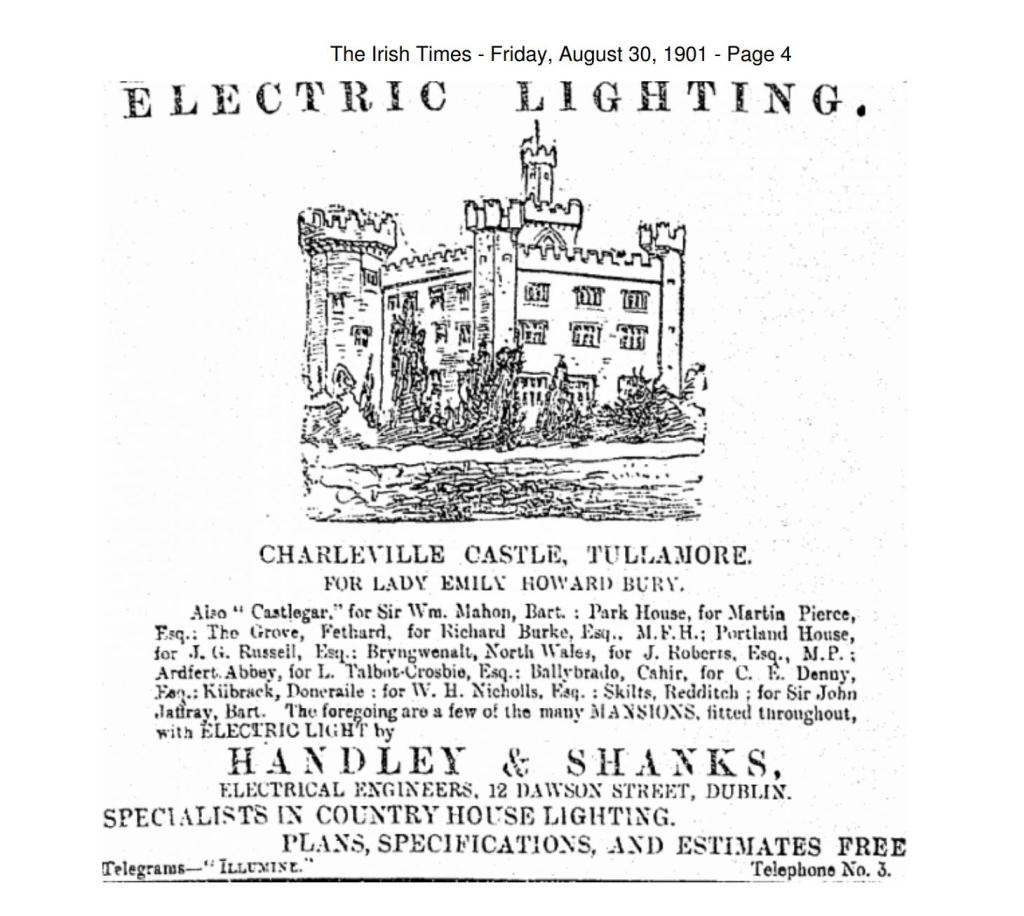
A 1901 advert for a supplier featuring Charleville Castle. By 1912 the castle had been largely vacated by its owner Lady Bury. Courtesy of Irish Times
It is hard to believe now that before the 1850s there was no public lighting in any of the Offaly towns. Neither was there any on moonlit evenings up to 1921, or after 12 midnight up to the early 1960s. Visitors to the Aran Islands will recall walking on its pitch-black roads, and, nearer home, those living in the countryside experience it every evening if making a short journey on foot. Rural electrification did not follow the towns until the late 1940s in many areas in Offaly and this has been documented in lectures at Bury Quay and the records of interviews now in Offaly Archives. See also a useful piece on the arrival of ESB provided electricity on http://www.esbarchives). Surprisingly there is nothing surviving of the minutes of the local gas companies in Offaly or the private electricity companies that were taken over by ESB in c. 1930. The company’s dealings with the urban council can be followed in the local press and in the minute books of the council (now in Offaly Archives). The Tribune was the only Tullamore newspaper in 1921 as the printing works of the Offaly Independent had been destroyed by the British military in November 1920. It reported the switch-on while the Birr Chronicle did likewise a week earlier.
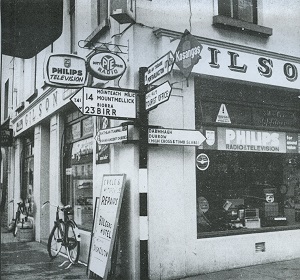
Sales of electrical goods took off only in the 1960s. Here the well-known Tom Gilson’s shop, Tullamore
Next blog is on Saturday 18 on Charleville by Dr Judith Hill. Email info@offalyhistory.com for the link to the Monday lecture.
On 25 Sept. Dr Mary Jane Fox on Columcille and copyright disputes
We welcome Pat McLoughlin this week as a new contributor writing about attacks on trains in the Clara-Ballycumber area during the War of Independence. Pat writes: I grew up between Clara and Ballycumber in the townland of Clonshanny. Thomas Bracken who was Adjunt Officer 1st Battalion, Offaly No. 2 Bde. is my grandfather, Brigid Bracken (née Reilly) Cumann na mBan is my Grandmother. The Bracken family who at that time lived in Erry, Clara were all involved on the War of Independence. My neighbours Tommy and Annie Berry (née Morris) and John Minnock were among many veterans in that community. The War of Independence I grew up with was fought in Clara, Ballycumber, The Barney Bridge, The Island, on the Banagher line, the people who fought it were the people we lived alongside. The people and stories were part of our lives, then came funerals with Tricolour draped coffins, Military honours for Irish War Heroes and life moved on. 100 years on the Military Archive maintained by the Irish Defence Forces gives me an opportunity to recreate some of the history of the community where I grew up.
Change is always about but perhaps more so since ‘Nine Eleven’ 2001 and March 2020 than we care to appreciate. Changes in eating out in Tullamore’s streets in recent days would have come as a shock to our predecessors of 1914. We are not Spain as Brewery Tap owner, Paul Bell, recently remarked but the fine weather and the adoption of coffee over tea are all helping. In the interior things are changing too. The love of banking halls is gone and now it is all doors and screens as new ways of working come in. The new county offices inTullamore (2002), and in many other buildings, may yet have to be reconfigured, and as for nightclubs what are we to do. On top of that some Tullamore municipal councillors are talking of revisiting our list of Protected Structures to remove those buildings that cannot be sold and are falling down.
All this talk of change, inside and out, suggests that we look again at what we had in the way of streetscapes before that period of great turbulence when Ireland was on the verge of Home Rule and Partition was unmentionable. It was ‘The Sunday before the War’ time. Thanks to the work of photographer Robert French (1841–1917) and the Lawrence Studio (1865–1942) we can look back, not in anger or nostalgia, but in awe at what was achieved in our towns over the period from the 1740s to 1914, but more especially in the years of growth and prosperity from 1891 to the First World War.
The Lawrence Collection of some 40,000 photographs are well known. Perhaps less so that the online catalogue from the National Library (nli.ie) is in large format, high resolution, for the Offaly towns, allowing us to dig down/zoom in to see the detail that escapes one looking at the ubiquitous printed photograph in the pub or the tablemat. There are almost 200 Lawrence photographs for the Offaly towns and villages. For Tullamore there are at least 17, for Birr over 70, Banagher 3, Clara 20, Edenderry over 16, Portarlington 18, Kilcormac 12 including four placed in County Cavan, Clonmacnoise at least 33, Kinnitty 3, Mountbolus 1, and perhaps more to be identified. These figures are estimates and likely to change such as one of the earliest for Tullamore (late 1890s perhaps) that became available in recent years, or at least better known and the subject of this blog.
A very fine book from Kieran Hickey and Allen Lane (1973)(more…)
A big welcome to Martin Moore this week as a new contributor to Offaly History blog and with a new topic. A big thanks also for the work of the sports historians in the county including the late John McKenna on association football in Tullamore in the 20th century.Martin is preparing an article for Offaly Heritage 12 (forthcoming later in the year).
Recent research into the origins of association football in Ireland has demonstrated that Offaly was – for a brief period – a centre of early soccer activity, involving one of the first soccer teams in Ireland. The traditional understanding is that soccer was consciously ‘introduced’ to Belfast in 1878, from where the game eventually spread around the rest of the island. The real story, however, is not quite so straightforward. We now know that soccer was played in other parts of Ireland before 1878 and Offaly, Tipperary and Sligo were centres where the code was played in the late 1870s and early 1880s, though it failed to take root and was not sustained.
This week we have a blog provided by Eduardo García Saenz (member of Champagnat Rugby Club, Economist, Journalist and Sports’ Historian, especially in rugby, soccer and horse Polo. In this article he is presenting about THOMAS St. George ARMSTRONG (1797-1875); born in Garrycastle, near Banagher and who made a fortune in Argentina. His son bought Garrycastle House, Banagher in 1890 and is in Burke’s Landed Gentry 1912 edition with lands in Garrycastle and a residence in Paris. This is our last blog of this year and so far we have achieved 103,000 views for our blogs since 1 Jan. 2020. Thanks contributors and readers for all your help and wishing you all the best in 2021. Like our blog to ensure you get it every week per an email advice. All our blogs can be found at Offalyhistoryblog and our web platform http://www.offalyhistory.com. We post them every week to Facebook and Twitter (Offaly History).
Eduardo García Saenz
Eduardo is the the great-great-grand child (Chozno Grandson) of Thomas Armstrong who died in Buenos Aires in 1875. Eduardo has visited Dublin and Malahide, but has not yet had the opportunity to visit Banagher, Birr and Tullamore. He is aware of our ‘delicious Irish whiskey and also the malt’. In rugby he knows that there are two good rugby clubs in Co, Offaly: Tullamore RFC and Birr RFC.
Eduardo writes that the Armstrong family gave the land in Banagher to build St. Rynagh’s Church in 1826 and donated the bells for the church. Thomas Armstrong was also a donor to the Catholic church in Banagher in 1873 (King’s County Chronicle, 20 Mar. 1873). In 1847 he donated £50 to support famine relief in Banagher and Lusmagh, and later to the Crimean War Fund.
We would welcome blogs from overseas on the contribution of people from the midlands of Ireland in their adopted country (to info@offalyhistory.com). We draw attention to the Dictionary of Argentina Biography and the like for Australia. These are now online. The Irish DIB goes on line free in 2021.
Many readers and their parents will have great recollections of the dancing scene in Ireland. You can help write the history. Share your thoughts and send on the stories needed to build a picture of the dancing scene in Ireland. Many will recall Je t’aime played in the 1960s in St Mary’s Hall, or the Harriers, Tullamore. But what about the County Ballroom and the parish halls in Clara, Birr, Rahan, Killeigh and so many more. Did dancing bring about the ‘ruin of virtue’?
Dancing has always been a source of expression, fun and entertainment in Ireland. People danced at the crossroads, in each other’s houses, at social events, festivals, and in licensed dancehalls all around the country. From the early twentieth century the Catholic hierarchy became particularly concerned with the opportunities that might arise for sexual immorality in dancehalls. In October 1925 the bishops and archbishops of Ireland issued a statement which was to be read at ‘the principal masses, in all churches on the first Sunday of each quarter of the ecclesiastical year.’ The statement referred to the ‘evils of dancing’ and it was ‘a grave and solemn warning to the people with regard to the spiritual dangers associated with dancing’. The statement noted: ‘We know too well the fruit of these [dance] halls all over the country. It is nothing new, alas, to find Irish girls now and then brought to shame, and retiring to the refuge of institutions or the dens of great cities. But dancing halls, more especially, in the general uncontrol of recent years, have deplorably aggravated the ruin of virtue due to ordinary human weakness. They have brought many a good innocent girl into sin, shame and scandal, and set her unwary feet on the road that leads to perdition’. The behaviour of the men did not elicit much comment. From the mid-1920s and throughout the early 1930s there were constant references in the newspapers to the problems of dancehalls and motor cars. In 1931 Cardinal McRory combined the two and saw a growing evil in ‘the parking of cars close to dancehalls in badly lighted village streets or on dark country roads. Cars so placed are used … by young people for sitting out in the intervals between dances’. ‘Joy-riding’ had a very different connotation in the period than it does now. Reporting on a sermon by the bishop of Galway, the Irish Independent noted that ‘joy-riding’ was conducted by ‘Evil men – demons in human form come from outside the parish and outside the city – to indulge in this practice. They lure girls from the town to go for motor drives into the country, and you know what happens… it is not for the benefit of the motor drive. It is for something infinitely worse’.
John O’Donovan stayed in Banagher from 10-21 January 1834 where he was accompanied by Thomas O’Connor. As mentioned in a previous blog he used his time there to look at two historic sites in particular, in addition to his normal work. He first concentrated on Clonmacnoise, writing his first substantial and detailed letters on 15 January 1838. This followed on from his request that documents be sent from Dublin ahead of his arrival. He had visited Clonmacnoise and had collected a considerable amount of information about the church site and general area.
He first concentrated on the individual monuments on the site as detailed in earlier manuscripts and associated the monument to the relevant family names. His local contact was a man named Patrick Molloy but O’Donovan was sceptical about the accuracy of the information provided by him. In addition, he dealt with the map produced by Sir James Ware dated 1705; on this map Ware had identified 10 churches at Clonmacnoise, see below. For each monument O’Donovan checked the age of each as indicated in the Annals, checked the background of each one and compared that to a report in Petrie’s possession. (more…)
An attractive new book on the history and memorials of Saint Rynagh’s Old Graveyard in Banagher has just been published. The book has 192 pages, almost 400 photographs and historical images plus a collection of essays and short articles on eminent souls buried there and on aspects of the site’s ecclesiastical history. The book is written by James Scully, a long-time student of Banagher’s history. This is your Saturday blog coming early because of Halloween.
Over the past few months I have been finalizing a book on the memorials in Saint Rynagh’s Graveyard in Banagher. For some time now the recording of the transcriptions has been complete but the decision to add a description of each memorial has absorbed more time than intended. It has however been a most rewarding task because now when I visit other graveyards I look at memorials with a more trained eye and with greater awareness of the skills and talents of the stonecutters. This has fostered a greater appreciation of the decorative carvings and lettering styles which are abundant throughout County Offaly. It has also prompted greater recognition of unusual features such as ligatures, mirrored letters, ampersands and other hallmarks of a vernacular style. Above all it has stimulated a resolve to publicize those monuments which are unique whether it be for the occupational or funerary symbols portrayed on them or that they are fine examples of a particular stonecutter. Tombstones which have a dedication of literary merit or those which carry symbols of the Passion of Our Lord will also be a focus of attention.






 offalyhistoryblog