
We had a blog last April on the 100th anniversary of the death of Matthew Kane. Now we recall the first procession in his memory from Tullamore to his place of burial in Mucklagh in late January 1922. Those early weeks of February 1922 saw the commencement of the removal of the British forces from Offaly in the aftermath of the Anglo-Irish Treaty. The barracks at Daingean, Clara, Shannonbridge and the great Birr barracks were handed over to the IRA. In the first week of February the Offaly Independent was again issued after a break of fifteen months due to the burning by the Crown forces in early November 1920 (see an earlier blog).
(more…)Category: Birr
-
The departure of the British Military from Offaly one hundred years ago – Birr Barracks. Stephen Callaghan, Blog No 354, 5th Feb 2022
In the aftermath of the Anglo-Irish Treaty Birr Barracks in Offaly was one of the first to be evacuated by the British military. It was also the largest in the county. Stephen Callaghan takes up the story.
Wednesday, 2 February 2022 marked the centenary anniversary of the departure of the Leinster Regiment from Birr Barracks. A historically significant event which little is known about. The signing of the Anglo-Irish Treaty in December 1921 effectively saw the withdrawal of the British Army from Ireland which would take place over the coming months, with British military barracks around the country being handed over to the newly created National Army. This mass exodus included the Leinster Regiment depot staff based in Birr Barracks, which it had called home for the past 41 years.
(more…)
-
Offaly and the Treaty Debate: widespread acceptance. Specially contributed, Blog No 347, 12th Jan 2022
Early 1922 saw just two local organs of public opinion in Offaly – the Midland Tribune and the King’s County Chronicle. The Tribune was owned by the long-term nationalist Mrs Fanning, widow of the late Dr Fanning and herself active in regard to Sinn Féin policy on amalgamation of the workhouses. Her editor was James Pike from Roscore, long-term supporter of Sinn Féin who was now ready to recommend acceptance of the Treaty. So also was Archie Wright, owner of the Protestant and unionist Birr-based Chronicle. The Offaly Independent was more representative of North Offaly, but its printing works had been destroyed by crown forces in November 1920 and did not re-emerge until late spring 1922. During the course of 2022 we plan to bring you articles on the evolving situation in Ireland and Offaly in 1922 and we will be looking into the Offaly Archives, Offaly History Centre and Offaly Libraries to dig deeper for the nuggets.
(more…)
-
Well that Beats Banagher!! A humourous expression of amazement. By Kieran Keenaghan and James Scully. Blog 346, 8th Jan 2022

This famous phrase or exclamation or some version of it has been in use for hundreds of years. There are few instances if any in the English-speaking world where a placename appears in this manner. In all cases it was used dramatically to emphasise in a humorous way what has been said or written. The phrase was seldom if ever employed in a derogatory sense. It was regularly used by public speakers such as members of parliament or lawyers and judges in court. While it was often referred in Great Britain, and indeed in other countries throughout the world, the most common usage was by people at all levels of society in Ireland and it was very much an Irishism. It appears in the works of many famous writers such as AnthonyTrollope, William Carelton, W.B.Yeats, Joyce’s Finnegans Wake and Plunkett’s Farewell Companions. It also featured regularly in newspapers and on other media as can be seen in the selection below:
(more…)
-
A novel approach to Charlotte Brontë’s honeymoon. By James Scully. Blog N0 343, 24th Dec 2021
Pauline Clooney’ Charlotte & Arthur, an imaginative recreation of the Charlotte Brontë’s honeymoon in Wales and Ireland, is an exciting combination of fact and fiction. The extensive historical research which preceded the writing of the book is evident throughout and this coupled with the creation of less historic characters and the weaving in of more fictional nuances ensures a work that is at once refreshing and convincing. While the sources of history are comparatively plentiful for this episode due to Charlotte’s prolific letter writing and an abundance of biographies of the two main characters, it is the richness of Pauline Clooney’s writing that makes the work engrossing and appealing.
(more…)
-
The internees released from the camps following the Treaty of 6 December 1921. A time of ferment in politics. By Michael Byrne. Blog No 340, 15th Dec 2021
The scene at the railway station [Tullamore] will long be remembered. Long before the hour for arrival of the train, the stream of people to the station premises and surroundings was continuous. There was joy everywhere and the light and hope that the glad tidings brought were seen in the faces of the huge gathering. The railway station premises were thronged while from every point of vantage round about it people awaited the home-coming of the boys whose familiar faces they yearned to see once more.

Ballykinlar autograph courtesy Offaly Archives. For further on this see Offaly History and Decade of Centenaries/ gallery. ‘Autograph books were an important aspect of the material culture of the camps and the internees signed each other’s books with political quotes, inspirational messages, and artwork depicting the camps or political ideals. Although prisoners were released from the camps following the Truce in 1921, anti-treaty republicans were again interned in prison camps such as Tintown in the Curragh during the Civil War.‘ – Offaly Archives Late 1921 was a time of ferment in Offaly. Once the Truce was announced in July 1921 attention turned to matters such as reforms in public health that would see the county infirmary along with the workhouses at Edenderry and Birr closed. The former workhouse at Tullamore was now to serve as county hospital and ‘county home’. It was a major reform pushed through by Sinn Féin who dominated much of local government, save in the urban councils of Birr and Tullamore. As more people were pushed out of the institutions and the economic situation deteriorated the demand for home help grew. Some of the ratepayers were concerned but not the Midland Tribune which was then owned by Mrs Margaret Powell who was one of the few women involved in the Birr local health committees.[1] Her editor from 1912 to late 1940s was James Pike from Roscore, Screggan. Four women sat on the Tullamore Hospitals and Homes Committee chaired by Mrs Wyer. Pike in an editorial on 17 December 1921 was to describe it as a momentous week with the secret debates in the Dáil. Offaly Technical Committee did not wait for the outcome of the Dáil debate and supported the Treaty almost immediately.[2] Supporters included the chairman Fr O’Reilly, Kilcormac, Revd John Humphreys and James Rogers as did Revd R.S. Craig.
(more…)
-
Cassandra, Countess of Rosse (1851-1921) – a profile of her life on the centenary of her death. By Graham Sykes. Blog No 339, 11 Dec 2021
During the summer of 1908 the 4th Earl and Countess of Rosse made their customary journey to London in order to enjoy the society ‘season.’ Sadly, this was to be their final visit together, for although the sixty-seven-year-old Earl had been in declining health for some time, soon after they returned to Birr Castle his condition began to deteriorate markedly, so much so that by Saturday 29 August he could no longer be rallied. He died later that same evening, with his wife present to the end.
What would the future hold for the dowager Countess of Rosse? She had been mistress of Birr Castle for almost four decades, having arrived in Ireland newly-married when barely eighteen years-of-age in 1870. In common with her mother-in-law, Mary Rosse (née Field), Frances Cassandra Harvey Hawke had come from a wealthy Yorkshire family, being the only child of the 4th Baron Hawke of Towton. She too had inherited property from her father – two country estates, the largest being Womersley – which naturally brought with them a measure of responsibility. However, the Earl had quickly allayed any local fears that the couple might be lured away to England. At a banquet held in his honour at the then Dooly’s Royal Arms Hotel shortly after their honeymoon, he reassured the assembled dignitaries of his firm intention to remain among them. A successful marriage requires both parties to adjust to their changed circumstances, but the Earl’s pledge meant that Cassandra’s life was destined to undergo by far the more radical transformation. Although not yet formally ‘out’ in society, she would be required to settle in a country about which she initially understood very little and find her place within an entirely new social circle.
(more…)
-
Christmas Reading from Offaly History – twelve new titles of Offaly interest, one for every day of the Festive Season. Another bumper year for local studies. Blog No 337, 4th Dec 2021
All the books here can be purchased from Offaly History (Bury Quay, Tullamore and online) and at Midland Books, Tullamore. You can also view/ borrow at Offaly Libraries and consult at Offaly History Centre.
Rathrobin and the two Irelands: the photographs of Middleton Biddulph, 1900-1920. Michael Byrne (Offaly History, Tullamore, 2021), 330 pages, 280×240, hardcover, €24.99.
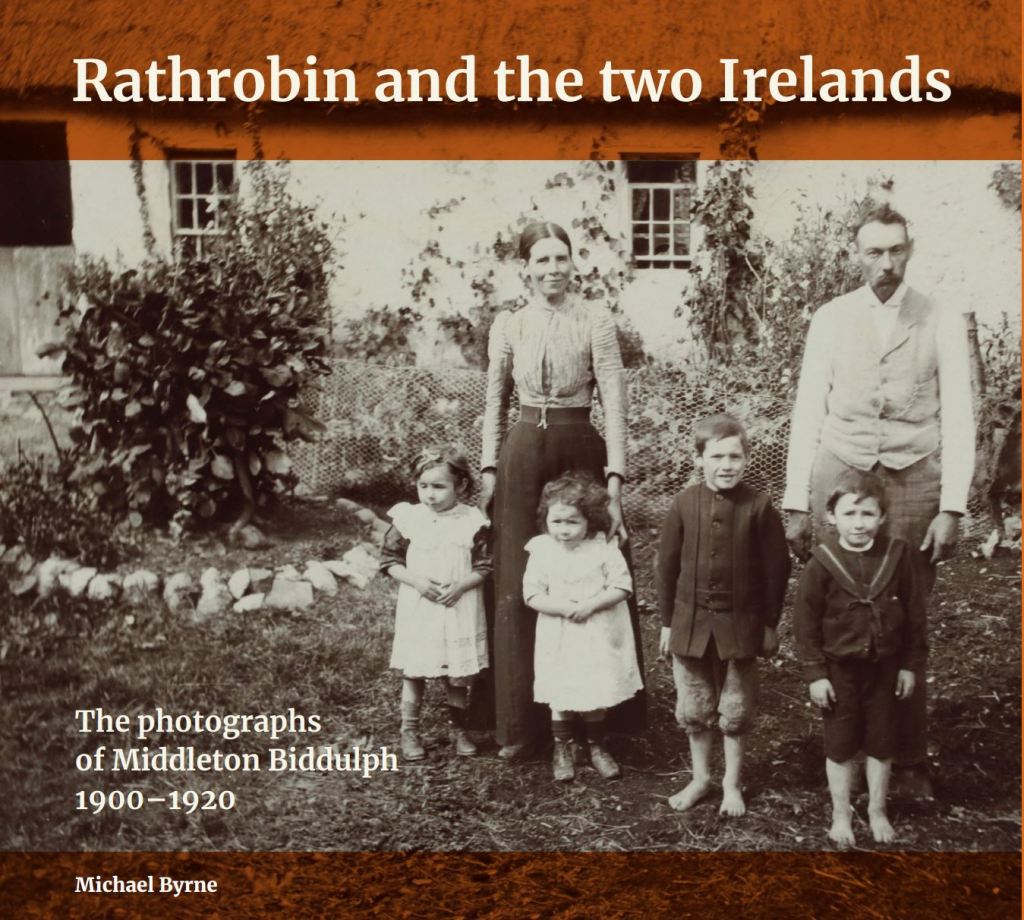
Rathrobin is a book that keeps on giving. Its 250 Biddulph photographs from the 1870s to 1920s, all carefully captioned, depict the two Irelands – unionist and nationalist, Catholic and Protestant, landed and cabbage garden. What is interesting about the pictures of Colonel Biddulph (1849-1926) of Rathrobin near Mountbolus are the nuances. He was of the lesser gentry, was a tenant of the Petty Lansdownes, and was well aware of the Plantations of the 16th and 17th centuries. He appreciated the needs of the farm labourers and was decent to his own tenants, staff and farm workers. His entire estate was not much more than a 1,000 acres. Biddulph’s circle was also the lesser gentry and those who served it such as land agents, bankers and clergy. The Catholic Protestant divide was strong but landed Catholic families did mix in Bidduph’s set, but not merchants or traders (even if very rich). Biddulph had an empathy with his farm workers and their families and sought their advancement. Many local families were photographed, together with the farming activities of his own employees.
Biddulph’s story, and that of his associates and friends, is illustrated by a selection of over 300 pictures in all, of which 250 are from the Biddulph Collection in Offaly Archives, and fifty more to illustrate the introductory essay and provide the all-important context. The essay and the photographs provide a more nuanced understanding of Ireland in the revolutionary period of 1900–23. Biddulph’s wonderful house at Rathrobin that he had so carefully ‘restored’, and all his farm improvements, were lost in the Civil War in 1923. Many other big houses from Ashford, to Ballyfin, Durrow, Brookfield, Screggan Manor and Charleville are also recorded in this volume. Some such as Brockley Park in Laois are now gone thereby making this an important work of record. The photographs by Middleton Biddulph were taken at a crucial moment in Ireland’s history. Their publication now could not come at a better time. Rathrobin is the portrait of one small estate and Killoughy parish in Offaly from the 1650s to the 1920s, but the story is of national interest. T.E. Lawrence spoke of the Arab Revolt, perhaps in Ireland we can talk of the Irish Revolt and not the full circle Revolution. You decide.
Rathrobin was supported by the Decade of Commemorations Unit in the Department of Tourism, Culture, Arts, Gaeltacht, Sport and Media
(more…)
-
The 14th and 15th earls of Huntingdon of Sharavogue, Shinrone and the Birr barracks scandal. By Stephen Callaghan. Blog No 335, 1st Dec 2021
Warner Francis John Plantagenet Hastings was born on 8 July 1868 at 54, St Stephen’s Green Place, Dublin. He was the son of Francis Power Plantagent Hastings, 14th Earl of Huntingdon, and Mary Anne Wilmot Westenra. The title of Earl of Huntingdon was an English peerage title originally created in 1065, the current title is its seventh incarnation which was created in 1529.
The 14th Earl married Mary Anne Wilmot Westenra 15 August 1867, who was the only daughter of Colonel Honourable John Craven Westenra, of Sharavogue, King’s County – a member of the Irish Whig party.
The family acquired lands in Waterford and King’s County. In the latter they lived in Sharavogue House. The house was originally built in the 1820s and was described as containing drawing and dining rooms of the finest proportion, a library, seven bedrooms, servant apartments, stables, coach houses and offices. A walled garden and 100 acres of land. Later additions to the house were made by notable Irish architect Sir Thomas Deane.
(more…)
-
‘The present war will be the greatest and most appalling the world has ever seen. The results will be proportionately as great both to conqueror and conquered.’ Bernard C. Molloy, former MP South King’s County in August 1914. By Michael Byrne. Blog No 333, 24th Nov 2021
If only the American policymakers of late years since 2001 (Afghanistan), (or even Kennedy and LBJ) had read B.C. Molloy. A former MP for King’s County, Bernard Charles Molloy, was one of the few to predict that the First World War would not be over by Christmas 1914. Molloy read the signs well, besides he had fought with the French in 1870 and knew the strength and perseverance of the Prussians. He was an MP in King’s County from 1880 to 1900 and died in 1916. It is a good time to reflect as we recently marked 11 November and the anniversary of the Truce and the Peace in June 1919. It was a a war that killed at least 40,000 Irishmen, led to 1916, the War of Independence and the Second World War.
(more…)
 offalyhistoryblog