
Back in 2014 I was an intern in the Heritage Office in Offaly County Council. I compiled a database of all known post 1700 burial grounds in the county. Compiling the database required thorough desk and field based research. During fieldwork I visited 170 of the 187 burial grounds I recorded. While visiting these places I noted many interesting and unusual features, some of which are the basis for this blog post. The list is of course subjective. There are certainly more interesting and unique features waiting to be discovered in Offaly burial grounds. (more…)
Category: Birr
-
Local history: ‘gone to pot’ or some remarks on Goss Ware/crested china by John Stocks Powell. Blog No 189, 15th April 2020

Home Rule/Rome Rule. A china mug with a portrait of Pope Pius X (1903-14) who
increased the devotionalism of the Catholic church, who promulgated the Ne Temere
decree concerning the children of mixed marriages, whose orders on the role of women in
church music (1903) was commented on by the Morkan sisters in James Joyce’s story ‘The
Dead’, and who oversaw the excommunication of Fr. George Tyrrell (1861-1909) on a
charge of heresy, whose childhood had been spent at Dangan’s Farm between
Portarlington and Mountmellick. He also enjoined the admission of children to regular
communion at the age of reason.
(Autobiography … of George Tyrrell, 2 vols. 1912, p.20-22)We welcome a new contributor to the blog this week with this article by John Stocks Powell. Enjoy and remember we have almost 190 articles to read at http://www.offalyhistoryblog. Like to get it each week and share to your friends.
There is a hierarchy of sources for the historian, local historians and those with the wider landscapes. The principal material is the written word; evidences from the time, written archives, and later written published assessments such as county histories, church memoirs, Ph.D. studies gone to print. On-line developments have made for more in quantity, and more exciting revelations, from the checking of dates on Wikipedia, or the digitised sources such as Irish and British newspapers online, and directories. Yet we know the old cliché that history is written by the winners, and that is especially true when trying to write about the history of the losers, the poor, and the illiterate. Every source has its importance.
-
A Birr Letter’s Untold Story: Hugh Leonard of Crinkill. By Stephen Callaghan. Blog No 186, 8th April 2020
Today it is all too easy to take modern technology and communication for granted. When was the last time you remember sitting down to attentively write an important letter with pen and paper? It might be fair to say that letter writing has become a dying art form. For Hugh Leonard 168 years ago this letter was important in the hope of claiming battle and prize money owed to his late son, William, who died in India in 1849. This blog post examines the contents of this letter. (more…)
-
How did we cope with Cholera in Offaly in the 1830s? Edited from an article by Dr Tim O’Neill in Offaly Heritage (2003).Blog No 178, 7th March 2020

The Offaly County Hospital, Church Street, Tullamore, had 50 beds while the population in 1841 was twice what is is now. Cholera was the epidemic disease most feared around the world in the nineteenth century.A letter from Tullamore of 1832 describes the devestating disease of cholera. ‘We had 165 deaths. All bridges to the town are cut and broken. Every house is shut up and there is no such thing as business. Men who would eat their breakfact in perfect health would be buried before dinner.’
In the eighteenth century neighbouring countries began to suffer from the disease and in the nineteenth century it attacked Europe. Cholera spread around the world in great epidemics from its traditional base in the Indian sub-continent and carried with it high mortality rates, severe suffering and terrifying symptoms. These began in 1817 but the first wave did not reach Europe and was halted temporarily at the shores of the Caspian Sea. From there in 1829 it spread rapidly through Europe. It arrived in Ireland around St Patrick’s Day 1832. This was the most serious cholera outbreak in Ireland in the nineteenth century and it has been estimated that 25,378 people died during that epidemic. The Irish death rate was high when compared to other countries for the same period.
-
The spirit of the Shannon: a journey along the River Shannon in Richard Hayward’s footsteps. Offaly History Centre, Monday 17 Feb. 2020. Blog No 175, 15th Feb 2020

In August 1939 the Irish travel writer Richard Hayward set out on a road trip to explore the Shannon just two weeks before the Second World War broke out. His evocative account of that trip, Where the River Shannon Flows, became a bestseller. The book, still sought after by lovers of the river, captures an Ireland of small shops and barefoot street urchins that has long since disappeared.
Eighty years on, inspired by his work, Paul Clements retraces Hayward’s journey along the river, following – if not strictly in his footsteps – then within the spirit of his trip. From the Shannon Pot in Cavan, 344 kilometres south to the Shannon estuary, his meandering odyssey takes him by car, on foot, and by bike and boat, discovering how the riverscape has changed but is still powerful in symbolism. Paul Clements will be giving an illustrated lecture on Monday 17 Feb. at 8.00 p.m. at the Offaly History Centre, Bury Quay, Tullamore ‘The spirit of the Shannon: a journey along the River Shannon in Richard Hayward’s footsteps’ Admission is €5 and includes tea and biscuits. So why not come along to hear and see this wonderfully illustrated talk.
-
A D. E. Williams Limited Tullamore maltster for fifty years tells his story. By the late Michael Power of Marian Place, Tullamore. Blog No 174, 8th Feb 2020
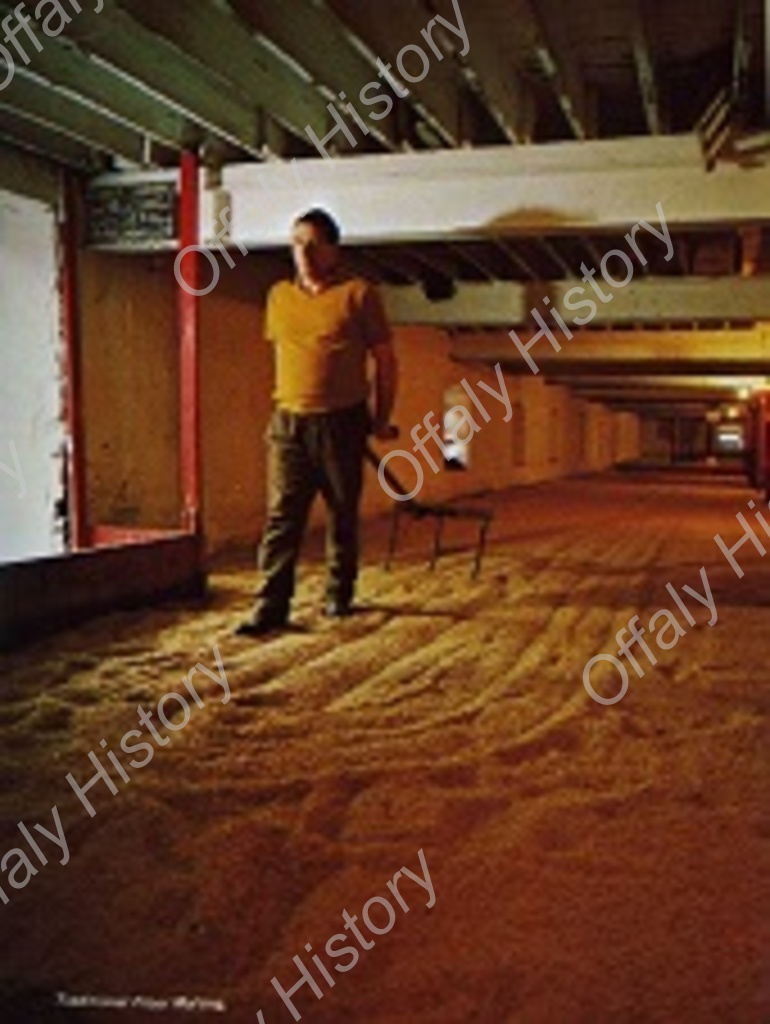
The old floor malting process for hundreds of years ceased in Tullamore in 1969. Cover pic is of Water Lane now entrance to Main Street, Tullamore. Courtesy of Fergal MacCabe. The Williams company of Tullamore (1884–1996) was in the malting business from 1892. Other Tullamore firms included Egan, Tarleton and B. Daly, the Tullamore distillery. In this article Michael Power tells his story. This piece was first published in Jip-cat, pig’s head, petticoats and combinations: our lives, our times in Tullamore and surrounding districts; editor Feargal Kenny. Tullamore: Tullamore Active Retirement Association, 2002 (available from Offaly History Centre).
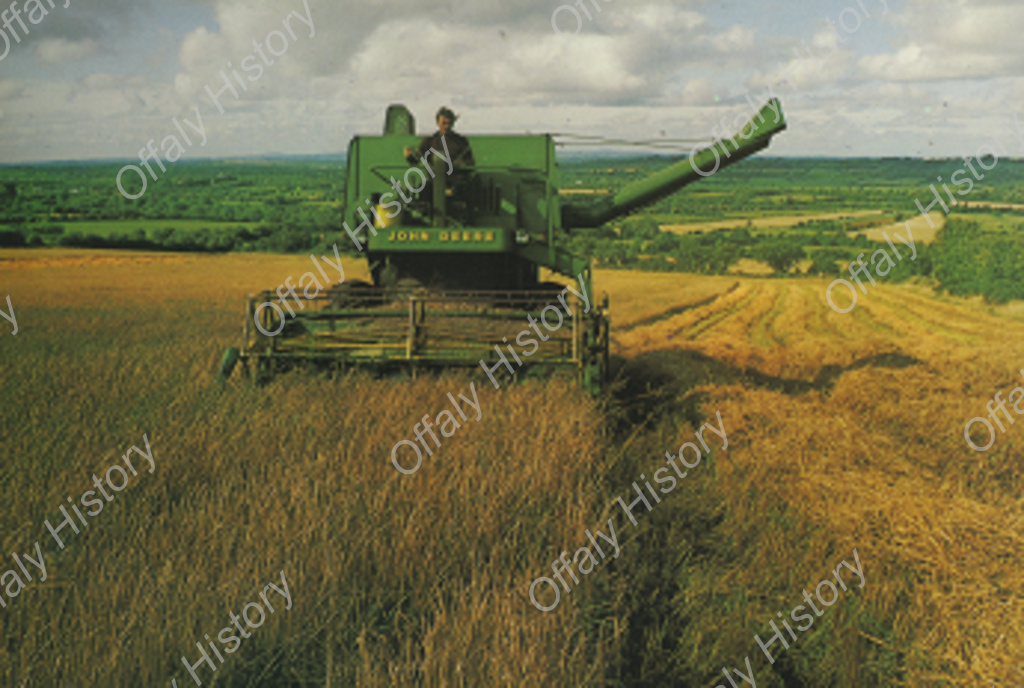
Modernisation of agriculture in the 1970s As a seasonal worker in the Maltings, you started in September when the harvest came in and wound up in May when the malting was over. I became a permanent worker [at Williams/B Daly/Tullamore Distillery [in 1932 and remained there for fifty years. The work was hard, labouring work, carrying sacks, working in the malthouse, screening malt and barley and carrying sacks of grain.
-
Workhouse orphan emigration, particularly those from Parsonstown (Birr). By Perry McIntyre. Blog No 172, 25 Jan 2020
Perry McIntyre is the Chair of the Great Irish Famine Commemoration Committee (Email: contact@irishfaminememorial.org. Website: www.irishfaminememorial.org).
On 4 May 2017 Offaly Historical and Archaeological Society archivist, Lisa Shortall, brought up the Parsonstown Union Letter Book [Reference OHS 71] for me to consult at Bury Quay. (This item is now available to consult at Offaly Archives). My interest was to see what clues may have been recorded about any of the 136 young women who left King’s County for Australia during 1848-1850 as part of the Famine emigration to Australia, now often referred to as ‘Earl Grey’s workhouse orphan scheme’. During these three years 4114 young women aged between 13 and 18 were selected as healthy, suitable domestic servants and potential marriage partners and they were given a free passage from Ireland to one of three Australian colonies: two in New South Wales (Sydney and Port Phillip) and Adelaide in South Australia. (more…)
-
The Queen, Princess Margaret and Dooly’s Hotel, Birr by Cosney Molloy. Blog No 168, 28th December 2019

I was in Birr over the Christmas and chatting in Dooly’s I recalled that it will be 59 years this weekend since the first visit of a Royal princess to Ireland – Princess Margaret and Anthony Armstrong Jones- and that was the first royal visit to Ireland in over thirty years. The son of Anne, Countess of Rosse (by her first husband), Anthony Armstrong Jones, married the Queen’s only sister in May 1960. It was a grand affair and the Countess of Rosse, always one for beauty and glamour, was the finest dressed of the three mothers-in-law present at the royal wedding. The happy couple visited Birr six months later on New Year’s Eve 1960. The town of Birr witnessed an influx of pressmen never seen before in the midlands and perhaps not till that EC meeting in Tullamore ten or fifteen years ago.
-
ROBERT BALL, ASTRONOMER AND TEACHER AT BIRR 1865-1867, DESCRIBES HIS TIME AT BIRR CASTLE. Presented by Michael Byrne. Blog No 158, 26th Oct 2019

The Great Telescope about 1845 with the castle in the background Surviving diaries and accounts of activities in Offaly (King’s County) in the nineteenth century are uncommon and because of this all need to be catalogued and evaluated. Diaries of travel writers, correspondence and memoirs can all throw light on activities of that time. One such source recently acquired by the Offaly Historical and Archaeological Society for its library is Reminiscences and Letters of Sir Robert Ball edited by his son W. Valentine Ball and published in 1915. It sets the scene for the intellectual milieu in which the children of the third earl of Rosse grew up and provides further information on the construction of the great telescope. Recently, a history of the building of the telescope was reprinted by Cambridge University as a cheap paperback while the Royal Society hosted a lecture on the ‘Leviathan of Parsonstown’ now available as a podcast.
 offalyhistoryblog